Written by Sam Ali
Published: October 6, 2026
Read Time: 16 minutes
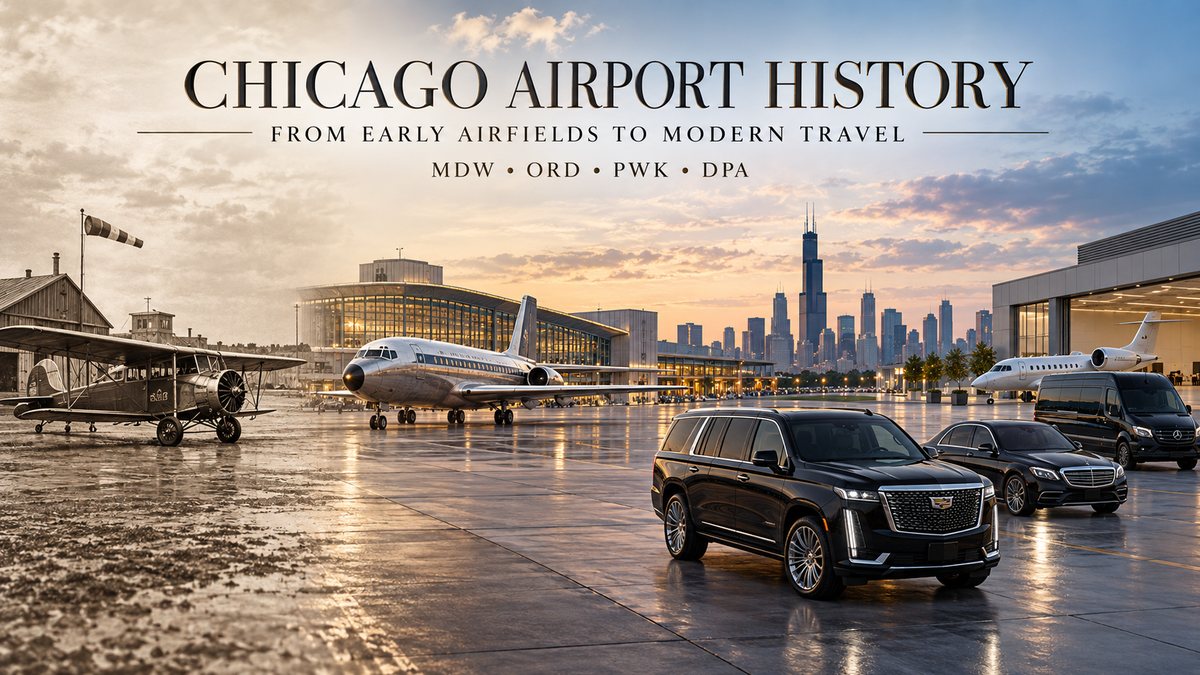
Chicago airport history did not begin with O’Hare. Long before ORD became one of the world’s great aviation hubs, Chicago Municipal Airport—today’s Midway International Airport—was handling airmail, passengers and rapidly increasing commercial traffic. At almost the same time, a small grass field north of the city was beginning the journey that would eventually turn it into Chicago Executive Airport.
Over the following century, the Chicago region developed several airports with very different roles. Midway became an early giant of commercial aviation. O’Hare was built for the postwar jet age and eventually took over as the city’s dominant international gateway. Chicago Executive grew into a major business-aviation reliever, while DuPage Airport developed into an important corporate and general-aviation facility west of the city.
Quick answer: Chicago airport history spans far more than ORD and MDW. Midway and Chicago Executive both trace their roots to 1926. Midway became one of the world’s busiest commercial airports before the jet age, while Chicago Executive evolved from a grass flying field into a major business-aviation airport. O’Hare was selected as Chicago’s new airport site in 1945 and opened to commercial traffic in 1955. DuPage’s postwar development helped establish another important corporate-aviation gateway west of Chicago. Together, these airports explain why Chicago today serves commercial passengers, private flyers, corporate travelers and groups through several distinct aviation systems.
Chicago Airport History Begins With Midway
Chicago Municipal Airport opened in 1926, years before O’Hare began commercial passenger service.
According to the Chicago Department of Aviation’s official Midway history, the airport opened on May 8, 1926. It was formally dedicated the following year, only months after Charles Lindbergh’s famous transatlantic flight. The first airmail flight arrived from Omaha in 1927.
Growth came quickly.
In 1928, Chicago Municipal Airport handled 41,660 passengers on 14,498 flights. By 1929 it was recognized as the busiest airport in the United States. The first passenger terminal and administration buildings followed in 1931, and by 1932 the airport was handling more than 100,000 passengers and had become the world’s busiest airport—a distinction the official airport history says it would retain until 1961. Chicago O’Hare International Airport
That makes Midway much more than Chicago’s smaller alternative to O’Hare.
It is one of the foundational airports in American commercial aviation.
Airmail, Passenger Flights and Early Airport Life
The early airport served a world in which commercial aviation was still establishing itself.
Runways, hangars, airfield lighting and passenger facilities were developing alongside the aircraft themselves. In 1929, an air traffic controller reportedly used a flag from the end of the runway to indicate when it was safe for aircraft to depart. By 1936, nonstop service to New York had arrived.
The airport also started developing services recognizable to modern travelers. Hertz opened a rental-car operation there in 1947, while the Cloud Room restaurant opened in 1948 with views across the airfield. Chicago O’Hare International Airport
Those details show how airports were already becoming more than places where aircraft landed.
They were turning into transportation centers with passenger services, dining and connections to the city beyond the runway.
Today’s Midway Airport limo service operates in a dramatically different airport environment, but travelers still face the same basic challenge: connecting the flight with the next part of the journey.
Why the Name Changed to Midway
In 1949, Chicago Municipal Airport was renamed Midway Airport in honor of the Battle of Midway, the pivotal World War II naval battle fought in the Pacific in 1942.
By 1950, Midway was home to 15 scheduled airlines.
Passenger traffic passed five million in 1952, and international carriers were expanding Chicago’s reach. Air France introduced service to Paris in 1953, while BOAC—later British Airways—began London service in 1954. Chicago O’Hare International Airport
Chicago already possessed one of the world’s great commercial airports.
The problem was that aviation technology was moving faster than the airport could physically grow.
Chicago Airport History Changes When O’Hare Opens
The next chapter began northwest of Chicago.
In 1945, Orchard Field was selected as the site for Chicago’s new airport. The property had previously housed a Douglas aircraft assembly plant and already contained four intersecting concrete runways.
The city renamed the airport Chicago O’Hare International Airport in 1949 to honor naval aviator Lieutenant Commander Edward H. “Butch” O’Hare, a Medal of Honor recipient.
Commercial passenger service officially began in 1955, when O’Hare handled 176,902 passengers in its first year. The airport continued expanding rapidly, reaching approximately 7,200 acres by 1959. The Chicago Department of Aviation documents the progression in its official O’Hare history.
O’Hare was built with something Midway increasingly lacked:
room to grow.
The Expressway Was Almost as Important as the Runways
An airport can have enormous runways and modern terminals, but passengers still need a practical way to reach it.
In 1960, an eight-lane expressway connection opened between O’Hare and downtown Chicago. The main terminal complex and a 5,000-car parking facility were completed the following year. Chicago O’Hare International Airport
That road connection helped transform O’Hare from an airfield outside the city into a practical Chicago transportation gateway.
The relationship between airports and highways remains important today. A passenger landing at ORD still has to reach the Loop, River North, Rosemont, Oak Brook, Schaumburg, Naperville, the North Shore or another destination after leaving the terminal.
For travelers making that journey today, the dedicated O’Hare Airport limo service handles the modern ground side of the route.
1962 Changed Chicago Aviation
By 1961, O’Hare commercial traffic had already passed Midway.
Then, in 1962, scheduled Midway operations transferred to O’Hare. Passenger traffic at O’Hare climbed to about 10 million, and the airport became the world’s busiest airport by the measure cited in Chicago’s official airport history.
It was a remarkable reversal.
Midway had been one of the defining airports of early commercial aviation.
Now O’Hare represented the future.
Larger aircraft, greater passenger capacity, expanding terminals and an enormous airfield gave Chicago room to participate fully in the jet age.
O’Hare Did Not Make Midway Disappear
Midway’s decline after O’Hare opened did not become permanent.
Airlines gradually returned. Chicago invested in the airport, and the growth of smaller airlines and lower-fare carriers helped give Midway a new role in the regional aviation system.
By the end of 1968, Midway had handled more than 1.66 million passengers, a substantial recovery from the low point after airlines shifted to O’Hare. Chicago O’Hare International Airport
Today, Chicago benefits from having two major commercial airports rather than forcing every passenger through the same facility.
O’Hare serves as the larger global hub.
Midway remains particularly useful for many domestic travelers and passengers coming from downtown and Chicago’s south and southwest suburbs.
Travelers deciding how much time to allow before an MDW departure can use the guide to how early to get to Midway Airport for current planning rather than relying on the historical timeline.
Chicago Executive Airport Started Small Too
While Midway was becoming a major commercial airport, another aviation story was beginning north of Chicago.
Chicago Executive Airport was founded in 1926 as a roughly 40-acre grassy field with dirt runways.
Its official 100-year history records the airport’s first name as Gauthier’s Flying Field. After brothers Frank and Pete Barchard dedicated it as an airport, it became Swallow Airplane Field, named for a Swallow OX-5 aircraft based there.
In November 1928, the airport was incorporated as Pal-Waukee Air Port.
The field expanded to 91 acres during the 1930s and 109 acres during the 1940s. Priester Aviation Service acquired the airport in 1953 and continued developing the property for decades.
This was a completely different path from Midway.
Chicago Executive did not grow primarily as a giant airline terminal.
It evolved around general aviation and business flying.
From Pal-Waukee to Chicago Executive Airport
The airport continued to gain infrastructure through the postwar decades.
A paved runway gained lighting, corporate hangars were built, and a 5,000-foot runway opened in the 1960s. The FAA commissioned an air traffic control tower in 1967.
In 1986, the City of Prospect Heights and Village of Wheeling purchased Pal-Waukee, changing the airport from private to public ownership.
The name Chicago Executive Airport officially arrived in 2006, reflecting the airport’s increasingly important role in corporate and private aviation. Chicago Executive Airport
For passengers using private or charter aircraft today, Chicago Executive Airport transportation at PWK connects the aviation side of the trip with Chicago, the North Shore and surrounding business destinations.
DuPage Developed Around Western-Suburban Aviation
DuPage Airport followed another path.
Official airport planning documents show that portions of the original airport property were transferred from the federal government to DuPage County in 1947 under the postwar Surplus Property Act.
Much later, during the early 1980s, the airport authority, FAA and Illinois aviation officials pursued an extensive development program intended to position the airport for increasing business-aviation demand in the West Chicago area.
The airport’s official Master Plan describes DPA as a general-aviation airport with a particular focus on business and corporate aviation and identifies it as a reliever airport for O’Hare and Midway.
Its location west of Chicago also gives it a different geographic role.
A private flyer heading toward West Chicago, Naperville, Oak Brook or other western-suburban destinations may have a very different ground itinerary from someone arriving at PWK or ORD.
The current DuPage Airport limo service is designed around that private and corporate aviation environment.
Chicago Airport History Includes Business Aviation
Commercial terminals tell only part of the story.
ORD and MDW serve enormous numbers of airline passengers, but business aviation has its own airport ecosystem. Chicago Executive and DuPage allow private aircraft, corporate aviation departments, charter operators and other general-aviation users to access the Chicago region without following the same terminal process used by airline passengers.
The ground handoff is different too.
A commercial traveler thinks in terms of airline, terminal, baggage claim and curb.
A private flyer often thinks in terms of aircraft, FBO, passenger, vehicle and destination.
That difference is why private jet limo and FBO service should be planned differently from a standard terminal pickup.
For a deeper explanation of that process, the Chicago Private Jet Transportation Guide explains how the aircraft, FBO, chauffeur and final destination fit together.
Four Airports, Four Different Roles
Chicago’s airport system makes more sense when each airport is viewed according to the role it developed over time.
- Midway International Airport (MDW) — one of Chicago’s earliest great commercial airports, now an important domestic gateway particularly convenient for downtown and many south- and southwest-suburban travelers.
- O’Hare International Airport (ORD) — the postwar airport that grew into Chicago’s dominant international and connecting hub.
- Chicago Executive Airport (PWK) — a nearly century-old general-aviation airport that evolved into a major corporate and private-jet facility.
- DuPage Airport (DPA) — a western-suburban general and corporate aviation airport positioned for business travelers and private aircraft.
For travelers interested in the present-day operational differences rather than history, the Chicago Airport Transfer Guide covering all four airports compares the modern transportation side of ORD, MDW, PWK and DPA.
Airport Ground Transportation Changed With the Airports
The aircraft were not the only vehicles changing.
Early airline passengers commonly relied on taxis, hotel cars, private automobiles, buses and traditional chauffeur-driven vehicles after landing.
As corporate aviation and business travel expanded, formal sedans became increasingly important. The Lincoln Town Car eventually became almost synonymous with professional airport and executive transportation.
Then passenger needs changed again.
Families carried more luggage. Executive teams wanted to remain together. Premium SUVs offered more passenger and cargo capacity. Mercedes-Benz S-Class sedans raised the executive-car standard, while Cadillac Escalades and Lincoln Navigators became common choices for airport travel.
Sprinters added another category for corporate teams, families and groups that needed a single vehicle with substantially more room.
That evolution can be seen in a modern luxury vehicle fleet that now includes 2026 S-Class sedans, Escalades, Navigators, Suburbans and executive Sprinter vehicles alongside traditional stretch limousines.
The Meaning of Airport “Limo Service” Changed Too
A limousine used to evoke one very specific image: a large chauffeur-driven sedan or, later, a stretched vehicle.
Airport travelers today may use a sedan, SUV or Sprinter instead.
The vehicle changed because the passenger’s needs changed.
A solo executive traveling from O’Hare to a Loop meeting may want a discreet sedan.
A family arriving with several large suitcases may be better served by an SUV.
A corporate team may need a Sprinter.
That is why a modern Chicago limo service can represent several vehicle classes instead of one traditional limousine design.
The common thread is prearranged professional transportation from one part of the trip to the next.
Black Cars Became Part of Airport Business Travel
Professional airport transportation also became less ceremonial and more business-focused.
A polished black sedan or SUV could serve an executive arriving at O’Hare without drawing the attention associated with a stretch limousine. The same vehicle could continue to a hotel, financial district office, suburban headquarters or client meeting.
That helped make Chicago black car service particularly relevant to airport and corporate transportation.
The visual style became more discreet.
The underlying expectation became higher: professional presentation, a confirmed reservation, schedule awareness and an appropriate vehicle.
Chauffeurs Became Part of a Larger Travel System
The chauffeur’s job evolved along with airport operations.
Decades ago, communication might have meant telephone dispatch and radio instructions.
Modern airport trips can involve flight-status monitoring, terminal information, text communication, route changes, passenger updates and coordination with corporate travel planners.
A professional Chicago chauffeur service therefore sits at the intersection of driving and logistics.
The passenger sees the vehicle.
Behind that vehicle is a schedule that may depend on the flight, baggage, customs, terminal conditions, traffic and the next appointment.
Airport Pickup Became Smarter
Flight tracking fundamentally changed airport pickups.
Instead of treating the scheduled arrival time as fixed, transportation providers can monitor when an aircraft is actually expected to arrive.
If a flight lands early, the pickup can move with it.
If it is delayed, the chauffeur does not have to operate from outdated information.
The Chicago flight delay and cancellation guide explains how that affects a reserved car when an ORD or MDW schedule changes.
Technology did not eliminate uncertainty from air travel.
It made ground transportation better able to respond to it.
Meet & Greet Added Another Kind of Airport Handoff
A traveler arriving at a major airport may not want to navigate the ground transportation process alone.
That is especially true for international travelers, first-time visitors, senior executives, families, VIP guests or people unfamiliar with the airport.
With airport Meet & Greet service, the chauffeur can meet the passenger inside the terminal, assist with luggage and escort the traveler toward the vehicle.
The modern service is very different from early airport transportation, but the goal remains surprisingly similar:
make the transition from aircraft to ground travel easier.
O’Hare Pickup Is Its Own Travel Skill
O’Hare’s size means that simply saying “pick me up at the airport” is not always enough.
The airline, terminal, domestic or international arrival, baggage status and meeting method can all affect the handoff.
Travelers who want the current process rather than the historical background can use the O’Hare chauffeur meeting-point guide before arrival.
For passengers continuing directly into the city, the O’Hare-to-downtown transportation comparison explains the differences among rail, taxi, rideshare, shuttle and private-car options.
Airport Transportation Became a Corporate Operation
Large companies rarely think about an executive airport trip as an isolated ride.
The traveler may need to move through:
airport → hotel → meeting → second meeting → dinner → airport
The transportation becomes part of the business schedule.
That is where Chicago corporate limo service fits into the airport system.
If several executives travel together, a Chicago Sprinter limo service can keep the team, luggage and schedule in one vehicle.
For larger movements, Chicago group transportation can coordinate travelers who would otherwise split across several cars.
Shuttles Developed Around Repeated Passenger Movement
Not every airport transportation problem is a single passenger going from Point A to Point B.
Hotels, conferences, weddings and corporate programs may need repeated movements between the same locations.
That is where Chicago shuttle service differs from a traditional one-way airport car.
The vehicle may operate a repeating pattern:
airport → hotel → airport
or:
hotel → convention → hotel
The transportation format changed because modern travel created new patterns of passenger movement.
Hourly Transportation Solved the Multi-Stop Problem
Airport transportation does not always end at the first destination.
A business traveler may land, check luggage at a hotel, attend several meetings and return to the airport later that evening.
Booking each segment separately can create unnecessary handoffs.
A reserved block of hourly limo service can keep the same vehicle connected to a multi-stop itinerary.
That is another example of airport transportation becoming part of the larger travel day rather than simply a ride away from the terminal.
The Cost of Getting to the Airport Changed Too
Travelers today can compare driving and parking, taxi fares, rideshare pricing, hotel shuttles, trains and private vehicles before choosing.
The decision can change with trip length, passenger count, luggage and airport.
Someone leaving a personal vehicle for a week faces a different cost equation from someone traveling alone for one night.
The Chicago airport parking pricing guide helps compare parking with leaving the vehicle at home, while current Chicago limo pricing provides the transportation side of the comparison.
The important part is comparing the complete trip rather than one isolated number.
Taxi, Shuttle or Private Car?
Chicago airport travelers have more ground options than early passengers could have imagined.
A taxi can still be useful for a spontaneous trip.
Rail can be economical for a traveler with manageable luggage.
A hotel shuttle can make sense when the property offers a convenient schedule.
A private vehicle may make more sense when the passenger wants the transportation reserved before the flight arrives.
The taxi versus private car service guide for O’Hare and Midway examines the taxi side of that decision, while the hotel airport shuttle versus private car comparison covers another common choice.
There is no single ground option that is best for every traveler.
The history of Chicago aviation itself shows why: different passengers, airports and trips create different transportation needs.
One Airport Service Now Connects Several Aviation Systems
The modern Chicago airport limo service can connect travelers with ORD, MDW, PWK and DPA even though those airports evolved for very different reasons.
That flexibility would have been difficult to imagine when Chicago Municipal Airport first opened.
Commercial airline passengers, private flyers, families, executives and groups can now use different vehicles and pickup processes while remaining within one regional airport network.
That is one of the biggest changes of all.
The airport is no longer viewed as the end of a transportation system.
It is one connection within it.
A Short Chicago Aviation Timeline
A few milestones show how dramatically the region’s airports evolved:
- 1926: Chicago Municipal Airport opens; Chicago Executive Airport also traces its founding to 1926.
- 1927: Chicago Municipal Airport is formally dedicated and receives its first airmail flight.
- 1928: The field that became Chicago Executive is incorporated as Pal-Waukee Air Port.
- 1929: Chicago Municipal Airport is recognized as the busiest airport in the United States.
- 1932: Chicago Municipal Airport becomes the world’s busiest airport.
- 1945: Orchard Field is selected for development as Chicago’s new airport.
- 1947: Federal property connected with what became DuPage Airport is transferred to DuPage County.
- 1949: Chicago Municipal Airport becomes Midway; Orchard Field is renamed O’Hare.
- 1955: O’Hare officially begins commercial passenger service.
- 1960: An expressway connection opens between O’Hare and downtown Chicago.
- 1962: Scheduled Midway operations shift to O’Hare, which reaches about 10 million passengers.
- 1986: Pal-Waukee changes from private to public ownership.
- 2006: Pal-Waukee Airport is officially renamed Chicago Executive Airport.
- Today: ORD and MDW serve commercial aviation while PWK and DPA play important roles in private, corporate and general aviation.
The timeline connects airports that are often discussed separately and shows that Chicago aviation developed through several overlapping eras rather than one airport simply replacing another. Chicago O’Hare International Airport
Frequently Asked Questions
Which Chicago airport is the oldest?
Midway International Airport and Chicago Executive Airport both trace their histories to 1926. Midway opened as Chicago Municipal Airport in May 1926, while Chicago Executive began that year as a small grass flying field.
Was Midway once the world’s busiest airport?
Yes. Chicago’s official airport history says Chicago Municipal Airport became the world’s busiest airport by 1932 and retained that distinction until the early O’Hare era.
Why was Midway Airport renamed?
Chicago Municipal Airport was renamed Midway in 1949 in honor of the Battle of Midway during World War II.
When did O’Hare begin serving commercial passengers?
O’Hare officially opened to commercial air traffic in 1955.
Did O’Hare replace Midway completely?
No. Much scheduled airline traffic shifted to O’Hare, but Midway later recovered and continues operating as one of Chicago’s two major commercial airports.
What was Chicago Executive Airport called before PWK became Chicago Executive?
It began as Gauthier’s Flying Field, later became Swallow Airplane Field and then Pal-Waukee Air Port. The Chicago Executive Airport name was adopted in 2006.
What type of flights use Chicago Executive Airport?
PWK primarily serves general aviation, business aviation, private aircraft, charter operations and flight training rather than scheduled airline traffic on the scale of O’Hare or Midway.
What is DuPage Airport mainly used for?
DuPage Airport primarily serves general, business and corporate aviation and functions as a reliever airport within the Chicago aviation system.
Which Chicago airports handle private jets?
Private and corporate aviation can use several airports, but Chicago Executive and DuPage are particularly important private-aviation facilities. Private-flight operations can also occur at other Chicago-area airports depending on the aircraft and itinerary.
How should travelers choose between Chicago airports?
The answer depends on the flight, airline, destination after landing, private versus commercial aviation, and where the traveler needs to be in the Chicago region.
Why Chicago Airport History Still Matters
Chicago’s airports developed because travelers kept changing.
Early airmail and passenger flights helped establish Midway.
The jet age demanded an airport with enough room to expand, giving O’Hare its opportunity.
Corporate and private aviation created a different need, helping airports such as Chicago Executive and DuPage develop their own roles.
Ground transportation changed at the same time—from taxis, hotel cars and formal sedans to black cars, luxury SUVs, executive Sprinters, flight tracking and in-terminal passenger assistance.
Understanding how those systems developed makes today’s Chicago airport network easier to understand.
Four airports can all serve the same metropolitan area because they do not perform exactly the same job.
For airport transfers, private aviation, corporate travel or group transportation, call (708) 998-6336 or contact the reservations team.
All Star Limo Service
Chicago, IL
Phone: (708) 998-6336
Reservations: 24/7

Monday Morning at Midway: A Business Travel Guide
Early Departures, Stevenson Traffic and How to Time Your Car Service to Chicago’s Smaller Airport…
Chicago Holiday Lights by Car Service
The Mag Mile Lights, ZooLights and Christkindlmarket in One Evening, Without Parking or Driving Home…
Personal Driver vs. Chauffeur Service
Salary, Taxes, Insurance, and When a Private Chauffeur on Demand Makes More Sense — A…
Renting a Luxury Car vs. Hiring a Chauffeur for Your Wedding
Who Drives, Who Parks, and What a Private Chauffeur Actually Takes Off Your Plate —…
Shared Airport Shuttle vs. Private Car Service
Extra Stops, Fixed Schedules, and When a Private Chauffeur Is Worth It for O’Hare and…
Taxi vs. Car Service From O’Hare and Midway
Meters, Taxi Lines, and What a Private Chauffeur Actually Changes When You Land — An…
Halloween Night Party Bus & Limo in Chicago
Stretch Limos, Sprinter Party Buses, and Who Actually Needs Which for October 31 — A…
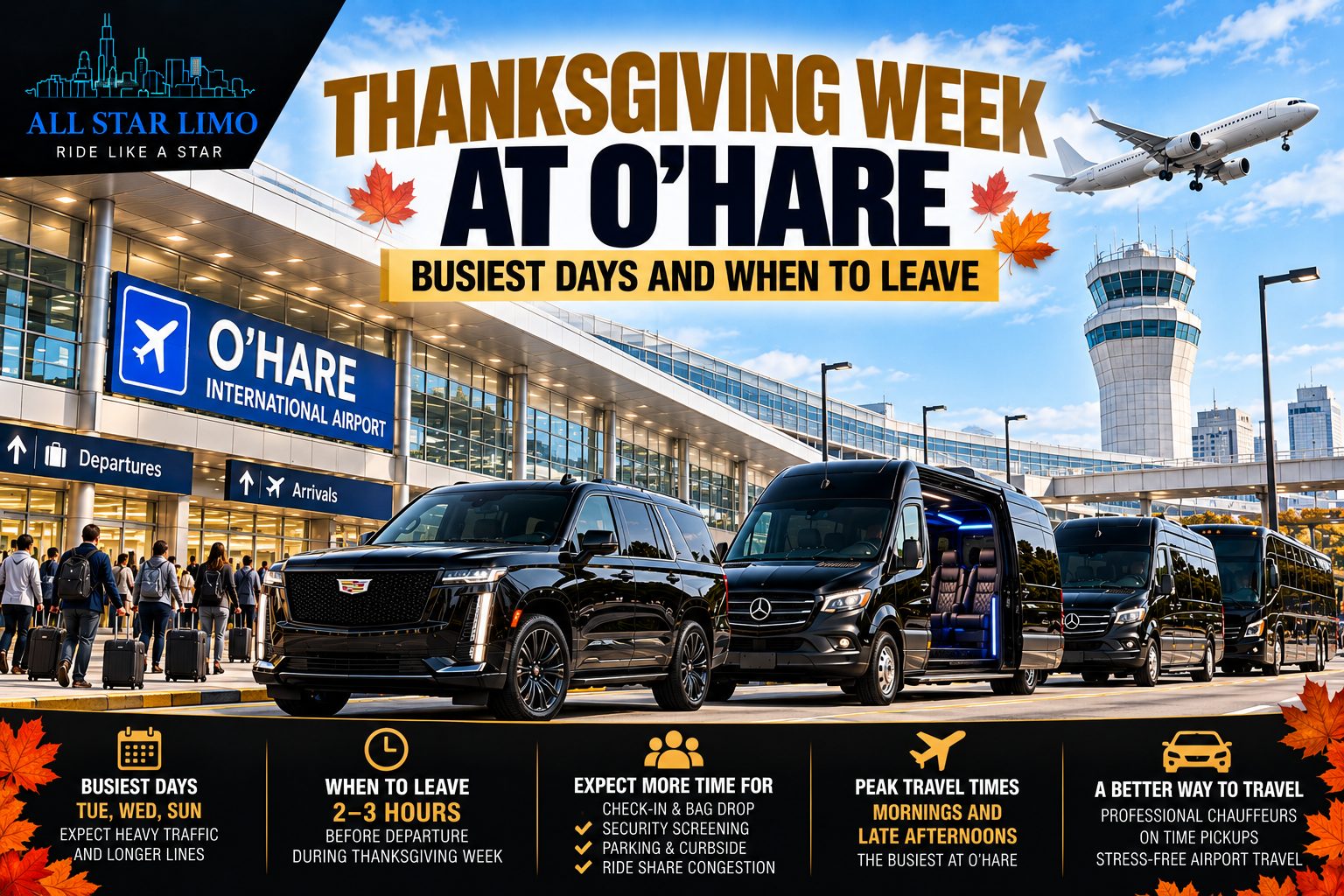
Thanksgiving Week at O’Hare: Busiest Days and When to Leave
Written by the All Star Limo Service team, Chicago chauffeurs and dispatchers serving the city…
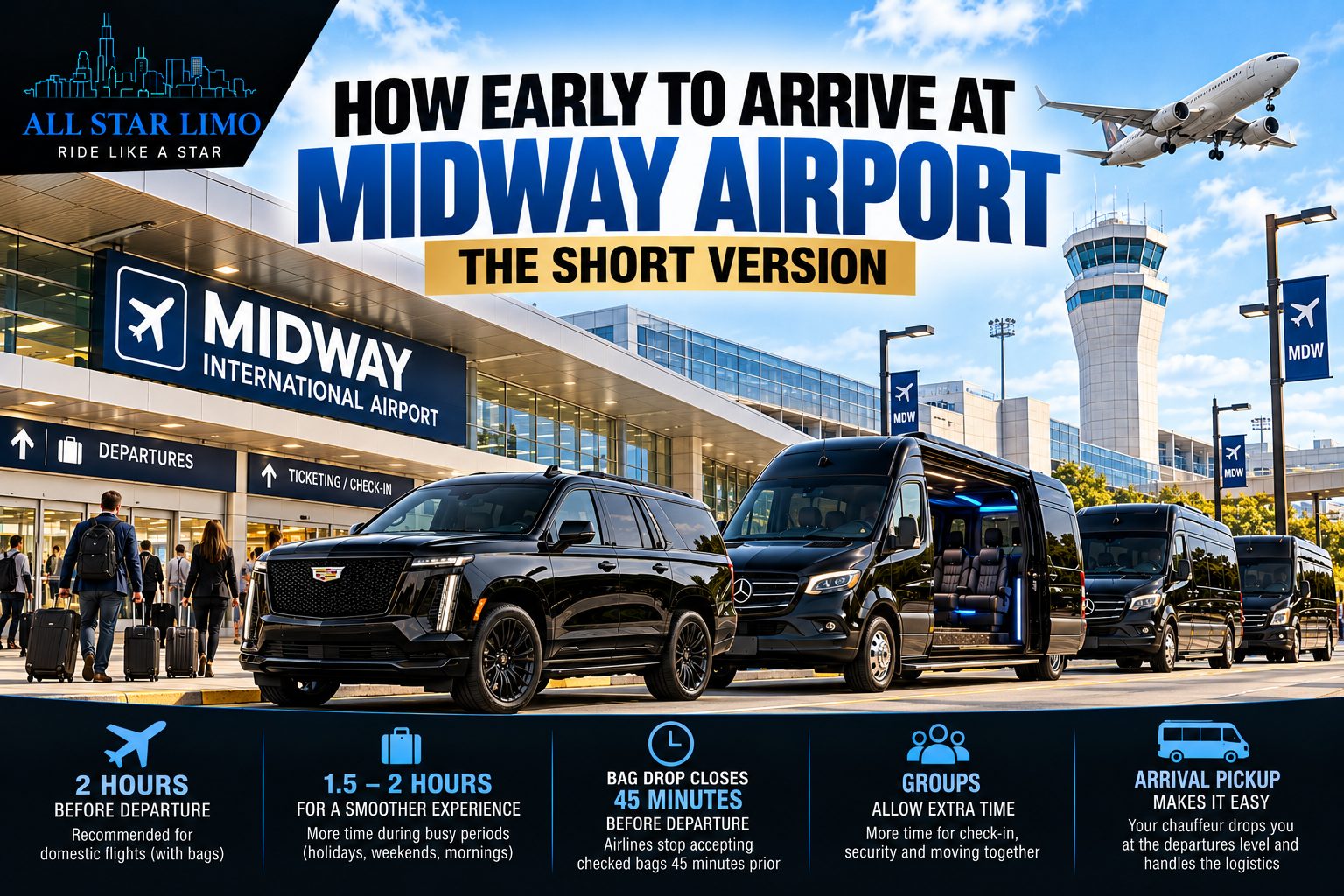
How Early to Get to Midway Airport
Written by the All Star Limo Service team, Chicago chauffeurs and dispatchers serving the city…
O’Hare to Downtown Chicago: Every Option Compared
Written by the All Star Limo Service team, Chicago chauffeurs and dispatchers serving the city…
Private Jet Limo Service: PWK & DPA
Ground Transportation Built Around FBO Pickup and Private Aviation Schedules, Not Commercial Terminal Traffic By…
Chicago Shuttle Service: When You Need More Than a Limo
Moving Large Groups Repeatedly, Not Just Once — A Guide for Weddings, Events, and Conventions…
Concert Night: Limo vs. Parking
What Parking Actually Looks Like at Wrigley Field, the United Center, and Soldier Field —…
Long-Distance Travel: Drive or Fly?
How to Think Through the Drive-vs-Fly Decision for a Trip Just Outside Chicago — A…
Wicker Park Nightlife: Limo Service Guide
Getting to and From Chicago’s Trendiest Nightlife District Without the Parking Hunt or the Rideshare…
Event and Group Transportation in Chicago: Sizing, Shuttles and Timing
Written by the All Star Limo Service dispatch team. Updated September 29, 2026. Event and…
Corporate Ground Transportation in Chicago: Accounts, Billing and Duty of Care
Written by the All Star Limo Service dispatch team. Updated September 29, 2026. Corporate Ground…
The Chicago Airport Transfer Guide: Timing, Terminals and All Four Airports
Written by the All Star Limo Service dispatch team. Updated September 29, 2026. The Chicago…
Chicago Holiday Trip: Hotels and Getting Around
Where to Stay for Christkindlmarket, the Lights, and the Shopping — and How to Get…
Where to Stay for Chicago Marathon Weekend
Which Neighborhoods Work Best for Runners and Spectators, and How to Plan Rides Around Race-Day…
Hotel Checkout to O’Hare: Timing Your Pickup
How to Work Backward From Your Flight So Your Ride Leaves the Hotel at the…
Night Out in Chicago: Safe Rides Home
Why Planning Your Ride Home Before the Night Starts Beats Hoping a Rideshare Shows Up…
Tinley Park to Midway: What It Costs and How Long It Takes
Written by the All Star Limo dispatch team. Updated September 25, 2026. Quick answer: Midway…
Orland Park to O’Hare: Rates, Drive Times and Pickup Tips
Written by the All Star Limo dispatch team. Updated September 25, 2026. Quick answer: Orland…
McCormick Place Hotels to the Show Floor
The Smartest Way to Get From Your Room to a Convention Without Fighting Rideshare Lines…
Hotel Group Transportation: Vans vs. Multiple Ubers
Why Splitting a Group Into Several Rideshares Costs More Than It Looks Like — And…
Magnificent Mile Hotels: A Visitor’s Guide
What Makes This Stretch of Michigan Avenue Different, and How to Get There Without Fighting…
Hotel to O’Hare: Limo vs. Uber
What Actually Differs Between a Flat-Rate Airport Transfer and Hailing a Rideshare From the Hotel…
Best Downtown Hotels for Business Travelers
Where Executives Actually Stay for Meetings in the Loop, River North, and Streeterville — and…
O’Hare Parking vs. Car Service: The Real Cost From the Suburbs
Written by the All Star Limo dispatch team · Updated September 22, 2026 Quick answer: O’Hare’s…
How Much Is a Car Service to O’Hare? Real Prices by Suburb and Vehicle
Written by the All Star Limo dispatch team · Updated September 22, 2026 Quick answer: A…

Ohare Midway Flight Delayed or Cancelled Guide
Flight Delayed or Cancelled? Your Chicago Airport Car Backup Plan Updated September 2026 · Written…

Where to Meet Your Chauffeur at O’Hare
Where to Meet Your Chauffeur at O’Hare: The Complete Pickup Guide Updated September 2026 ·…
A Visitor’s Guide to Getting Around Chicago
Updated September 2026 · Written by the All Star Limo dispatch team — serving Chicagoland…
Prom Season in Chicago: A Parent’s Guide to Booking Safely
Updated September 2026 · Written by the All Star Limo dispatch team — serving Chicagoland…
Chicago Wedding Venue Transportation Guide
Updated September 2026 · Written by the All Star Limo dispatch team — serving Chicagoland…
Chicago Holiday Party & New Year’s Eve Limo Guide
Updated September 2026 · Written by the All Star Limo dispatch team — serving Chicagoland…
24/7 Emergency & Last-Minute Limo Service in Chicago
Updated September 2026 · Written by the All Star Limo dispatch team — serving Chicagoland…
What Is a Chauffeur Service? A Chicago Guide
Updated September 2026 · Written by the All Star Limo dispatch team — serving Chicagoland…
O’Hare vs. Midway
Updated September 2026 · Written by the All Star Limo dispatch team — serving Chicagoland…
Sedan, SUV, Sprinter, or Stretch: Which to Book?
Updated September 2026 · Written by the All Star Limo dispatch team — serving Chicagoland…
Chauffeured Limo vs. Rideshare in Chicago
Updated September 2026 · Written by the All Star Limo dispatch team — serving Chicagoland…
Tinley Park to O’Hare & Midway Guide
Tinley Park to O’Hare & Midway: Airport Car Service Guide Updated September 2026 · Written…
Orland Park to O’Hare & Midway: Airport Car Service Guide
Orland Park to O’Hare & Midway: Airport Car Service Guide Updated September 2026 · Written…
5 Reasons to Choose an Airport Limo for Your Chicago Trip
Pack only what you need and avoid overpacking to streamline the check-in and security screening…
Chicago Transportation History: Airports, Union Station, the L and Route 66
Written by the All Star Limo Service Team | Published October 20, 2026 | 13-minute…
Thanksgiving O’Hare Car Service | Midway & Suburbs
Written by the All Star Limo Service Team | Published October 20, 2026 | 12-minute…
Chicago Corporate Campus Directory: Office Parks From the Loop to Oak Brook, Schaumburg and Deerfield
Written by the All Star Limo Service Team | Published October 20, 2026 | 13-minute…

A Tuesday Night at United Center: Blackhawks Penguins Car Service in Chicago
Written by All Star Limo Service Team Published: October 7, 2026 Read Time: 13 minutes…
The History of McCormick Place and Chicago Conventions: From World’s Fairs to Modern Trade Shows
Written by All Star Limo Service Team Published: October 6, 2026 Read Time: 16 minutes…
Chicago Airport History Guide: From Early Airfields to O’Hare, Midway, PWK & DuPage
Written by Sam Ali Published: October 6, 2026 Read Time: 16 minutes Chicago airport…
Bulls vs Celtics Limo Service: Dec 30 United Center Guide
Written by Sam Ali | Published: October 6, 2026 | Read Time: 12 minutes Why…
How to Choose a Limo Service in Chicago: 2026 Buyer’s Guide
Written by Sam Ali | Published: October 6, 2026 | Read Time: 14 minutes How…