Written by the All Star Limo Service Team | Published October 20, 2026 | 13-minute read
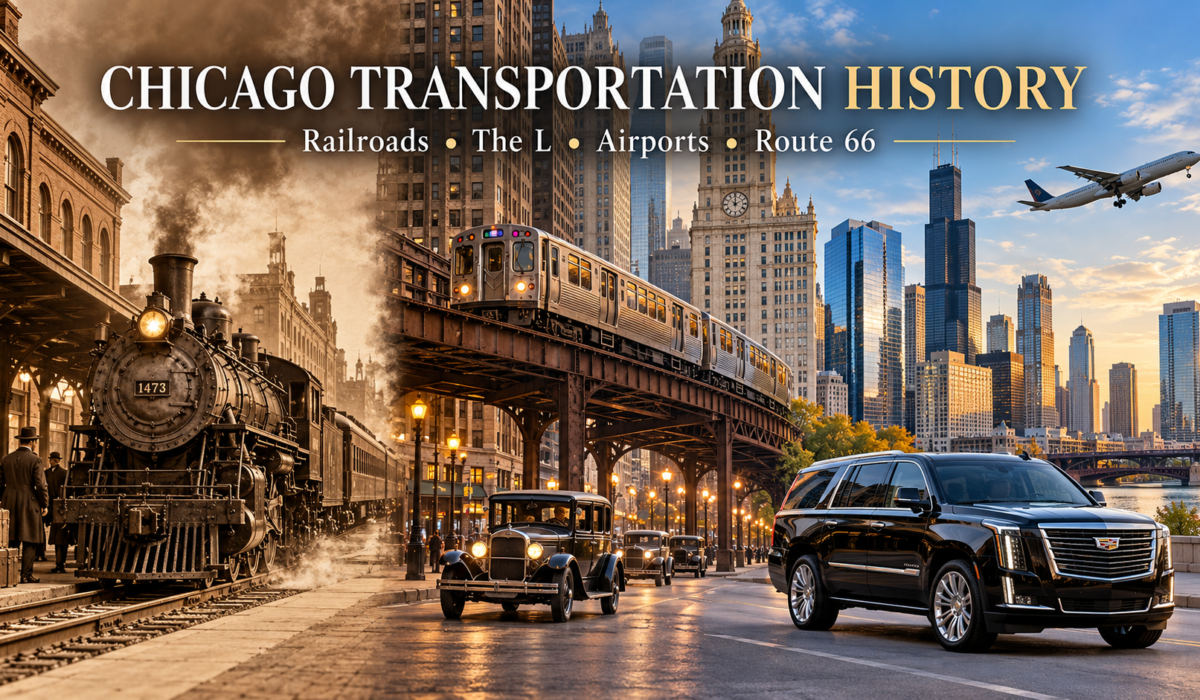
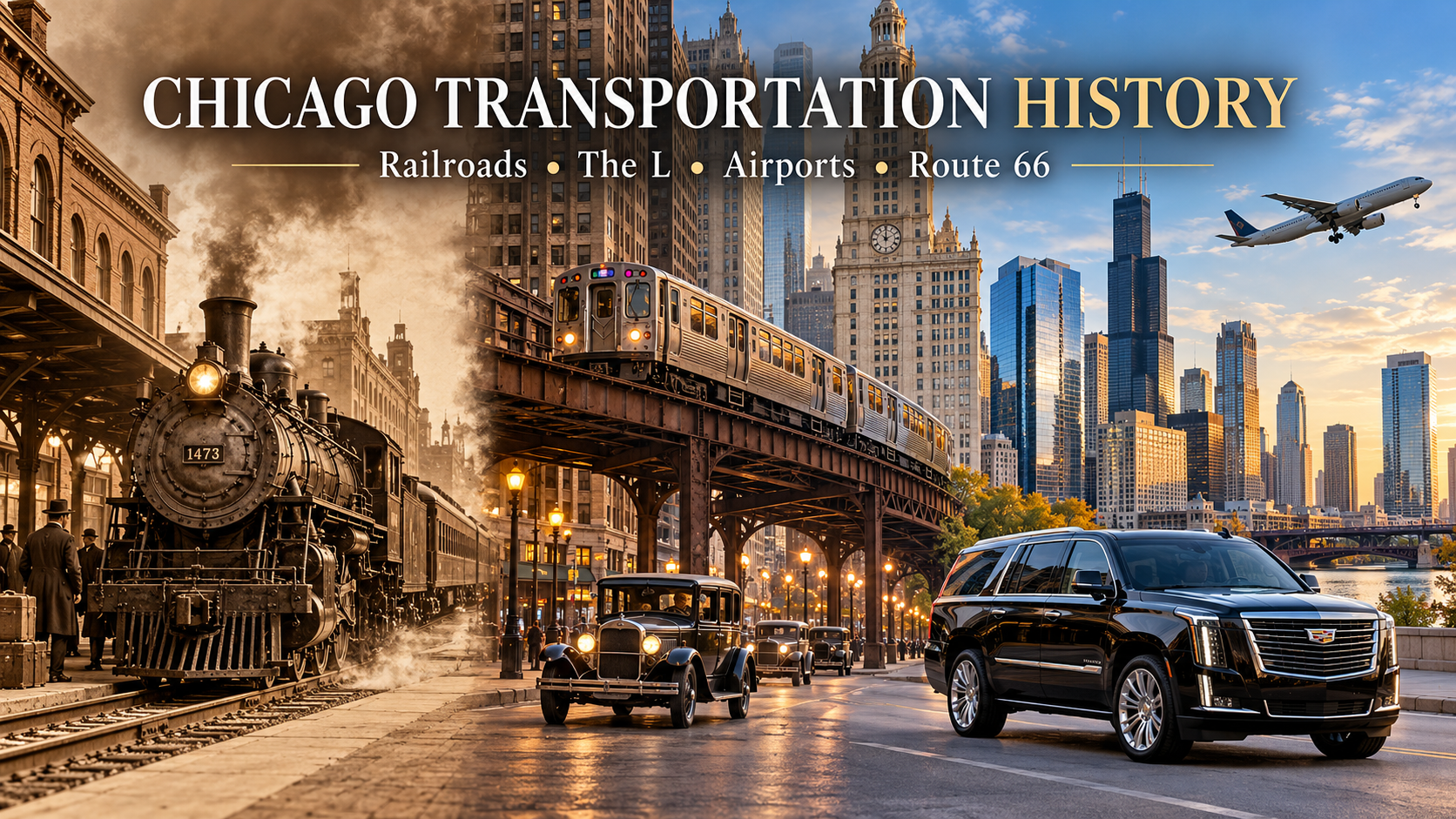
Chicago transportation history is the story of how a growing city became one of America’s most important crossroads. From the first steam locomotives arriving in the 1840s to the opening of elevated railways, the construction of Union Station, the development of O’Hare and Midway airports, and the beginning of Route 66, Chicago’s transportation systems helped shape the city’s economy, neighborhoods, and national importance.
Few American cities have developed so many major transportation networks in one location. Railroads connected the Midwest to eastern markets. Elevated trains helped residents and workers move around an expanding city. Union Station became a landmark passenger terminal. Airports established Chicago as an international aviation gateway. Route 66 carried generations of travelers westward.
Today, these systems operate together. Visitors can arrive by airplane, long-distance train, commuter rail, or automobile before continuing to a hotel, corporate office, convention center, or suburban destination.
For travelers using Chicago limo service, understanding the city’s geography and transportation legacy provides useful context for planning modern airport transfers, train-station pickups, sightseeing itineraries, and business travel.
Quick Answer: Chicago became a transportation hub through successive waves of development: railroad expansion beginning in 1848, elevated rail service starting in 1892, Union Station opening in 1925, the establishment of Chicago Municipal Airport in 1926, the creation of Route 66 in 1926, and O’Hare’s commercial opening in 1955. These overlapping systems transformed Chicago into a major center for rail, highway, aviation, business, and tourism.
Chicago Transportation History: Quick Facts and Important Dates
| Year | Transportation milestone | Why it matters |
|---|---|---|
| 1848 | Chicago’s first railroad locomotive operates | Beginning of the city’s rise as a major rail center |
| 1859 | Horse-drawn streetcar service begins | Early urban public transportation |
| 1892 | First elevated railway opens | Establishes Chicago’s famous L system |
| 1897 | Loop Elevated opens | Connects major downtown rapid-transit routes |
| 1925 | Chicago Union Station opens | Consolidates major passenger rail operations |
| 1926 | Chicago Municipal Airport opens | Beginning of today’s Midway Airport |
| 1926 | U.S. Route 66 is designated | Connects Chicago with the American Southwest and Pacific Coast |
| 1943 | State Street Subway opens | Expands rapid-transit capacity beneath downtown |
| 1947 | Chicago Transit Authority begins operations | Unifies major city transit operations |
| 1955 | O’Hare begins commercial passenger service | Starts a new era of aviation expansion |
| 1984 | Rapid-transit service reaches O’Hare | Connects the airport to the city’s rail network |
| 1993 | Orange Line service reaches Midway | Provides a rapid-transit airport connection |
These milestones show how Chicago’s transportation network developed in stages rather than through a single master project.
Chicago Transportation History Begins With the Railroads
Chicago’s transformation into a major transportation center began long before aviation and interstate highways.
During the first half of the nineteenth century, Chicago was a growing settlement near Lake Michigan with access to waterways and inland trade routes.
Its location made it attractive to merchants and agricultural producers, but moving goods over long distances remained difficult.
Railroads changed that.
The Pioneer locomotive arrives in 1848
In October 1848, the Pioneer locomotive made an early journey from Chicago on the developing Galena and Chicago Union Railroad.
The Chicago History Museum’s account of the Pioneer locomotive describes how the engine became a symbol of Chicago’s railway beginnings.
The locomotive operated at a time when railroad construction was still new to the region.
Although its initial journeys covered relatively short distances, the railway represented an important change in how goods and people could move.
Farmers, merchants, and manufacturers increasingly gained access to larger markets as railroad connections expanded.
Chicago becomes a national railroad hub
The railroad network grew dramatically during the following decades.
Lines connected Chicago with agricultural communities across the Midwest and with important eastern destinations.
The city became a significant point for the movement of grain, livestock, manufactured goods, and passengers.
Railroads also helped support related industries.
Warehouses, grain elevators, meatpacking businesses, factories, and hotels benefited from Chicago’s growing transportation role.
Travelers moving between distant parts of the country often passed through Chicago because its rail connections served multiple directions.
That pattern helped establish Chicago’s reputation as a national crossroads.
Passenger stations become city landmarks
As railroad activity increased, Chicago developed several important passenger terminals.
These buildings were not simply places where travelers boarded trains.
They were gateways to the city, connecting visitors to downtown businesses, hotels, residential neighborhoods, and the broader region.
Passenger terminals influenced surrounding real estate and street development.
They also established transportation corridors that still matter to Chicago visitors today.
How Chicago’s Elevated Railway Changed Urban Travel
As Chicago expanded, moving residents through busy streets became increasingly challenging.
Horse-drawn transportation and early streetcars helped, but the growing city needed a higher-capacity system.
Elevated railways offered an important solution.
The first elevated railway opens in 1892
Chicago’s first elevated rapid-transit line began operating on June 6, 1892.
The early railway used steam-powered trains, with electrification following during the system’s early development.
The network expanded rapidly as different companies developed routes serving additional neighborhoods.
These elevated lines allowed travelers to move above street congestion and helped connect residential districts with downtown employment.
The Chicago Transit Authority’s official historical transit milestones document these early developments.
The Loop Elevated opens in 1897
The Loop Elevated opened in October 1897.
Its elevated tracks formed a central connection for rapid-transit routes entering downtown Chicago.
Over time, the railway became one of the city’s defining architectural and transportation features.
The steel tracks, elevated platforms, and trains traveling between downtown buildings created a recognizable urban landscape.
The name “Loop” also became closely associated with Chicago’s central business district.
Today, residents and visitors still experience this distinctive environment when traveling through downtown.
For travelers exploring historic downtown streets, our Loop limo service guide provides information about modern pickups, hotels, office buildings, and transportation connections in the area.
The CTA brings multiple systems together
The Chicago Transit Authority began operations in 1947.
This represented an important organizational change in the history of Chicago transit.
Previously separate operations were brought into a broader public transportation structure.
Over time, the system continued developing its rail and bus networks.
Today, the CTA serves many of the destinations that shaped Chicago’s transportation identity.
The elevated tracks are especially memorable, but the system also includes subway sections, street-level connections, and expressway-median routes.
Chicago Transportation History and the Opening of Union Station
Chicago Union Station represents another major chapter in the city’s development as a railroad center.
Opened in 1925, the station was designed to accommodate increasing passenger rail demand and create an impressive transportation gateway.
Its construction reflected Chicago’s status as one of the nation’s leading rail cities.
Daniel Burnham’s vision
Architect Daniel Burnham envisioned a major railroad terminal as part of Chicago’s development.
After his death, the design and construction were completed by his successor architectural firm.
The station opened after approximately ten years of construction.
According to Chicago Union Station’s official history, the building was created through the collaboration of multiple railroads and included substantial supporting railway infrastructure.
The project required much more than a monumental passenger hall.
Tracks, rail yards, bridges, and related structures had to connect with the existing city.
The Great Hall becomes an architectural landmark
Union Station’s Great Hall is one of the building’s most recognizable features.
Its high barrel-vaulted skylight, classical architectural details, and spacious interior were intended to provide a grand experience for rail passengers.
The building’s design reflected an era when major railway stations were civic landmarks.
Passengers entering the Great Hall encountered an environment intended to communicate Chicago’s commercial importance.
The station remains an important architectural destination, not merely a transportation facility.
Union Station in the modern travel network
Today, Union Station serves Amtrak intercity passengers and Metra commuter rail services.
Travelers arrive from different parts of Illinois and from cities throughout the country.
Some passengers remain downtown.
Others continue to Chicago hotels, O’Hare, Midway, or suburban destinations.
Our Chicago Union Station car service guide explains modern pickups, passenger coordination, and connections to Chicago airports and surrounding suburbs.
The historic station is therefore still part of a much larger transportation network.
Why station pickup planning matters
Unlike an airport, Union Station places travelers directly within downtown Chicago.
However, arriving at the station does not guarantee that the final destination is nearby.
A family arriving from Milwaukee might continue to a suburban residence.
An executive arriving from another city could be traveling to a conference at McCormick Place.
A visitor may need to transfer from a train to an airport.
Each situation requires different ground transportation arrangements.
The continuing importance of Union Station illustrates how historic infrastructure can remain valuable while traveler needs change.
The History of Chicago Airports: Midway and O’Hare
Chicago’s aviation story developed during the twentieth century, when commercial flying began to transform long-distance passenger travel.
The region eventually established a network of airports serving commercial airlines, general aviation, and corporate aircraft.
Two airports became particularly significant to the city’s commercial aviation identity.
Midway begins as Chicago Municipal Airport
Chicago Municipal Airport opened on May 8, 1926.
The airport served early commercial aviation and airmail operations at a time when the industry was developing rapidly.
According to the Chicago Department of Aviation’s official Midway history, the airport expanded during the following years, adding facilities and supporting increasing passenger traffic.
By the early 1930s, it had become one of the world’s leading commercial airports.
Its role demonstrated Chicago’s importance in the emerging aviation industry.
Why the airport became Midway
In 1949, Chicago Municipal Airport was renamed Midway Airport.
The name commemorated the Battle of Midway, an important naval engagement during World War II.
By this period, commercial flying had grown significantly.
Airlines offered increasingly extensive passenger networks, and Chicago was a major destination for domestic and international travel.
However, developments in aircraft size and aviation technology placed pressure on the airport’s available space.
Chicago needed additional capacity.
O’Hare develops from Orchard Field
The site for O’Hare was selected in 1945.
Previously associated with wartime aircraft production, the property offered opportunities for large-scale airport development.
The airport was renamed O’Hare International Airport in 1949 in honor of naval aviator Edward H. “Butch” O’Hare.
Commercial passenger operations began in 1955.
The Chicago Department of Aviation’s O’Hare history documents the airport’s expansion and the development of its commercial operations.
O’Hare eventually became Chicago’s dominant international aviation gateway.
Its growth also depended on the development of roads connecting the airport with the city.
Two commercial airports serving one region
Midway did not disappear when O’Hare expanded.
Instead, the airports developed different roles within Chicago’s passenger transportation network.
Both remain important for travelers arriving in or departing from the region.
Airport selection depends on the airline, destination, flight schedule, and ground travel requirements.
All Star’s existing Chicago airport history guide explores the individual development of O’Hare, Midway, Chicago Executive, and DuPage Airport in greater detail.
This broader article connects that aviation history with Chicago’s railroads, highways, and passenger transportation systems.
How Airport Transportation Changed Chicago Travel
Airports transformed not only long-distance travel but also the way people moved across the Chicago metropolitan area.
As commercial aviation expanded, passengers needed dependable transportation between terminals, hotels, homes, and business districts.
The airport became the beginning or end of a larger ground journey.
Connecting airports with downtown Chicago
O’Hare’s expansion depended partly on major roadway improvements.
The completion of an expressway connection helped make the airport more accessible from the city.
As airport traffic increased, travelers relied on a combination of private automobiles, taxis, buses, and other ground transportation options.
The development of professional airport transportation created additional options for business travelers and passengers carrying substantial luggage.
Today, Chicago airport limo service supports scheduled trips between airports and destinations throughout Chicagoland.
The available vehicle types differ significantly from those used during the early years of commercial aviation.
Rail connections reach both airports
Chicago continued connecting its airports to public transportation.
CTA rail service reached O’Hare in September 1984.
The Orange Line began serving Midway in October 1993.
These milestones helped integrate the airports with the city’s rapid-transit system.
Travelers now have several transportation options depending on their destination, group size, luggage, and scheduling requirements.
Airport travel beyond commercial terminals
Chicago’s aviation network also includes private and corporate flying.
Chicago Executive Airport and DuPage Airport serve important roles in the region’s general and business aviation system.
Private aviation requires a different type of ground transportation coordination from a conventional airline arrival.
Instead of using ordinary terminal procedures, passengers may arrive through fixed-base operators.
Our Chicago private jet transportation guide explains how aircraft arrivals, FBOs, passengers, chauffeurs, and ground destinations fit together.
Chicago Transportation History: Route 66 Begins Downtown
Chicago has another extraordinary place in American transportation history.
It marks the traditional eastern beginning of Route 66, one of the country’s most famous historic highways.
Route 66 was established in 1926 as part of the developing numbered U.S. highway system.
The route connected Chicago with communities across the Midwest, Southwest, and western United States.
Route 66 and the growth of automobile travel
During the early twentieth century, automobile ownership expanded.
More Americans wanted roads suitable for long-distance travel.
The creation of numbered highways made navigation between cities easier.
Route 66 connected existing roads into a long-distance corridor.
According to the National Park Service’s Route 66 history, the highway became an important connection between Chicago and the American West.
Businesses along the route developed around increasing automobile traffic.
Service stations, roadside restaurants, lodging facilities, and other attractions served motorists traveling through small towns and larger cities.
Chicago’s original Route 66 connection
Historic Route 66 began in downtown Chicago and traveled southwest through Illinois.
Over time, the highway underwent realignments.
That means the exact historic route depends on the period being discussed.
The National Park Service’s Illinois Route 66 guide explains the state’s historic route and its changing alignments.
Visitors interested in exploring Route 66 should distinguish between historic alignments, commemorative signs, and modern roads.
The highway’s cultural importance remains strong even though it is no longer part of the active U.S. numbered highway network.
Route 66 as a Chicago visitor experience
The Chicago portion of Route 66 gives visitors an opportunity to connect with automobile history without traveling the entire cross-country route.
A short visit might focus on the downtown beginning and selected historic corridor landmarks.
A longer itinerary can continue through southwest-suburban and Illinois communities associated with the highway.
When planning multiple stops, hourly chauffeur service may be useful because the vehicle and itinerary can be arranged around the sightseeing schedule.
Historic locations, road access, and stopping arrangements should be checked before the trip.
The Role of Streetcars, Buses, and Urban Highways
Chicago’s transportation development did not involve only major railroads and airports.
Everyday urban travel changed dramatically as the city grew.
Horse-drawn streetcars began serving Chicago in the nineteenth century.
Cable cars and electric streetcars followed.
These systems allowed more residents to live farther from downtown workplaces.
Streetcars shape expanding neighborhoods
Streetcar routes supported the development of residential neighborhoods and commercial corridors.
New transportation connections made previously distant areas more accessible.
As the city expanded, transportation improvements influenced where homes, stores, and factories were built.
By the middle of the twentieth century, buses and rapid transit increasingly shaped everyday travel.
Expressways change regional movement
The expansion of Chicago’s expressway system created new connections between the city, its suburbs, airports, and neighboring states.
Automobile travel became an increasingly important part of regional transportation.
These roads supported commuting, freight movement, airport access, and suburban business development.
However, expressway construction also reshaped neighborhoods and affected established communities.
Chicago’s transportation legacy includes these consequences as well as the improvements in regional accessibility.
Transportation as a network
A modern trip may involve several transportation modes.
A visitor might fly into O’Hare, reach a downtown hotel by private vehicle, use the L to explore the city, and depart from Union Station.
Another traveler may drive into Chicago, attend an exhibition, and continue to Midway for an evening flight.
The systems are different, but they connect through the city’s larger transportation geography.
How McCormick Place Fits Into Chicago’s Transportation Story
Chicago’s development as a convention city added another dimension to its transportation network.
Large exhibitions bring together visitors arriving by airplane, train, bus, and automobile.
Those visitors must then travel between hotels, meeting venues, and the convention center.
McCormick Place reflects the city’s long history of hosting major commercial events.
From world’s fairs to convention transportation
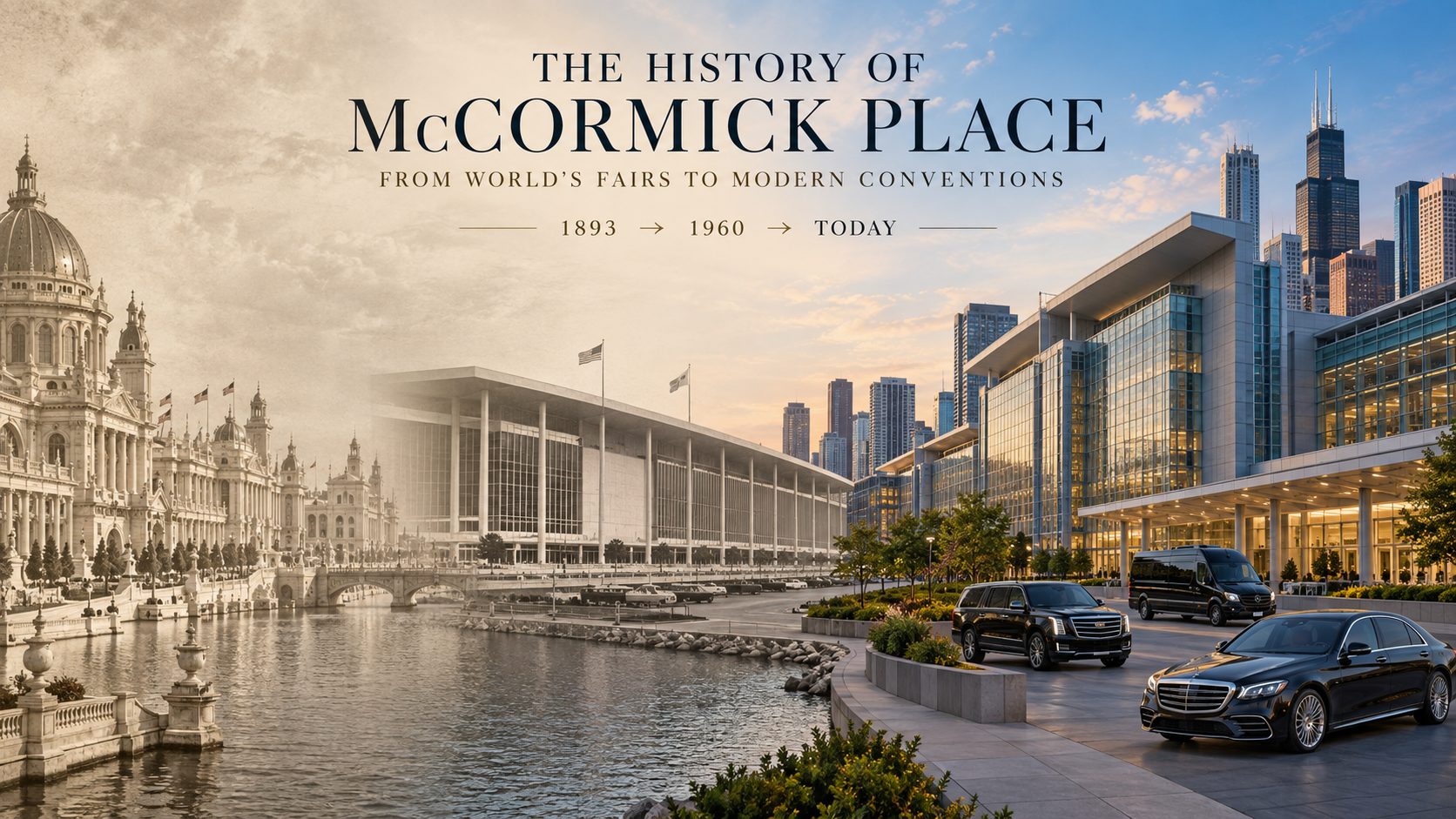
Chicago hosted major international exhibitions long before McCormick Place existed.
The 1893 World’s Columbian Exposition demonstrated the city’s ability to attract and accommodate large numbers of visitors.
Later exhibitions reinforced Chicago’s role as a major meeting destination.
McCormick Place opened in 1960 and developed into a large convention campus through successive expansions.
The complete story appears in our history of McCormick Place and Chicago conventions.
Modern convention transportation
Contemporary convention travel involves coordinating airport arrivals, hotel transfers, scheduled meetings, and group transportation.
A conference might require executive cars for speakers and larger vehicles for several colleagues.
Our McCormick Place convention transportation guide explains current planning considerations for exhibitions and business events.
For conference delegations and corporate groups, Chicago Sprinter limo service provides an option for passengers who need to travel together.
The modern vehicles are different from those used during Chicago’s earliest exhibitions, but the need to move visitors efficiently has remained.
Transportation Milestones and the Evolution of Chauffeured Travel
The history of professional ground transportation parallels changes in Chicago’s larger transportation systems.
Early travelers relied on horse-drawn vehicles, later followed by motorcars and dedicated passenger services.
As the city expanded, chauffeured transportation became one option for reaching railway terminals, hotels, airports, business meetings, and special events.
From formal sedans to modern executive vehicles
Professional passenger transportation evolved as vehicle technology changed.
Traditional luxury sedans became familiar choices for business and airport travelers.
Over time, full-size SUVs offered additional options for passengers and luggage.
Executive vans and Sprinters created more choices for groups.
Modern reservations can also involve flight information, vehicle selection, and scheduled multi-stop itineraries.
A contemporary luxury vehicle fleet reflects the different transportation needs of individuals, families, executives, and groups.
Corporate travel across Chicago
Chicago’s transportation systems helped make the city an important center for commerce.
Corporate visitors now travel between downtown offices, suburban business parks, hotels, convention centers, and airports.
Although rail and road networks make those journeys possible, coordinating several appointments still requires careful planning.
For executives and visiting teams, Chicago corporate limo service provides arrangements for business meetings, airport transfers, and multi-stop transportation.
The basic planning requirement remains the same: identify the correct destination, allow enough travel time, and coordinate the handoff between transportation modes.
Planning a Chicago Transportation History Tour
Travelers interested in the city’s transportation heritage can organize a sightseeing itinerary around several major locations.
The ideal schedule depends on the group’s interests and how much time is available.
A transportation-themed day does not need to cover every landmark.
A smaller number of well-chosen stops can offer a more enjoyable experience.
| Historic theme | Suggested destination | What visitors can explore |
|---|---|---|
| Passenger rail | Chicago Union Station | Railway architecture and the Great Hall |
| Elevated trains | Chicago Loop | Historic elevated tracks and downtown stations |
| Early rail history | Chicago History Museum | Railroad artifacts and Chicago’s development |
| Highway travel | Historic Route 66 starting area | The beginning of an iconic American road |
| Aviation history | O’Hare and Midway history resources | The evolution of the city’s commercial airports |
| Convention development | McCormick Place area | Chicago’s modern exhibition infrastructure |
Start at Union Station
Union Station is a useful opening destination for visitors who appreciate historic architecture.
The Great Hall and surrounding building provide a strong introduction to the importance of rail travel.
Before visiting, check the station’s operating conditions and areas available to the public.
Explore the Loop’s elevated railway
The Loop provides an opportunity to see Chicago’s historic elevated train infrastructure in an active urban setting.
Visitors can appreciate the relationship between railway tracks, city streets, and downtown buildings.
The trains remain operational, so sightseeing should follow all public access and transit safety rules.
Visit Chicago’s highway heritage
The downtown Route 66 starting area connects the city with a larger story of American automobile travel.
Historic route information can help visitors understand the original corridor and later changes.
Not every historic marker is suitable for a vehicle stop, so parking and passenger access should be planned carefully.
Allow time for architecture and museums
Chicago’s transportation story is connected to architecture, commerce, industrial development, and neighborhood history.
Museums, preserved buildings, and historic districts offer context beyond the transportation infrastructure itself.
Choose destinations based on official visiting information rather than assuming all historic properties are open to the public.
Frequently Asked Questions About Chicago Transportation History
1. Why did Chicago become such an important transportation hub?
Chicago’s location near Lake Michigan and its connections to railroads, waterways, highways, and airports helped it become a major center for trade, passenger travel, and industry.
2. When did Chicago’s first railroad begin operating?
Chicago’s early railroad operations began in 1848, when the Pioneer locomotive operated on the developing Galena and Chicago Union Railroad.
3. When did Chicago’s first elevated train begin service?
The first elevated rapid-transit line began operating on June 6, 1892.
4. When was the Chicago Loop Elevated built?
The Loop Elevated opened in 1897, establishing an important downtown connection for Chicago’s rapid-transit network.
5. When did Chicago Union Station open?
Chicago Union Station opened in 1925 after approximately ten years of construction.
6. Who designed Chicago Union Station?
Daniel Burnham developed the original vision, and his successor architectural firm completed the design and construction.
7. Which Chicago airport opened first?
Chicago Municipal Airport, now Midway International Airport, opened in 1926, decades before O’Hare began commercial service.
8. When did O’Hare Airport open?
O’Hare began commercial passenger operations in 1955, after the former Orchard Field site was developed into a major airport.
9. Why is Route 66 associated with Chicago?
Chicago was the historic eastern starting point of Route 66, which connected the city with communities across the American West.
10. When did the CTA begin operating?
The Chicago Transit Authority began operations in October 1947.
11. When did the L reach Chicago’s airports?
CTA rail service reached O’Hare in 1984, while Orange Line service began connecting Midway with the rail network in 1993.
12. Which Chicago transportation landmarks are worth visiting?
Union Station, the Loop’s elevated railway, Chicago History Museum, historic Route 66 locations, and selected transportation-related architectural sites are useful starting points.
Why Chicago Transportation History Still Matters
Understanding Chicago transportation history helps explain why the city remains an important destination for business travelers, tourists, convention attendees, and passengers connecting between different transportation systems.
Railroads established Chicago’s national commercial importance.
Elevated trains transformed travel within the growing city.
Union Station became a monumental passenger gateway.
Airports connected Chicago with national and international destinations.
Route 66 helped define an era of American automobile travel.
Today’s transportation options build on those earlier developments.
A visitor may arrive at O’Hare, continue to a hotel by luxury SUV, attend a downtown conference, explore historic rail landmarks, and depart through Union Station.
Chicago’s transportation systems continue to connect the city with the region and the wider world.
Explore Chicago or Arrange Your Next Ride
Whether you’re planning a historical sightseeing itinerary, visiting Chicago for business, connecting between an airport and train station, or coordinating transportation for a group, our reservation team can help you discuss the available vehicle and service options.
Plan Your Chicago Transportation
Book Your Chauffeured Ride Online or call (708) 998-6336 for availability and a transportation quote.
About the All Star Limo Service Team
The All Star Limo Service team coordinates chauffeured transportation throughout Chicago and the surrounding suburbs. Services include airport transfers, executive transportation, hourly bookings, group travel, and luxury vehicle reservations.
Service Area: Chicago, Illinois, and surrounding suburbs
Phone: (708) 998-6336
Email: info@allstarlimoservice.com
Reservations: 24/7

Monday Morning at Midway: A Business Travel Guide
Early Departures, Stevenson Traffic and How to Time Your Car Service to Chicago’s Smaller Airport…
Chicago Holiday Lights by Car Service
The Mag Mile Lights, ZooLights and Christkindlmarket in One Evening, Without Parking or Driving Home…
Personal Driver vs. Chauffeur Service
Salary, Taxes, Insurance, and When a Private Chauffeur on Demand Makes More Sense — A…
Renting a Luxury Car vs. Hiring a Chauffeur for Your Wedding
Who Drives, Who Parks, and What a Private Chauffeur Actually Takes Off Your Plate —…
Shared Airport Shuttle vs. Private Car Service
Extra Stops, Fixed Schedules, and When a Private Chauffeur Is Worth It for O’Hare and…
Taxi vs. Car Service From O’Hare and Midway
Meters, Taxi Lines, and What a Private Chauffeur Actually Changes When You Land — An…
Halloween Night Party Bus & Limo in Chicago
Stretch Limos, Sprinter Party Buses, and Who Actually Needs Which for October 31 — A…
Thanksgiving Week at O’Hare: Busiest Days and When to Leave
Written by the All Star Limo Service team, Chicago chauffeurs and dispatchers serving the city…
How Early to Get to Midway Airport
Written by the All Star Limo Service team, Chicago chauffeurs and dispatchers serving the city…

O’Hare to Downtown Chicago: Every Option Compared
Written by the All Star Limo Service team, Chicago chauffeurs and dispatchers serving the city…
Private Jet Limo Service: PWK & DPA
Ground Transportation Built Around FBO Pickup and Private Aviation Schedules, Not Commercial Terminal Traffic By…
Chicago Shuttle Service: When You Need More Than a Limo
Moving Large Groups Repeatedly, Not Just Once — A Guide for Weddings, Events, and Conventions…
Concert Night: Limo vs. Parking
What Parking Actually Looks Like at Wrigley Field, the United Center, and Soldier Field —…
Long-Distance Travel: Drive or Fly?
How to Think Through the Drive-vs-Fly Decision for a Trip Just Outside Chicago — A…
Wicker Park Nightlife: Limo Service Guide
Getting to and From Chicago’s Trendiest Nightlife District Without the Parking Hunt or the Rideshare…
Event and Group Transportation in Chicago: Sizing, Shuttles and Timing
Written by the All Star Limo Service dispatch team. Updated September 29, 2026. Event and…
Corporate Ground Transportation in Chicago: Accounts, Billing and Duty of Care
Written by the All Star Limo Service dispatch team. Updated September 29, 2026. Corporate Ground…
The Chicago Airport Transfer Guide: Timing, Terminals and All Four Airports
Written by the All Star Limo Service dispatch team. Updated September 29, 2026. The Chicago…
Chicago Holiday Trip: Hotels and Getting Around
Where to Stay for Christkindlmarket, the Lights, and the Shopping — and How to Get…
Where to Stay for Chicago Marathon Weekend
Which Neighborhoods Work Best for Runners and Spectators, and How to Plan Rides Around Race-Day…
Hotel Checkout to O’Hare: Timing Your Pickup
How to Work Backward From Your Flight So Your Ride Leaves the Hotel at the…
Night Out in Chicago: Safe Rides Home
Why Planning Your Ride Home Before the Night Starts Beats Hoping a Rideshare Shows Up…
Tinley Park to Midway: What It Costs and How Long It Takes
Written by the All Star Limo dispatch team. Updated September 25, 2026. Quick answer: Midway…
Orland Park to O’Hare: Rates, Drive Times and Pickup Tips
Written by the All Star Limo dispatch team. Updated September 25, 2026. Quick answer: Orland…
McCormick Place Hotels to the Show Floor
The Smartest Way to Get From Your Room to a Convention Without Fighting Rideshare Lines…
Hotel Group Transportation: Vans vs. Multiple Ubers
Why Splitting a Group Into Several Rideshares Costs More Than It Looks Like — And…
Magnificent Mile Hotels: A Visitor’s Guide
What Makes This Stretch of Michigan Avenue Different, and How to Get There Without Fighting…
Hotel to O’Hare: Limo vs. Uber
What Actually Differs Between a Flat-Rate Airport Transfer and Hailing a Rideshare From the Hotel…
Best Downtown Hotels for Business Travelers
Where Executives Actually Stay for Meetings in the Loop, River North, and Streeterville — and…
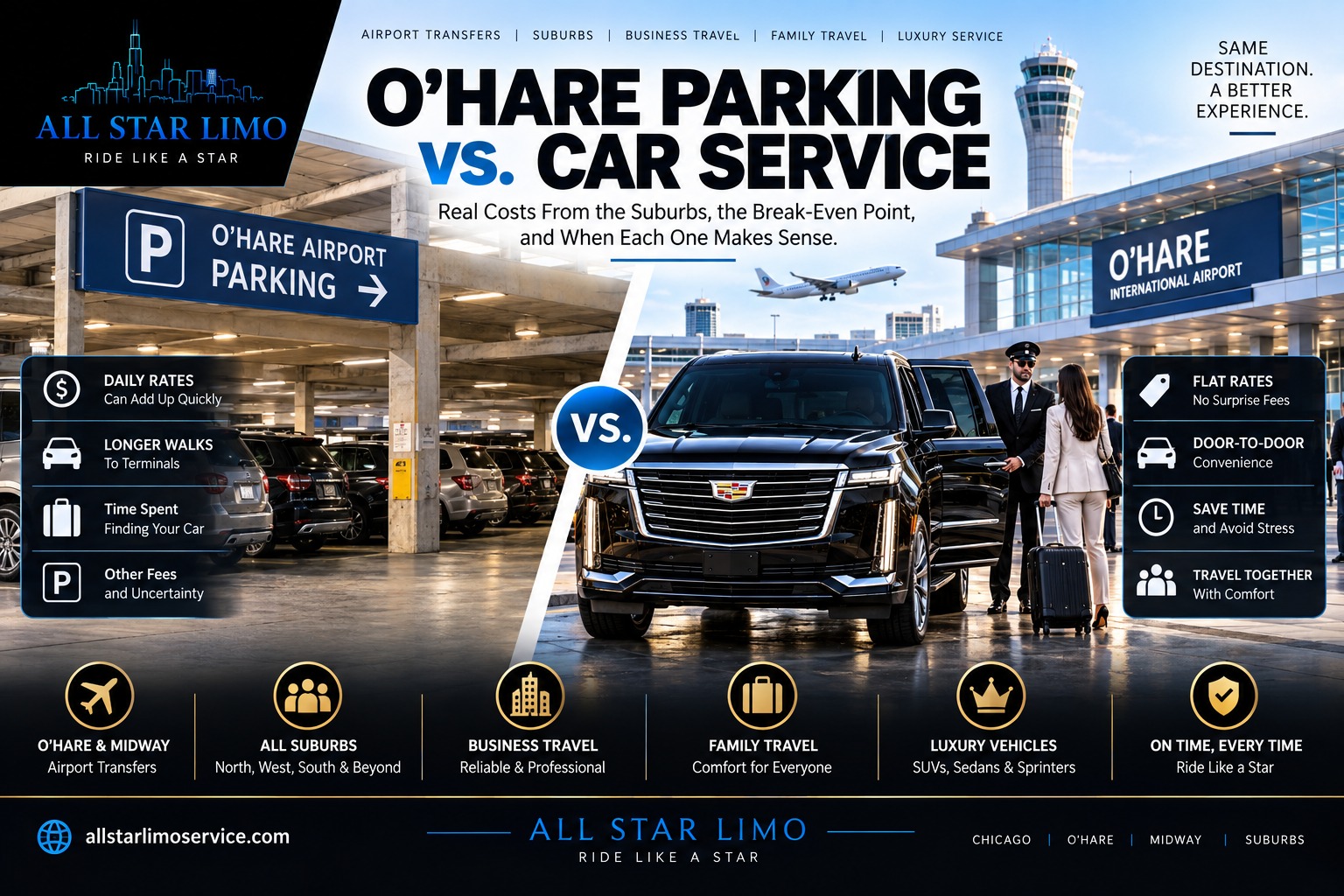
O’Hare Parking vs. Car Service: The Real Cost From the Suburbs
Written by the All Star Limo dispatch team · Updated September 22, 2026 Quick answer: O’Hare’s…
How Much Is a Car Service to O’Hare? Real Prices by Suburb and Vehicle
Written by the All Star Limo dispatch team · Updated September 22, 2026 Quick answer: A…

Ohare Midway Flight Delayed or Cancelled Guide
Flight Delayed or Cancelled? Your Chicago Airport Car Backup Plan Updated September 2026 · Written…

Where to Meet Your Chauffeur at O’Hare
Where to Meet Your Chauffeur at O’Hare: The Complete Pickup Guide Updated September 2026 ·…
A Visitor’s Guide to Getting Around Chicago
Updated September 2026 · Written by the All Star Limo dispatch team — serving Chicagoland…
Prom Season in Chicago: A Parent’s Guide to Booking Safely
Updated September 2026 · Written by the All Star Limo dispatch team — serving Chicagoland…
Chicago Wedding Venue Transportation Guide
Updated September 2026 · Written by the All Star Limo dispatch team — serving Chicagoland…
Chicago Holiday Party & New Year’s Eve Limo Guide
Updated September 2026 · Written by the All Star Limo dispatch team — serving Chicagoland…
24/7 Emergency & Last-Minute Limo Service in Chicago
Updated September 2026 · Written by the All Star Limo dispatch team — serving Chicagoland…
What Is a Chauffeur Service? A Chicago Guide
Updated September 2026 · Written by the All Star Limo dispatch team — serving Chicagoland…
O’Hare vs. Midway
Updated September 2026 · Written by the All Star Limo dispatch team — serving Chicagoland…
Sedan, SUV, Sprinter, or Stretch: Which to Book?
Updated September 2026 · Written by the All Star Limo dispatch team — serving Chicagoland…
Chauffeured Limo vs. Rideshare in Chicago
Updated September 2026 · Written by the All Star Limo dispatch team — serving Chicagoland…
Tinley Park to O’Hare & Midway Guide
Tinley Park to O’Hare & Midway: Airport Car Service Guide Updated September 2026 · Written…
Orland Park to O’Hare & Midway: Airport Car Service Guide
Orland Park to O’Hare & Midway: Airport Car Service Guide Updated September 2026 · Written…
5 Reasons to Choose an Airport Limo for Your Chicago Trip
Pack only what you need and avoid overpacking to streamline the check-in and security screening…
Chicago Transportation History: Airports, Union Station, the L and Route 66
Written by the All Star Limo Service Team | Published October 20, 2026 | 13-minute…

Thanksgiving O’Hare Car Service | Midway & Suburbs
Written by the All Star Limo Service Team | Published October 20, 2026 | 12-minute…
Chicago Corporate Campus Directory: Office Parks From the Loop to Oak Brook, Schaumburg and Deerfield
Written by the All Star Limo Service Team | Published October 20, 2026 | 13-minute…

A Tuesday Night at United Center: Blackhawks Penguins Car Service in Chicago
Written by All Star Limo Service Team Published: October 7, 2026 Read Time: 13 minutes…
The History of McCormick Place and Chicago Conventions: From World’s Fairs to Modern Trade Shows
Written by All Star Limo Service Team Published: October 6, 2026 Read Time: 16 minutes…
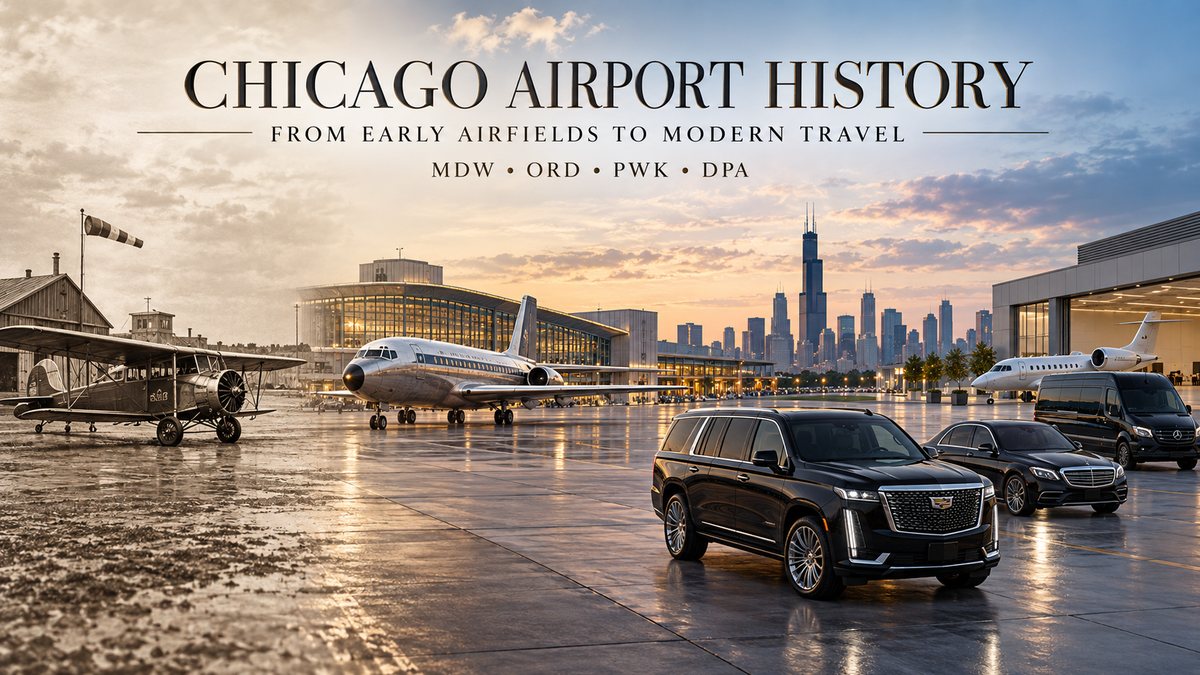
Chicago Airport History Guide: From Early Airfields to O’Hare, Midway, PWK & DuPage
Written by Sam Ali Published: October 6, 2026 Read Time: 16 minutes Chicago airport…
Bulls vs Celtics Limo Service: Dec 30 United Center Guide
Written by Sam Ali | Published: October 6, 2026 | Read Time: 12 minutes Why…
How to Choose a Limo Service in Chicago: 2026 Buyer’s Guide
Written by Sam Ali | Published: October 6, 2026 | Read Time: 14 minutes How…