Written by All Star Limo Service Team
Published: October 6, 2026
Read Time: 16 minutes
The history of McCormick Place is about much more than the construction of one convention center. It reflects Chicago’s long ambition to bring enormous exhibitions, trade shows, business gatherings and visitors together in one city. Decades before the first McCormick Place opened on the lakefront, Chicago had already demonstrated through world’s fairs, railroad exhibitions and national conventions that it could host events on a massive scale.
Today, McCormick Place is a multi-building campus with millions of square feet of exhibit space, hotels, meeting rooms, ballrooms, an arena and transportation systems designed around the movement of enormous crowds. Getting there took more than a century of experimentation, expansion, rebuilding and changing ideas about how convention visitors should move through Chicago.
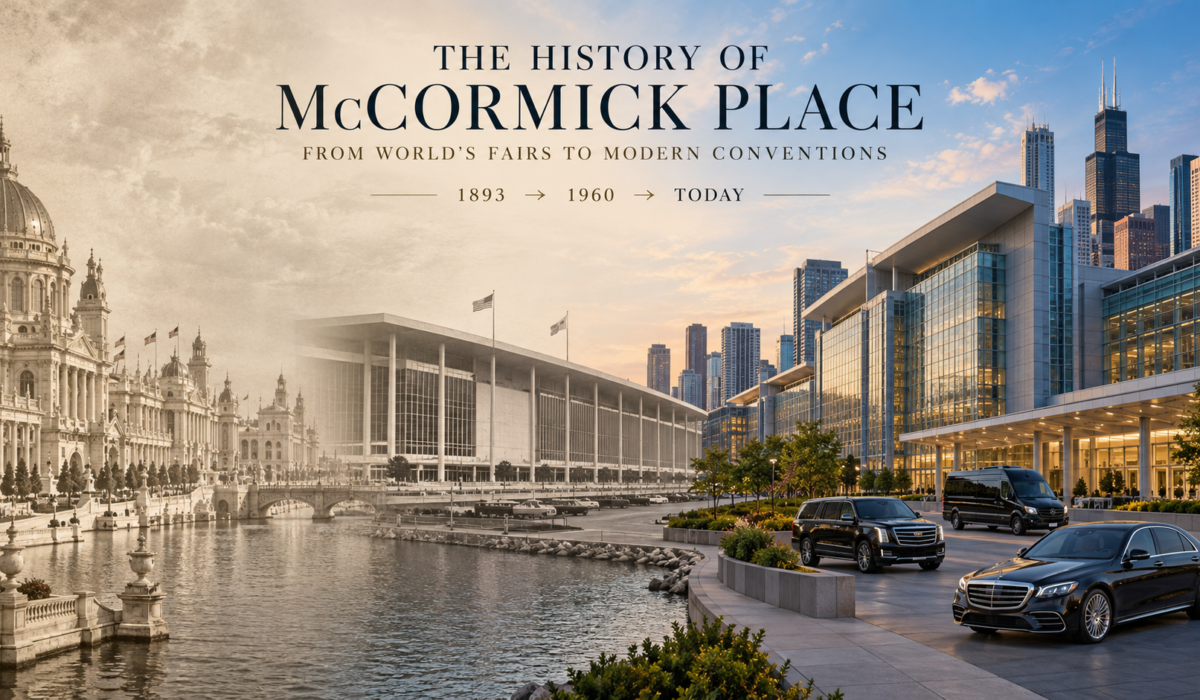
Quick answer: The history of McCormick Place reaches back to Chicago’s development as a major exhibition and convention city. The 1893 World’s Columbian Exposition established Chicago’s ability to attract visitors on an extraordinary scale, while the 1933 Century of Progress and the successful 1948 Chicago Railroad Fair strengthened calls for a permanent exhibition center. McCormick Place opened in 1960, was devastated by fire in 1967, reopened in 1971 and expanded repeatedly into today’s four-building lakefront convention campus.
Chicago Was Hosting Huge Events Long Before McCormick Place
McCormick Place did not create Chicago’s convention culture from nothing.
The city had been bringing extraordinary numbers of visitors together since the 19th century. The most famous early example was the 1893 World’s Columbian Exposition, held in Jackson Park and the surrounding South Side fairgrounds.
More than 27 million people visited the fair during its six-month run. The enormous temporary city covered hundreds of acres and included tens of thousands of exhibits, exhibition halls, entertainment, transportation systems and the original Ferris Wheel.
The fair was not a direct institutional predecessor of McCormick Place, but it proved something important about Chicago: the city could organize, house, feed and transport visitors attending an event of international scale.
That ability would become increasingly valuable as conventions and trade shows developed into major business activities during the 20th century.
Travelers interested in Chicago’s broader exhibition history can explore the Chicago History Museum’s World’s Fair collections.
How the History of McCormick Place Began With Chicago’s Exhibition Ambitions
The connection becomes much more direct with the 1933–34 Century of Progress International Exposition.
Held along Chicago’s lakefront, the second Chicago world’s fair celebrated scientific, industrial and technological progress during the Great Depression. Tens of millions of visitors ultimately attended during its two seasons.
McCormick Place’s own official history specifically identifies the 1933 exposition as an important stage in Chicago’s search for a permanent exhibition center. Although early attempts to establish a permanent facility did not immediately succeed, the idea remained alive.
Then came another major event.
In 1948, Chicago successfully hosted a large railroad exposition on the lakefront. That event helped convince Chicago Tribune publisher Colonel Robert R. McCormick that the city needed a permanent exhibition hall capable of attracting conventions and trade shows year after year.
The concept was moving from temporary fairs toward permanent convention infrastructure.
Who Was Robert R. McCormick?
McCormick Place takes its name from Colonel Robert R. McCormick, the longtime editor and publisher of the Chicago Tribune.
McCormick became one of the principal advocates for a world-class permanent exhibition facility in Chicago. Under his leadership, state support developed for the idea of a permanent hall where Chicago could host industrial exhibitions, conventions and trade shows.
He would not live to see the building that carried his name.
McCormick died in 1955. That same year, Illinois approved construction of a 360,000-square-foot exhibition hall and created the Metropolitan Fair and Exposition Authority, the predecessor of today’s Metropolitan Pier and Exposition Authority.
By 1958, Illinois had issued $41.8 million in bonds. Construction began the following year.
Chicago was finally getting its permanent convention center.
McCormick Place Opens in 1960
The original McCormick Place opened in 1960 on Chicago’s lakefront.
The facility represented a major commitment to Chicago’s convention business. It contained approximately 320,000 square feet of main exhibition space, 23 meeting rooms and a 5,000-seat theater. McCormick Place
At the time, a facility of that size could host exhibitions and industry gatherings that would have been difficult to accommodate elsewhere in the city.
Its lakefront location also placed it near downtown hotels, major roads and Chicago’s growing transportation network.
Convention travel was becoming an industry of its own.
Visitors were no longer simply coming to Chicago for sightseeing. Companies were sending exhibitors, sales teams, executives, clients and thousands of attendees who all needed hotels, restaurants, meeting space and transportation.
That connection between conventions and the surrounding city remains central to modern corporate transportation in Chicago.
The 1967 Fire Changed the History of McCormick Place
On January 16, 1967, disaster struck.
A massive fire swept through the exhibition hall as preparations were underway for the National Housewares Manufacturers Association show. The main convention facility was effectively destroyed, and security guard Kenneth Goodman lost his life in the fire.
The destruction could have represented the end of the lakefront convention-center experiment.
Instead, Chicago rebuilt.
City and state leaders moved quickly to restore the city’s position in the convention industry. The replacement East Building opened in 1971, designed by Gene Summers of C.F. Murphy Associates. It included approximately 522,000 square feet of exhibit space, 20 meeting rooms, theaters and restaurants.
During its first year, the rebuilt facility hosted 51 expositions, surpassing the previous annual high recorded by McCormick Place.
Chicago had not simply restored the convention center.
It had increased its capacity.
Convention Demand Kept Outgrowing the Buildings
The rebuilt East Building was not the end of the expansion story.
Convention demand continued increasing, and Chicago needed more exhibit space if it wanted to compete for the largest national and international trade shows.
During the 1980s, plans moved forward for what became McCormick Place North. The new building came into full use in 1986, with the International Machine Tool Show among its earliest major events. It was officially dedicated in 1987.
By then, McCormick Place was becoming less like a single building and more like a convention district.
That distinction matters today because first-time visitors can still underestimate the scale of the campus.
The current McCormick Place Convention Transportation Guide explains the building layout, entrances, airport timing and transportation considerations for people attending present-day shows.
The history explains why the campus became so complicated in the first place.
The South Building Created Another Massive Expansion
Chicago approved another enormous expansion in the early 1990s.
The South Building, which opened in 1996, added approximately 2.9 million gross square feet to the complex. Its exhibition component alone included about 840,000 square feet, along with approximately 160,000 square feet of meeting space.
For convention organizers, that changed what Chicago could host.
Large exhibitions could occupy vast contiguous spaces while simultaneously using meeting rooms, ballrooms and nearby facilities for educational sessions, executive meetings, product demonstrations and private events.
For transportation coordinators, the scale created another challenge.
Thousands of people might leave hotels during the same morning window and return after the show closes. Executives may have separate meetings. Exhibitors may leave for client dinners. Airport arrivals can occur throughout the day.
That is why modern convention travel increasingly requires more than one transportation type.
Hotels and the History of McCormick Place
A convention center is much more useful when attendees can stay nearby.
That became increasingly important as McCormick Place expanded.
In 1998, the Hyatt Regency McCormick Place opened with approximately 800 guest rooms and a parking garage. The hotel later expanded, and additional development continued around the convention campus.
The Marriott Marquis Chicago followed in 2017 with more than 1,200 rooms and extensive meeting space, directly connected to the convention district. A multi-brand Hilton development later added hundreds more nearby rooms.
These hotels changed convention transportation in an interesting way.
Some attendees could now walk across connected structures to parts of the campus. Others still stayed downtown in the Loop, River North, Streeterville or along Michigan Avenue.
That created two very different convention trips:
hotel physically connected to McCormick Place, and hotel requiring daily transportation to the campus.
The McCormick Place Hotels to the Show Floor guide focuses specifically on that modern travel problem.
The McCormick Place Busway Changed Convention Transportation
One of the most interesting chapters in McCormick Place transportation history came in 2002.
The Metropolitan Pier and Exposition Authority opened a dedicated approximately 2.5-mile busway running alongside the rail corridor through Grant Park. Its purpose was highly specific: move convention attendees between downtown hotels and McCormick Place more efficiently.
That is remarkable when viewed historically.
Chicago had reached the point where moving convention attendees was important enough to justify transportation infrastructure designed specifically around trade-show travel.
The busway reflected a fundamental reality of large conventions: moving ten executives is one problem; moving hundreds or thousands of attendees between hotels and the convention center is another.
Modern Chicago shuttle service follows the same principle on a smaller and more customized scale, using planned routes and repeated movements when groups need to travel between hotels, airports, offices and event venues.
The West Building Makes the Campus Even Larger
Expansion continued into the 21st century.
The West Building opened in 2007, adding approximately 2.7 million gross square feet to the convention complex, including 460,000 square feet of exhibition space and 250,000 square feet of meeting space.
By this point, describing McCormick Place as a “convention hall” no longer captured the scale of the property.
It had become a connected campus.
The North, South and West Buildings and Lakeside Center could simultaneously support exhibit halls, meetings, ballrooms, theaters, restaurants, registration areas and enormous amounts of event infrastructure.
That scale is one reason a company bringing a team to McCormick Place should organize transportation according to passenger schedule, not merely according to total headcount.
The broader Chicago Corporate Transportation Guide explains how executives, employees and clients can require different movements even when everyone is attending the same convention.
Wintrust Arena Adds Another Dimension
The convention district continued expanding beyond traditional exhibit halls.
Wintrust Arena opened in 2017, adding a major event and sports venue directly beside the McCormick Place complex. It is connected to McCormick Place West and has become part of the broader convention and entertainment campus.
This means a single corporate event can now involve very different spaces.
An attendee might spend the morning on a trade-show floor, move into meeting rooms during the afternoon and attend a large general session or evening program at the arena.
Transportation planning therefore cannot always assume that everyone leaves at the same time.
When a conference itinerary includes dinners, receptions or other Chicago venues after the official program, hourly limo service can make more sense than treating every movement as an unrelated transfer.
McCormick Place Today Is Almost a City Within the City
The modern campus is enormous.
McCormick Place reports approximately 2.6 million square feet of exhibition space across its North, South and West Buildings and Lakeside Center. Current facility information also lists 173 meeting rooms, hundreds of thousands of square feet of meeting space, major ballrooms, the Arie Crown Theater and Wintrust Arena.
The venue attracts roughly three million visitors in a typical year, according to current McCormick Place information.
Travelers can review the campus directly through the official McCormick Place planning information.
The size explains why transportation planning around a major show can look completely different from transportation to an ordinary downtown meeting.
Knowing which building, which entrance, which hotel and which departure time can matter more than simply knowing that the destination is McCormick Place.
Airports Became Part of the Convention System
A large Chicago convention effectively begins before attendees reach the convention center.
Many participants arrive through O’Hare or Midway, travel to hotels, attend the show for several days and return to the airport afterward.
A modern Chicago airport limo service therefore becomes part of the convention itinerary rather than an unrelated ride.
The two commercial airports create different travel patterns.
An attendee using O’Hare Airport transportation is approaching McCormick Place from the northwest side of the metropolitan area, while someone using Midway Airport transportation begins much closer to Chicago’s South Side.
Traffic conditions, flight schedules, luggage and hotel location all influence the ground itinerary.
For major delegations, those airport arrivals can also occur in waves rather than all at once.
Executive Transportation and Convention Transportation Are Not the Same Thing
A convention may have thousands of attendees, but a CEO may only need transportation for one person.
That distinction matters.
A senior executive may land at O’Hare, travel to a hotel, attend a private meeting, arrive at McCormick Place later than the main delegation and leave early for a client dinner.
Trying to force that itinerary into the group shuttle schedule can make both transportation plans worse.
For principals and VIP guests, Chicago chauffeur service or discreet Chicago black car service can operate separately from the group schedule.
Meanwhile, the main corporate delegation can travel together.
Convention transportation works best when passengers are grouped according to what they actually need to do.
The Sprinter Became a Modern Convention Vehicle
Earlier convention travelers commonly moved in taxis, hotel vehicles, buses and professional sedans.
The Mercedes-Benz Sprinter added another useful category.
A medium-size team staying at the same hotel and attending the same trade show can travel together without requiring a full-size motorcoach. A Chicago Sprinter limo service can also accommodate luggage for airport movements and keep a corporate group together between the hotel, convention center and evening functions.
The current luxury vehicle fleet includes 2026 S-Class sedans, Cadillac Escalades, Lincoln Navigators, Chevrolet Suburbans and executive Sprinter options alongside specialty vehicles.
That mix reflects how convention transportation has changed.
One vehicle no longer has to solve every assignment.
Large Delegations Need a Transportation System
Once the group grows beyond one vehicle, transportation becomes an operating plan.
Attendees may arrive on different flights. Some stay at different hotels. Executives may have separate dinners. Exhibitors may need earlier arrivals than ordinary attendees.
A Chicago group transportation service can coordinate those movements across multiple passenger groups, while the existing Event and Group Transportation sizing guide explains why passenger count, luggage and timing should be established before vehicles are selected.
The important lesson is surprisingly consistent with McCormick Place itself.
Build around the actual demand.
The convention center expanded because larger events needed more space.
Transportation should expand only when the passenger plan requires it.
Trade Shows Also Changed Chicago Business Travel
McCormick Place helped turn convention travel into a significant part of Chicago’s business economy.
An exhibitor may need several days of transportation between the airport, hotel, show floor, restaurants and client functions.
A sales team may spend the day inside McCormick Place before hosting customers somewhere in River North or the West Loop.
An international delegation may need airport arrivals, Meet & Greet assistance, hotel transfers and several days of scheduled movements.
That makes Chicago corporate limo service relevant well beyond the executive airport transfer.
The transportation becomes part of the event operation.
Conventions Changed Chicago Hotels and Restaurants Too
McCormick Place did not grow in isolation.
The convention business helped support hotels, restaurants, meeting spaces and entertainment throughout downtown and the Near South Side.
The relationship even appears in the financing history of major McCormick Place expansions. When the South Building expansion was authorized in 1991, funding mechanisms included taxes or fees associated with hotels, restaurants, rental cars and ground transportation—industries expected to benefit from convention activity.
That connection still makes sense.
A convention attendee may spend only eight hours on the show floor but several days in Chicago.
The rest of the trip can involve hotels, restaurants, airport transfers, customer dinners, sightseeing and private events.
That broader visitor economy is one reason the convention center became such an important Chicago institution.
Major Events Go Beyond Trade Shows
McCormick Place has also hosted events far outside the traditional trade-show world.
The campus hosted the 2012 NATO Summit, bringing world leaders and approximately 2,000 journalists to Chicago. It hosted President Barack Obama’s 2012 Election Night rally, his 2017 farewell address and numerous other major public and political events.
These events demonstrate the flexibility of a complex originally developed around conventions.
Today, the same campus can accommodate major exhibitions, association meetings, corporate programs, sporting events, concerts and large special events.
For gatherings where the venue is only one part of the evening, Chicago events limo service supports transportation between hotels, McCormick Place and other Chicago destinations.
McCormick Place Even Became a Hospital
Perhaps the most unusual chapter came in 2020.
As COVID-19 disrupted the global events industry, McCormick Place was temporarily transformed into a large civilian alternate-care facility. More than 1,000 hospital beds were prepared inside the convention complex with the involvement of the U.S. Army Corps of Engineers, Illinois National Guard and state and local health agencies.
Large conventions did not return for roughly 16 months.
In July 2021, the Chicago Auto Show was among the events marking the facility’s return to major public exhibitions.
It was another example of a building complex repeatedly adapting to circumstances that its original planners could never have predicted.
Convention Transportation Today Starts With the Schedule
Modern transportation technology makes convention travel easier, but it does not eliminate the need for planning.
Flight tracking can adjust an airport pickup when a flight lands late. Dispatch technology can coordinate several vehicles. Mobile communication can help a chauffeur and passenger find one another around a busy venue.
But technology cannot fix an unrealistic itinerary.
If twenty attendees need to leave different hotels at different times, transportation has to reflect that reality.
If one executive has a separate dinner, that traveler may need another vehicle.
If a team expects to spend the entire day moving among several destinations, a reserved vehicle may need to remain with them.
The goal of professional Chicago limo service is not simply to place everyone into one vehicle. It is to match transportation to the schedule.
What Does Convention Transportation Cost?
Convention pricing depends on the vehicle, number of passengers, reservation duration, route, pickup locations and whether the transportation involves one transfer or several hours of service.
A single executive sedan from a downtown hotel to McCormick Place is fundamentally different from several Sprinters operating repeated hotel loops during a large conference.
The current Chicago limo pricing guide provides broader rate information, but convention coordinators should request quotes around the actual passenger schedule.
That means knowing who is traveling, where they are staying, when they need to arrive and whether everyone follows the same itinerary.
A Short McCormick Place Timeline
The history of McCormick Place can be understood through a series of major milestones:
- 1893: Chicago hosts the World’s Columbian Exposition, demonstrating its ability to attract visitors and exhibitions on an enormous scale.
- 1933–34: A Century of Progress strengthens Chicago’s international exhibition tradition.
- 1948: The Chicago Railroad Fair renews interest in building a permanent exposition center.
- 1955: Illinois approves construction of a permanent exhibition hall and creates the authority that would operate it.
- 1960: The original McCormick Place opens.
- 1967: A devastating fire destroys the main exhibition hall.
- 1971: The rebuilt East Building opens.
- 1986: McCormick Place North comes into use.
- 1996: The South Building opens.
- 1998: Lakeside Center reopens and the Hyatt Regency McCormick Place opens.
- 2002: The dedicated McCormick Place convention busway begins operation.
- 2007: The West Building opens.
- 2017: Wintrust Arena and Marriott Marquis Chicago become major additions to the surrounding convention campus.
- 2020: McCormick Place temporarily becomes a large alternate-care facility during the COVID-19 pandemic.
- Today: The campus offers approximately 2.6 million square feet of exhibit space across four major convention buildings.
Those expansions explain why a facility that began with one exhibition hall has become one of the largest convention environments in North America.
Frequently Asked Questions
When did McCormick Place first open?
The original McCormick Place opened in 1960 on Chicago’s lakefront.
Who was McCormick Place named after?
It was named for Colonel Robert R. McCormick, longtime editor and publisher of the Chicago Tribune and an important advocate for building a permanent convention center in Chicago.
Did the original McCormick Place burn down?
Yes. A major fire destroyed the main exhibition hall in January 1967. Chicago rebuilt the facility, and the new East Building opened in 1971.
Was McCormick Place connected to Chicago’s world’s fairs?
Chicago’s earlier world’s fairs were not the same institution, but they established the city’s long tradition of hosting enormous exhibitions. McCormick Place’s official history specifically connects the 1933 Century of Progress and the 1948 Railroad Fair with later efforts to create a permanent exposition center.
How large is McCormick Place today?
The North, South and West Buildings and Lakeside Center together provide approximately 2.6 million square feet of exhibition space.
How many buildings make up McCormick Place?
The main convention campus consists of four primary convention buildings: North, South, West and Lakeside Center.
Is Wintrust Arena part of the McCormick Place campus?
Wintrust Arena is part of the broader McCormick Place/McCormick Square campus and is connected to McCormick Place West.
Are there hotels connected to McCormick Place?
Yes. Major hotel development around the campus includes Hyatt Regency McCormick Place, Marriott Marquis Chicago and additional nearby properties.
Which Chicago airport is closer to McCormick Place?
Midway is geographically closer than O’Hare, but the best airport depends on the traveler’s flight options, airline, schedule and complete itinerary.
What transportation works best for a corporate team attending a convention?
It depends on the number of travelers and whether everyone follows the same schedule. Individual executives may use sedans or SUVs, medium-size teams may use Sprinters, and larger programs can require several vehicles or planned shuttle movements.
Why the History of McCormick Place Matters Today
The history of McCormick Place shows how Chicago repeatedly adapted to the changing scale of conventions and business travel.
The city began with temporary fairs and exhibitions capable of drawing enormous crowds. It eventually committed to a permanent convention center, rebuilt it after a catastrophic fire and expanded it again and again as trade shows demanded more exhibit halls, meeting rooms, hotel rooms and transportation capacity.
The vehicles arriving outside changed too.
Traditional sedans gave way to executive black cars. Luxury SUVs became common for airport travelers and principals. Sprinters created another option for corporate teams. Shuttle systems evolved for groups moving repeatedly between hotels and the show floor.
But the basic problem has remained remarkably consistent:
Chicago brings large numbers of people together, and those people still need an organized way to reach the event.
For a convention, trade show, corporate program or McCormick Place transportation quote, call or contact the reservations team.
All Star Limo Service
Chicago, IL
Phone:
Reservations: 24/7


Monday Morning at Midway: A Business Travel Guide
Early Departures, Stevenson Traffic and How to Time Your Car Service to Chicago’s Smaller Airport…
Chicago Holiday Lights by Car Service
The Mag Mile Lights, ZooLights and Christkindlmarket in One Evening, Without Parking or Driving Home…
Personal Driver vs. Chauffeur Service
Salary, Taxes, Insurance, and When a Private Chauffeur on Demand Makes More Sense — A…
Renting a Luxury Car vs. Hiring a Chauffeur for Your Wedding
Who Drives, Who Parks, and What a Private Chauffeur Actually Takes Off Your Plate —…
Shared Airport Shuttle vs. Private Car Service
Extra Stops, Fixed Schedules, and When a Private Chauffeur Is Worth It for O’Hare and…
Taxi vs. Car Service From O’Hare and Midway
Meters, Taxi Lines, and What a Private Chauffeur Actually Changes When You Land — An…
Halloween Night Party Bus & Limo in Chicago
Stretch Limos, Sprinter Party Buses, and Who Actually Needs Which for October 31 — A…

Thanksgiving Week at O’Hare: Busiest Days and When to Leave
Written by the All Star Limo Service team, Chicago chauffeurs and dispatchers serving the city…
How Early to Get to Midway Airport
Written by the All Star Limo Service team, Chicago chauffeurs and dispatchers serving the city…

O’Hare to Downtown Chicago: Every Option Compared
Written by the All Star Limo Service team, Chicago chauffeurs and dispatchers serving the city…
Private Jet Limo Service: PWK & DPA
Ground Transportation Built Around FBO Pickup and Private Aviation Schedules, Not Commercial Terminal Traffic By…
Chicago Shuttle Service: When You Need More Than a Limo
Moving Large Groups Repeatedly, Not Just Once — A Guide for Weddings, Events, and Conventions…
Concert Night: Limo vs. Parking
What Parking Actually Looks Like at Wrigley Field, the United Center, and Soldier Field —…
Long-Distance Travel: Drive or Fly?
How to Think Through the Drive-vs-Fly Decision for a Trip Just Outside Chicago — A…
Wicker Park Nightlife: Limo Service Guide
Getting to and From Chicago’s Trendiest Nightlife District Without the Parking Hunt or the Rideshare…
Event and Group Transportation in Chicago: Sizing, Shuttles and Timing
Written by the All Star Limo Service dispatch team. Updated September 29, 2026. Event and…
Corporate Ground Transportation in Chicago: Accounts, Billing and Duty of Care
Written by the All Star Limo Service dispatch team. Updated September 29, 2026. Corporate Ground…
The Chicago Airport Transfer Guide: Timing, Terminals and All Four Airports
Written by the All Star Limo Service dispatch team. Updated September 29, 2026. The Chicago…
Chicago Holiday Trip: Hotels and Getting Around
Where to Stay for Christkindlmarket, the Lights, and the Shopping — and How to Get…
Where to Stay for Chicago Marathon Weekend
Which Neighborhoods Work Best for Runners and Spectators, and How to Plan Rides Around Race-Day…
Hotel Checkout to O’Hare: Timing Your Pickup
How to Work Backward From Your Flight So Your Ride Leaves the Hotel at the…
Night Out in Chicago: Safe Rides Home
Why Planning Your Ride Home Before the Night Starts Beats Hoping a Rideshare Shows Up…
Tinley Park to Midway: What It Costs and How Long It Takes
Written by the All Star Limo dispatch team. Updated September 25, 2026. Quick answer: Midway…
Orland Park to O’Hare: Rates, Drive Times and Pickup Tips
Written by the All Star Limo dispatch team. Updated September 25, 2026. Quick answer: Orland…
McCormick Place Hotels to the Show Floor
The Smartest Way to Get From Your Room to a Convention Without Fighting Rideshare Lines…
Hotel Group Transportation: Vans vs. Multiple Ubers
Why Splitting a Group Into Several Rideshares Costs More Than It Looks Like — And…
Magnificent Mile Hotels: A Visitor’s Guide
What Makes This Stretch of Michigan Avenue Different, and How to Get There Without Fighting…
Hotel to O’Hare: Limo vs. Uber
What Actually Differs Between a Flat-Rate Airport Transfer and Hailing a Rideshare From the Hotel…
Best Downtown Hotels for Business Travelers
Where Executives Actually Stay for Meetings in the Loop, River North, and Streeterville — and…
O’Hare Parking vs. Car Service: The Real Cost From the Suburbs
Written by the All Star Limo dispatch team · Updated September 22, 2026 Quick answer: O’Hare’s…
How Much Is a Car Service to O’Hare? Real Prices by Suburb and Vehicle
Written by the All Star Limo dispatch team · Updated September 22, 2026 Quick answer: A…

Ohare Midway Flight Delayed or Cancelled Guide
Flight Delayed or Cancelled? Your Chicago Airport Car Backup Plan Updated September 2026 · Written…

Where to Meet Your Chauffeur at O’Hare
Where to Meet Your Chauffeur at O’Hare: The Complete Pickup Guide Updated September 2026 ·…
A Visitor’s Guide to Getting Around Chicago
Updated September 2026 · Written by the All Star Limo dispatch team — serving Chicagoland…
Prom Season in Chicago: A Parent’s Guide to Booking Safely
Updated September 2026 · Written by the All Star Limo dispatch team — serving Chicagoland…
Chicago Wedding Venue Transportation Guide
Updated September 2026 · Written by the All Star Limo dispatch team — serving Chicagoland…
Chicago Holiday Party & New Year’s Eve Limo Guide
Updated September 2026 · Written by the All Star Limo dispatch team — serving Chicagoland…
24/7 Emergency & Last-Minute Limo Service in Chicago
Updated September 2026 · Written by the All Star Limo dispatch team — serving Chicagoland…
What Is a Chauffeur Service? A Chicago Guide
Updated September 2026 · Written by the All Star Limo dispatch team — serving Chicagoland…
O’Hare vs. Midway
Updated September 2026 · Written by the All Star Limo dispatch team — serving Chicagoland…
Sedan, SUV, Sprinter, or Stretch: Which to Book?
Updated September 2026 · Written by the All Star Limo dispatch team — serving Chicagoland…
Chauffeured Limo vs. Rideshare in Chicago
Updated September 2026 · Written by the All Star Limo dispatch team — serving Chicagoland…
Tinley Park to O’Hare & Midway Guide
Tinley Park to O’Hare & Midway: Airport Car Service Guide Updated September 2026 · Written…
Orland Park to O’Hare & Midway: Airport Car Service Guide
Orland Park to O’Hare & Midway: Airport Car Service Guide Updated September 2026 · Written…
5 Reasons to Choose an Airport Limo for Your Chicago Trip
Pack only what you need and avoid overpacking to streamline the check-in and security screening…
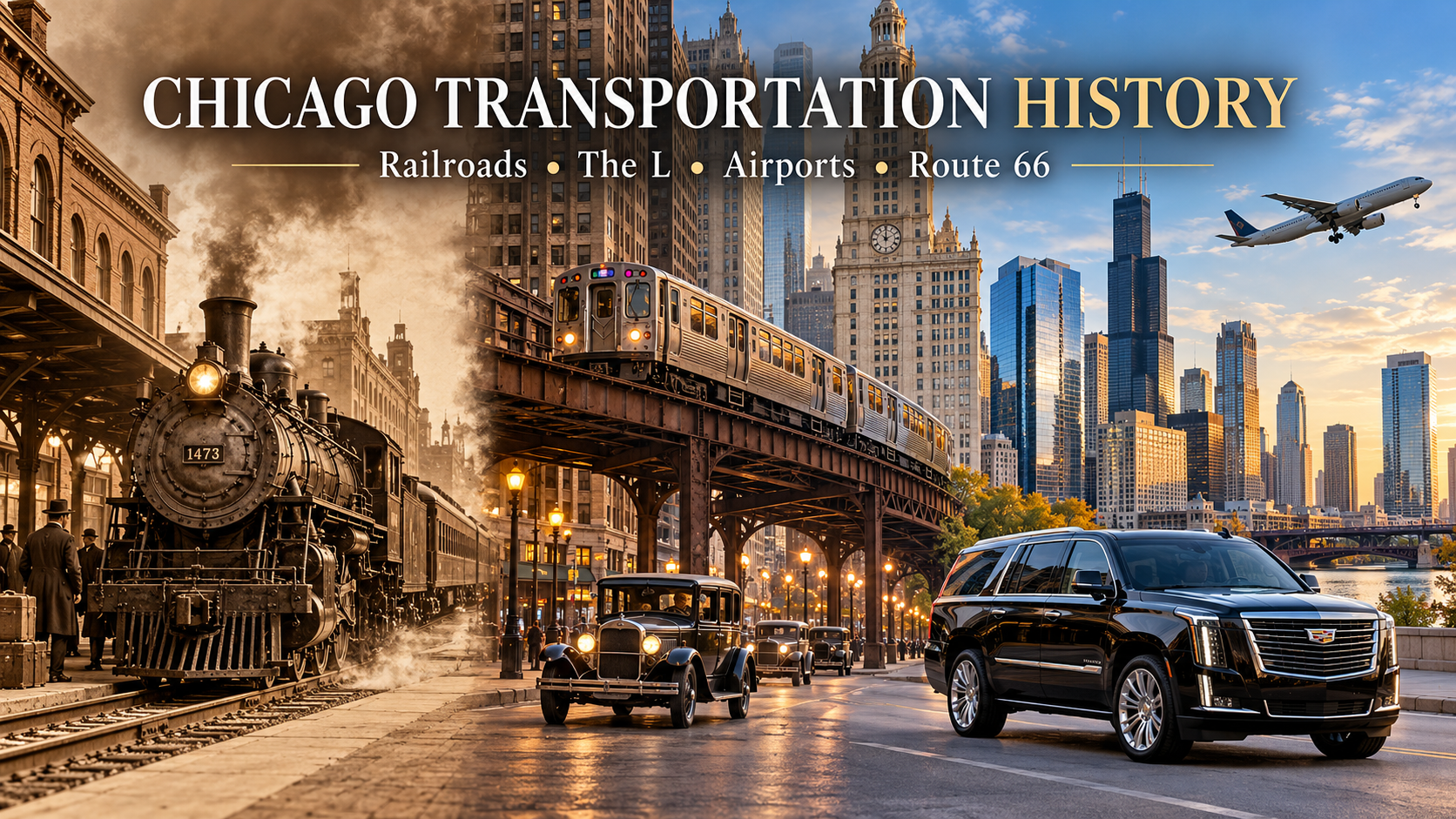
Chicago Transportation History: Airports, Union Station, the L and Route 66
Written by the All Star Limo Service Team | Published October 20, 2026 | 13-minute…
Thanksgiving O’Hare Car Service | Midway & Suburbs
Written by the All Star Limo Service Team | Published October 20, 2026 | 12-minute…
Chicago Corporate Campus Directory: Office Parks From the Loop to Oak Brook, Schaumburg and Deerfield
Written by the All Star Limo Service Team | Published October 20, 2026 | 13-minute…
A Tuesday Night at United Center: Blackhawks Penguins Car Service in Chicago
Written by All Star Limo Service Team Published: October 7, 2026 Read Time: 13 minutes…
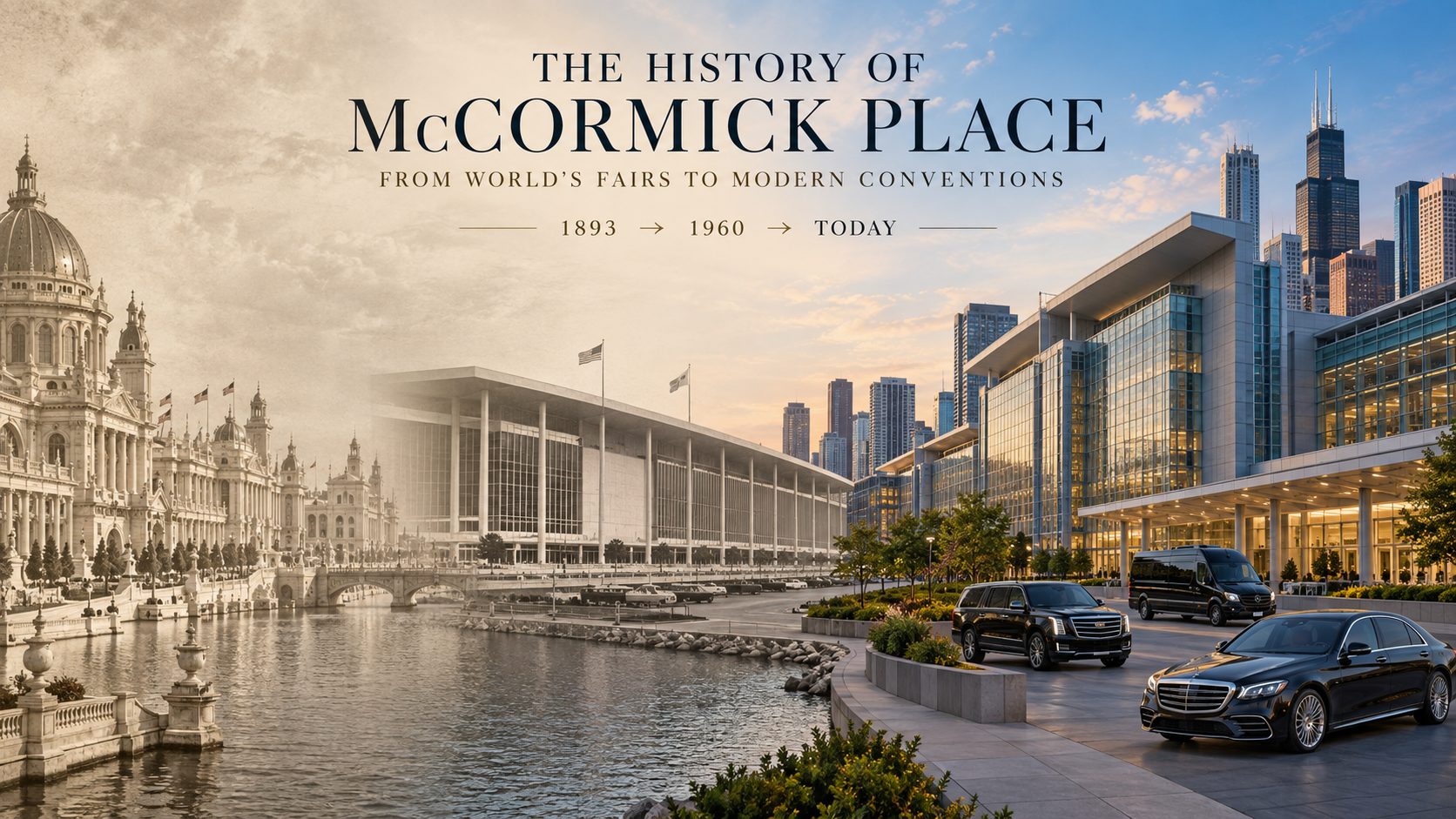
The History of McCormick Place and Chicago Conventions: From World’s Fairs to Modern Trade Shows
Written by All Star Limo Service Team Published: October 6, 2026 Read Time: 16 minutes…
Chicago Airport History Guide: From Early Airfields to O’Hare, Midway, PWK & DuPage
Written by Sam Ali Published: October 6, 2026 Read Time: 16 minutes Chicago airport…
Bulls vs Celtics Limo Service: Dec 30 United Center Guide
Written by Sam Ali | Published: October 6, 2026 | Read Time: 12 minutes Why…
How to Choose a Limo Service in Chicago: 2026 Buyer’s Guide
Written by Sam Ali | Published: October 6, 2026 | Read Time: 14 minutes How…