
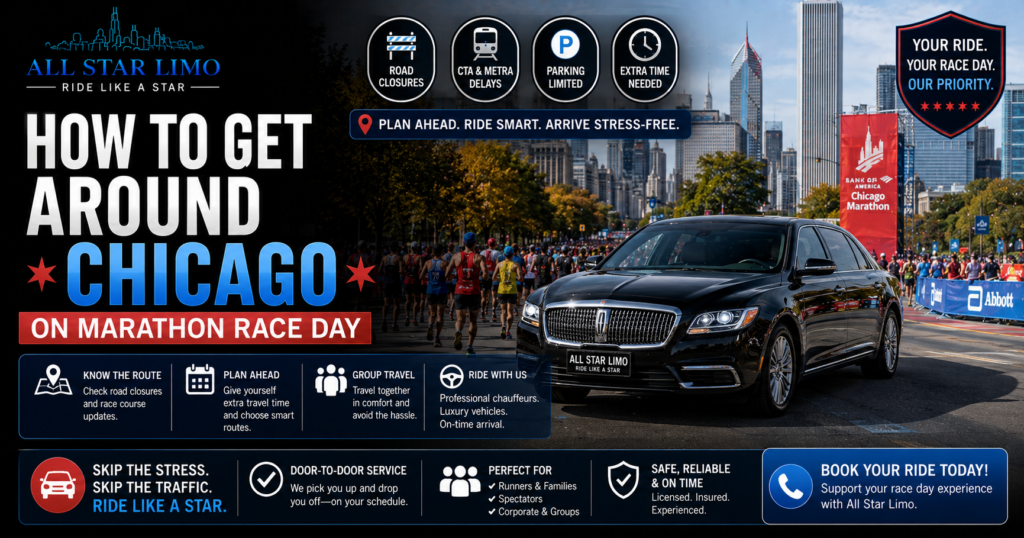
The Bank of America Chicago Marathon takes place Sunday, October 11, 2026, starting and finishing in Grant Park. The race course closes to traffic around 6 a.m. and stays closed through roughly 4 p.m., with no-parking and towing zones enforced from 1 a.m. along the entire route. If you’re dropping off a runner, meeting family after the finish, or trying to catch your athlete at multiple viewing points, book a chicago marathon transportation guide-style hourly car service in advance — regular rideshare and taxis are largely useless once the closures go into effect, and pre-planned routes with a professional chauffeur who knows the closure map are the only reliable way to move around downtown that morning.
The Chicago Marathon is one of the biggest single-day events downtown sees all year. More than 50,000 runners cross the start line in Grant Park, and roughly 1.7 million spectators pack 29 neighborhoods along the 26.2-mile course. That’s incredible for the city — and genuinely disruptive for anyone who needs a car to get somewhere on race morning. Streets don’t just get busy; they get physically closed, often for six to ten hours at a stretch, and the closures ripple out well beyond the marathon course itself because every cross-street feeding into it backs up too.
If you’re flying in the night before to drop off a runner at 5 a.m., trying to catch your spouse at mile 10 and then again at the finish, or coordinating a car for out-of-town family who’ve never dealt with a major marathon before, the difference between a smooth morning and a stressful one usually comes down to one thing: understanding the road closure map before you’re sitting in a car that can’t move.
This guide walks through exactly what happens to Chicago’s downtown streets on marathon day, how to plan an early drop-off, how to build a spectator route that actually works, and how to reunite with your runner at the finish without wandering Grant Park for an hour. We’ll also cover the questions we get asked most often by families booking Chicago marathon transportation with us every October.
Understanding the Road Closure Map (What It Means for Your Route)
The single biggest mistake people make on Chicago Marathon day is treating it like a normal traffic day with “a bit more congestion.” It isn’t. The course closure is a hard, physical barrier — police barricades, cones, and officers stationed at intersections — and once it’s up, there is no driving across it, no matter how empty a side street looks on your GPS.
What the closure actually covers
The 26.2-mile course winds through 29 Chicago neighborhoods, starting and finishing in Grant Park. In practice, that means the closures touch a huge cross-section of downtown and near-downtown Chicago, including:
- The Loop — the start/finish area around Grant Park sees the earliest and longest closures of the day
- Near North Side / River North — the course runs north through this corridor early in the race
- Old Town, Lincoln Park, and the Gold Coast — closures here typically lift earlier since runners pass through before mid-morning
- Pilsen, Bridgeport, and the South Side neighborhoods — closures here tend to run later into the morning as the course loops back downtown
Street-level closures generally begin overnight, with the city posting “tow zone” restrictions that take effect around 1 a.m. on race morning. Vehicles left on the course route are typically towed starting at 1 a.m., so if you’re staying at a downtown hotel and driving in for the weekend, parking off the marked route the night before matters. The full-course closure to vehicle traffic generally begins around 6 a.m. and doesn’t fully reopen until roughly 4 p.m., though individual streets clear earlier once the last runners and course-support vehicles pass through.
Why “just check Google Maps” doesn’t work
Google Maps and most GPS apps don’t reliably reflect temporary event closures in real time, especially rolling closures that open and close block by block as the race progresses. A route that shows as “12 minutes” can turn into a dead end at a police barricade with no way to reroute except backtracking several miles. This is the number one reason marathon-day car service calls spike every year — people who tried to self-navigate downtown and got stuck.
The most reliable source for the exact closure map each year is the official Chicago Marathon website, which publishes street-by-street closure times as race week approaches. But even with the map in hand, knowing which streets are closed is only half the problem — you also need a driver who knows the detour logic around those closures, which is where local, marathon-experienced chauffeurs earn their keep. Our chauffeurs run this exact route every October and build drop-off and pickup plans around the actual closure sequence, not a generic map.
Practical takeaway for planning your route
Before race day, identify three things: where you’re starting from, where the nearest open perimeter street is to your destination, and what time that street closes relative to your arrival. Anyone driving into or through downtown Chicago that morning — whether for the marathon or simply because they live or work nearby — should build in significantly more buffer time than usual and expect to approach the Loop from the outside in, not straight through the middle.
Who else gets affected, even without a bib
It’s not only runners and spectators who feel the closures. Hotel guests with no connection to the race, downtown residents trying to run weekend errands, and even people just passing through Chicago on marathon Sunday all get caught off guard. If you have a hotel checkout, a flight to catch, or a business meeting that morning, treat it the same way a runner’s family would — confirm your route against the current closure map and build in extra time, because “I’m not even going to the marathon” doesn’t exempt you from the barricades.
Lake Shore Drive and the expressways
Lake Shore Drive itself is part of the course for a stretch and closes to general traffic accordingly, which pushes north-south travelers onto surrounding streets that are already absorbing marathon-related congestion. The interstate expressways feeding downtown — the Kennedy, Eisenhower, and Dan Ryan — generally stay open, but their downtown exits feed directly into the closure zone, so getting off the highway doesn’t mean you’re close to your destination. This is exactly the kind of local knowledge that matters more than a generic navigation app on marathon morning: knowing which exit still gets you within walking distance versus which one drops you at a dead-end barricade.
Weather and visibility add another layer
Chicago in October is unpredictable — race-morning temperatures can swing from crisp and clear to rainy and cold within the same week. Weather doesn’t change the closure map, but it does change how much time people spend outside waiting for pickup, which is one more reason to have a warm, dry vehicle staged and ready rather than hoping a rideshare car appears quickly in the rain.
Early-Morning Runner Drop-Off Logistics
If you’re running the marathon, your race morning starts hours before the gun goes off — and getting to Grant Park is its own logistical challenge separate from the 26.2 miles ahead of you.
Why drop-off timing is tighter than people expect
Runners are generally asked to arrive in Grant Park well ahead of the first wave, since gear check, bag drop, and getting to your corral all take time, and the closest streets to Grant Park close to vehicle traffic earlier than the rest of the course. Waves typically begin rolling out starting around 7:20 a.m. with wheelchair and handcycle starts, followed by the professional and general waves shortly after. That means most runners need to be dropped off, through security, and settled well before 7 a.m. — which puts drop-off traffic right in the window when the closest streets to Grant Park are already restricted.
Where drop-off actually works
The practical drop-off zone shrinks every year as the closures tighten around Grant Park itself. A car can generally get you close on the perimeter streets bordering the park, but not directly to the start corrals — expect a short walk from your drop-off point regardless of how you arrive. The advantage of a scheduled car service over rideshare here is predictability: a driver who’s done this before knows which perimeter street will still be open at 5:30 a.m. versus 6:15 a.m., and can time your arrival to land in that window rather than guessing.
Building your morning timeline
A reasonable framework for runner drop-off:
- Confirm your hotel or home departure time based on distance from Grant Park, adding at least 30–45 extra minutes versus a normal-traffic estimate.
- Schedule your car for a fixed pickup time, not “whenever I’m ready” — rideshare availability craters in the pre-dawn hours as every runner in the city is trying to book a car at once.
- Plan for the last quarter-mile on foot. No vehicle, including chauffeured cars, will get you to the actual start corral. Wear something you can shed and leave behind, since gear check has its own line.
- Tell your driver your bib wave, if you have one, since it affects how early you truly need to be there.
Because demand for cars spikes so hard in that early window, this is one occasion where booking well in advance genuinely matters more than usual. If you’re staying in The Loop the night before the race, a scheduled early-morning pickup is one of the simplest ways to remove the single most stressful part of your race morning — worrying about whether you’ll actually make it to your corral on time.
Dropping off from a suburban hotel
Not every runner stays downtown. Plenty of families base themselves in the suburbs — Naperville, Oak Brook, Schaumburg, or the south suburbs around Orland Park and Tinley Park — and drive in on race morning. This adds real risk if you’re relying on a personal vehicle, because parking downtown that morning is scarce even before you factor in the closures, and any legal parking spot you do find may still require a long walk once the streets around Grant Park lock down. A scheduled chauffeur pickup from a suburban hotel removes the parking question entirely: the driver handles the approach into downtown, drops the runner as close as the closures allow, and isn’t left circling for a place to park while everyone else in the city tries to do the same thing.
Traveling with a group of runners
If more than one person in your party is running, coordinate a single vehicle rather than several separate rides. Groups often have slightly different wave times or want to split off to different gear-check areas, so it helps to tell your driver everyone’s wave assignment up front and agree on a single drop-off point that works for the group as a whole. This is also where a larger vehicle — an SUV or Sprinter rather than a sedan — pays off, since it keeps the whole group together and moving on one schedule instead of managing multiple pickups in the dark.
What to bring (and what not to bring) in the car
Race mornings are cold, and most runners bring a throwaway layer, but don’t leave valuables in the car if you’re being dropped off — plan for the vehicle to either wait briefly at a nearby staging point or head off and return later for pickup, since parking directly at the drop zone usually isn’t possible once closures are active. Confirm with your driver in advance whether the plan is a straight drop-off or a wait-and-return, so there’s no confusion in the pre-dawn crowd.
Spectator Strategy — Multi-Point Viewing Without Getting Stuck
Watching a runner in the Chicago Marathon is genuinely one of the best spectator experiences in American sports — if you plan the route. If you don’t, it’s easy to spend the whole morning stuck on the wrong side of a barricade, watching the race on your phone instead of in person.
The core challenge: the course is a loop, not a line
Because the marathon route loops through so many neighborhoods and crosses back near itself multiple times, spectators often assume they can simply drive from one viewing spot to the next as the race progresses. In reality, once you’re inside the closure perimeter, moving between viewing points usually means walking or taking public transit — a car can’t cut across the course.
A workable multi-point viewing plan
Seasoned marathon spectators generally pick two to three viewing points that are reachable from each other without crossing the live course, then use the CTA ‘L’ system to move between them on foot and rail rather than by car. Two commonly used points:
- Near the start (around Mile 1): Grand Avenue between Columbus Drive and State Street, or State Street between Grand Avenue and Jackson Boulevard, both offer good early-race viewing close to Grant Park.
- Near the finish: the cheer zone around Michigan Avenue and Roosevelt Road gives strong visibility as runners approach the final stretch.
Between those points, most spectators rely on the CTA rather than a car, since train lines can cross under or around closed streets in ways vehicles simply can’t.
Where a car service still helps
Even though you won’t be driving between viewing points during the race, a scheduled car is still valuable for:
- Getting downtown before the closures lock in — arriving by 6 a.m. via a driver who knows the approach streets beats trying to find parking cold.
- Getting home or back to your hotel afterward, when rideshare demand spikes hardest and prices surge the most.
- Coordinating a group — families or friend groups watching together often want one reliable vehicle waiting on the outer edge of downtown rather than everyone separately fighting for a rideshare at 3 p.m.
If your group is planning a full day around the race — watching, celebrating afterward, maybe heading to a post-race brunch or gathering — an hourly limo rental with a driver on call all day removes the guesswork entirely. You’re not trying to book a new ride every time you move; the car and driver are simply there when you need them, parked outside the closure zone until you’re ready.
A note for out-of-town spectator groups
Families flying in specifically to watch tend to underestimate how much of downtown becomes inaccessible by car. If you’re hosting a small group — say, coordinating pickups from O’Hare or Midway the day before, plus marathon-day spectating, plus a celebration dinner that evening — it’s often simpler to book one coordinated event transportation plan for the whole weekend rather than piecing together separate rides for each leg.
Spectating with kids or elderly family members
Standing on a crowded curb for hours, then walking between viewing points on packed sidewalks, is a lot to ask of young children or grandparents. If your group includes anyone who tires easily or needs regular breaks, it’s worth limiting your plan to a single strong viewing point rather than attempting the full multi-point circuit, and having a car staged nearby where anyone who needs to sit down, warm up, or step away from the crowd can do so without the group splitting up. This is one of the more overlooked reasons families book a driver for the full morning rather than a single ride — the car itself becomes a home base.
Corporate and running-club groups
Chicago Marathon weekend is also a major event for corporate sponsor teams and run clubs who bring out large groups to cheer on employees or members. For groups larger than a handful of people, coordinating group transportation — a Sprinter van or small bus rather than several separate cars — keeps everyone moving together, simplifies pickup logistics at a single agreed point, and avoids the coordination headache of matching up multiple smaller vehicles across a closure zone.
Finish-Line Reunion & Pickup Planning
Of everything covered in this guide, the finish-line reunion is where the most families end up frustrated — not because the plan was hard, but because there usually wasn’t one.
Why the finish area is harder than it looks
Grant Park after the race is enormous and extremely crowded. Runners exit through a long finish chute that includes medal pickup, food and recovery stations, gear bag retrieval, and — for many runners — a genuine need to just sit down for a few minutes before they can walk anywhere. Meanwhile, cell networks in the immediate finish area get overloaded with tens of thousands of people trying to text and call at once, which means “I’ll just call you when I’m done” is a much less reliable plan on marathon day than it sounds.
Set a fixed meeting point, not a moving target
The single most useful thing families can do is agree, well before race day, on one specific, easy-to-describe landmark outside the densest part of the finish area — not “somewhere near the finish line,” which is exactly where the crowd is thickest. Save that location as a pin in everyone’s phone in advance, and treat it as the plan even if cell service is spotty when you actually need it.
Build in real time, not goal-pace time
It’s tempting to plan pickup around a runner’s goal finish time, but that’s rarely how the morning actually goes. Add real time for:
- The finish chute itself, which can take 20–30 minutes to walk through even after crossing the line
- Gear bag retrieval, which involves its own line
- Changing out of race clothes, especially in cooler October weather
- The walk from the finish area out to wherever vehicles can actually reach
A driver scheduled for “somewhere after 11 a.m., we’ll text you” tends to work far better than one scheduled for the runner’s exact projected finish time.
Where your car should actually wait
Because Grant Park itself stays closed to vehicles well after the race finishes, your pickup vehicle won’t be waiting right at the finish line — it’ll be staged on a perimeter street outside the restricted zone. This is another spot where a professional, marathon-experienced chauffeur adds real value: rather than you trying to guess which nearby street is open, your driver already knows the standard staging points used once the finish-area closures start easing, generally from mid-morning onward.
After the reunion
Once everyone’s together, getting out of downtown is its own challenge — sidewalks and streets near Grant Park stay packed well into the afternoon, and rideshare pricing in the area tends to spike hard as thousands of people try to leave at once. A pre-booked car with a flat rate avoids that surge entirely, whether you’re headed back to a hotel, to the airport for a same-day flight home, or out to the suburbs.
If you get separated
Even with a plan, large crowds and inconsistent cell service mean families occasionally get separated for longer than expected. If that happens, stay at the agreed meeting point rather than both people moving to try to find each other — two moving targets rarely find one another in a crowd that size. The Chicago Marathon also operates official medical and lost-and-found services throughout the finish area for runners who need assistance, which is worth knowing about but shouldn’t be your primary plan; a fixed, pre-agreed meeting point is still the most reliable option.
Flying out the same day
Some runners and families fly out the evening of the marathon, which adds real time pressure on top of an already tiring day. Because getting from the finish area to O’Hare or Midway crosses through the same closure zone as everything else in this guide, same-day departures need extra buffer time — both for the walk out of the restricted zone and for standard airport-arrival timing on top of that. A scheduled airport transfer booked with a realistic pickup window, rather than an exact time based on a goal finish, is the safer approach for anyone catching a flight that evening.
FAQ: Chicago Marathon Transportation
When exactly do the road closures start and end on marathon day?
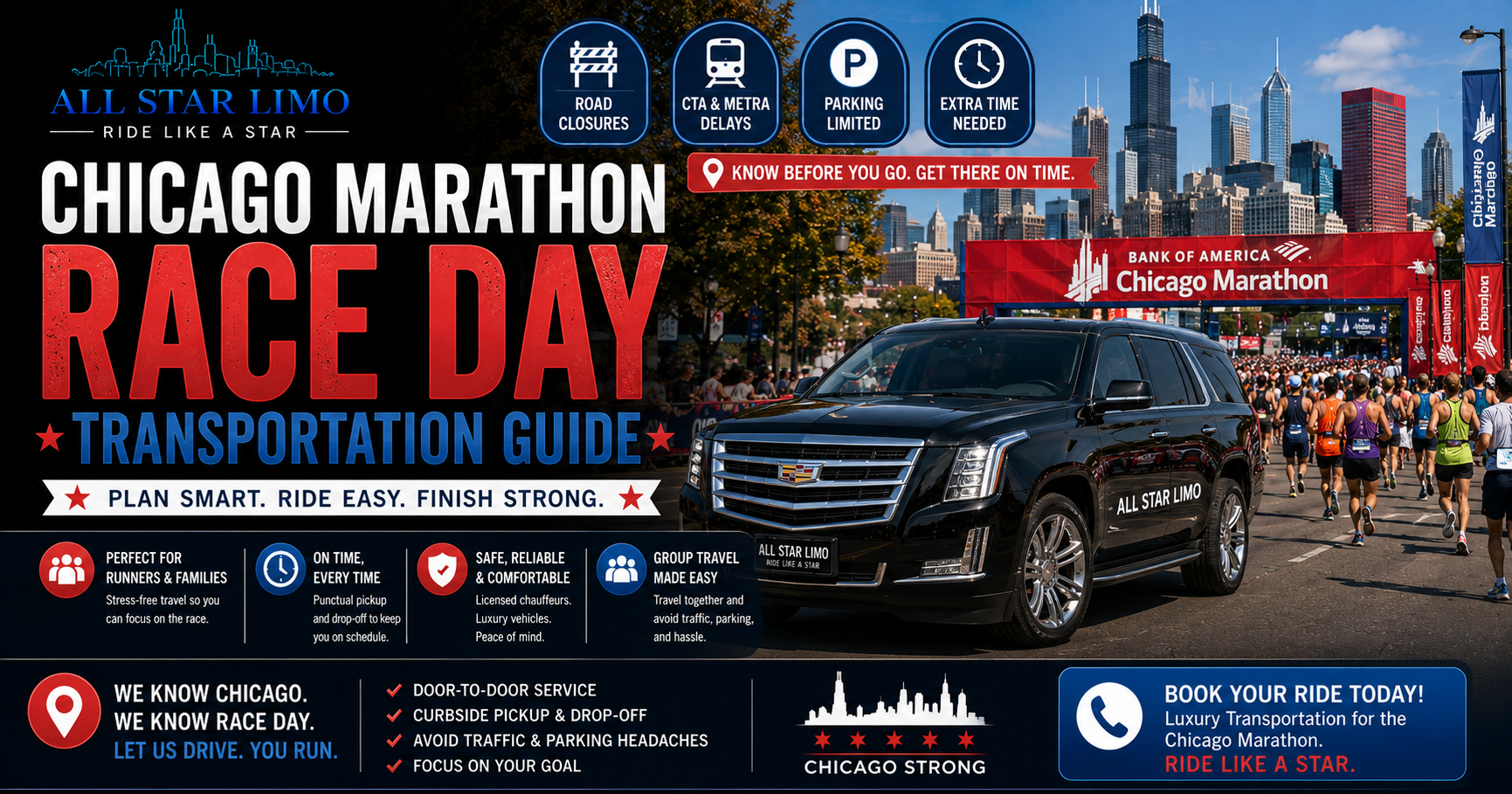
Street-level “no parking, tow zone” restrictions typically begin around 1 a.m. on race morning, with vehicles left along the route towed from that point. The full course generally closes to traffic around 6 a.m. and reopens gradually through the day, with most closures lifted by roughly 4 p.m. Exact times shift slightly year to year, so always confirm current closures on the official Chicago Marathon site closer to race week rather than relying on a previous year’s schedule.
Can rideshare drivers get close to Grant Park on race morning?
Generally, no — not directly. Rideshare drivers face the same closures as everyone else, and many decline marathon-morning trips near downtown altogether because of the unpredictability. Pre-booked car service with a driver who plans routes around the closure map is far more dependable than trying to hail a rideshare that morning.
Where’s the best place to watch if I want to see my runner more than once?
Pick two or three viewing points connected by CTA train rather than road, since you generally can’t drive between spots along the course while it’s active. A common combination is a Mile 1 viewing spot near Grand Avenue or State Street, followed later by the finish-area cheer zone near Michigan Avenue and Roosevelt Road.
How early should I book a car for marathon weekend?
As early as possible — ideally several weeks out for early drop-off, spectator, or pickup service. Demand for downtown transportation spikes hard on marathon weekend, and availability for early-morning slots (4–6 a.m.) fills first.
Is it better to book an hourly car for the whole day instead of separate one-way rides?
For most spectator groups and families, yes. An hourly limo rental keeps one driver and vehicle on call throughout race morning and afternoon, which avoids repeatedly trying to book new rides as demand — and pricing — spikes near the finish.
What if my flight lands the same day as the marathon?
It’s doable, but plan carefully. Traffic around O’Hare and Midway isn’t directly affected by the downtown closures, but getting from the airport into the closure perimeter afterward requires the same route-planning as any other marathon-day trip. A chauffeur familiar with both the airport routes and the marathon closure map can coordinate both legs in a single booking.
Do the road closures affect areas outside the direct race route, like nearby hotels or restaurants?
Yes, indirectly. Streets that intersect the course are closed even where the marathon itself only passes through briefly, and traffic redirected off the route often backs up onto nearby streets that aren’t part of the course at all. Hotels, restaurants, and businesses within a few blocks of the route can see significant access disruption even if they’re not technically “on” the marathon path, so it’s worth checking proximity to the course — not just whether an address is directly on it — when planning any pickup or drop-off near downtown that day.
Related Guides: Sprinter Van vs Stretch Limo vs Party Bus Chicago
Plan Your Chicago Marathon Transportation Early
Marathon weekend is one of the few days a year where “I’ll just grab a car when I need one” genuinely doesn’t work downtown. Whether you need an early drop-off in The Loop, a car on standby all morning through an hourly limo rental, or coordinated event transportation for your whole group’s race weekend, booking ahead with a chauffeur who knows the closure map is the difference between a smooth morning and a frustrating one.
All Star Limo has been running Chicago’s downtown streets for over a decade, including every marathon weekend. Our chauffeurs plan routes around the actual closure sequence — not a generic map — for runner drop-offs, spectator days, and finish-line reunions across the city and suburbs.
Book your Chicago Marathon transportation now → or call (708) 998-6336 to plan your race-day route with our team.