Chicago , il

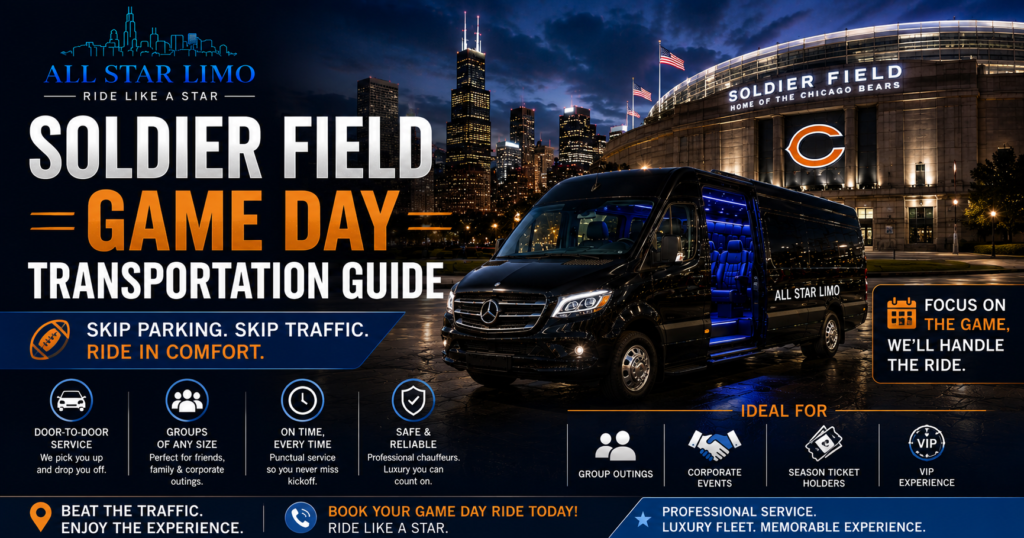
A chauffeured ride to Soldier Field on a Chicago Bears game day typically runs $80–$150/hour for a sedan or SUV, or a flat rate in the $120–$250 range for a round trip from downtown or the near suburbs, depending on vehicle size, distance, and how long you need the driver to wait during tailgating. Larger groups riding in a Sprinter van or stretch limo should expect higher hourly minimums, usually with a 3–4 hour minimum on game days. Book your Soldier Field ride online or call to get an exact quote for your group size and drop-off window.
If you’ve ever tried to drive yourself to a Bears game, you already know the drill. You leave with plenty of time to spare, and somewhere around Roosevelt Road or the Stevenson Expressway ramp, that cushion disappears. By the time you’re circling the Waldron Deck looking for a spot that isn’t $60 and three-quarters of a mile from the stadium, kickoff is uncomfortably close and your tailgate window has shrunk to almost nothing.
Soldier Field sits inside Museum Campus, which is one of the most congested pieces of real estate in Chicago on a Sunday afternoon. It shares roads, parking lots, and pedestrian traffic with the Field Museum, the Shedd Aquarium, and the Adler Planetarium — and on a Bears home game, all of that gets funneled through the same handful of access points along DuSable Lake Shore Drive and Solidarity Drive. A chauffeured car service sidesteps most of that by handling the driving, the parking logistics, and the exit strategy, so your group can focus on tailgating and the game instead of traffic.
This guide walks through exactly what makes Soldier Field traffic so difficult, where a chauffeured drop-off actually beats self-parking, how group transportation works for larger watch parties and tailgate crews, and — probably the most underrated part of game day — how to time your pickup so you’re not standing on Waldron Drive for 45 minutes after the final whistle.
Why Soldier Field/Museum Campus Traffic Gets Ugly on Game Days
Soldier Field wasn’t built with modern NFL-sized crowds in mind, and neither was the road network around it. Understanding why the congestion happens makes it a lot easier to plan around it.
It’s Not Just a Stadium — It’s a Campus
Soldier Field sits on the Museum Campus, sandwiched between the Field Museum, the Shedd Aquarium, and the Adler Planetarium, with Northerly Island just to the south. On a normal weekend, this area handles a steady flow of families, tour buses, and museum visitors. On a Bears Sunday, you add roughly 61,500 stadium-bound fans on top of that baseline traffic, all converging on the same narrow strip of land between the lake and the Loop.
There’s no separate “game day only” road network. Fans, museum-goers, cyclists on the Lakefront Trail, and delivery vehicles for the surrounding venues are all competing for the same lanes at the same time — which is a big part of why a five-minute drive from the South Loop can turn into a 40-minute crawl on a Sunday afternoon.
Lakefront Road Closures and Restricted Access
The City of Chicago and the Chicago Park District routinely close or restrict segments of DuSable Lake Shore Drive, Solidarity Drive, and McFetridge Drive around Soldier Field for several hours before and after kickoff. The exact closure pattern shifts slightly from game to game depending on kickoff time and expected attendance, but the general rule holds: the closer you get to the stadium, the fewer through-routes remain open, and the ones that do stay open get backed up fast.
This matters most for anyone unfamiliar with the area. If you don’t already know which streets flip to local-access-only on game day, you can end up boxed into a detour loop that adds 20–30 minutes to what should be a short drive — often right as you’re trying to make it in before opening kickoff.
One-Way-In, One-Way-Out Bottlenecks
Museum Campus has a limited number of vehicle entry points, and most of them funnel to the same few exits. Pre-game, that means a slow crawl in. Post-game, it means tens of thousands of cars, rideshares, and buses all trying to leave through the same handful of chokepoints within a 20-minute window right after the final whistle.
This is the single biggest reason self-parking punishes patience. Whether you’re in the Waldron Deck, the North Garage, or one of the surface lots off McFetridge, you’re stuck in the same queue as everyone else the moment the game ends — and there’s no way to route around it once you’re inside your own car with nowhere to go.
Rideshare Surge Pricing and Designated Zones
Rideshare pickup for Soldier Field events is typically restricted to designated zones that can be a fair walk from your actual gate, and pricing surges hard in the 30–45 minutes after a game ends, when tens of thousands of fans are requesting a ride at the same moment. It’s not unusual to see rideshare quotes triple or quadruple right after the final whistle, on top of a 15–20 minute wait just to get matched with a driver.
A pre-booked chauffeured service avoids both problems. The rate is set in advance, and your driver already knows where to be and when — no bidding against 60,000 other people for the next available car.
How Kickoff Time Changes the Traffic Pattern
Not every Bears game creates the same traffic profile, and it’s worth planning around the specific kickoff time rather than assuming every Sunday looks the same.
- Early (Noon) kickoffs tend to compress arrival traffic into a tighter window, since most fans are heading in around the same one- to two-hour stretch on a weekend morning. Streets around Museum Campus fill up fast, but they also clear reasonably quickly once the pregame rush passes.
- Afternoon kickoffs (3:25 PM CT) overlap with weekend museum traffic, lakefront joggers and cyclists, and sometimes a Sunday brunch crowd downtown, which stacks extra congestion on top of the usual stadium traffic.
- Primetime games (Sunday, Monday, or Thursday night) add rush-hour traffic into the mix, since fans are arriving straight from work. Expect the drive in to be noticeably heavier than a weekend day game, particularly along the Stevenson and DuSable Lake Shore Drive.
- Weather-affected games — snow, heavy rain, or extreme cold — slow everything down further, both for vehicles and for fans walking between the parking areas and the gates. A closed vehicle with a driver who isn’t also trying to navigate an unfamiliar route in bad weather makes a real difference on these days.
Museum Campus Isn’t Optional Overflow — It’s the Whole Route
Because DuSable Lake Shore Drive runs directly along the lakefront through Museum Campus, there’s no meaningful way to bypass this stretch of road if you’re arriving from the north, downtown, or the South Loop. Suburban commuters coming from the west or south face a similar bottleneck merging onto Museum Campus roads from I-55 or the Stevenson. There isn’t a secret back route that skips the congestion entirely — the best strategy is knowing which access points stay open longest and timing your arrival to avoid the peak of the rush, which is exactly the kind of local knowledge a chauffeur who drives this route regularly brings to the trip.
Tailgate-Friendly Drop-Off Options
Tailgating is a real part of the Bears game day tradition, and any transportation plan for Soldier Field needs to account for it — which is where a lot of rideshare and self-parking plans fall short.
Why Rideshare Doesn’t Work Well for Tailgating
Rideshare is built around point-to-point trips, not multi-hour waits in a parking lot. Drivers can’t sit with you at the tailgate for three hours before circling back, and requesting a fresh pickup once the lots start clearing out post-game means competing with everyone else who had the same idea. If your plan includes grilling in the lot for a few hours before kickoff, rideshare simply isn’t designed around that kind of timeline.
Where a Chauffeured Drop-Off Makes Sense
A chauffeured car service works differently because you’re booking the vehicle and driver for a window of time, not a single point-to-point trip. That opens up a few practical drop-off strategies for Bears fans:
- Drop at the lot, pickup after the game: Your driver drops your group directly at your tailgate lot or a nearby surface lot, then heads off to wait elsewhere (avoiding paying for hours of dead parking time) and returns for a scheduled post-game pickup.
- Drop and go, no tailgate: If your group is skipping the tailgate and heading straight to your gate, a curbside drop as close to your entry point as game-day restrictions allow saves the walk from the deep lots.
- Extended hourly booking: For groups that want the vehicle on standby the entire time — tailgating, walking to the gate, and waiting through the game — an hourly booking keeps the same driver and vehicle with you from arrival to final pickup, which is the simplest option if you don’t want to coordinate timing twice.
Coordinate the Exact Lot Ahead of Time
Soldier Field’s surrounding lots (including the Waldron Deck, the North and South Garages, and the surface lots along McFetridge Drive and Solidarity Drive) each have different access points depending on which roads are open that day. Confirming your specific lot or gate with your driver ahead of time — not just “Soldier Field” as a general destination — is what actually gets your group dropped off close to your tailgate spot instead of a quarter-mile away.
Loading Coolers, Grills, and Gear
If your tailgate setup includes coolers, folding chairs, a portable grill, or other bulky gear, a Sprinter van or full-size SUV gives you the cargo room a sedan can’t. This is worth flagging when you book — letting the dispatcher know your group size and how much gear you’re bringing helps match you to a vehicle that can actually fit everything without a second trip.
Chauffeured Drop-Off vs. Self-Parking: What You’re Actually Trading Off
It helps to think about this as a straightforward trade-off rather than a simple “which is cheaper” question, since the two options solve different problems.
- Self-parking means paying a flat lot fee (often $40–$80+ depending on the lot and how close it is to the stadium), plus the time cost of arriving early to secure a decent spot, plus sitting in the exit queue with everyone else after the game. Your car is available on your own schedule, but only once the lot actually clears.
- Chauffeured drop-off removes the parking fee entirely and replaces it with an hourly or flat transportation rate. You lose the ability to leave on a whim mid-tailgate, but you gain a driver who isn’t drinking, isn’t stuck circling for a spot, and who can position the pickup away from the worst of the post-game bottleneck.
For a group of four or more splitting the cost, a chauffeured ride often lands close to what everyone would have spent combined on parking and rideshare surge pricing anyway — with a lot less hassle built into the day.
Tailgating Responsibly
One practical upside worth mentioning: with a chauffeur handling the driving, nobody in your group needs to be the designated driver. That’s a genuine consideration for a day that, for a lot of fans, includes tailgate drinks before an afternoon game.
Group Transportation for Bears Watch Parties
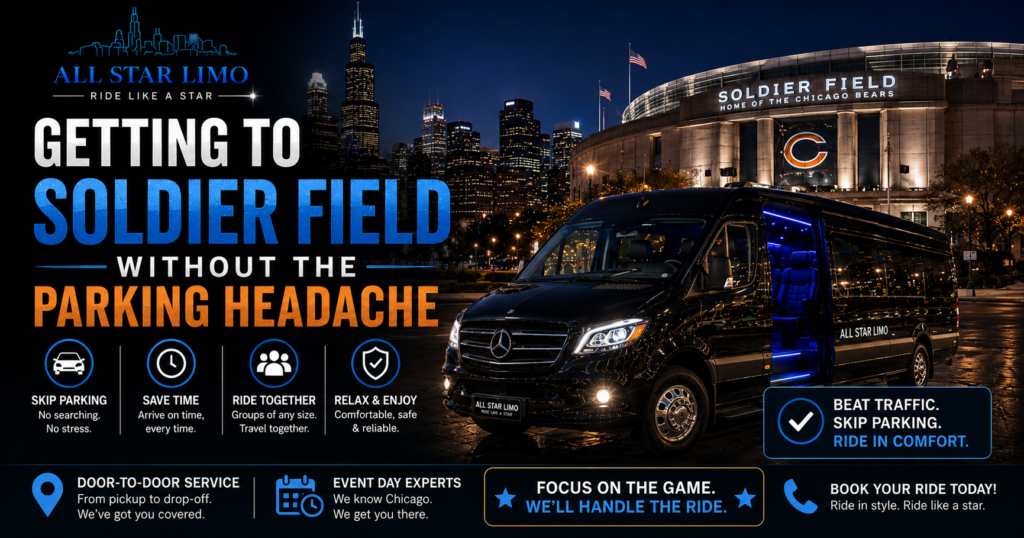
Bears games are inherently a group activity — tailgate crews, bachelor parties timed around a home game, corporate client outings, and extended family groups all show up in bigger numbers than a typical airport run or dinner reservation. Getting everyone to Soldier Field in one coordinated trip solves a logistics problem that individual rideshares can’t.
Why Splitting Into Multiple Rideshares Falls Apart
A group of 10 or 12 people trying to get to a Bears game via individual rideshare requests usually means splitting into three or four separate cars, each hitting different surge pricing, taking different routes, and arriving at different times — sometimes 20 or 30 minutes apart during peak game-day demand. Reassembling the group once everyone’s inside Museum Campus adds another layer of coordination that nobody wants to deal with before kickoff.
One Vehicle, One Departure Time
Group transportation solves this by keeping everyone together in a single vehicle with one departure time and one arrival point. For Bears watch parties and tailgate crews, that typically means:
- Sprinter vans for groups of 10–14, with enough cargo space for tailgate gear
- Stretch limousines for groups that want to make the ride itself part of the pregame atmosphere
- Sprinter party buses for larger groups who want room to stand, socialize, and keep the energy going on the ride over
- Full-size SUVs for smaller groups of 5–6 who still want more room than a standard sedan
Multi-Stop Pickups Before Kickoff
Group bookings for Soldier Field often involve picking up different people from different addresses — a few friends downtown, someone from the South Loop, another from a suburb like Orland Park or Tinley Park — before heading to the stadium together. This kind of multi-stop coordination is exactly what group transportation is built for, and it’s worth mapping out your pickup order with the dispatcher when you book so the route makes sense geographically instead of zig-zagging across the city.
Corporate and Client Entertainment
For businesses using a Bears game to entertain clients or reward a team, group transportation also solves a professionalism problem that rideshare can’t: everyone arrives together, in one vehicle, without anyone stuck waiting on a delayed driver or scrambling for a ride separately. It’s a small detail, but it sets the tone before the group even gets to the stadium.
Booking Ahead for Big Game Days
Primetime matchups, division rivalry games, and late-season games with playoff implications sell out group transportation fast. If you’re planning a tailgate crew or watch party trip for a marquee Bears game, booking a week or two ahead — rather than the Friday before — gives you a much better shot at your preferred vehicle type.
Related Guides: Corporate Holiday Party Transportation in Chicago
Post-Game Exit Strategy (Why Timing Your Pickup Matters)
This is the part of game day that trips up even experienced Bears fans. Getting to Soldier Field is usually the easy half — getting out is where a good plan actually pays off.
The First 20 Minutes After the Final Whistle Are the Worst
The heaviest congestion of the entire day happens in the 15–20 minutes immediately after the game ends, when tens of thousands of fans hit the exits simultaneously. Every parking deck, every rideshare zone, and every through-street around Museum Campus fills up at once. If your pickup is scheduled for the exact moment the final whistle blows, you’re walking straight into the worst possible window.
Build In a Buffer
The simplest fix is timing your pickup 15–25 minutes after the expected end of the game, rather than right at it. This gives the initial surge of foot and vehicle traffic time to thin out, and it gives your driver a realistic shot at reaching a pickup point without getting stuck in the same gridlock as everyone leaving at once. It also means less standing around for your group — a pickup timed too early just means your driver is sitting in the same jam you’re trying to avoid.
Pick a Specific, Discussable Meeting Point
“Meet at Soldier Field” isn’t specific enough once 60,000 people are leaving at the same time. A concrete meeting point — a specific gate, a corner along Waldron Drive, or a landmark near your original drop-off — makes it much easier for your driver to actually find your group in a crowd. If your group tailgated before the game, returning to that same lot for pickup is usually simpler than trying to coordinate a new spot from inside the stadium.
Text-Based Coordination Beats Guessing
Since cell service can get spotty in a packed stadium bowl and phone-based apps struggle with everyone in the same square mile trying to connect at once, agreeing on a simple text-based check-in with your driver ahead of time (rather than relying on a live rideshare map ping) tends to work more reliably for a Soldier Field pickup.
Factor In Overtime and Weather Delays
Chicago Bears games occasionally run long — overtime, weather delays, or a longer-than-usual halftime for a promotional event can all push the actual end time later than the scheduled one. Booking with some flexibility built in, and confirming with your driver that the pickup window can shift if the game runs long, avoids the awkward situation of your ride showing up before you’re actually out.
Flying in for the Game? Combine Your Airport Transfer with Stadium Transportation
Soldier Field draws plenty of out-of-town fans, especially for marquee matchups, away-team road-trip groups, and fans flying in to combine a Bears game with a Chicago weekend. If that’s your situation, it’s worth planning the airport-to-stadium leg as part of the same trip instead of booking two unrelated rides.
Landing at O’Hare or Midway Before Kickoff
Both of Chicago’s major airports connect to Soldier Field, but the drive time and traffic pattern differ enough that it’s worth planning around whichever one you’re flying into.
- From O’Hare, the drive downtown and on to Museum Campus typically runs 35–50 minutes outside of rush hour, longer if your arrival overlaps with weekday traffic or a primetime kickoff.
- From Midway, the trip is usually faster — often 20–30 minutes to downtown and Museum Campus — since Midway sits closer to the city on the south side.
Booking a single chauffeured trip that covers your airport pickup, a hotel drop if needed, and the eventual ride to Soldier Field keeps your whole day on one schedule instead of coordinating a rideshare from the airport and a separate car service to the stadium.
Same-Day Arrivals Need a Buffer
If you’re flying in the morning of a game, build in extra time between your scheduled landing and kickoff — flight delays are common enough that cutting it close on a game day is risky. A chauffeur who’s tracking your flight in real time can adjust the pickup automatically if your arrival shifts, which takes one variable off your plate on an already tight schedule.
Hotel-to-Stadium Trips
For fans staying downtown, in River North, or near McCormick Place, the drive to Soldier Field is short, but it still runs through the same Museum Campus bottlenecks as everyone else. Booking your hotel-to-stadium leg in advance — rather than trying to hail a car curbside on game morning — avoids the scramble that comes with every other hotel guest trying to do the same thing at once.
Related Guides: Chicago Bachelorette Party Transportation Guide
FAQ: Chicago Bears Game Day Transportation
How much does a limo or car service to Soldier Field cost?
Rates typically start around $80–$100/hour for a sedan and increase for SUVs, Sprinter vans, and stretch limos. Most Bears game-day bookings run on a 3–4 hour minimum to cover pregame tailgating time plus the post-game wait, so a full round trip commonly falls in the $250–$500+ range depending on group size and vehicle type. For an exact number based on your pickup location and group size, check current rates on the Chicago limo pricing page or call for a same-day quote.
Can I book a driver to wait through the entire game, including tailgating?
Yes — this is the most common way Bears fans book Soldier Field transportation. An hourly booking keeps your vehicle and chauffeur with your group from pregame tailgating through the final pickup, so you’re not coordinating two separate trips.
Where does a chauffeured service actually drop off for Soldier Field?
Drop-off location depends on which roads are open for that specific game and which lot or gate your tailgate is set up in. Confirming your exact lot (Waldron Deck, North Garage, South Garage, or one of the surface lots) with your driver ahead of time gets you the closest possible drop, since Museum Campus access points shift based on game-day closures.
Is a car service actually faster than driving myself and parking?
For most fans, yes — mainly because you skip circling for parking before the game and you skip sitting in your own car during the post-game exit crawl. A chauffeured pickup timed 15–25 minutes after the final whistle also avoids the worst of the immediate post-game bottleneck, which self-parked drivers can’t do since they’re stuck leaving with everyone else the moment they get back to their car.
How far in advance should I book for a Bears game?
For a standard Sunday home game, a few days’ notice is usually enough. For primetime matchups, division rivalry games, or late-season games with playoff stakes, book at least a week or two ahead — group vehicles and Sprinter vans get reserved quickly for high-demand games. You can book online anytime or call to check same-week availability.
What size vehicle do I need for my tailgate crew?
It depends on group size and how much gear you’re bringing. A sedan comfortably fits 2–3 with light bags, a full-size SUV handles 5–6 with more room for coolers and folding chairs, and a Sprinter van covers groups of 10–14 along with tailgate equipment. For crews of 15 or more, a Sprinter party bus or stretch limo keeps everyone together in one vehicle instead of splitting into multiple cars. Mention your group size and what you’re bringing when you book so dispatch can match you with the right fit.
Can the driver combine a Soldier Field trip with other Museum Campus stops?
Yes. Since Soldier Field shares Museum Campus with the Field Museum, Shedd Aquarium, and Adler Planetarium, a lot of fans build a full day around the game — visiting a museum beforehand, tailgating, then heading into the stadium. Booking it all as one extended trip with the same driver is simpler than arranging separate rides for each stop, and it means someone who already knows the current road closures is handling every leg of the day.
Make Soldier Field the Easy Part of Game Day
Between the Museum Campus congestion, the lakefront road closures, and the post-game bottleneck at the exits, Soldier Field is one of the more logistically demanding stadiums in the NFL to drive yourself to. A chauffeured ride takes the guesswork out of all three — a driver who knows the current road closures, a drop-off coordinated to your actual tailgate lot, and a pickup timed to skip the worst of the post-game crawl.
Whether you’re planning a full tailgate crew, a smaller group heading straight to your seats, or a corporate outing built around a Bears game, our Events Limo Service covers everything from a single sedan to a full group transportation fleet with Sprinter vans, party buses, and stretch limos for larger tailgate crews.
If you’re building a full Museum Campus day around the game — catching the Shedd Aquarium or the Field Museum beforehand — the same driver can handle the whole itinerary in one booking instead of coordinating separate rides for each stop.
Every booking includes a chauffeur familiar with the current Museum Campus road closures for that specific game, so you’re not relying on a GPS app that doesn’t know DuSable Lake Shore Drive is restricted three hours before kickoff. That local knowledge is really the whole value of booking ahead — it turns the most unpredictable part of game day into the one part you don’t have to think about.
Book your Soldier Field game-day ride online or call (708) 998-6336 to get a quote for your group size and tailgate plans.
Explore More