Chicago , il

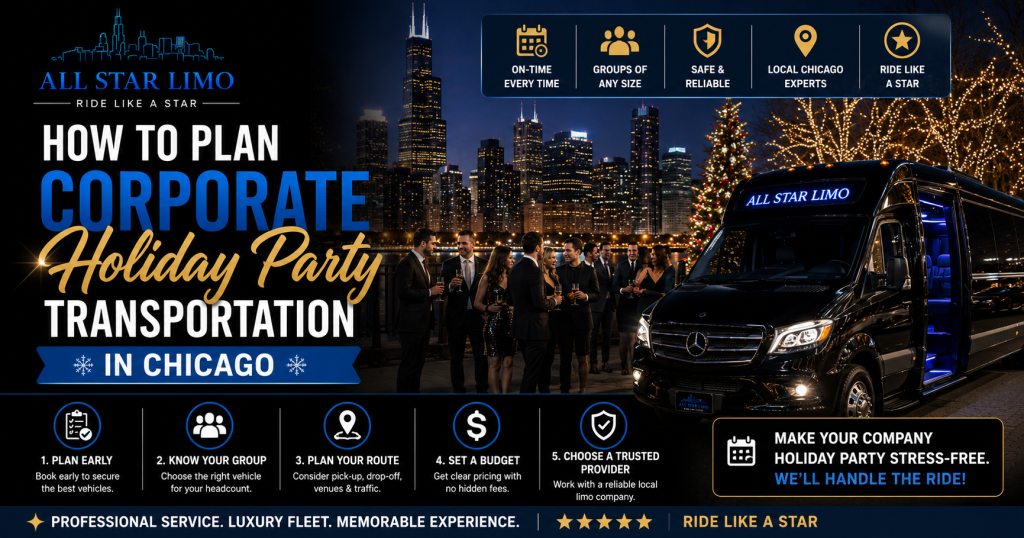
If you’re the person in charge of getting fifty, a hundred, or three hundred coworkers safely from the office (or from six different suburban offices) to a downtown venue and back again in December, you already know this isn’t a small logistics problem. It’s part transportation plan, part liability shield, part morale booster. Get it right and nobody remembers the ride — they remember the party. Get it wrong and the ride is the story people tell in January.
This guide walks through exactly how Chicago-area HR teams, office managers, and event planners should approach corporate holiday party transportation — what it actually costs, which vehicle fits your headcount, how to handle multi-location pickups, and how to avoid the December-in-the-Loop traffic mistakes that turn a 20-minute drive into an hour of standing around in the cold.
Real Chicago Corporate Transportation Pricing
Before the details, here’s a fast reference for anyone who needs a number for a budget spreadsheet right now. These are current Chicago corporate hourly rates (3-hour minimum), based on published corporate limo pricing for executive vehicles:
| Vehicle Type | Typical Capacity | Best For | Hourly Rate (3-hr min) |
|---|---|---|---|
| Executive Sedan | 1–3 passengers | Small leadership groups or point-to-point single-office pickups | $80–$90/hour |
| Premium SUV (Escalade/Navigator) | 5–6 passengers | Small teams or VIP client transport | $95–$120/hour |
| Sprinter Van | 10–14 passengers | Mid-size departments or a single suburban office commuting downtown | $150/hour |
| Stretch Limo | 6–8 passengers | Executive parties or smaller groups wanting a specialty vehicle | $160/hour |
| Mini Shuttle / Group Charter | 20–28+ passengers | Multi-department companies with one or two pickup points | Quoted per headcount and route — request a group transportation quote |
Rates vary by date, hours booked, and how close you are to peak holiday weekends (the first three Saturdays of December book fastest), and most providers add an after-hours premium of roughly 20% for pickups between 10 PM and 6 AM. Always request a written quote based on your exact headcount, pickup list, and timing — December pricing shifts fast as availability tightens. See a full breakdown on the Chicago limo pricing page.
The rule of thumb: if you’re moving fewer than 10–12 people from one location, a Sprinter van usually beats booking multiple sedans on cost per person. Once you cross 20–25 people, or you have multiple pickup addresses, a shuttle or group charter almost always works out cheaper and simpler than booking several separate vehicles.
Why Employers Book Group Transportation for Office Parties
It’s tempting to think of holiday party transportation as a “nice-to-have” — something you add if the budget allows. In practice, for any company serving alcohol at an offsite event, it’s closer to a risk-management step than a perk.
The Liability Angle, Explained Accurately
Illinois has one of the broadest alcohol-liability statutes in the country, formally the Liquor Control Act of 1934, Section 6-21 — commonly called the Dram Shop Act (235 ILCS 5/6-21). It’s worth understanding what it actually covers before using it to justify a transportation budget: the statute creates liability for licensed sellers of alcohol — bars, restaurants, and licensed venues — who serve someone who then causes injury to a third party. It does not, on its own, make an employer a “dram shop” defendant simply for hosting a party where a licensed venue serves the drinks. You can review the current statutory language and liability limits directly on the Illinois Liquor Control Commission’s site.
Where employer exposure actually comes from is broader: ordinary negligence and vicarious-liability theories. If a company sponsors an event, controls when and how alcohol is served, and an employee who was visibly over-served causes an accident driving home, courts look at whether the employer took reasonable steps to prevent foreseeable harm.
Providing group transportation is one of the clearest, most documentable steps an employer can point to if that question ever comes up — alongside things like a cash-bar cutoff time or drink-ticket limits. This is a general liability-mitigation practice, not legal advice specific to your situation — for anything company-specific, talk to your employment counsel.
This matters just as much for smaller companies as large ones. A 40-person startup renting a private room at a River North restaurant carries the same fundamental exposure category as a 400-person enterprise renting a ballroom — the difference is scale, not risk category. HR and legal teams increasingly build “transportation provided” into the holiday party checklist for exactly this reason.
Morale and the Employee Experience
Set the liability question aside for a moment, because there’s a simpler business case: how people get to and from the party shapes how they feel about the party.
Employees who have to find their own parking near a packed downtown venue in December — or navigate transit after a few drinks in freezing weather — arrive stressed and leave early. A pre-arranged shuttle that picks people up from the office and drops them right back at the same spot removes that friction entirely. People stay longer, drink less anxiously, and don’t spend half the party thinking about how they’re getting home.
For hybrid or distributed teams, paid transportation is also a visible signal that the company values people’s time and safety, not just the party itself.
The Cost-of-Doing-Nothing Comparison
Many office managers default to reimbursing rideshare receipts instead of booking group transportation, assuming it’s cheaper. It often isn’t, once you compare it honestly:
- Rideshare surge pricing during Friday and Saturday nights in December (especially near major event venues) routinely runs well above normal fares, with no way to predict the total in advance.
- Reimbursement requires expense processing, receipt collection, and inevitably a few disputed amounts.
- There’s no coordination — some employees leave at 9 PM, some at midnight, and nobody controls the flow.
- You lose the documentation value entirely, since individual rideshare receipts don’t demonstrate a company-sponsored, pre-planned safe-ride program the way a scheduled shuttle booking does.
For any group over roughly 15–20 people, a scheduled shuttle or charter is usually close to cost-neutral against total rideshare reimbursement at worst, and meaningfully cheaper at best — while adding control and a documented transportation plan.
A Simple Budget Comparison Example
Consider a 30-person office party at a downtown venue, roughly four miles from the office, running from 6:00 PM to 11:00 PM.
- Rideshare reimbursement approach: Even a modest $20–$35 average per one-way trip once Friday-night surge pricing kicks in, times two trips per person, times 30 people, lands between roughly $1,200 and $2,100 — before admin time spent approving receipts, and before accounting for the fact that surge pricing near a busy event district can spike well beyond that range with no warning.
- Group shuttle approach: A Sprinter van booked at $150/hour for a 6-hour window (pickup, standby, and return) runs about $900, or a mini shuttle/charter sized for the full group typically prices out comparable to or below the rideshare total once you request an exact group transportation quote — with one predictable invoice and full coverage for the entire group regardless of how the night unfolds.
The exact numbers shift with distance, vehicle type, and hours, but the pattern holds across most Chicago-area bookings: once you’re coordinating a group rather than individuals, scheduled transportation is close to cost-neutral at worst, and meaningfully cheaper at best — while removing the coordination burden.
Multi-Location Pickup Planning (Suburban Offices → Downtown Venue)
This is where holiday party transportation planning gets genuinely complicated, and where most of the mistakes happen.
Map Your Pickup Points Before You Call Anyone
If your company has one office, skip to vehicle selection. If you have multiple offices — a common setup for firms with locations in Naperville, Oak Brook, Schaumburg, or the south suburbs alongside a downtown headquarters — map every pickup point before requesting quotes, not after.
For each location, gather:
- Exact pickup address (and whether there’s a loading zone or safe curbside pickup spot — some suburban office parks have restrictive parking rules)
- Approximate headcount from that location
- Desired pickup time
- Drive time to the venue, accounting for December traffic (more on this below)
Sequential Loop vs. Parallel Vehicles
There are two basic models for multi-location pickup, and the right one depends on your headcount and budget.
Sequential loop: One vehicle drives a route, stopping at each office in sequence before heading downtown. This works well when your suburban offices are relatively close together and headcount per stop is modest — say, 8–15 people each. The tradeoff is time: the first pickup location’s employees sit through extra driving while the vehicle collects everyone else.
Parallel vehicles: Each office gets its own vehicle that departs independently and arrives at the venue around the same target time. This is faster for everyone and scales better for larger headcounts, but costs more since you’re paying for multiple vehicles rather than one continuous route.
A practical middle ground many Chicago-area companies use: parallel vehicles (a Sprinter per office, for example) for offices that are far apart or have larger headcounts, and a sequential loop for two or three smaller, geographically close offices.
Building the Pickup Schedule
Work backward from your desired venue arrival time, not forward from your earliest pickup. Decide when you want guests walking in the door, then subtract travel time plus a buffer for each stop, plus loading time — allow 5–10 minutes per stop for people to actually board, which always takes longer than planners expect, especially with coats, bags, and gift exchanges in tow.
For the return trip, build in flexibility. Office parties rarely end precisely on schedule, and a rigid one-shot return pickup leaves people stranded if the party runs long. Two common solutions:
- Staggered return departures — schedule return shuttles at two or three time windows (e.g., 10:00 PM, 11:00 PM, and midnight) rather than one fixed pickup.
- On-call return service — the vehicle stays available and the driver or dispatch team coordinates return timing directly with a designated point of contact once the party is genuinely winding down. Hourly rentals are built around exactly this kind of flexible, standby model.
Worked Example: A Three-Office Pickup Plan
Here’s how it might play out for a company with offices in Naperville, Oak Brook, and a downtown Chicago headquarters, all headed to a River North venue for a 7:00 PM arrival.
- Naperville (18 employees): Roughly 35–40 minutes to River North outside rush hour, but December Friday-evening traffic on I-88 and the Kennedy can push that closer to 55–60 minutes. Given the headcount and distance, this office gets its own Sprinter van, departing independently.
- Oak Brook (12 employees): About 30–35 minutes to River North under normal conditions. Because Oak Brook and Naperville are roughly 15 minutes apart, some companies route one vehicle through both suburban offices sequentially rather than booking two separate vans — but only if the combined headcount (30 people here) still fits comfortably and the extra loop time doesn’t push the first pickup’s departure too early.
- Downtown HQ (25 employees): Since this group is already close to the venue, a short walk or a single black car shuttle can work — this is often the easiest of the three groups to plan for, precisely because the travel time is short and predictable.
Mapping it out like this — even informally in a spreadsheet — before requesting quotes gives your transportation provider a much more accurate picture to price against, and it usually surfaces scheduling conflicts before they become a day-of problem.
Choosing the Right Vehicle for Your Headcount
Getting vehicle selection right is mostly about matching capacity to headcount without leaving people crammed in or paying for empty seats.
Under 10 People: Executive SUVs or a Single Sedan
For a small leadership team or a single department gathering, one or two black car SUVs typically make the most sense — comfortable, and well-suited to point-to-point trips where everyone’s coming from roughly the same place.
10–20 People: Sprinter Vans
This is the sweet spot for a single mid-size office or department. A Sprinter van comfortably seats 10–14 passengers with luggage/gift space, and two Sprinters can cover a 20-person group more efficiently than a full-size bus running half-empty.
20–40 People: Mini Shuttle or Group Charter
Once headcount crosses 20, a shuttle or group charter becomes the more economical choice on a per-person basis, and simplifies coordination to one vehicle, one departure, one arrival.
40+ People: Multiple Vehicles or a Coordinated Fleet
Large all-staff parties usually need multiple vans or shuttles running staggered routes, especially with pickups spread across several office locations. At this scale, ask your provider for a fleet coordination plan — a single point of contact managing dispatch across vehicles, rather than each vehicle operating independently. All Star Limo’s group transportation page outlines exactly this kind of multi-vehicle coordination.
A Note on “Right-Sizing” for Comfort, Not Just Capacity
A vehicle rated for 14 passengers technically fits 14 people, but “fits” and “comfortable for a two-hour evening in party clothes with coats and gift bags” are different standards. Many experienced planners book to roughly 80–85% of stated capacity for holiday events specifically, since attendees are dressed for an event, not a commute, and often carrying more than usual.
Timing It Right — Loop and Downtown Traffic During December
December in the Loop is its own traffic category, and it catches out-of-practice planners every year.
Why December Traffic Behaves Differently
Several things compound at once during Chicago’s holiday season:
- Shorter daylight hours push commuter traffic and event traffic into overlapping windows earlier in the evening.
- Holiday market and lights displays — Christkindlmarket, the Magnificent Mile Lights Festival, Millennium Park’s ice rink — draw significant additional downtown and Michigan Avenue traffic on weekend evenings.
- Weather-related slowdowns — even light snow noticeably increases Kennedy and Eisenhower Expressway travel times and the odds of an accident-related slowdown.
- Valet and loading-zone congestion outside popular event venues gets worse in December as multiple companies book the same weekend evenings for their parties.
Practical Timing Adjustments
- Add 20–30 minutes of buffer to whatever your GPS estimates for a weekday-evening downtown arrival in November. December Friday and Saturday evenings routinely run slower than the same trip earlier in the fall.
- Avoid a 6:00–6:30 PM arrival window if you can help it — that’s peak overlap between commuter traffic leaving downtown and event traffic arriving. A 7:00 PM or later arrival, or a 5:00–5:30 PM early arrival, usually clears more easily.
- Confirm the venue’s loading zone situation in advance. Many downtown restaurants and event spaces have limited or no dedicated bus/shuttle unloading space, so your driver needs a pre-arranged drop-off plan rather than improvising on the night.
- For return trips, build in extra buffer on the back end too — post-event Michigan Avenue and Loop traffic on a weekend night near a holiday market can be just as slow as the arrival window.
A transportation provider that’s actually worked Chicago’s Loop and River North during December weekends will already have workaround routes and known drop-off spots for the busiest venues — worth asking about directly when you request quotes.
What to Ask a Transportation Provider Before You Book
Not every limo or shuttle company is set up to handle a multi-stop corporate event with confidence, so vet a provider with a short list of direct questions rather than assuming a quoted price covers everything you need.
Insurance and licensing:
Ask directly whether the vehicles and drivers are commercially licensed and insured for group passenger transport. A provider that hesitates or can’t produce this quickly isn’t one to book for an event where your company’s name is attached.
Experience with multi-stop corporate bookings:
A provider that mostly handles weddings and airport runs may not have a system for coordinating pickups across several office locations on a tight schedule. Ask how they’d structure your specific pickup list, and listen for whether they’re proposing a real plan or just quoting a generic hourly rate. All Star Limo’s corporate transportation page lists dedicated account management specifically for this kind of multi-stop planning.
Backup vehicle policy:
December is the highest-demand month of the year for Chicago ground transportation. Ask what happens if a vehicle has a mechanical issue the day of your event — a provider with a larger fleet and a clear backup policy is a meaningfully safer bet than a single-vehicle operator.
Day-of communication process:
Confirm how the driver, or dispatch team for multi-vehicle bookings, will communicate with your designated point of contact — especially for coordinating return pickups if the event runs long.
Cancellation and headcount-change policy:
Corporate headcounts shift in the weeks before an event as people RSVP. Ask how late you can adjust vehicle size or headcount without penalty, and what the cancellation window looks like.
Gratuity and total cost transparency:
Ask for an all-in quote — hourly rate, gratuity, any fuel or wait-time surcharges — rather than a bare hourly figure that turns into a surprise on the final invoice. The pricing page is a useful benchmark to compare quotes against.
Booking Checklist for HR and Office Managers
4–6 weeks before the event:
- Confirm final venue and exact address
- Estimate total headcount and gather pickup locations if multi-office
- Decide on vehicle type(s) based on headcount (see vehicle guide above)
- Request quotes from at least two transportation providers, including All Star Limo
- Confirm provider’s insurance and licensing
2–3 weeks before:
- Finalize pickup addresses and headcounts per location
- Set pickup times working backward from desired arrival
- Decide on return transportation model (fixed departure vs. staggered vs. on-call)
- Confirm loading/drop-off arrangements with the venue
- Share a written itinerary with the transportation provider, including a day-of contact person and phone number
1 week before:
- Send employees a clear internal communication: pickup locations, times, and what happens if the party runs long
- Confirm final headcount with the transportation provider
- Designate a point of contact reachable by phone throughout the event
Day of:
- Confirm driver arrival with a text or call before the first pickup
- Have the day-of contact’s number visible/shared with drivers
- Track return timing and communicate any changes to the driver in real time
FAQ
How far in advance should we book holiday party transportation in Chicago?
Four to six weeks is a safe target, especially for the first three Saturdays in December, which tend to book out first. Popular vehicles — Sprinter vans and shuttles — go first, so waiting until the last two weeks of November often means settling for a less-than-ideal vehicle mix or a compromised pickup schedule.
Is group transportation actually cheaper than reimbursing rideshare receipts?
For groups under about 10 people, individual rideshare can sometimes be comparable. Past that, a scheduled shuttle or Sprinter usually wins on total cost, and consistently wins on coordination, since a pre-booked group ride is a documented, predictable plan in a way scattered individual reimbursements aren’t.
What if our party runs later than planned?
This is exactly why a fixed one-time return pickup is risky. Staggered return windows or an on-call return arrangement handle this far better than a single scheduled departure time.
Do we need multiple vehicles if we have several office locations?
Not necessarily — it depends on distance and headcount. Two or three smaller, nearby offices can often be served efficiently by one vehicle running a sequential pickup loop. Offices that are far apart, or that each have larger headcounts, usually justify separate vehicles running in parallel.
Does providing transportation actually reduce our liability exposure?
It’s one of the more documentable steps an employer can take to show reasonable care around a company-sponsored event where alcohol is served. Illinois’s dram shop statute (235 ILCS 5/6-21) primarily targets licensed alcohol sellers rather than the employer directly, but employer exposure through general negligence and vicarious-liability theories is real, and group transportation is consistently cited as a meaningful, defensible precaution alongside drink limits and a clear event end time. This is general information, not legal advice for your specific situation.
What size vehicle makes sense for a 25-person office party?
A shuttle or mini charter in the 20–28 passenger range is usually the most efficient single-vehicle option at that headcount. Two Sprinter vans is a reasonable alternative if you need to split pickups across two locations.
Should we tell employees the transportation schedule in advance, or just have it available?
Communicate it clearly in advance — pickup locations, times, and what the return plan looks like if the party runs late. Employees who know exactly when and where to meet the vehicle are far less likely to wander off to find their own ride.
What happens if fewer or more people RSVP than expected?
This is common enough that most providers build in some flexibility, which is exactly why the vendor-vetting questions above matter. Confirm your provider’s policy on adjusting vehicle size close to the event date — ideally you want the ability to scale up or down within a week or two of the party without a rebooking penalty.
Is it better to book one large vehicle or several smaller ones?
It depends on your pickup geography more than your total headcount. One office, one vehicle is usually simpler and cheaper. Multiple, distant pickup points usually favor several smaller vehicles running in parallel, even if the total capacity ends up similar, because it avoids the time cost of a long sequential loop.
Do drivers wait at the venue during the party, or come back later?
Both models exist. For shorter events, some companies book a vehicle to stay on standby, or return once, at a fixed end time. For longer or less predictable events, an hourly, on-call arrangement — where the driver is available within a set window and coordinates directly with your day-of contact — tends to work better.
Plan It Once, Get It Right
Corporate holiday party transportation isn’t complicated once you break it into its actual pieces: know your headcount and pickup points, pick the right vehicle size, build in real December-traffic buffers, and plan the return trip with the same care as the pickup. Do that, and the transportation becomes invisible — which is the goal. Nobody should be talking about the ride on Monday; they should be talking about the party.
If you’re planning transportation for your Chicago office holiday party this year, All Star Limo’s Corporate Limo Service team handles exactly this kind of multi-stop, HR-coordinated event logistics, with dedicated account management for companies booking across multiple pickup locations. For larger all-staff gatherings, Group Transportation options scale from Sprinter vans up to full coordinated fleets. And if your event timing is uncertain or you want flexible return coverage, Hourly Limo Rentals give you an on-call vehicle for exactly the kind of staggered pickup/return schedule this guide recommends. You can review current pricing or book online directly.
Whichever vehicle mix you land on, the earlier you lock in your headcount, pickup points, and timing, the more options — and better pricing — you’ll have heading into Chicago’s busiest transportation month of the year.