Chicago , il

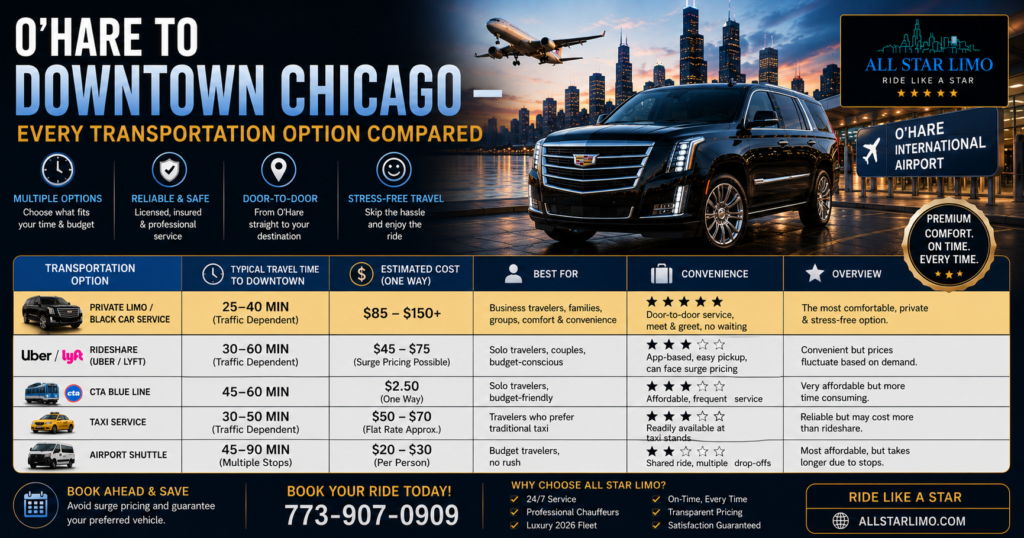
O’Hare International Airport sits roughly 17 miles from The Loop. The CTA Blue Line train covers that distance in about 40–45 minutes for $5. A rideshare or private car takes 30–45 minutes in normal traffic but can stretch past 60 minutes during rush hour. There’s no single “best” option — it depends on your luggage, budget, group size, and how much your time is worth.
Landing at O’Hare for the first time can be disorienting. The airport is enormous, the signage for ground transportation is scattered across five terminals, and every rideshare driver, taxi dispatcher, and shuttle counter seems to be pitching a different option. This guide breaks down the five realistic ways to get from O’Hare to downtown Chicago, what each one actually costs once you account for tips, surcharges, and waiting, and which type of traveler each option suits best.
O’Hare International Airport (ORD) is one of the busiest airports in the world, and its distance from the city center — about 17 miles northwest of The Loop — means ground transportation isn’t an afterthought the way it might be at a smaller regional airport. Depending on the terminal you land in, the vehicle you choose, and the time of day, your total door-to-door time can range from under 40 minutes to well over 90. Understanding the trade-offs before you land saves you from standing at a curb comparing apps while the taxi line grows behind you.
This guide is written for the traveler standing at baggage claim trying to decide, not for someone who already has a favorite app installed and a routine down. We’ll walk through each mode in the order most first-time visitors consider them, then break it down by traveler type so you can match the option to your actual trip instead of a generic recommendation.
Cost, Time, and When It Makes Sense
The CTA Blue Line is Chicago’s only direct rail connection between O’Hare and downtown, and for budget-conscious travelers without much luggage, it’s usually the fastest way to beat traffic. The O’Hare station sits underneath Terminal 2, connected to Terminals 1 and 3 by underground walkways (Terminal 5, the international terminal, requires an Airport Transit System people-mover ride to reach the station).
A one-way ride costs $5, paid with a Ventra card, a Ventra app pass, or a contactless credit card tapped directly at the turnstile. Trains run 24 hours a day, with departures roughly every 7–10 minutes during the day and less frequently overnight. The trip to the Loop stations (Clark/Lake, Washington, Monroe, Jackson) takes about 40–45 minutes without transfers, since the Blue Line runs express-style with no stops between O’Hare and Rosemont during off-peak periods.
Pros of the Blue Line
- Cheapest option by far at $5 flat, regardless of time of day
- Immune to traffic — arrival time is predictable even during rush hour or bad weather
- Runs around the clock, so it works for red-eye arrivals
Where it falls short
- Stations require stairs, escalators, or elevators with large suitcases — not ideal for families with multiple bags
- Downtown stations don’t drop you at your hotel door; expect a walk or a short second leg (rideshare, bus, or foot) after exiting
- Standing room only during peak commuting hours, especially with luggage taking up space
- Some travelers, particularly late at night or solo, prefer not to navigate transit systems in an unfamiliar city
The Blue Line makes the most sense for solo travelers, backpackers, and budget-focused visitors carrying a single bag who are comfortable navigating a subway system. If you’re arriving with checked luggage for a family of four, the math changes quickly — a private option often ends up costing less per person once everyone’s fare and the hassle of hauling bags through stations is factored in.
Navigating the O’Hare Blue Line station
Signage inside O’Hare directs passengers toward the “CTA Trains” exit, and the walk from baggage claim to the platform generally takes 5–10 minutes depending on your terminal. Terminal 5 arrivals need to ride the Airport Transit System (ATS) — a free automated people-mover — to reach Terminal 2, where the station entrance is located. Fare gates accept a physical Ventra card (sold from vending machines at the station), the Ventra mobile app, or a contactless tap of most major credit and debit cards. There’s no need to buy a ticket in advance.
Once on board, the Blue Line runs express from O’Hare through Rosemont before making local stops toward downtown, meaning the first several minutes of the ride cover a lot of ground quickly. During peak commuting hours (roughly 7–9 a.m. and 4–6:30 p.m. on weekdays), expect standing room only, particularly if you’re boarding at O’Hare with luggage during the evening rush when commuters are also filling the train.
What happens after you exit the train
This is the detail first-time visitors most often overlook: the Blue Line drops you at a downtown station, not at your hotel. Depending on which Loop station you exit — Clark/Lake, Washington, Monroe, Jackson, or LaSalle — you may still need to walk several blocks, hop in a taxi, or grab a short rideshare to reach your final destination. For a hotel a few blocks from the station, that’s a minor inconvenience. For a hotel further out, like River North or the Gold Coast, it adds meaningful time and effort, especially with bags in tow.
Express Bus & Airport Shuttle Options
Between the train and a private vehicle sits a middle tier: scheduled shuttle vans and express bus services that pick up from designated curbs at each terminal and drop passengers at major downtown hotels or a central terminal.
Shared-ride shuttle vans typically run $30–$40 per person one-way, with door-to-door service to your specific downtown hotel. Because they’re shared, the driver often makes multiple stops before reaching your destination, so total travel time can run anywhere from 50 minutes to well over 90 minutes depending on how many other passengers are on the route and the order of drop-offs. Most shuttle companies require advance reservation, though some accept walk-up bookings at the curb depending on availability.
There are also public express bus options connecting O’Hare to certain downtown points, generally priced lower than shared shuttles but with fewer departures and less predictable scheduling than the Blue Line.
Who shuttles work for
- Travelers who want door-to-door service but don’t need a private, direct ride
- Groups of two or three where splitting a shared fare beats paying for a private vehicle
- Visitors with moderate luggage who don’t want to navigate train stations
The trade-offs
- Unpredictable timing — a shared van with multiple stops can turn a 40-minute drive into 90 minutes
- Advance reservations are often required, which doesn’t help if your flight is delayed
- Per-person savings shrink fast once you’re traveling with 3+ people, at which point a private SUV or Sprinter often costs about the same or less
How shuttle pricing actually breaks down
A single traveler paying $35 for a shared shuttle isn’t a bad deal compared to a $50 rideshare. But run the math for a family of four: four shuttle seats at $35 each is $140, often for a ride that takes longer than a direct private vehicle because of the extra stops. A private SUV covering the same route as a flat rate frequently lands in a similar or lower total price, while also being faster and door-to-door with no other passengers’ luggage competing for space. Shuttles make the most financial sense for one or two travelers who value the door-to-door drop-off but don’t want to pay rideshare surge pricing or navigate the train.
Rideshare (Uber/Lyft) Pricing Reality at O’Hare
Rideshare is the default choice for a large share of O’Hare arrivals, and for good reason — it’s available on demand, doesn’t require a reservation, and drops you directly at your destination. But the pricing at O’Hare is less predictable than most first-time visitors expect.
A standard UberX or Lyft ride from O’Hare to downtown typically runs $35–$60 during normal conditions, but that range can climb significantly higher during surge pricing windows — Friday evening rush hour, major conventions at McCormick Place, severe weather delays that bunch up arrivals, or late-night bar closing hours when demand spikes across the city. It’s not unusual to see quoted fares of $80–$100+ during peak surge events, sometimes with little warning before you accept the ride.
There’s also the pickup logistics to consider. O’Hare‘s rideshare pickup zones are located on designated levels of the parking garages, which means a walk (sometimes a long one) from baggage claim before you even meet your driver — often 10–15 minutes on top of the ride itself, longer during high-volume periods when the pickup queue backs up.
What to expect with rideshare
- No reservation needed, available 24/7 on demand
- Price is unpredictable — surge pricing can more than double the base fare with no advance warning
- Walk to the designated pickup zone adds time not reflected in the app’s ETA
- Vehicle size and driver quality vary ride to ride — no guarantee of a spacious car for a family with luggage
- Cancellations and driver reassignments are common during high-demand periods
Rideshare works well for solo or two-person trips with light luggage during off-peak hours. It becomes a less reliable bet exactly when reliability matters most — during storms, holiday travel weeks, and major event weekends — which is when surge pricing and driver availability issues hit hardest.
The hidden costs riders often miss
The fare shown at booking isn’t always the final number. Rideshare apps can add a small airport pickup fee on top of the base fare, and the total climbs further with tip, tolls if your route uses them, and any surge multiplier applied at the moment you request the ride. A quoted $40 fare can realistically land closer to $50–$55 once tip and fees are added — worth factoring in before comparing it head-to-head with a flat-rate private car quote that already bundles those costs in.
Cancellations and reassignments
During high-volume arrival windows — a bank of international flights landing within the same hour, for example — the rideshare pickup queue at O’Hare can back up substantially. It’s not unusual for a ride to be reassigned to a different driver mid-wait, resetting your position in the queue and adding 10–20 minutes you didn’t plan for. This is one of the main reasons business travelers with a fixed meeting time or families managing tired kids often opt for a pre-booked private car instead.
Private Car / Black Car Service — Who It’s Actually For
A private black car or limo service sits at the top of the comfort and reliability spectrum. Instead of competing for a rideshare driver in a crowded pickup zone, a professional chauffeur is assigned to your specific flight, tracks your arrival in real time, and is waiting when you land — even if your flight is delayed by hours.
The biggest difference from rideshare is price predictability. A private car service typically quotes a flat rate at the time of booking, so a Friday-night pickup during a citywide event costs the same as a quiet Tuesday morning — no surge multiplier, no last-minute fare jump. For O’Hare-to-downtown transfers, flat rates commonly start in the $90 range for an executive sedan, with SUVs and larger vehicles priced higher depending on capacity.
This is also the option that scales best for groups and families. Rather than splitting into two rideshare vehicles or hoping a shuttle van has room, a single SUV or Sprinter van comfortably handles a family with several suitcases, or a small group traveling together, without extra coordination.
Where private car service earns its price
- Flat, predictable pricing — no surge, no meter, quoted before you land
- Real-time flight tracking — your driver adjusts to delays automatically, no need to call or rebook
- Meet-and-greet and luggage assistance — a chauffeur meets you at baggage claim or curbside and handles bags
- One vehicle for the whole group — no splitting up, no per-person shuttle math
- Professional, licensed, insured chauffeurs rather than gig drivers with variable experience
Private car service isn’t the cheapest option on this list, but for late-night arrivals, business travelers who can’t afford a surge-priced surprise, families juggling luggage and small children, or anyone who simply wants a stress-free landing after a long flight, it’s often the option that makes the most practical sense. All Star Limo’s O’Hare Airport Limo Service and Black Car Service both operate on this flat-rate, flight-tracked model for downtown transfers.
Flat rates vs. metered pricing
The core value proposition of a private car service comes down to one thing: you know the price before you land. A flat-rate quote for O’Hare to downtown covers the vehicle, chauffeur, tolls, and standard wait time in a single number agreed at booking. Compare that to a taxi running a meter through downtown congestion, or a rideshare app recalculating your fare mid-surge, and the appeal becomes obvious for anyone who prefers to know their transportation budget in advance rather than find out after the ride ends.
Vehicle options for different group sizes
Private car services typically offer a range of vehicles rather than a one-size-fits-all sedan. An executive sedan comfortably handles one to three passengers with standard luggage. A full-size SUV such as a Cadillac Escalade or Lincoln Navigator fits up to six passengers with more luggage capacity — useful for families or small groups. For larger groups or events, a Sprinter van seats up to fourteen, eliminating the need to split into multiple vehicles entirely. Matching the vehicle to your group size upfront, rather than hoping a rideshare car has enough trunk space, is one of the quieter advantages of booking ahead.
Comparison Table: Cost, Time, Luggage Capacity & Reliability
| Option | Cost (one-way) | Travel Time | Luggage Capacity | Reliability |
|---|---|---|---|---|
| CTA Blue Line | $5 flat | ~40–45 min | Low (stairs, crowded cars) | High (unaffected by traffic) |
| Shared Shuttle/Bus | $25–$40/person | 50–90+ min (multi-stop) | Moderate | Moderate (depends on route load) |
| Rideshare (Uber/Lyft) | $35–$60+ (surge variable) | 30–60 min + pickup walk | Moderate (vehicle varies) | Low-Moderate (surge, driver variability) |
| Private Car / Black Car | From ~$90 flat rate | 30–45 min | High (SUV/Sprinter options) | High (flight-tracked, dedicated driver) |
Best Option by Traveler Type
Business travelers
If you’re heading to a downtown meeting straight off a flight, the cost of the ride matters less than arriving on time, presentable, and without the stress of a surge-priced rideshare or a crowded train car. A pre-booked chauffeur service with flight tracking removes the biggest variable — a delayed flight or a gate change won’t leave you stranded, since the driver adjusts automatically. Many business travelers also prefer the reliability of corporate limo service for recurring trips and monthly billing.
Families with kids and luggage
Multiple suitcases, a stroller, and tired kids don’t mix well with subway stairs or a cramped rideshare sedan. A private SUV sized for the whole family — with a chauffeur who helps load bags at the curb — tends to be worth the price difference over splitting into two rideshare cars or hoping a shuttle van has room. Larger families or multi-family groups may want to look at group transportation options that seat more passengers in one vehicle.
Solo backpackers and budget travelers
If you’re traveling light and comfortable navigating a subway system, the CTA Blue Line is hard to beat at $5. It’s the most economical option on this list by a wide margin, and the fixed price means no surprises regardless of when you land.
Late-night or red-eye arrivals
Landing at O’Hare after midnight changes the calculus. The Blue Line still runs, but an unfamiliar transit system at 1 a.m. isn’t appealing to every traveler, and rideshare availability can thin out late at night, sometimes with longer wait times or higher prices. A private car booked in advance guarantees a driver is waiting regardless of the hour — useful for solo travelers, women traveling alone, or anyone who’d rather not wait outside a terminal at 2 a.m. hoping a rideshare accepts the trip.
Group travel and corporate teams
When multiple people are landing on the same flight or arriving within the same window — a wedding party, a corporate team flying in for a conference, or friends meeting up for a weekend — coordinating separate rideshares or shuttle seats adds unnecessary friction. A single Sprinter van or stretch vehicle booked through group transportation keeps everyone together from baggage claim to the hotel, with one pickup point and one drop-off instead of a scattered convoy of separate cars.
Weather-sensitive travel
Chicago winters bring snow, ice, and the kind of wind that makes standing at a curb waiting for a rideshare genuinely unpleasant. During severe weather, rideshare demand spikes right as driver availability drops, which is exactly when surge pricing hits hardest and wait times stretch longest. A pre-booked private car isn’t weather-proof against traffic delays, but it does guarantee a driver is dispatched and tracking your flight regardless of what’s happening outside, without the added uncertainty of app-based surge pricing during a storm.
Skip the Guesswork — Book a Flat-Rate O’Hare Transfer
Flight tracking, meet-and-greet, and a professional chauffeur waiting when you land. No surge pricing, no shared stops, no stress.
Frequently Asked Questions
How long does it take to get from O’Hare to downtown Chicago?
Expect about 40–45 minutes on the CTA Blue Line regardless of traffic, or 30–45 minutes by car during normal conditions. Rush hour traffic (weekday mornings and evenings) can push a car ride past 60 minutes, so build in extra buffer time if you have a tight schedule.
What’s the cheapest way to get from O’Hare to downtown?
The CTA Blue Line at $5 flat is the cheapest option by a wide margin. It’s a strong choice for solo travelers with light luggage who don’t mind navigating stairs and a moderately crowded train.
Is the CTA Blue Line safe for tourists?
The Blue Line is used daily by thousands of commuters and is generally considered safe, especially during daytime hours. As with any city transit system, standard precautions apply — stay aware of your belongings, especially with luggage, and consider your comfort level with the route if arriving very late at night.
How much does an Uber or Lyft cost from O’Hare to the Loop?
Typically $35–$60 under normal conditions, but surge pricing during peak hours, bad weather, or major events can push fares significantly higher with little advance notice. There’s also a walk to the designated rideshare pickup level that adds time beyond the app’s quoted ETA.
Should I book a private car in advance or just arrange one on arrival?
Booking in advance is recommended, especially for early-morning flights, red-eye arrivals, or peak travel periods. A pre-booked private car locks in a flat rate and guarantees your chauffeur is tracking your specific flight, so you’re covered even if your arrival time shifts. You can book online or call ahead to confirm availability.
What’s the best option for a family of four with luggage?
A private SUV or black car service tends to work out best once you account for the hassle of hauling multiple suitcases through a train station or splitting into separate rideshare vehicles. One vehicle, one flat rate, and a chauffeur who helps load bags usually beats the alternatives for families.
Does traffic really add that much time to the drive from O’Hare?
Yes, and it’s one of the biggest variables to plan around. The Kennedy Expressway, the main route between O’Hare and downtown, can slow to a crawl during weekday rush hour or after a Bears game lets out downtown. A 30-minute drive at 10 a.m. on a Tuesday can easily become a 60–75 minute crawl at 5 p.m. on a Friday. If you’re on a tight schedule, build in extra buffer time for any car-based option, or default to the traffic-proof Blue Line.
Can I get a taxi at O’Hare instead of using an app?
Traditional taxis are still available at designated curbside taxi stands outside baggage claim, with metered pricing rather than a flat rate. Taxi meters in Chicago run on distance and time, so a slow trip through downtown traffic costs more than a quick one — unlike a flat-rate private car, where the price is locked in regardless of how long the drive takes.
How do I book a private car for an early-morning flight?
Most private car services accept bookings 24–48 hours in advance for standard availability, though same-day requests are often accommodated depending on the schedule. For a guaranteed early-morning pickup, booking the day before is the safer bet — you can reserve online or call ahead to confirm your exact pickup time and flight number.
Related Reading
- Downtown Chicago Hotel to Airport — Drive Time Guide by Hotel
- First-Time Flyer’s Guide to Meet & Greet: Curbside vs Baggage Claim Pickup
- What’s Actually Included in a Professional Airport Car Service Booking?
- Best Time to Book to Avoid Peak-Demand Pricing