Chicago , il

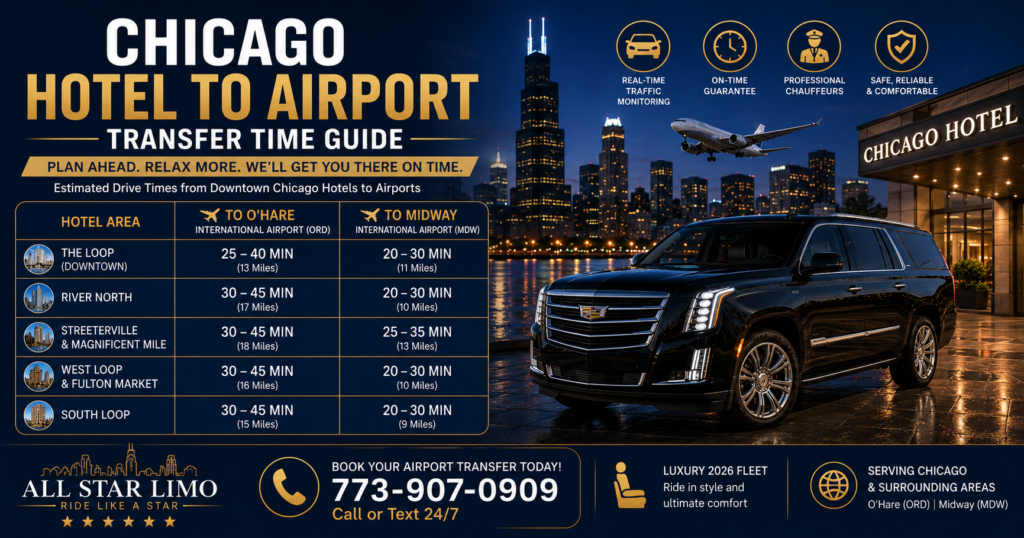
From most downtown Chicago hotels, budget 35–50 minutes to O’Hare (ORD) and 20–30 minutes to Midway (MDW) during off-peak hours. During weekday rush hour (7–9 AM and 3:30–6:30 PM), add 20–40 minutes to either trip. Hotels in the Loop and near McCormick Place sit slightly closer to Midway; hotels in the Gold Coast and River North sit roughly equidistant from both airports, with O’Hare usually the longer leg.
That single answer works for a rough estimate — but if you’re checking out of a specific hotel for a specific flight, “35 to 50 minutes” isn’t precise enough to plan a reliable departure. This guide breaks down real drive times by hotel, explains why the range is so wide, and covers what actually changes your buffer — traffic, valet timing, and convention-season crowding around McCormick Place.
Why “It Depends on Traffic” Isn’t a Good Enough Answer
Every downtown Chicago hotel concierge will tell you the same thing: “give yourself extra time, there’s always traffic.” That’s true, but it’s not actionable. The real variables that move your drive time by 15–30 minutes in either direction are:
- Time of day — Kennedy Expressway (I-90/94) rush-hour backups toward O’Hare are the single biggest swing factor
- Day of week — Friday afternoon and Sunday evening are consistently the worst for airport-bound traffic in Chicago
- Convention activity — McCormick Place events can add congestion on Lake Shore Drive and the Stevenson Expressway (I-55) corridor even outside normal rush hour
- Weather — snow, ice, or heavy rain routinely adds 20+ minutes to either airport route
- Route choice — I-90/94 (Kennedy) vs. I-290 (Eisenhower) to I-294, or Lake Shore Drive to I-55 for Midway, can differ by 10–15 minutes depending on the hour
A chauffeur who drives these routes daily adjusts for all five factors before pulling up to your hotel. A generic “45 minutes” estimate from a map app doesn’t.
The Two Routes That Determine Almost Every Downtown-to-Airport Trip
Nearly every downtown Chicago hotel departure to O’Hare or Midway funnels onto one of two corridors, and knowing which one your driver will use — and why — helps explain the wide time ranges in this guide.
To O’Hare:
Most downtown routes join the Kennedy Expressway (I-90/94) heading northwest, then continue on I-190 into the airport. This is the single most traffic-sensitive stretch in the city for airport travel — the Kennedy carries both O’Hare-bound traffic and the daily commuter flow between downtown and the northwest suburbs, so any incident, construction zone, or rush-hour backup on this corridor adds delay that a map app’s default estimate often underestimates. An alternate route via the Eisenhower Expressway (I-290) to I-294 north exists and is sometimes faster during a Kennedy incident, but it’s a longer route in clear conditions, so it’s typically only used as a detour, not a default.
To Midway:
Downtown routes generally head south via Lake Shore Drive or the Dan Ryan Expressway (I-90/94 south) to the Stevenson Expressway (I-55), then west to Cicero Avenue and into Midway. This route is shorter in raw mileage and generally less congested than the Kennedy corridor, which is the main reason Midway transfers run faster and more predictably than O’Hare transfers from the same starting point — but the Stevenson does see its own rush-hour slowdowns, and periodic construction on I-55 can erase the time advantage entirely for weeks at a stretch.
Understanding which corridor your trip depends on is useful even if you’re not driving yourself: it’s the reason a chauffeur who drives these roads daily can tell you within a few minutes what a given departure time will actually look like, rather than defaulting to a flat estimate regardless of the hour.
Drive-Time Table by Hotel
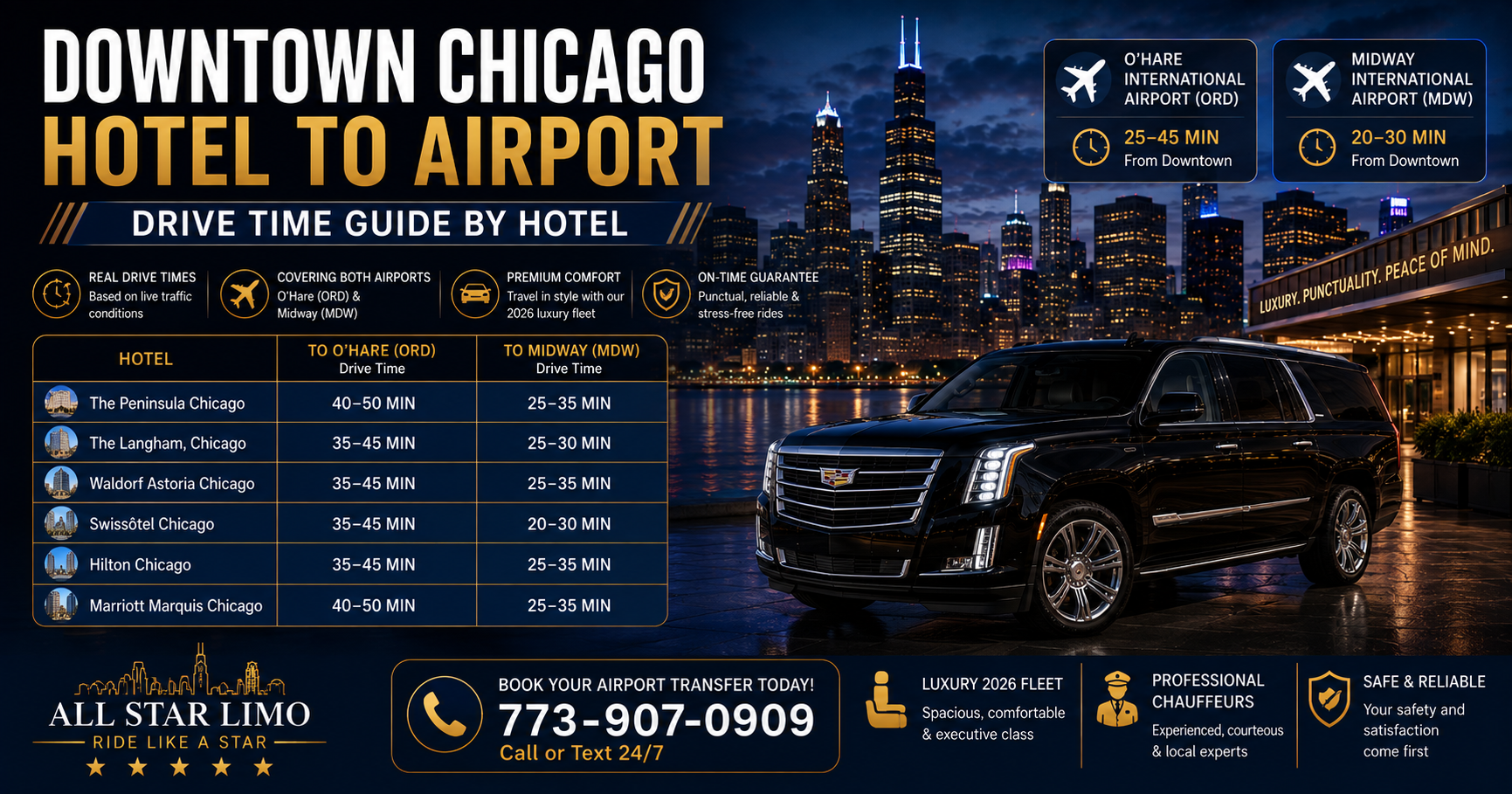
The table below covers four hotels that anchor Chicago’s major downtown corridors — the Loop, the Gold Coast/Magnificent Mile, and River North/Streeterville. Distances are road miles; times are typical off-peak drive times, not rush hour.
| Hotel | Neighborhood | Distance to O’Hare | Off-Peak Drive Time (O’Hare) | Distance to Midway | Off-Peak Drive Time (Midway) |
|---|---|---|---|---|---|
| Palmer House Hilton | The Loop | ~18 mi | 25–35 min | ~12 mi | 20–30 min |
| Hyatt Regency Chicago | The Loop (Wacker Dr.) | ~17–18 mi | 25–35 min | ~11 mi | 20–28 min |
| The Drake | Gold Coast | ~17–18 mi | 25–35 min | ~11–12 mi | 20–30 min |
| Marriott Magnificent Mile | River North / Mag Mile | ~18 mi | 25–35 min | ~12 mi | 22–30 min |
A pattern worth noting: Loop hotels are consistently a few minutes closer to Midway than Gold Coast or River North hotels, because Midway sits southwest of downtown and the Loop is the southern edge of the central business district. If your flight is out of Midway and you have flexibility on where you stay for a Chicago trip, a Loop hotel shaves a few minutes off the transfer. For O’Hare, the difference between neighborhoods is negligible — all of them funnel onto the Kennedy Expressway eventually.
None of the figures above account for rush hour. That’s the next section, because it matters more than which hotel you’re staying at.
Beyond the Four Anchor Hotels — General Ranges by Downtown Area
If your hotel isn’t listed above, you can estimate using its neighborhood, since drive times cluster tightly by area rather than by individual property:
- The Loop (south of the river, around Michigan Ave, State St, and Wacker Dr): Closest downtown area to Midway (roughly 20–30 minutes off-peak), with O’Hare times in line with the rest of downtown (25–35 minutes off-peak).
- River North / Streeterville (north of the river to roughly Chicago Ave): Slightly longer to Midway than Loop hotels (22–32 minutes off-peak) since it’s a few miles further north; O’Hare times are comparable to the Loop.
- Gold Coast / Magnificent Mile (Michigan Ave north of the river, Oak Street area): Similar profile to River North — a few minutes longer to Midway, comparable to O’Hare.
- West Loop (Fulton Market, near Union Station): Often the fastest downtown starting point for O’Hare, since it sits closer to the Kennedy/Eisenhower interchange — sometimes 5–10 minutes quicker off-peak than Loop or Gold Coast hotels.
- South Loop / Near McCormick Place: Fastest downtown starting point for Midway via I-55, covered in detail in the next section, with different considerations for O’Hare due to Lake Shore Drive access.
These are general planning ranges, not guarantees — always confirm exact timing with your driver or hotel concierge closer to your departure, especially during rush hour or event weeks.
Rush Hour vs. Off-Peak Buffer Times
The single biggest factor in your departure time isn’t your hotel — it’s what time you’re pulling out of the valet line. Here’s how the same trip changes across the day:
| Time Window | To O’Hare (from downtown) | To Midway (from downtown) |
|---|---|---|
| Early morning (5–6:30 AM) | 25–35 min | 18–25 min |
| Morning rush (7–9:30 AM) | 45–65 min | 30–45 min |
| Midday (10 AM–2:30 PM) | 30–40 min | 20–30 min |
| Afternoon rush (3:30–6:30 PM) | 50–70 min | 35–55 min |
| Evening (7–10 PM) | 30–45 min | 22–32 min |
| Late night (10 PM–5 AM) | 25–30 min | 18–22 min |
Friday afternoons deserve a special note. Chicago’s Friday 3:30–6:30 PM rush is reliably the worst window of the week — outbound commuter traffic on the Kennedy stacks up with weekend travelers, and what’s normally a 30-minute run to O’Hare can stretch past an hour. If your flight departs on a Friday evening, add real buffer or move your pickup time earlier than the table above suggests.
Sunday evening is the mirror image for the return trip — inbound traffic from O’Hare into downtown backs up as weekend travelers return, though this affects hotel check-in more than departure timing.
The practical rule most frequent Chicago business travelers use: for a domestic flight, request pickup 3 hours before boarding if departing during rush hour, and 2–2.5 hours if departing off-peak. For international departures, add 30–45 minutes to either window for extra check-in and security time at O’Hare’s international terminals.
McCormick Place Hotels — Special Considerations for Convention Travel
If you’re staying at a hotel near McCormick Place — or any of the downtown hotels during a major convention week — the drive-time math changes in ways a standard map estimate won’t catch.
Why convention weeks are different:
- Lake Shore Drive congestion. McCormick Place sits along Lake Shore Drive, and large trade shows (NRF-scale conventions, medical and manufacturing shows) can back up LSD traffic well outside normal rush hour, particularly around show open and close times (8–9 AM and 4–5 PM).
- Rideshare and taxi queue overload. During peak convention departure windows — typically the final morning of a multi-day show — rideshare pickup zones and taxi stands at McCormick Place and nearby hotels get overwhelmed. Wait times for a rideshare pickup alone can run 20–30 minutes on top of the drive.
- I-55 as the McCormick Place route to Midway. From McCormick Place, the fastest route to Midway typically runs via the Stevenson Expressway (I-55), which is a shorter, more direct shot than the downtown-to-Midway routes further north. Budget 15–25 minutes off-peak, but this route is also sensitive to Stevenson construction, which runs periodically.
- To O’Hare from McCormick Place, plan on 30–45 minutes off-peak via Lake Shore Drive to the Kennedy, and 55–75 minutes during a convention-week rush hour combined with show-closing congestion.
The single biggest mistake convention travelers make is booking a pickup time based on a generic map estimate rather than the show’s actual closing schedule. If a trade show floor closes at 5 PM and everyone tries to leave McCormick Place at once, a rideshare or shared shuttle queue can add far more delay than the drive itself. This is where a pre-scheduled private pickup — with a chauffeur already staged and waiting rather than summoned on demand — makes the real difference, not the marginal minutes saved on the drive.
How Far Ahead to Request Hotel Pickup
Timing your pickup request depends on the trip type:
- Domestic flight, standard weekday: Book pickup 24–48 hours ahead. Same-day booking is usually possible but not guaranteed during high-demand periods.
- Domestic flight during rush hour or a Friday departure: Same lead time, but request a pickup time that assumes rush-hour drive times, not off-peak.
- International flight: Book 48+ hours ahead if possible, and request pickup 3.5–4 hours before your scheduled departure to account for extended check-in.
- Convention week (McCormick Place or major downtown events): Book as early as possible — ideally 1–2 weeks ahead. Convention weeks strain every ground transportation option in the city simultaneously, and pre-scheduled private pickups are far more reliable than anything requested same-day.
- Early-morning flights (before 6 AM): These are actually the easiest to plan around — traffic is lightest, but hotel valet and lobby staff may be reduced, so confirm your pickup point (valet vs. a side entrance) the night before.
A general guideline that holds across all these scenarios: the earlier and more precisely you can tell your driver your actual valet or lobby wait, the tighter your buffer can be. Vague instructions like “I’ll be down around 6” lead to wasted idle time or missed pickups. A specific room-checkout-to-curb estimate (most guests take 10–15 minutes from wake-up call to curb, more with luggage or a group) tightens the whole plan.
Valet Coordination — What to Expect
Downtown Chicago hotel valet operations vary, and this is one of the most overlooked variables in airport-departure planning.
What typically happens with a pre-scheduled private car:
- Your driver checks in with the hotel valet or bell desk 5–10 minutes before your requested pickup time.
- The vehicle is staged at the hotel’s designated pickup zone — usually the main entrance, though some Loop hotels with tight street frontage use a side or lower-level entrance during peak hours.
- Your driver (or the bell desk, depending on the hotel) confirms room number or name, and luggage assistance is handled either by hotel bell staff or the chauffeur, depending on the hotel’s policy.
- If you’re running early or late, a direct line to your driver — not a dispatch center — means the pickup adjusts without you losing your place in a queue.
Where this differs from rideshare:
A rideshare driver typically can’t wait in a hotel’s designated pickup zone for more than a couple of minutes without cancellation risk or additional wait-time fees, and many downtown hotels restrict rideshare staging to a separate curb or lower level entirely — which means extra walking time with luggage. Some Loop and Gold Coast hotels have had ongoing friction with rideshare platforms over valet-zone access, which is worth knowing if you’re budgeting your “curb to car” time as zero.
Tipping and logistics:
Most downtown hotels don’t charge a fee for a scheduled private car to use the valet loop, though very high-traffic properties during convention weeks may direct all vehicles — private car included — to a designated loading zone rather than the main entrance. If you’re on a tight schedule, it’s worth confirming pickup location with the hotel concierge the same day, since these zones sometimes shift for events.
Why Flat-Rate Beats Rideshare Surge During Convention Season
Convention season in Chicago — spring trade show season and fall convention months in particular — is when rideshare pricing volatility is most likely to disrupt a travel plan. A few things happen simultaneously:
- Demand spikes as thousands of attendees try to leave McCormick Place or downtown hotels within the same 1–2 hour window
- Rideshare surge pricing can push a normally $35–45 O’Hare trip to $80–120 or more during peak convention departure times
- Driver availability drops in the exact windows you need it most, since rideshare supply doesn’t scale instantly with sudden demand
- Wait times extend, sometimes 15–20+ minutes past your requested pickup, which eats directly into your flight buffer
A flat-rate private car sidesteps all four problems at once. The price is locked in when you book — it doesn’t matter if you’re leaving at 5 AM on a quiet Tuesday or in the middle of a convention-week rush. And because the vehicle is scheduled and staged in advance rather than summoned on demand, there’s no queue to compete for.
This matters most for exactly the scenarios covered in this guide: convention departures, rush-hour trips, and any flight where a 20-minute unexpected delay could mean missing a boarding window. For a routine midday, off-peak trip, the price and time difference between options is smaller — but for the trips where reliability actually counts, a scheduled flat-rate pickup removes the two biggest sources of last-minute risk.
A Sample Departure Timeline — Loop Hotel to O’Hare on a Weekday Morning
It helps to see the full sequence rather than just a single drive-time number. Here’s a realistic walkthrough for a business traveler leaving a Loop hotel for a 9:30 AM domestic flight out of O’Hare, departing during the tail end of morning rush hour:
- 6:15 AM — Wake-up call / alarm. Pack final items, confirm boarding pass.
- 6:35 AM — Call down to valet or confirm pickup with driver via text; luggage ready at the door.
- 6:45 AM — Arrive at lobby/valet. If using a pre-scheduled private car, the vehicle is already staged; luggage loaded in 2–3 minutes.
- 6:48 AM — Depart hotel. At this hour, traffic on the Kennedy is building but not yet at peak — expect 40–50 minutes to ORD rather than the full 65-minute worst case.
- 7:35 AM — Arrive at O’Hare terminal curb or, with meet-and-greet service, already inside heading to security.
- 7:45–8:15 AM — Security and walk to gate, with buffer for TSA lines at a busy terminal.
- 9:30 AM — Boarding.
That leaves a comfortable margin even if the drive runs slightly over the estimate — which is the point of planning around rush-hour numbers rather than off-peak best-case timing. Compare this to a traveler who leaves at 6:48 AM for a Midway flight instead: the same rush-hour conditions typically add less delay on the shorter I-55 route, so a 20–30 minute drive is realistic even during the same time window, and the buffer built into a 9:30 AM boarding time would be considerably larger.
The exercise is worth doing for your own trip: work backward from boarding time, subtract security and walk time, subtract your rush-hour-adjusted drive time (not the off-peak number), and add 10–15 minutes for the unpredictable — a slow valet moment, a delayed elevator, a driver stuck two minutes further back in a queue than expected.
Weather and Seasonal Considerations
Chicago’s weather adds a layer on top of standard rush-hour math, and it affects the two airport corridors differently:
- Winter snow and ice (December–March): Both the Kennedy and the Stevenson slow significantly during active snowfall, but the Kennedy’s higher traffic volume means backups compound faster. A normally 30-minute O’Hare run can extend past 90 minutes during a heavy snow event combined with rush hour. If snow is forecast on a travel day, request pickup at the rush-hour estimate plus an additional 30–45 minute buffer.
- Summer construction season (April–October): IDOT and city construction projects cluster in warmer months. Lane closures on the Kennedy, Eisenhower, or Stevenson can appear with little notice and persist for weeks. This is one of the reasons a driver who covers these routes daily is more reliable than a static map estimate — active construction rarely shows up correctly in generic time predictions.
- Severe thunderstorms: Less predictable than snow but can cause sudden slowdowns on Lake Shore Drive in particular, which is more exposed and prone to localized flooding at low points near the McCormick Place stretch.
Rideshare, Taxi, or Private Car — Does the Vehicle Type Change the Drive Time?
The actual driving time between a hotel and an airport is roughly the same no matter what’s carrying you — a rideshare, a taxi, and a private sedan all sit in the same traffic on the same expressway. Where the total door-to-gate time diverges is everything around the drive itself:
- Wait time before pickup: A rideshare requested on-demand from a downtown hotel during a busy window can take 5–15 minutes just to arrive, longer during surge periods when driver supply tightens. A pre-scheduled private car is staged and waiting at your requested time, so this wait time is close to zero.
- Pickup zone logistics: Many downtown hotels direct rideshare and taxi traffic to a separate curb or lower-level zone, sometimes a short walk from the lobby — particularly during busy periods when the main valet loop is reserved for hotel guests using valet parking. A scheduled private car typically uses the main valet entrance.
- Luggage handling: Rideshare and taxi drivers aren’t obligated to assist with luggage, and many won’t leave the vehicle in a busy pickup zone to do so. Private chauffeur service generally includes luggage assistance as standard.
- Cancellation and reassignment risk: A rideshare booked in advance can still be reassigned to a different driver or cancelled close to pickup time if the platform can’t find a match, which is a real risk during convention weeks or severe weather. A private car booking, once confirmed, doesn’t get reshuffled the same way.
- Price predictability: Covered in more detail above, but worth repeating here: the driving time is identical, yet the price for an identical route can vary by 2–3x with surge pricing, while a flat-rate private car stays the same regardless of demand.
For a low-stakes midday trip with a generous flight buffer, these differences are minor inconveniences at worst. For a tight morning connection, a convention-week departure, or a trip where a 15-minute unexpected delay could mean missing a flight, they’re the difference between a predictable morning and a stressful one.
Frequently Asked Questions
How early should I leave my downtown Chicago hotel for a morning flight?
For a domestic flight, leave 2.5–3 hours before boarding if your drive falls within the 7–9:30 AM rush window. If your flight departs before 7 AM, off-peak traffic means 2–2.5 hours is usually enough, including check-in and security.
Is Midway or O’Hare closer to most downtown hotels?
Midway is generally 5–7 miles closer than O’Hare from Loop, Gold Coast, and River North hotels, translating to roughly 10–15 fewer minutes off-peak. The difference narrows or disappears during rush hour, since both routes are affected by downtown congestion leaving the city.
Does hotel location within downtown actually matter for airport drive time?
For Midway, yes — Loop hotels have a slight edge over Gold Coast or River North hotels. For O’Hare, the difference between downtown neighborhoods is minor, since nearly every route funnels onto the Kennedy Expressway regardless of starting point.
How much extra time should I add during a McCormick Place convention?
Add 20–30 minutes beyond standard rush-hour estimates if you’re departing during a show’s closing hours, and book your ground transportation well in advance — same-day rideshare and taxi availability drops sharply during peak convention departure windows.
Can I request a specific pickup point at my hotel, like a side entrance instead of the main valet?
Yes, with a pre-scheduled private car this is easy to arrange — just confirm with your driver or booking agent ahead of time. This isn’t typically possible with on-demand rideshare, which usually defaults to a single designated pickup zone.
What if my flight time changes after I’ve booked my hotel pickup?
With a pre-scheduled chauffeur service that tracks your flight, pickup times adjust automatically to schedule changes. It’s worth confirming this capability when booking, since not every ground transportation option monitors flight status in real time.
Which route is faster to O’Hare — the Kennedy Expressway or the Eisenhower to I-294?
The Kennedy Expressway (I-90/94 to I-190) is faster in clear, off-peak conditions and is the default route for most downtown hotels. The Eisenhower-to-I-294 route is longer in mileage and is generally only faster during a major Kennedy incident or extreme rush-hour backup — an experienced driver will switch routes in real time if conditions call for it.
Do West Loop hotels have an advantage for airport departures?
For O’Hare, yes — West Loop hotels near Fulton Market and Union Station sit closer to the Kennedy/Eisenhower interchange, which can save 5–10 minutes off-peak compared to Loop or Gold Coast hotels. For Midway, the advantage is smaller since the route still runs through similar southbound corridors.
How much does weather add to a typical hotel-to-airport drive?
Active snowfall combined with rush hour can more than double a normally 30-minute drive to O’Hare. Even light snow outside rush hour typically adds 10–20 minutes. Checking the forecast the night before a travel day is worth the two minutes it takes.
Should I ask my hotel to call a car, or book directly with a car service?
Both work, but booking directly gives you more control over pickup time changes, flight tracking, and driver communication. Hotel concierge desks are useful for last-minute bookings but often use whichever service they have a standing relationship with, which may not track your specific flight in real time.
Plan Your Departure With a Ride That Adjusts to Chicago Traffic — Not the Other Way Around
Drive-time estimates are a starting point, not a guarantee — and the gap between “25 minutes” and “65 minutes” on the same downtown-to-O’Hare route is exactly why a flat-rate, pre-scheduled pickup beats guessing with a rideshare app on departure day.
All Star Limo provides flat-rate airport transfers from every major downtown Chicago hotel, with live dispatch and real-time flight tracking built into every booking — so your pickup time adjusts if traffic, weather, or your flight schedule changes.
→ Book Your Airport Limo Service
→ See Corporate & Convention Transportation Options
Related reading: