Chicago , il

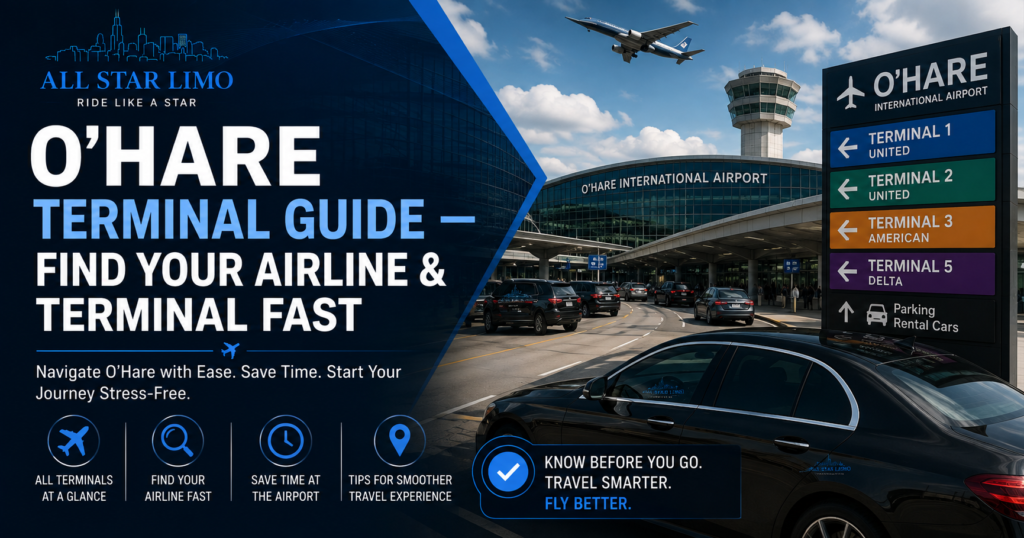
O’Hare International Airport (ORD) runs four active terminals — Terminal 1, Terminal 2, Terminal 3, and Terminal 5 — spread across nine concourses, with no Terminal 4 in between (more on that oddity below). If you’ve ever pulled up to the wrong curb, walked the wrong direction from security, or missed a connection because you assumed your airline was “over there somewhere,” you already know why this matters.
This guide breaks down exactly which terminal every major airline uses at O’Hare, how the free ATS train connects everything, where curbside pickup actually happens at each terminal, and what to do if you’re still not sure where you need to be. Bookmark it before your next trip.
O’Hare is one of the busiest airports in the world by both passenger count and flight volume, and its layout reflects decades of expansion rather than a single unified design — which is part of why the terminal system can feel confusing even to travelers who fly through it regularly. Understanding the basic logic of the layout (who’s grouped where, and why) makes the whole airport easier to navigate, whether you’re catching a connection, meeting someone at arrivals, or coordinating a pickup for a business trip.
Quick-Answer Box: O’Hare Terminals at a Glance
| Terminal | Concourses | Who Flies There | Domestic or International |
|---|---|---|---|
| Terminal 1 | B, C | United Airlines (mainline), Lufthansa, All Nippon Airways | Mostly domestic, some international |
| Terminal 2 | E, F | United Express regional, Air Canada, JetBlue, Alaska Airlines | Domestic + limited international |
| Terminal 3 | G, H, K, L | American Airlines (mainline + American Eagle), British Airways, Aer Lingus, Iberia, Japan Airlines, Spirit | Domestic + select international |
| Terminal 5 | M | Delta, Southwest, Frontier, and most other international carriers | International hub, plus domestic Delta/Southwest/Frontier |
A few things worth knowing right away:
- There is no Terminal 4. It was planned in O’Hare‘s original layout decades ago and never built, so the airport simply skips from Terminal 3 to Terminal 5. Don’t waste time looking for signage — it doesn’t exist.
- Terminals 1, 2, and 3 are connected by an indoor, airside walkway. You can walk between them without leaving security, though the walk from Terminal 1 to Terminal 3 takes roughly 15–20 minutes.
- Terminal 5 stands alone. It’s not physically connected to the other three, so getting there means riding the free ATS train and clearing security again on arrival.
- O’Hare is currently in the middle of the O’Hare 21 modernization program, an $8.5 billion project that will eventually add a new Global Terminal and a 19-gate Concourse D. Some gate assignments can shift during construction phases, so always double-check your boarding pass on the day you fly — this guide reflects the current terminal structure, but airlines do occasionally move.
If your airline isn’t listed below or you want a hand with the pickup logistics on either end, our O’Hare Airport limo service team tracks flights and terminal assignments for every trip we book, so you never have to guess.
Why Getting the Terminal Right Actually Matters
O’Hare is enormous — roughly 84 million passengers pass through it a year, and by aircraft movements it’s one of the busiest airports on the planet, averaging close to a flight every 37 seconds during peak hours. The road system around the terminals is laid out in a hexagon shape, which is efficient for traffic flow but disorienting the first time you drive it. Pull up to the wrong terminal loop and you’re not looking at a two-minute fix — you’re looking at re-merging into departures traffic, circling the entire hexagon, and adding 10–20 minutes to a trip you’d already budgeted tightly.
It’s the same story for arrivals. If a friend or family member is picking you up and doesn’t know you’ve moved from a Terminal 2 gate to a Terminal 3 gate on a rebooked flight, they can end up waiting at the wrong curb while you’re waiting at another one a mile away. Knowing your terminal — and confirming it again on the day you fly — removes almost all of that risk.
Terminal-by-Airline Breakdown (Domestic Carriers)
Terminal 1 — United Airlines’ Home Base
Terminal 1 is United Airlines’ primary hub at O’Hare and the terminal most travelers flying United domestic will use. It’s split into two concourses:
- Concourse B — connects directly to the main terminal building and ticketing area.
- Concourse C — a satellite concourse reached through O’Hare’s famous neon-lit underground pedestrian tunnel, one of the most photographed spots in the airport.
Terminal 1 handles the bulk of United’s mainline domestic departures and arrivals, plus a handful of United’s international routes. Lufthansa and All Nippon Airways also operate select flights out of Terminal 1 as Star Alliance partners flying alongside United.
Check-in is on the upper level; baggage claim sits on the lower level, which is also where curbside pickup happens.
Amenities worth knowing about:
the United Polaris Lounge sits in Concourse C and is currently undergoing an expansion, so expect some construction noise near that gate area through the first half of the year. United Club lounges are available in both concourses for domestic connections. Security lines at Terminal 1 tend to move fastest early morning and late evening; midday departures (roughly 10 a.m. to 2 p.m.) see the heaviest volume, since that’s when the bulk of United’s mainline schedule departs.
Who else uses Terminal 1:
as Star Alliance partners flying alongside United, Lufthansa and All Nippon Airways both operate a limited number of flights from this terminal rather than Terminal 5, which is where most other international carriers are based. If you’re flying one of these two airlines, don’t assume you need the international terminal — confirm your gate first.
Terminal 2 — The Smallest, Busiest-to-Change Terminal
Terminal 2 is the smallest of O’Hare‘s domestic terminals, split across Concourses E and F. It’s used by a mix of carriers:
- United Express regional flights
- Air Canada
- JetBlue
- Alaska Airlines
Terminal 2 is also the terminal most affected by ongoing construction. As part of the O’Hare 21 project, it’s slated to eventually be replaced entirely by a new “Global Terminal” — a combined domestic-international facility. Until that opens, Terminal 2 continues to operate normally, but gate assignments here are the most likely to shift, so this is the terminal where checking your boarding pass the morning of your flight matters most.
Because Terminal 2 is airside-connected to both Terminal 1 and Terminal 3, it also functions as something of a walking shortcut between the two — travelers connecting from a United flight to an American flight (or vice versa) will typically pass straight through Terminal 2’s corridor without stopping. Dining and shopping options here are noticeably more limited than in Terminals 1, 3, or 5, simply due to its smaller footprint, so if you have a long layover, you may prefer to walk toward Terminal 1 or Terminal 3 for more food options.
Terminal 3 — American Airlines’ Hub and O’Hare’s Busiest Terminal
Terminal 3 is American Airlines’ home at O’Hare and, by gate count and passenger volume, the busiest terminal at the airport. It covers four concourses — G, H, K, and L — with roughly 80 gates total.
- American Airlines mainline flights (domestic and select international) operate out of Terminal 3.
- American Eagle regional flights are based primarily out of Concourse F in Terminal 2, so if you’re on a smaller regional jet under the American brand, don’t assume Terminal 3 automatically — check your boarding pass.
- Terminal 3 also hosts several international carriers, including British Airways, Aer Lingus, Iberia, and Japan Airlines, along with Spirit Airlines domestic service (Spirit’s gate assignments have shifted in the past, so confirm before you fly).
Terminal 3 is home to American’s Admirals Club (Concourses G and L), the Flagship Lounge (Concourses H and K), and the independent Centurion Lounge for American Express Platinum and Centurion cardholders.
Getting around inside Terminal 3:
because it spans four concourses and roughly 80 gates, internal walk times can be significant — Concourse G to Concourse L is one of the longer in-terminal walks at O’Hare. If you’re connecting between American flights, check your gate numbers as soon as you land rather than assuming a quick walk; some connections here genuinely take 15 minutes or more on foot. As the busiest terminal by passenger volume, security checkpoints at Terminal 3 also tend to have the longest average wait times at O’Hare, particularly during the Tuesday–Thursday business travel peak and Friday afternoon departures.
Ongoing changes:
Terminal 3 is one of the terminals expected to see the most reshaping as the O’Hare 21 project progresses over the next several years, alongside the addition of the new Concourse D nearby. None of this affects day-to-day operations right now, but it’s part of why double-checking gate assignments close to your travel date is worth the extra minute.
A Note on Southwest and Frontier
Southwest and Frontier both operate out of Terminal 5 rather than a dedicated domestic-only terminal — a quirk of how O’Hare’s gate space is allocated. If you’re flying either airline, skip straight to the Terminal 5 section below; don’t assume they’re grouped with the other domestic carriers in Terminals 1–3.
International Terminal (Terminal 5) — What’s Different
Terminal 5 is O’Hare’s international terminal, and it operates differently from the rest of the airport in a few important ways.
It’s not connected to Terminals 1, 2, or 3:
Unlike the airside walkway linking the domestic terminals, Terminal 5 sits apart from the main complex. To get there — whether you’re connecting from a domestic flight or starting your trip at Terminal 5 — you’ll take the free Airport Transit System (ATS) train, and you’ll need to clear security again once you arrive, even if you already cleared it elsewhere in the airport.
It just got bigger:
Terminal 5 recently underwent a major expansion that added ten new gates, along with additional restaurants and amenities, and a more efficient baggage handling system. It now has a single concourse, Concourse M, with roughly 35 gates.
Who flies there:
- Most international carriers not already based in Terminal 1 or Terminal 3 (this covers the majority of foreign flag carriers serving Chicago)
- Delta Air Lines — all Delta flights, domestic and international
- Southwest Airlines — all Southwest flights
- Frontier Airlines — all Frontier flights
- U.S. Customs and Border Protection facilities for international arrivals
Terminal 5 is also home to the Delta Sky Club, considered one of the better-rated lounges at O’Hare, with views out over the tarmac. Since the expansion, the terminal also has considerably more dining options than it used to, along with additional seating near the newer gates — useful if you’re waiting out a long connection window on an international itinerary.
A note on domestic flights from Terminal 5:
it can feel counterintuitive that Delta, Southwest, and Frontier — three airlines most travelers think of as purely domestic — are based in the international terminal rather than grouped with United and American in Terminals 1–3. This is simply a function of how gate space has historically been allocated at O’Hare rather than a reflection of route type, so if you’re flying any of these three, plan your route to Terminal 5 the same way you would for an international flight, even on a fully domestic itinerary.
Security at Terminal 5:
because Terminal 5 handles both international departures and a meaningful share of domestic traffic (Delta, Southwest, Frontier), its checkpoints see steady volume throughout the day rather than the sharper peaks seen at Terminal 3. TSA PreCheck and Global Entry lanes are both available here, and Global Entry kiosks are particularly useful for international arrivals working through Customs.
Practical tip for international arrivals:
budget extra time after landing at Terminal 5. Between deplaning, clearing Customs and Border Protection, and collecting baggage, international arrivals routinely take longer than domestic ones — which is exactly why having a chauffeur who tracks your flight and adjusts pickup timing automatically matters more here than anywhere else in the airport. Our Meet & Greet service is built specifically around this — your chauffeur meets you inside, past Customs, so you’re not searching for a curb after an international flight.
ATS Train Basics — How to Move Between Terminals
The Airport Transit System (ATS) is O’Hare‘s free, 24/7 people-mover train, and it’s the fastest way to move around the airport when you’re not simply walking the connected Terminals 1–3 corridor.
What the ATS connects:
- All four terminals (1, 2, 3, and 5)
- The economy parking lots
- The Multi-Modal Facility (MMF), where rental cars and most rideshare pickups are centralized
When you actually need it:
- Traveling to or from Terminal 5 — since it’s not connected by walkway, the ATS (or an airside transfer bus) is the only way in or out without leaving the secure area.
- Connecting between a remote parking lot and any terminal.
- Reaching the Multi-Modal Facility for rental car pickup or most rideshare pickups.
When you don’t need it:
if you’re moving between Terminals 1, 2, and 3, you can walk the indoor airside corridor directly — it’s slower than the train for longer trips (the T1-to-T3 walk runs 15–20 minutes) but doesn’t require waiting for a train car, and many travelers prefer it for shorter hops like Terminal 2 to Terminal 3.
The ATS runs frequently and the ride itself is short, but factor in walking time to and from each station, especially with luggage. If you’re cutting it close on a connection that requires a Terminal 5 transfer, budget at least 30–45 minutes total for the walk, wait, ride, and security re-clearance.
A quick word on other ways around O’Hare:
beyond the ATS, the CTA Blue Line connects O’Hare directly to downtown Chicago from a station near Terminal 2, and long-term/economy parking lots are also served by the ATS rather than requiring a separate shuttle. Rental car counters have been consolidated at the Multi-Modal Facility, so rental car pickup follows the same ATS route as rideshare pickup described below.
Peak ATS wait times:
during the height of morning departures (roughly 5–7 a.m.) and the evening arrival rush (5–8 p.m.), ATS platforms can get crowded and trains fill up fast, occasionally requiring a wait for the next car. If your connection window is under 45 minutes and requires a Terminal 5 transfer during these windows, it’s worth notifying your airline at check-in so gate agents are aware.
Curbside Pickup Points by Terminal
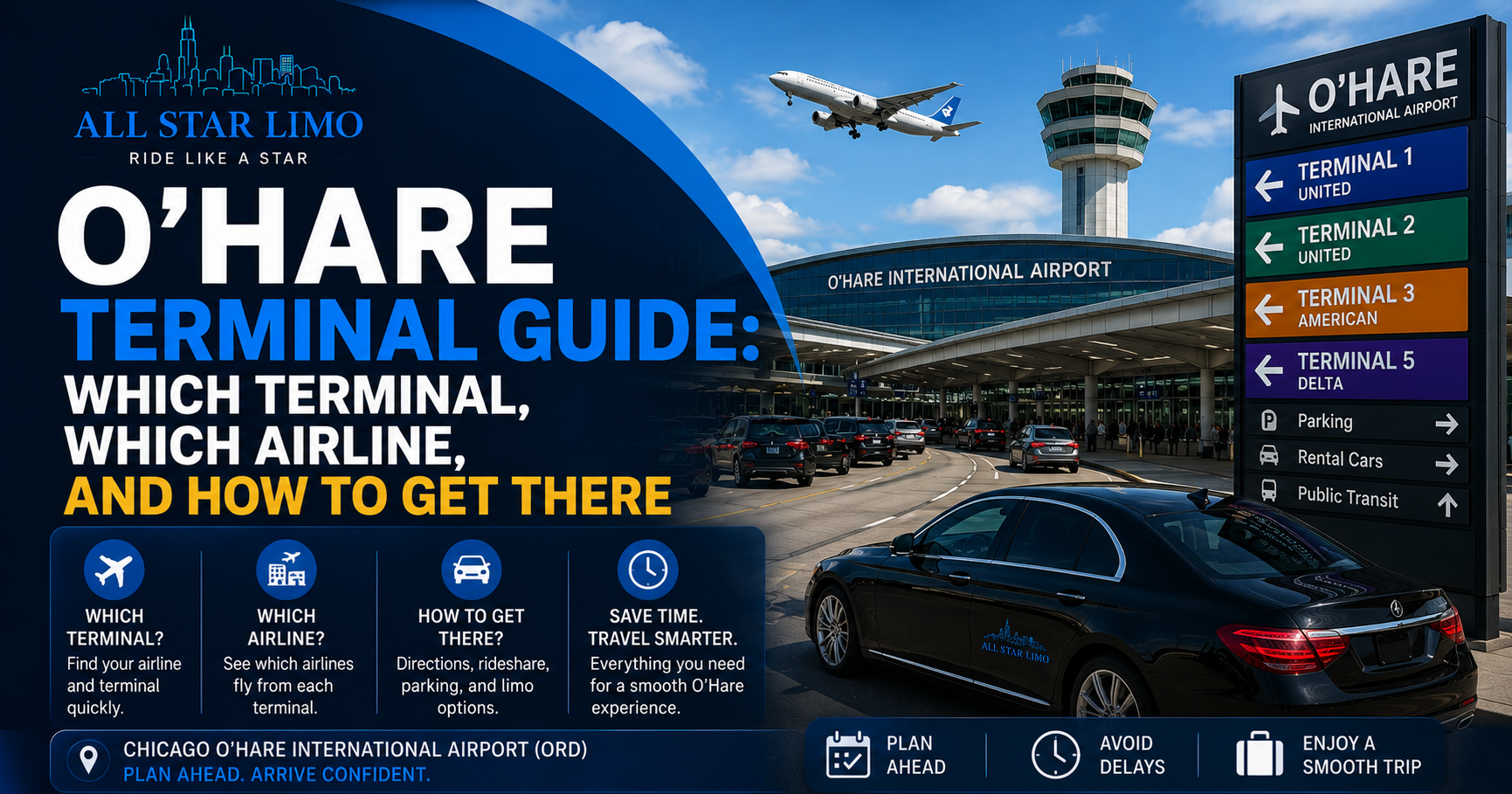
This is where most of the confusion — and most of the wasted time circling the terminal loop — actually happens. O’Hare’s pickup setup depends on whether you’re using rideshare or a private car service, and it’s different at each terminal.
Rideshare (Uber/Lyft):
Pickup is centralized at the Multi-Modal Facility, reached via the ATS from any terminal. That means after landing at any of O’Hare’s four terminals, rideshare passengers walk to baggage claim, follow signage to the ATS, ride to the MMF, and then meet their driver in a separate structure — often a 10–15 minute walk-plus-ride process before the ride even starts.
Private car and limo service:
This is the practical advantage of booking ahead. Licensed chauffeur services pick up directly at the terminal curb or, with meet-and-greet service, inside baggage claim itself — no MMF walk required. Terminal-by-terminal, that looks like:
- Terminal 1: Curbside pickup at the lower-level baggage claim exits.
- Terminal 2: Upper-level departures doors handle drop-off; arriving passengers are picked up at the lower-level curb outside baggage claim.
- Terminal 3: The busiest curb at the airport given Terminal 3’s gate volume — doors are labeled by concourse (roughly 3G through 3K), so knowing your concourse in advance speeds things up.
- Terminal 5: Curbside pickup is on the arrivals level, just outside the Customs and baggage claim area. Given the extra time international arrivals take to clear Customs, this is the terminal where a tracked, flexible pickup time matters most.
If you’re arriving with a chauffeur booked through All Star Limo, your driver tracks your flight in real time, adjusts for early or delayed arrivals automatically, and meets you at the correct terminal and curb — including inside baggage claim if you’ve booked our Meet & Greet service. You can see how this works terminal-by-terminal on our O’Hare Airport limo service page, or book your pickup online once your flight details are confirmed.
Departures (drop-off) work the same way in reverse:
Rideshare drop-off is generally handled curbside at each terminal’s departures level rather than routed through the Multi-Modal Facility, since drop-off doesn’t require the driver to park and wait. Private car and limo drop-off follows the same pattern — your chauffeur pulls up to the correct terminal’s departures curb, helps with luggage, and you’re inside heading to check-in within a minute or two, without the added walk that arriving rideshare passengers deal with at the MMF.
If you’re flying out of a smaller Chicago-area airport instead:
the same pickup principles apply but the logistics are simpler. Our chauffeurs also handle transfers to Midway Airport, Chicago Executive Airport (PWK) for private and charter flights, and DuPage Airport, coordinating directly with FBOs for runway-side pickups when needed.
Parking and Dining Notes by Terminal
A few extra details that don’t fit neatly into the airline breakdown above, but come up often enough to be worth including.
Parking:
O’Hare’s Main Garage sits closest to Terminals 1, 2, and 3, with short-term and long-term options directly accessible on foot. Terminal 5 has its own dedicated parking garage, separate from the Main Garage, which is convenient if you’re departing from or arriving at the international terminal and don’t want to deal with the ATS for your own car. Economy parking lots further from the terminals are connected to all four terminals via the ATS, and typically offer the lowest daily rates — worth considering for trips longer than a few days, factoring in the extra ATS ride time.
Dining:
Terminal 3, as O’Hare’s largest and busiest terminal, also has the widest range of dining options, spanning all four of its concourses. Terminal 5 has expanded its food and beverage offerings considerably as part of its recent renovation, adding several new options alongside its existing restaurants. Terminal 2, being the smallest terminal, has the most limited selection — if you have time before your flight and want more choices, the airside walkway makes it easy to head toward Terminal 1 or Terminal 3 instead.
Family and accessibility amenities:
all four terminals have nursing rooms, family restrooms, and accessible security lanes, though exact locations vary by concourse. If you need specific accommodations, checking with your airline or the O’Hare accessibility desk ahead of time is worth the extra step, particularly if your itinerary involves a Terminal 5 transfer where you’ll be walking further and clearing security twice.
What to Do If You’re Not Sure Which Terminal You Need
A few reliable ways to confirm your terminal before you head to the airport:
- Check your boarding pass or airline confirmation email. The terminal is almost always printed clearly, and it reflects the most current assignment — more reliable than memory or a general guide like this one, especially during construction phases.
- Use your airline’s app. Most major carriers show terminal and gate information in real time, including same-day changes.
- Check flychicago.com, O’Hare’s official site, for live terminal and gate lookups by flight number.
- If you booked a private car service, tell your chauffeur company your airline and flight number when you book. A service tracking your flight — like our O’Hare limo service — will already know your terminal and adjust pickup accordingly, so you don’t have to double-check anything yourself.
- When in doubt, allow extra time. If your airline recently shifted terminals (Terminal 2 carriers are the most likely to see this during the O’Hare 21 construction period) or you’re connecting through Terminal 5, build in an extra 20–30 minutes rather than assuming the fastest-case scenario.
And if you’re departing rather than arriving, the same principle applies in reverse — confirm your terminal the night before, not in the car on the way there. It’s a small step that avoids the worst version of an O’Hare trip: circling the terminal loop looking for the right curb with a flight boarding in twenty minutes.
FAQ
Does O’Hare have a Terminal 4?
No. Terminal 4 was part of O’Hare’s original planned layout but was never built, so the airport numbering skips from Terminal 3 to Terminal 5. There’s no missing signage to look for — it simply doesn’t exist.
Which terminal is United Airlines at O’Hare?
United’s mainline flights operate out of Terminal 1, split between Concourse B and Concourse C, connected by O’Hare’s underground pedestrian tunnel. United Express regional flights are based in Terminal 2.
Which terminal is American Airlines at O’Hare?
American Airlines mainline flights use Terminal 3, across Concourses G, H, K, and L. American Eagle regional flights are based primarily in Terminal 2, Concourse F, so it’s worth checking your specific flight if you’re on a smaller aircraft.
Which terminal do Delta, Southwest, and Frontier use?
All three operate out of Terminal 5, alongside most international carriers. This surprises a lot of travelers who expect domestic-only airlines to be grouped with United or American in Terminals 1–3.
How do I get between O’Hare terminals?
Terminals 1, 2, and 3 are connected by an indoor airside walkway — no need to leave security. Terminal 5 is separate and requires the free ATS train (plus re-clearing security on arrival). The ATS also connects all terminals to the Multi-Modal Facility and economy parking.
Where does rideshare pick up at O’Hare?
Uber and Lyft pickups are centralized at the Multi-Modal Facility, reached via the free ATS train from any terminal. That means a walk to baggage claim, a ride on the ATS, and then meeting your driver in a separate structure — often adding 10–15 minutes compared to a private car service, which can pick up directly at the terminal curb.
Do gate assignments at O’Hare ever change close to departure?
Yes, and it happens more often during O’Hare’s current construction period. Terminal 2 in particular sees the most frequent shifts as the O’Hare 21 modernization project moves forward. Always confirm your terminal and gate on your boarding pass or airline app the day you fly, rather than relying on a past trip or a general guide.
Skip the Terminal Guesswork
Terminal assignments shift, construction changes gate layouts, and international arrivals almost always take longer than you’d plan for. The easiest way to remove the guesswork is to have someone tracking it for you.
All Star Limo‘s O’Hare Airport limo service covers pickups and drop-offs at all four ORD terminals, with real-time flight tracking that adjusts automatically for early or delayed arrivals — so your chauffeur is waiting at the right curb, at the right terminal, every time. For international arrivals through Terminal 5 or any flight where you’d rather not deal with baggage alone, our Meet & Greet service puts your chauffeur inside the terminal, ready to help the moment you clear Customs or baggage claim.
Explore More