Chicago , il

- Home
- About
- Services
- Fleet
- Areas
- Pricing
- Blogs
- Contact
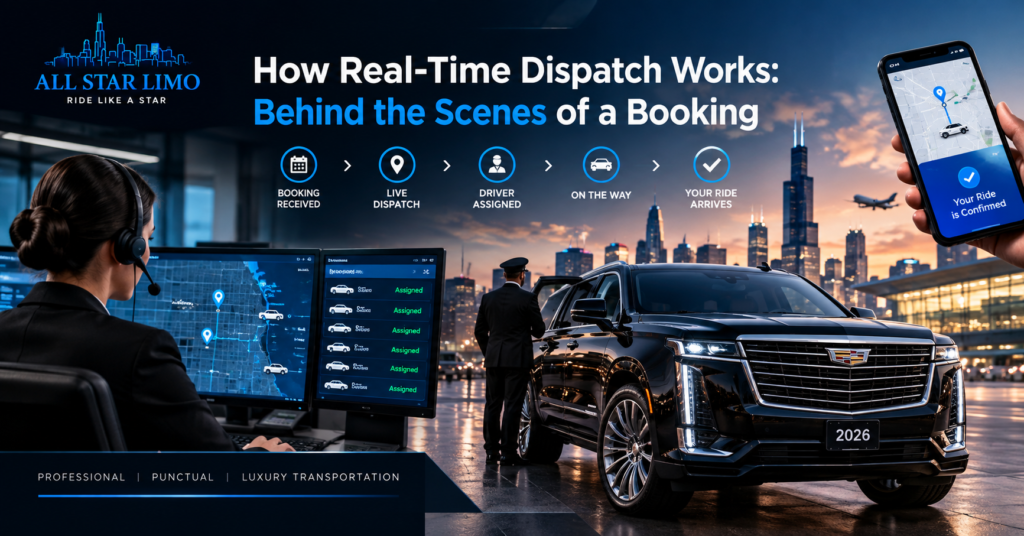
Most riders never think about what happens between clicking “confirm” and their car actually pulling up. It feels simple from the outside. It isn’t simple on the inside — and understanding the machinery behind it is what separates a service you can trust with a flight connection from one you’re just hoping works out.
A lot of what makes a car actually show up on time has nothing to do with the driver’s personal punctuality and everything to do with a system running quietly in the background — checking flights, watching traffic, tracking every vehicle in the fleet at once, and adjusting your specific trip before a small delay has any chance to become a bigger problem.
The moment you book, your trip enters a live system that assigns a specific vehicle and driver, tracks your flight or schedule in real time, adjusts automatically if anything changes, and keeps a dispatcher watching the whole thing until you’re safely dropped off. Here’s exactly how each piece works.
What Happens the Second You Book
- Your request — pickup, drop-off, time, vehicle type — lands in the dispatch system immediately, not in a pile to be sorted later.
- The system checks real fleet availability for your exact window, not just a general “yes we have cars” answer.
- If you gave a flight number, tracking starts here — before your flight has even taken off in some cases.
- A confirmation goes out to you right away, usually by email or text, with your trip details attached.
- Nothing about this step requires you to call and check in. The system is already working before you’ve closed the confirmation page.
- Behind the scenes, your trip is also cross-checked against any special requests you added — a child seat, extra luggage space, a specific pickup style — so those details travel with the booking rather than getting lost between the form and the actual dispatch.
- If you booked by phone instead of online, the exact same system gets updated by the person you spoke with — there’s no separate, slower process for phone bookings.
How a Specific Vehicle and Driver Get Matched to Your Trip
- Every open trip gets matched against every available vehicle and driver for that window — not assigned randomly, and not first-come-first-served among drivers.
- Location matters as much as availability. A driver technically “free” but across town isn’t a realistic match if someone closer can make the pickup easier.
- Vehicle type is filtered first — sedan, SUV, Sprinter, stretch — so you’re never matched to something that doesn’t fit your actual request.
- For airport trips, the system also weighs how far the driver needs to travel to reach the terminal in time, factoring in current traffic.
- Final assignment — the specific driver and vehicle — is usually locked in closer to your pickup time, not the moment you book, so the closest available match can be used.
- This delayed-assignment approach is deliberate, not a sign of disorganization. Locking in a driver the instant you book, hours or days ahead, would mean ignoring better options that become available closer to your actual pickup time.
- For a group or fleet-wide booking, this same matching logic runs across every vehicle in the request simultaneously, so the whole group’s vehicles are assigned as a coordinated set rather than one at a time.
Live Tracking — What’s Actually Being Tracked
- Your flight, if you gave a flight number. The system follows the actual flight, not the time you originally typed in.
- Your vehicle’s location, in real time, visible to dispatch the entire trip.
- Traffic conditions along the route, adjusted continuously rather than calculated once at booking.
- Weather, when it’s likely to affect drive time meaningfully — a snow advisory changes the math, and dispatch sees that early.
- None of this requires you to do anything. It runs in the background whether you check your phone or not.
- For an hourly booking — a shoot day, a multi-stop event, a wedding itinerary — the system also tracks elapsed time against your booked window, so both you and dispatch have an accurate, live picture of where the booking stands rather than a rough guess.
- If your trip involves a meeting or event rather than a flight, some providers can track that scheduled time similarly, adjusting pickup expectations if the event itself is known to run long.
How a Delay Gets Handled Before It Becomes Your Problem
- If your flight is delayed, the system sees it the same moment the airline updates it — often before you do.
- Your pickup time shifts automatically. No call needed on your end.
- If traffic builds unexpectedly on the route to your pickup, dispatch can reassign a closer vehicle rather than let a delay compound.
- If a vehicle has a mechanical issue or a driver runs into a genuine problem, dispatch reroutes another vehicle rather than leaving your trip unfilled.
- The goal at every step is the same: catch a problem before it reaches you, not explain it to you after it already has.
- This is also where reserve capacity comes into play — a small buffer of extra vehicles held back specifically so a genuine disruption doesn’t cascade into multiple missed pickups across the fleet.
- For a multi-stop or group booking, this same logic applies at the level of the whole itinerary — a delay at one stop gets absorbed and adjusted for at the next one, rather than silently compounding across the rest of the day.
How You Actually Reach a Human If Something Comes Up
- You get a direct line to either your assigned driver or a dedicated dispatch contact — not a generic call center queue.
- For a last-minute change (a new pickup address, an added stop), that update reaches your driver in the system, not through a slow game of telephone.
- If you can’t reach your driver for any reason, dispatch is watching the trip and can step in.
- This matters most exactly when you need it most — a missed connection, a sudden schedule change, a flight that lands three hours early.
- A direct line also matters for the small, everyday questions — confirming you’re at the right pickup zone, letting your driver know you’re running two minutes behind. These small confirmations resolve in seconds with a direct contact, compared to minutes or longer through a general support line.
- For a corporate account or a recurring booking, this contact often becomes more personal over time — the same dispatcher or account contact becoming familiar with your typical needs rather than starting fresh with every single trip.
What Dispatch Is Watching That You Never See
- Every vehicle’s live position, all at once, not one at a time as questions come in.
- How full each driver’s schedule already is, so a new request isn’t slotted into an impossible timeline.
- Which vehicles are closest to finishing their current trip, so a delayed pickup can sometimes still be covered by a nearby car wrapping up.
- Weather and traffic patterns citywide, not just on your specific route, since a citywide event or storm affects the whole fleet’s timing at once.
- Reserve capacity, held back specifically for exactly this kind of unexpected need.
- Driver rest and shift timing, particularly for longer or multi-day bookings, so a driver isn’t pushed beyond a reasonable working window just to cover a gap.
- Demand patterns building up in real time — a sudden cluster of same-day requests during a weather event, for instance — which lets dispatch proactively adjust rather than reacting only once capacity is already stretched thin.
Why This Matters More for Some Trips Than Others
- Airport transfers benefit the most — a missed pickup here can mean a missed flight, not just an inconvenience.
- Corporate travel benefits from consistency — the same level of tracking and adjustment across every trip, not just the important-looking ones.
- Group and event bookings benefit from dispatch watching multiple vehicles at once, keeping a whole group’s transportation aligned rather than each car operating independently.
- A routine local trip still runs through the same system, just with less at stake if timing shifts by a few minutes.
- The system doesn’t change based on the trip — the stakes of getting it right do.
- Production and shoot-day bookings lean especially hard on this flexibility, since a call sheet’s actual timing rarely matches its written schedule, and dispatch needs to track an hourly booking‘s elapsed time rather than a single fixed pickup moment.
- Wedding and prom bookings benefit from the same multi-stop tracking that group events use, since a single day often involves several timed stops that all need to stay coordinated against one another.
What This Looks Like From Your Side, Start to Finish
- You book — online or by phone.
- Confirmation lands in your inbox within minutes.
- Tracking begins immediately if you gave flight or schedule details.
- A specific driver and vehicle get locked in as your pickup time approaches.
- If anything changes — a delay, a traffic jam, a schedule shift — it’s adjusted before you’d even notice.
- Your driver arrives, on time, at the correct location, without you needing to have managed any of the steps above yourself.
- If you’re using meet & greet pickup, your driver is already positioned inside the terminal, timed to your actual landing rather than your originally scheduled one.
- At drop-off, the trip closes out in the system, and for a corporate account or standing booking, this feeds directly into your consolidated invoice rather than a separate manual entry.
That’s the whole point of the system: everything above happens so you don’t have to think about any of it.
A Few Things a Good Dispatch System Should Always Get Right
- Confirmation within minutes of booking — not hours, not “we’ll call you back.”
- A direct way to reach your driver or dispatch, not just a general inbox.
- Automatic adjustment for flight delays, without you needing to call and ask for it.
- A visible, confirmed vehicle assignment before pickup time, not a surprise at the curb.
- A real answer if something goes wrong — a reroute, a backup vehicle, a clear next step — not silence.
- Consistency across every booking type, whether it’s a $50 local ride or a multi-vehicle corporate event — the underlying system shouldn’t treat one as an afterthought compared to the other.
- Transparency about how a delay is being handled, rather than vague reassurance. A dispatcher who can tell you specifically what’s happening — “your new driver is eight minutes out” — is a stronger signal than a generic “someone’s on the way.”
If a provider can’t speak clearly to how they handle even one of these, that’s worth noticing before you book, not after.
Why This Beats Rideshare for the Trips That Actually Matter
- Rideshare assigns a driver only after you request one — there’s no advance planning behind your specific trip.
- No flight tracking exists on a standard rideshare request; you’re the one who has to remember to request a ride after landing.
- There’s no dispatcher watching your specific trip in the background — if something goes wrong, you’re the one who has to notice and fix it.
- For a routine, low-stakes ride, none of this matters much. For an airport transfer, a business trip, or anything with real consequences if it goes wrong, it matters a great deal.
- Rideshare pricing also fluctuates with demand in real time, which means the exact scenario where dispatch-level reliability matters most — a citywide weather event, a major local event — is also the scenario where rideshare pricing tends to spike.
- A scheduled, dispatch-backed booking removes both problems at once: the uncertainty of on-demand assignment and the unpredictability of surge pricing, at exactly the moments when a rider needs the most confidence in their transportation plan.
→ Compare Black Car Service vs. Rideshare for Business Travel
The Technology Running Quietly Underneath All of This
- GPS tracking on every vehicle feeds a live map dispatch can see at all times — not a periodic check-in, a continuous feed.
- Flight data integration pulls directly from airline systems, which is why tracking updates as fast as the airline itself updates, not on a delay.
- Automated scheduling logic handles the bulk of routine matching, freeing human dispatchers to focus on the exceptions — a delay, a change, a genuine problem — rather than every single routine assignment.
- A shared communication layer connects drivers, dispatch, and, for larger bookings, an on-site coordinator, so an update posted once is visible to everyone who needs it rather than requiring separate phone calls to each party.
- Historical data on traffic patterns and typical drive times feeds into how realistic a given pickup window actually is, rather than relying purely on a generic map app’s estimate.
- None of this technology matters if the people using it aren’t experienced — the system supports good dispatch decisions, it doesn’t replace the judgment of an experienced dispatcher who knows when a situation needs a human call rather than an automated one.
What Happens in a True Edge Case
- A vehicle breaks down mid-route. Dispatch is already watching that vehicle’s location, notices the stop immediately, and can begin routing a replacement before the driver even finishes calling it in.
- A driver gets sick or has an emergency. The trip doesn’t disappear — it goes back into the matching system covered in Step 2, and a new driver is found using the same location-and-availability logic as any other assignment.
- Two events collide on the same day — a citywide storm and a major sporting event, for instance. Dispatch prioritizes based on trip urgency (an airport transfer ahead of a flexible local ride, for example) rather than treating every trip identically under strain.
- A booking detail was entered incorrectly — a wrong flight number, a typo in the address. A dispatcher catching this early, ideally through a confirmation review, prevents it from becoming a same-day emergency.
- The system itself has an outage. Reputable providers maintain a manual backup process — phone-based dispatch continuing to function even if the automated system is temporarily down — so a booking already in progress doesn’t simply vanish.
- The measure of a good dispatch operation isn’t that nothing ever goes wrong. It’s how quickly and clearly a genuine problem gets caught, communicated, and fixed.
Frequently Asked Questions
Does dispatch really track my flight automatically, or do I need to update them myself?
A proper system tracks your actual flight number in real time — you don’t need to call in a delay or an early landing. It’s already visible to dispatch as soon as the airline updates it.
What happens if my driver is running late?
Dispatch typically sees this before you would, since they’re watching vehicle locations live, and can reroute a closer vehicle or communicate an accurate updated ETA rather than leaving you guessing.
Can I reach my actual driver directly, or only a general customer service line?
With a proper dispatch setup, you get a direct line to your assigned driver or a dedicated dispatch contact — not a generic queue that has to look up your trip from scratch.
Is my vehicle assigned the moment I book, or later?
The specific driver and vehicle are usually finalized closer to your pickup time, which lets dispatch match you with the closest realistic option rather than locking something in far too early.
How is this different from how rideshare apps work?
Rideshare assigns a driver only on demand, with no advance planning or flight tracking specific to your trip, and no dispatcher actively watching your ride in the background the way a professional car service does.
What if there’s a citywide weather event affecting every vehicle at once?
Dispatch monitors conditions across the whole fleet, not just your individual trip, which is how reserve capacity and rerouting decisions get made proactively rather than reactively.
Do I need to do anything on my end for any of this to work?
No — beyond giving accurate booking details (flight number, pickup address, timing), the tracking, adjustment, and communication all run in the background without requiring you to check in.
Does the same dispatch system handle both small individual bookings and large multi-vehicle events?
Yes, though larger bookings typically add an extra layer — an on-site coordinator or dedicated dispatch contact managing the full fleet in real time — on top of the same underlying tracking and matching system used for a single ride.
Can I see any of this tracking myself, or is it purely internal to dispatch?
Many providers offer some level of visibility to riders — a driver ETA, a confirmed vehicle assignment — though the full internal dispatch view (fleet-wide positioning, driver schedules) is generally an operational tool rather than something shared directly with each rider.
How quickly does the system actually respond to a flight delay?
Typically within minutes of the airline updating its own system, since flight data integration pulls that information directly rather than relying on a manual check.
What happens if I need to change my pickup time after already booking?
Contact your provider directly — a change gets entered into the same system your original booking used, and the vehicle and driver assignment adjusts accordingly rather than requiring an entirely new booking.
What happens if a vehicle breaks down or a driver has an emergency mid-trip?
Dispatch is watching every vehicle’s location continuously, so a stopped vehicle is noticed quickly, and the trip is rerouted to a replacement driver using the same matching logic as any standard assignment — you’re not left waiting indefinitely while the issue gets sorted out manually.
Is this level of dispatch tracking only available for expensive bookings, or does it apply to every ride?
The underlying system runs the same way regardless of trip size or cost — a routine local ride and a full corporate event both pass through the same core tracking and matching logic, though larger bookings sometimes add an extra layer of dedicated coordination on top.
Book a Ride Backed by a Real Dispatch System
Now you know what’s actually happening behind your confirmation email — a live system watching your trip, ready to adjust the moment something changes, so you don’t have to.
→ Book Your Airport Limo Service
Explore more:
All Star Limo
All Star Limo offers reliable Chicago limo service and black car transportation for airport transfers, corporate travel, and special events across Chicago and the surrounding suburbs. Travel in comfort with our professional chauffeurs and luxury fleet of sedans, SUVs, and Sprinter vans.
Located
Call Us