Chicago , il

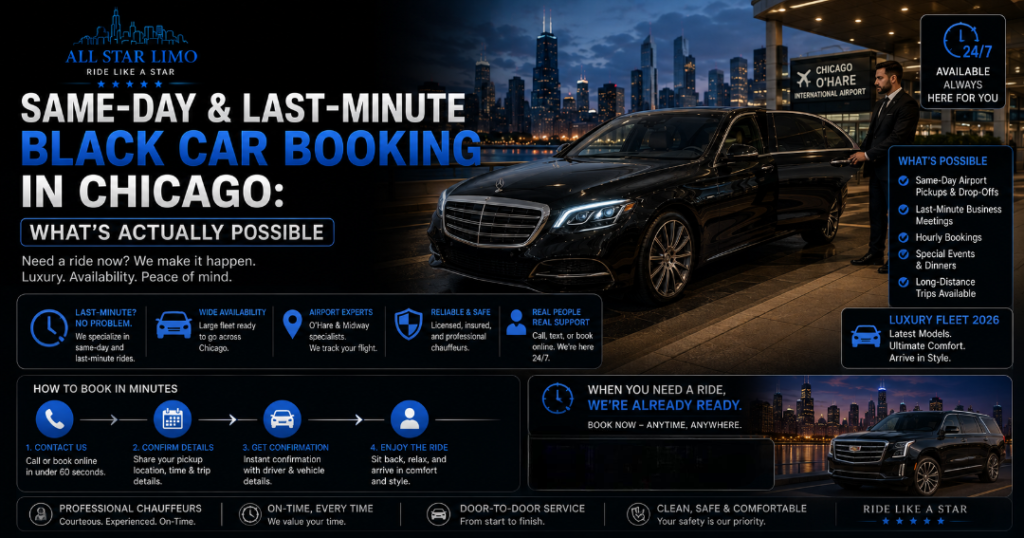
Same-day black car booking in Chicago is often possible, but it isn’t guaranteed the way advance booking is — availability depends heavily on the time of day, day of week, and how far in advance within “same-day” you’re calling. Calling dispatch directly is almost always faster than an online form for urgent requests. This guide covers why availability works the way it does, how to handle a genuine emergency scenario, and how your odds change depending on when you’re calling. For the standard step-by-step booking process itself, see our complete booking guide.
Needing a car on short notice is a different situation than planning a trip days in advance, and it deserves an honest answer rather than a blanket “yes, always available.” This guide focuses specifically on what determines whether a same-day request succeeds, what to do in a genuine emergency, and how to think about the trade-offs between a last-minute black car and other options like rideshare.
Why Availability Isn’t Guaranteed
Understanding why same-day availability fluctuates — rather than being a fixed yes-or-no — helps set realistic expectations and improves how you approach the request.
Fleet allocation happens in advance:
Most professional car services plan vehicle and driver schedules based on confirmed bookings, often a day or more ahead. A same-day request has to fit into whatever capacity wasn’t already allocated to earlier bookings — meaning availability at any given moment reflects how much of the day’s fleet is already committed, not how large the company’s total fleet is.
Driver shift structures matter:
Chauffeurs work scheduled shifts, and a driver who’s midway through a shift with back-to-back bookings can’t simply add another trip without displacing something else. A same-day request that comes in when most drivers are mid-shift and already booked has fewer available slots than one that comes in near a shift change or during a naturally lighter stretch of the day.
Vehicle type narrows availability further:
Even if standard sedans have some same-day flexibility, a specific request — a stretch limo, a large SUV, a particular luxury vehicle — draws from a smaller subset of the fleet, and that specific vehicle type may already be fully booked for the day even when general capacity looks available.
Demand isn’t evenly distributed across the day:
Certain windows — rush hour, weekend evenings, any day with a major local event — see concentrated demand that can exhaust same-day availability faster than a quiet weekday afternoon. This is covered in more detail in the peak vs. off-peak section below.
None of this means same-day booking is unreliable
— it succeeds far more often than not for standard vehicle requests during typical hours. It does mean the honest framing is “likely available, confirm quickly” rather than “always guaranteed,” and understanding why helps you act in ways that improve your specific odds.
Emergency and Urgent Scenarios
Beyond routine same-day bookings, certain situations carry extra time pressure and deserve their own approach.
A flight was cancelled or rebooked with short notice:
If you’re suddenly arriving earlier or later than originally planned, or at a different airport or terminal than booked, calling dispatch directly with the updated flight information is faster and more reliable than trying to modify an existing online booking through a web form. Mention explicitly that it’s a schedule change from an existing reservation if you already had one booked, since that context helps a dispatcher prioritize and adjust quickly rather than treating it as an entirely new request.
A missed connection leaves you needing ground transportation on short notice:
In this situation, providing your new arrival time, terminal, and any relevant flight details immediately — rather than waiting until you’ve landed — gives a dispatcher more lead time to arrange a vehicle even though the overall situation is last-minute from your perspective.
A sudden business meeting or event requires transportation within a few hours:
These requests are generally the most straightforward same-day scenario, since they don’t involve airport-specific timing constraints — a phone call with your pickup and drop-off details, timing, and passenger count is usually all that’s needed to get a quick answer on availability.
Severe weather or a citywide disruption affects transportation broadly:
During major weather events or widespread disruptions (a snowstorm, for instance), same-day and last-minute demand spikes citywide across all transportation types — not just black car services — which can affect availability even for requests that would normally be simple. In these situations, calling as early as you know you’ll need transportation, rather than waiting until the last possible moment, meaningfully improves your odds.
What all of these scenarios share:
Speed of communication matters more than in a standard advance booking. A phone call that gets your situation in front of a dispatcher immediately, with clear and complete details on the first attempt, is consistently more effective in an urgent scenario than a slower online submission or an incomplete initial request that requires follow-up questions to clarify.
Rideshare vs. Last-Minute Black Car — When to Choose Which
For an urgent need, rideshare is often the first instinct simply because it’s fast and familiar. It’s worth weighing directly against a last-minute black car request, since each has real advantages depending on the situation.
Rideshare tends to win when:
- You need a vehicle within minutes, not hours, and any reasonably comfortable car will do
- Your trip is short and doesn’t involve luggage, a group, or any special vehicle requirement
- You’re comfortable with variable, potentially surged pricing in exchange for speed
- The trip doesn’t require any advance coordination, like flight tracking or a specific pickup style
A last-minute black car booking tends to win when:
- You have meaningful luggage, a larger group, or need a specific vehicle type that a standard rideshare car doesn’t offer
- The trip involves an airport pickup where flight tracking and a more coordinated pickup process add real value, even on short notice
- You want price certainty rather than exposure to potential rideshare surge pricing during high-demand periods
- The occasion itself calls for a specific vehicle — even a last-minute event can still benefit from a more appropriate vehicle than whatever rideshare car happens to be nearby
- You’d rather work with a direct phone contact than navigate an app during a stressful, time-pressured situation
A realistic middle-ground consideration:
If your timeline is under an hour and your needs are simple, rideshare is generally the more dependable same-day option purely due to its on-demand model. If you have even a couple of hours of lead time and your needs are more specific — luggage, group size, airport coordination, vehicle type — a quick call to a black car dispatcher is worth attempting before defaulting to rideshare, since the outcome is often better-suited to the actual trip even on short notice.
Peak vs. Off-Peak Last-Minute Odds
Same-day availability isn’t uniform throughout the day or week — knowing the general pattern helps you gauge your odds realistically before calling.
Highest same-day availability, generally:
- Weekday mid-mornings and early afternoons (roughly 9 AM–2 PM), outside of any local event day
- Standard sedan requests, which draw from the largest portion of most fleets
- Off-season periods without major citywide conventions or events
Moderate same-day availability, generally:
- Weekday evenings outside of rush hour, though this narrows as the day progresses and more of the day’s bookings have already been allocated
- Weekend mornings, before weekend event and evening demand ramps up
- SUV requests, which have somewhat less flexibility than standard sedans but more than specialty vehicles
Lowest same-day availability, generally:
- Weekday rush hour windows (roughly 7–9:30 AM and 3:30–6:30 PM), when a large share of the fleet is already committed to scheduled trips
- Friday and Saturday evenings, particularly during wedding season, prom season, or any weekend with a major local event
- Specialty vehicle requests (stretch limos, larger luxury SUVs) at any time, simply due to smaller fleet numbers in those categories
- Any day coinciding with a major citywide convention, a significant sporting event, or severe weather affecting the whole city’s transportation demand simultaneously
The practical takeaway:
If your timing allows any flexibility at all, calling earlier in a lower-demand window — even for a trip scheduled later that same day — improves your odds of securing your preferred vehicle type compared to waiting until closer to a high-demand window to make the request.
What Dispatch Actually Checks When You Call
Understanding what happens on the other end of a same-day call can make the conversation faster and more productive.
Real-time vehicle and driver availability:
A dispatcher checks which vehicles matching your request (type, size) have an open slot in the relevant time window, cross-referencing against already-scheduled trips and driver shift timing.
Location logistics:
Where available vehicles currently are relative to your pickup location affects real feasibility — a vehicle technically “available” but currently on the opposite side of the city may not realistically make your pickup window, so a dispatcher factors in current vehicle positioning, not just an abstract availability count.
Trip duration and driver return logistics:
For a longer or more complex same-day trip, a dispatcher considers not just whether a vehicle is free to start your trip, but whether the driver can reasonably complete it and be available for anything already scheduled afterward — this is part of why a seemingly simple same-day request can sometimes take a few minutes to confirm rather than an instant yes.
Special requirements matching:
If you’ve mentioned specific needs — a car seat, extra luggage space, a particular pickup style — a dispatcher checks whether an available vehicle and driver can actually accommodate those specifics, not just whether any vehicle is free.
Why this means a quick phone conversation beats an instant online confirmation for same-day requests:
These real-time checks are easier to work through verbally with a dispatcher who can immediately relay availability and ask clarifying questions than through an automated online form, which is generally optimized for advance bookings with more lead time to process.
How to Improve Your Odds on a Same-Day Request
A few practical habits meaningfully increase the likelihood of a successful same-day booking:
- Call rather than submit an online form, especially for anything within the next few hours — direct conversation resolves availability faster than waiting for a form response.
- Have your details ready before you call — pickup and drop-off, timing, passenger count, and any special needs — so the dispatcher can check availability without needing a second call to gather missing information.
- Be flexible on vehicle type if your priority is getting a car quickly rather than a specific vehicle class — stating “I need any available vehicle for 3 people” opens more options than insisting on one specific type.
- Call as early as you know you’ll need transportation, even if the trip itself isn’t for several hours — this gives dispatch more lead time to fit your trip into the day’s schedule before other same-day requests fill remaining capacity.
- Mention any genuine time sensitivity clearly (a flight, a meeting, a specific deadline) so a dispatcher understands the priority and can communicate honestly about whether your timeline is realistic given current availability.
- If the first call doesn’t yield immediate availability, ask about the next realistic time slot rather than assuming no options exist at all — a dispatcher may be able to offer a vehicle slightly later or a different vehicle type sooner than your original request.
What to Have Ready Before You Call
Since speed of communication is the biggest lever you control in a same-day situation, having the following ready before you dial saves valuable time on the call itself:
- Exact pickup address, including any specific entrance, terminal, or unit detail — vague locations require follow-up questions that cost time
- Exact or best-estimate pickup time, and whether there’s flexibility on either side of it
- Drop-off address, with the same level of specificity
- Passenger count and any luggage details, especially if it’s more than a standard carry-on situation
- Flight number, if applicable, pulled from your actual boarding pass rather than an old itinerary
- Any vehicle type preference, and how firm that preference is — being upfront that you’re flexible if it helps availability can meaningfully speed up the conversation
- A callback number where you can be reached immediately, since dispatch may need to follow up with a confirmation or a clarifying question
Reading off these details in order, rather than answering them one at a time as a dispatcher asks, generally gets you to a confirmed answer faster — a same-day call is not the moment to figure out your itinerary while on the phone.
Why Some Requests Get Turned Down Even When the Fleet Looks Large
A common point of confusion: a company can have dozens of vehicles and still tell you nothing is available for your specific same-day request. This isn’t a matter of the company being unhelpful — it reflects a few realities worth understanding.
A large total fleet doesn’t mean a large same-day fleet. Most vehicles in a company’s fleet are already allocated to previously confirmed bookings on any given day — a same-day request is competing for whatever fraction of that fleet wasn’t already committed, which can be a small number even in a company with a sizable overall fleet.
Specific vehicle requests shrink the pool further. If your request is for a particular vehicle class — say, a large SUV or a stretch limo — you’re drawing from a specific, smaller subset of the fleet, not the total count, and that subset may simply be fully booked even when standard sedans have openings.
Geography matters as much as raw numbers. A vehicle technically free at that hour but currently on the far side of the city, finishing an earlier trip, may not realistically be able to reach your pickup location in time — even though it shows as “available” in a general sense.
Driver rest and shift-end timing is a real constraint, not a formality. A driver nearing the end of a shift, or one who’s already worked close to a full day, may not be assignable to a new trip regardless of vehicle availability, particularly for a longer or less predictable same-day request.
Understanding these constraints doesn’t change the outcome of a “no” on a specific request, but it does help calibrate expectations — a company turning down one specific request at one specific moment isn’t necessarily reflective of their overall capability or reliability, and trying again with more flexibility (a different vehicle type, a slightly different time) is often worthwhile rather than assuming availability is closed for the day entirely.
Real-World Scenario Walkthroughs
Seeing how these principles play out in specific situations makes the general guidance easier to apply when you’re actually facing a same-day need.
Scenario: A client meeting gets moved up to this afternoon. You call dispatch at 11 AM for a 2 PM downtown pickup. Because this falls within a weekday mid-day window — generally one of the higher-availability periods — and you’re flexible on vehicle type, a dispatcher is likely able to confirm a sedan within the call itself. Having your pickup and drop-off addresses ready, along with passenger count, means the call takes just a couple of minutes rather than requiring a callback.
Scenario: Your flight lands three hours earlier than scheduled due to a tailwind and equipment change. If you had an existing reservation with flight tracking, this is usually the smoothest same-day scenario, since a tracking system may already reflect the change automatically. If you didn’t have an existing reservation, calling dispatch as soon as you’re aware of the new landing time — ideally before you land, if you have connectivity — gives the most lead time, even though the overall window is still short.
Scenario: You need a car for a wedding-related emergency, like a vehicle breakdown en route to the ceremony. This is a high-urgency, time-sensitive scenario where calling immediately, being clear about the urgency and the specific timeline (a ceremony start time, for instance), and being open to whatever vehicle is available gives you the best chance of a fast resolution — this is not the moment to hold out for a specific vehicle style if any suitable, available option can get you there on time.
Scenario: You’re trying to book a stretch limo for a birthday celebration starting in four hours on a Saturday evening. This is realistically one of the harder same-day scenarios — Saturday evening is a high-demand window, and stretch limos are a smaller subset of most fleets. Calling as early in the day as possible, even well before four hours out, and being open to an alternative vehicle style (a luxury SUV, for instance) if the specific stretch limo isn’t available, meaningfully improves the odds of getting some suitable vehicle rather than none at all.
Scenario: A sudden need arises for airport transportation at 3 AM. Off-peak overnight hours often have different availability dynamics than daytime — fewer bookings compete for the same slots, but also potentially fewer drivers on active shift depending on the company’s overnight staffing. Confirming 24/7 availability directly with the specific provider, rather than assuming standard daytime availability patterns apply, is worth doing explicitly for very late or very early requests.
These examples aren’t exhaustive, but the underlying pattern repeats: urgency plus flexibility plus early communication is consistently the combination that produces the best same-day outcome, regardless of the specific scenario.
Communicating Urgency Effectively on the Phone
How you frame a same-day request during the actual call can influence how quickly and effectively a dispatcher can help, beyond simply having your details ready.
State the timeline first, clearly. Opening with “I need a pickup at [specific time] today” rather than working up to it gives a dispatcher immediate context for how to prioritize the conversation, rather than having them piece together urgency partway through a longer explanation.
Distinguish between “urgent” and “flexible” honestly. If your timing has some give — you could leave anytime in the next two hours, for instance — say so explicitly, since it opens up more potential options than a dispatcher assuming a fixed, rigid window. Conversely, if the timing is genuinely fixed (a flight departure, a ceremony start time), being clear about that helps a dispatcher understand what’s actually non-negotiable versus what might have some flexibility.
Avoid over-explaining the backstory before getting to the actual request. While context can be helpful — a cancelled flight, a sudden schedule change — leading with the practical details (time, locations, passenger count) and then briefly explaining the situation, rather than the reverse, generally gets to a usable answer faster.
Ask directly what your realistic options are if the first request can’t be met. Rather than assuming no options exist, asking “what’s the soonest you could have something available” or “is there a different vehicle type available in this window” often surfaces workable alternatives a dispatcher might not have volunteered unprompted.
Stay on the line if asked to hold briefly. A short hold while a dispatcher checks real-time vehicle positioning or confirms with a driver is a normal part of resolving a same-day request accurately — this brief wait is usually faster than it feels and produces a more reliable answer than a rushed, unconfirmed response given just to end the call quickly.
Frequently Asked Questions
How last-minute can I book a black car service in Chicago?
Requests within a few hours of pickup are often possible, particularly for standard sedans during non-peak times. Very short-notice requests (under an hour) are harder to guarantee and depend heavily on current fleet availability at that specific moment.
Is same-day booking more expensive than advance booking?
This varies by provider — some apply the same standard rates regardless of booking lead time, while others may have different pricing for last-minute requests. Ask directly when you call, since assuming either way can lead to a pricing surprise.
Should I call or use the online booking form for an urgent request?
Call directly for anything urgent or same-day. Phone conversations allow real-time availability checks and immediate confirmation, while online forms are generally better suited to advance bookings with more processing time.
What should I do if no vehicles are available for my exact requested time?
Ask the dispatcher about the nearest available time slot or an alternative vehicle type that might be available sooner — flexibility on either dimension often reveals options that weren’t apparent in the initial request.
Is a last-minute black car booking a good option during a flight emergency or missed connection?
Yes, particularly for airport trips where flight tracking and vehicle coordination add real value even under time pressure. Calling immediately with your updated flight details, rather than waiting until you’ve fully sorted out your new itinerary, gives dispatch the most lead time to help.
Does weather affect same-day availability?
Yes — severe weather increases demand across all transportation types simultaneously, which can reduce same-day availability even for requests that would normally be straightforward. Calling as early as possible during a weather event improves your odds significantly.
If I’m turned down for one vehicle type, should I try asking about a different one?
Yes — availability varies significantly by vehicle class, and a dispatcher unable to accommodate a specific request (a particular SUV model, for instance) may still have a sedan or a different vehicle type available in the same window. Flexibility on vehicle type is one of the most effective ways to convert a “no” into a “yes.”
Can I book a same-day trip for later that evening, or does “same-day” only mean immediately?
Same-day booking covers any request for a trip happening later that same calendar day, not just immediate departures. Calling earlier in the day for an evening trip, rather than waiting until closer to the actual pickup time, generally improves your odds since it gives dispatch more lead time to plan around your request.
What’s the difference between calling for a same-day trip today versus booking for tomorrow?
A booking for tomorrow, even made today, is generally treated as an advance booking rather than a same-day request, since it allows normal scheduling and fleet allocation processes to apply. This typically comes with more availability and more predictable pricing than a true same-day or immediate request.
Need a Car Today? Call Dispatch Directly
For anything urgent or same-day, a phone call gets you a real-time answer faster than any online form — our dispatch team checks live availability and works to fit your trip in, even on short notice.
Related reading: