Chicago , il

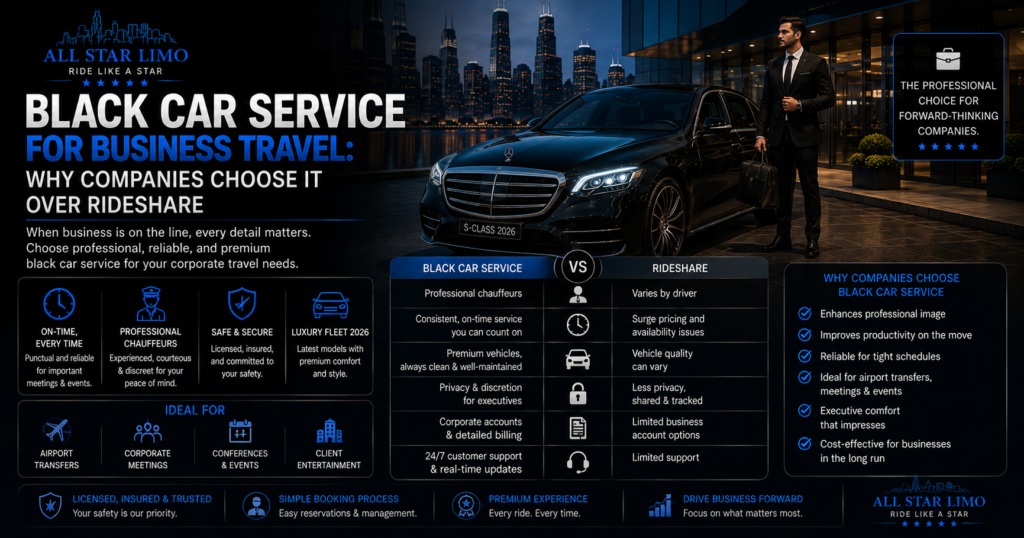
Companies increasingly move corporate ground transportation off rideshare apps and onto black car service for reasons that go beyond comfort — reliability and on-time performance, clearer liability and insurance coverage, simplified expense reporting through consolidated billing, and vetted, consistent drivers who understand professional discretion. Rideshare still has a place in business travel, but usually for different situations than the ones black car service is built to handle. This guide walks through the actual reasoning companies use when making this decision.
The shift away from rideshare for business travel isn’t primarily about status or luxury — it’s a practical response to specific pain points that build up over time with an on-demand consumer app used for professional purposes. This guide breaks down the reliability, liability, billing, and confidentiality reasoning that leads many companies to formalize corporate transportation through a black car service rather than defaulting to whatever rideshare driver happens to be nearby, along with a candid look at when rideshare genuinely remains the better choice.
Reliability & On-Time Guarantees
For business travel specifically, punctuality isn’t just a preference — it directly affects whether a meeting happens on time, whether a flight is caught, and whether a client’s first impression of your company is a positive one.
Pre-scheduled pickups remove the uncertainty of on-demand requests. A rideshare booking depends on driver availability at the exact moment you request it — during high-demand periods (rush hour, bad weather, major local events), this can mean a longer-than-expected wait or a driver assigned from further away than ideal. A black car service booking is scheduled and confirmed in advance, meaning the vehicle and driver are already planned around your specific pickup time rather than competing with real-time demand.
Flight tracking for airport-based business trips removes a common failure point. Rideshare doesn’t track your flight — you request a ride after landing, meaning any delay in deplaning, baggage claim, or customs adds to a wait that starts only once you actually request the ride. A black car service with flight tracking has your pickup adjusted automatically based on your actual arrival time, so a delayed flight doesn’t create an additional wait on top of the flight delay itself.
Consistency in vehicle and driver standards matters for a full day of travel. A single business trip might involve an airport pickup, a client meeting, and a return trip — potentially with three or more separate rideshare requests, each with a different driver and vehicle. A black car service booking, particularly for a multi-stop or full-day itinerary, typically maintains the same driver and vehicle throughout, reducing the number of variables that could introduce a delay or inconsistency across the day.
A track record of on-time performance is something a company can actually evaluate over repeated use. Because black car service typically involves an ongoing business relationship rather than a one-off app request, companies can assess a provider’s actual on-time reliability over multiple trips — a kind of accountability and performance history that isn’t really available with rideshare, where each ride is an independent, anonymous transaction with a different driver.
Liability & Insurance Considerations
This is one of the less visible but genuinely significant reasons companies formalize business travel through a professional car service rather than relying on rideshare or personal vehicles.
Commercial insurance coverage differs meaningfully from rideshare’s insurance structure. Professional black car services carry commercial auto insurance specifically structured around for-hire passenger transportation, with coverage limits and terms designed for business use. Rideshare insurance operates under a different, tiered structure that can vary based on the specific phase of the trip (whether the driver has accepted a ride, is en route, or has a passenger in the vehicle), which has historically created some ambiguity in liability scenarios that a corporate travel policy may want to avoid entirely.
Duty-of-care considerations increasingly factor into corporate travel policy. Many companies have a formal or informal duty-of-care obligation toward employees during business travel — a responsibility to take reasonable steps to ensure their safety while traveling for work purposes. Using a vetted, commercially insured, professionally licensed transportation provider is one concrete way companies address this obligation, compared to employees independently choosing whatever rideshare option is available in the moment.
Vendor accountability is clearer with a formal business relationship. When a company works directly with a car service provider — rather than employees expensing individual rideshare receipts — there’s a defined point of contact, a service agreement, and accountability structure in place if something goes wrong. This is a meaningfully different liability posture than an employee independently hailing a rideshare, where the company’s only connection to the trip is an after-the-fact expense reimbursement.
Background-checked, professionally licensed drivers reduce a category of risk. While rideshare platforms do conduct their own driver screening, a dedicated black car service typically has additional professional licensing requirements and often a more rigorous, ongoing vetting process specific to commercial passenger transportation — relevant context for a company weighing which service to formalize as its standard business travel option.
None of this means rideshare is inherently unsafe — millions of rideshare trips, including business trips, occur without incident. The distinction is about formal risk management: a company establishing black car service as its standard corporate travel option is making a deliberate choice about insurance structure, vendor accountability, and duty-of-care documentation, rather than leaving each individual trip’s liability profile to whatever rideshare driver happens to accept the request.
Consolidated Corporate Billing
Expense management is one of the more practical, day-to-day reasons finance and travel-management teams push for a formal transportation vendor rather than dozens of individual employee rideshare receipts.
A single monthly invoice replaces scattered individual expense reports. Rather than each employee expensing separate rideshare charges — each requiring individual receipt submission, categorization, and approval — a corporate account with a black car service typically consolidates all trips into a single, itemized invoice, dramatically simplifying the accounting and approval process.
Trip-level detail supports better cost tracking and policy compliance. A consolidated corporate account generally provides visibility into which employees are using the service, for what purpose, and how costs are trending — a level of reporting granularity that’s harder to achieve when transportation spend is scattered across individual employee expense submissions with inconsistent detail.
Predictable pricing supports budgeting in a way rideshare’s dynamic pricing doesn’t. Corporate black car accounts often negotiate flat rates for common routes or a standard hourly rate, giving finance teams a predictable cost basis. Rideshare’s surge pricing, by contrast, means the same trip can cost significantly different amounts depending on when it’s booked, complicating both individual expense predictability and broader travel budget forecasting.
Setting this up as a standing arrangement is its own decision with its own considerations — how the account is structured, invoicing frequency, and onboarding process. For a full breakdown of how a standing corporate transportation account actually works, see our dedicated guide to corporate chauffeur accounts, which covers billing structure and setup in more depth than is practical to repeat here.
Driver Vetting & Client Confidentiality
For certain kinds of business travel — executive transportation, client-facing trips, or situations involving sensitive information — who’s driving and how discreet they are becomes a real consideration, not just a comfort preference.
Professional chauffeurs are typically trained around discretion as a core job expectation, not just safe driving. This includes not engaging passengers in unwanted conversation, maintaining privacy around passenger conversations or phone calls conducted during the ride, and generally understanding that a business traveler’s time in the vehicle may involve confidential work.
Consistency in drivers builds a level of trust over repeated use that a rotating rideshare pool doesn’t offer. Companies using the same black car service repeatedly, particularly for executive travel, often develop familiarity with specific drivers who understand the company’s expectations, preferred routes, and general preferences — a relationship that simply doesn’t develop with an anonymous, constantly rotating rideshare driver pool.
Background screening standards are a reasonable point of comparison between providers. For any company evaluating a black car service specifically for executive or client-facing travel, it’s reasonable to ask directly about the specific background check and driving record review process used for driver hiring, rather than assuming all professional services vet drivers to the same standard.
Client-facing situations carry an added reputational dimension. When a company is transporting a client — picking someone up from the airport, driving them between meetings — the transportation itself becomes part of the client’s impression of the company. A polished, professional, reliable transportation experience reflects on the hosting company in a way that an inconsistent rideshare experience doesn’t offer the same control over.
Confidentiality matters most in specific high-stakes scenarios — M&A discussions, legal proceedings, executive recruiting, or any situation where sensitive conversations might occur during transit. For these specific scenarios, some companies go further and discuss explicit confidentiality expectations directly with their transportation provider, treating the arrangement similarly to other vendor relationships involving sensitive information.
Related Guide: How Luxury Chicago Limo Ensures Stress-Free Prom Transportation
When Rideshare Still Makes Sense
None of the reasoning above means rideshare has no place in business travel — for many situations, it remains a perfectly reasonable, even preferable, option.
Low-stakes, short, simple trips. A quick trip to a nearby restaurant for a casual team lunch, or a short hop where none of the reliability, liability, or confidentiality considerations above are particularly relevant, is often just as well served by rideshare as by a formally booked black car.
Highly unpredictable or last-minute schedules with minimal advance notice. For a trip that genuinely can’t be planned even a short time ahead, rideshare’s on-demand model has a real structural advantage — though as covered elsewhere, black car services can often accommodate same-day requests reasonably well too, so this advantage is smaller than it might initially seem.
Cost-sensitive, high-volume individual travel where consolidated billing isn’t the priority. For a company without the volume of corporate travel to justify setting up a formal account, or for occasional, lower-stakes individual trips, the overhead of a formal vendor relationship may not be worth it compared to simply expensing individual rideshare trips.
Markets or situations where black car service coverage is limited. In some smaller markets or less common travel scenarios, rideshare’s broader driver network may offer more consistent availability than a market’s black car service options, depending on the specific location and provider capacity.
The practical framework many companies land on: rideshare for casual, low-stakes, unplanned trips, and a formal black car service arrangement for higher-stakes travel — airport transfers, client-facing trips, executive travel, and situations where reliability, liability clarity, and consolidated billing genuinely matter. This isn’t an all-or-nothing choice; many companies use both, deployed based on the specific trip’s actual requirements rather than defaulting to one option for everything.
How to Evaluate a Black Car Provider for Corporate Use
If the reasoning above makes a formal black car arrangement worth considering, a few specific questions help evaluate whether a given provider is actually suited to corporate travel needs.
- What’s your on-time performance track record, and can you provide references from other corporate clients? A provider confident in their reliability should be able to speak to this concretely rather than only in general marketing language.
- What does your commercial insurance coverage look like, and can you provide documentation? This is a standard, reasonable request for any company formalizing a transportation vendor relationship.
- What’s your driver background check and vetting process? Ask for specifics rather than accepting a general assurance that drivers are “vetted.”
- How does your corporate billing and reporting work? Confirm whether consolidated invoicing, trip-level reporting, and any cost controls or spending limits are available and how they’re structured.
- Can you accommodate both scheduled and occasional same-day corporate requests? Even with a standing account, flexibility for last-minute needs matters for real-world business travel patterns.
- Do you have experience with executive or client-facing transportation specifically, if that’s relevant to your needs? A provider used primarily for standard airport transfers may have less experience with the discretion and consistency expectations of higher-stakes executive travel.

Productivity During Transit — An Underrated Business Case
Beyond reliability and liability, there’s a more direct productivity argument for black car service that often gets less attention than it deserves in this comparison.
A consistent, quiet vehicle environment supports actual work during transit. A scheduled black car trip, particularly with a driver experienced in professional transportation, tends to offer a more consistently quiet, work-friendly environment than an on-demand rideshare, where conversation levels, music preferences, and overall ride experience vary considerably by driver.
Wi-Fi and charging reliability matters more for business use specifically. As covered in more general terms elsewhere, in-vehicle Wi-Fi and charging vary by provider and vehicle, but a corporate account with a known, vetted fleet allows a company to confirm connectivity standards in advance — useful for executives who need to reliably work, take calls, or join virtual meetings during transit, rather than discovering inconsistent connectivity on an ad hoc rideshare basis.
Multi-stop days benefit from route and schedule familiarity. For an executive with a day involving several meetings across a city, a driver who understands the full day’s itinerary — rather than a series of independent, disconnected rideshare requests — can better manage timing between stops, account for traffic patterns across the specific route, and generally support a smoother overall day rather than treating each leg as an isolated trip.
The cumulative time savings across a business trip add up. Even small inefficiencies — a slightly longer rideshare wait time, a driver unfamiliar with an efficient route, inconsistent vehicle quality affecting comfort and ability to work — compound across a full day or a multi-day business trip in a way that’s easy to underestimate when comparing options purely on a per-trip cost basis.
For time-sensitive executives specifically, the value of not having to think about transportation logistics is itself a form of productivity. Not needing to open an app, confirm a driver, track an ETA, or manage payment for each individual leg of a business day frees up attention that can go toward actual work — a less tangible but real factor in why many executives and their assistants prefer a standing black car arrangement over managing rideshare independently throughout a travel day.
Industry-Specific Considerations
Certain industries have particular reasons to weigh this decision more carefully than others, given the nature of their work and travel patterns.
Legal and financial services:
Client confidentiality, the sensitivity of conversations that might occur during a ride between meetings, and often a higher baseline expectation around professional presentation make the discretion and consistency arguments particularly relevant for firms in these industries.
Healthcare and pharmaceutical:
Executive travel in these industries sometimes involves sensitive product or regulatory discussions, and the same confidentiality reasoning that applies to legal and financial services often extends here as well, alongside general executive travel volume that can justify a standing account.
Consulting and professional services:
High travel volume, frequent client-facing trips, and a strong professional-presentation expectation make consolidated billing and driver reliability particularly valuable for firms where consultants are traveling extensively and need transportation that doesn’t add friction to an already demanding schedule.
Technology and startups:
These companies sometimes lean more heavily on rideshare initially due to cost sensitivity and less formal travel policies, but often transition toward a formal black car arrangement as they scale, particularly once executive and investor-facing travel becomes more frequent and the reputational value of consistent, professional transportation becomes more apparent.
Event and conference-heavy industries:
Companies with frequent conference attendance, trade shows, or offsite events benefit particularly from the group transportation and multi-stop coordination that black car and broader chauffeur services can offer, beyond just individual point-to-point business travel.
None of this means any particular industry must use one option exclusively — but understanding which industry-specific factors apply to your own company’s travel patterns helps clarify how strongly the reliability, liability, and confidentiality arguments actually apply to your specific situation, versus being general considerations that may matter less for a given company’s actual travel needs.
Related Guide: Same-Day Last-Minute Black Car Booking Chicago
Measuring Whether the Switch Is Worth It for Your Company
For a company weighing whether to formalize black car service as its standard business travel option, a few practical measures help make the decision concrete rather than purely conceptual.
Track current rideshare spend and administrative time:
Before comparing costs, get an accurate picture of what business travel via rideshare actually costs today — not just the fare totals, but the administrative time spent processing individual expense reports, which is often underestimated when transportation spend is scattered across many small transactions.
Estimate the volume threshold where consolidation pays off:
A rough rule of thumb many finance teams use: once monthly business-travel rideshare spend across the company reaches a level where the administrative overhead of processing dozens of individual expense reports becomes a meaningful time cost, a consolidated account often pays for itself in administrative efficiency alone, before even factoring in the reliability and liability considerations.
Pilot with a specific travel segment first:
Rather than switching all business travel at once, many companies start by moving a specific segment — executive travel, client-facing trips, or airport transfers specifically — to a formal black car arrangement, evaluating the experience before expanding it company-wide.
Gather direct feedback from frequent business travelers:
Employees who travel often for work have direct experience with both rideshare and any formal transportation options tried, and their feedback on reliability, comfort, and overall experience is a valuable data point beyond pure cost comparison.
Revisit the arrangement periodically rather than treating it as a permanent, unreviewed decision;
Business travel patterns change, and periodically reassessing whether a standing arrangement still fits current travel volume and needs — rather than assuming an initial setup remains optimal indefinitely — keeps the arrangement aligned with actual company needs over time.
Frequently Asked Questions
Is black car service actually safer than rideshare for business travel?
Both can be safe in practice, but black car service typically offers more formal liability structure — commercial insurance built for passenger transportation, defined vendor accountability, and often more rigorous driver vetting standards specific to professional chauffeur services. This formal structure is a meaningful factor for companies with duty-of-care obligations toward traveling employees.
Why would a company pay more for black car service when rideshare is often cheaper per trip?
The comparison isn’t purely about per-trip cost — consolidated billing reduces administrative overhead, predictable pricing supports budgeting better than rideshare’s dynamic pricing, and the reliability and liability considerations covered above have value that doesn’t show up directly in a per-trip price comparison.
Can a company use both rideshare and black car service depending on the situation?
Yes, and many companies do exactly this — rideshare for low-stakes, casual, or highly last-minute trips, and a formal black car arrangement for higher-stakes travel like client-facing trips, executive transportation, and airport transfers where reliability and billing consolidation matter more.
How does consolidated corporate billing actually work with a black car service?
This typically involves setting up a standing account with the provider, after which trips are billed to a single monthly invoice rather than individual employee expense reports. For a detailed breakdown of how this setup process works, see our full guide to corporate chauffeur accounts.
Is black car service only worth it for large companies with high travel volume?
Not necessarily — even companies with moderate travel volume can benefit from the reliability and liability considerations covered here, though the case for a formal standing account (as opposed to booking individual trips as needed) does become stronger with higher volume, given the administrative benefits of consolidated billing.
Does using a formal black car service actually reduce a company’s legal liability compared to rideshare?
It can contribute to a stronger duty-of-care position, since a formally vetted vendor with commercial insurance and defined accountability offers more documented risk management than an employee independently choosing a rideshare option. That said, this is a general consideration rather than a guarantee, and companies with specific legal concerns should discuss their particular situation with legal counsel rather than relying solely on general industry reasoning.
How does black car service handle multi-city or multi-day business trips?
Many providers can coordinate transportation across a multi-day itinerary, sometimes partnering with providers in other cities for trips outside their primary service area. Discuss your specific itinerary with a provider in advance to understand how they handle any legs of the trip outside their direct coverage area.
What’s the typical onboarding process for setting up corporate black car service for the first time?
This varies by provider, but generally involves an initial conversation about your company’s travel patterns and needs, setting up billing and account details, and establishing any specific preferences (preferred vehicle types, confidentiality expectations, standard routes). Our dedicated corporate account guide covers this process in more detail.
Give Your Business Travel the Reliability It Deserves
Whether you’re formalizing corporate transportation for the first time or comparing options for a specific high-stakes trip, the case for black car service comes down to reliability, clear liability structure, and simplified billing — exactly the factors that matter most for business travel.
Related reading:
Related Guide: Professional Driver vs. Self-Driving Long Trips