Chicago , il

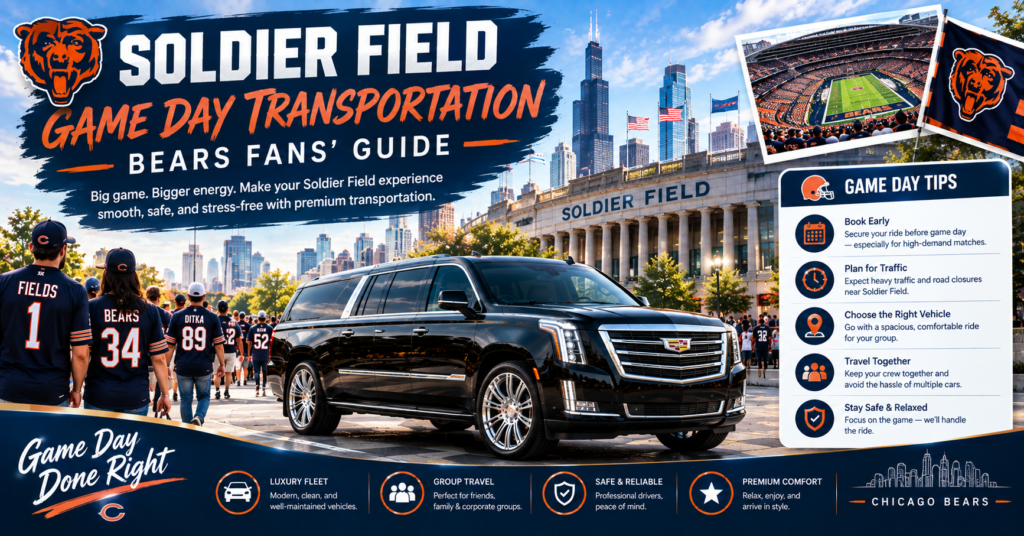
The smoothest drop-off points on Bears game day are near the McFetridge Drive and Waldron Drive entrances to Museum Campus, and it’s worth budgeting an extra 45–60 minutes beyond normal drive time because of Lake Shore Drive closures that start ramping up in the hours before kickoff. The return trip is usually the harder half of the day — plan your pickup location and timing before the final whistle, not after.
Soldier Field is, without much competition, the toughest stadium drive in Chicago. It’s not just the game-day crowd — it’s that Soldier Field sits inside Museum Campus, sharing roads and access points with the Field Museum, Shedd Aquarium, and Adler Planetarium, all funneling into the same narrow stretch of Lake Shore Drive and Solidarity Drive. On a normal day, that’s manageable. On a Bears Sunday with 60,000+ fans converging at once, it’s a different problem entirely. This guide walks through what actually happens to traffic and access around Soldier Field on game day, and how to plan transportation so you’re not the fan still circling for a drop-off spot as kickoff happens.
Museum Campus Layout & Why It Gets So Congested on Game Days
Soldier Field isn’t a standalone stadium with its own dedicated access roads — it’s part of Museum Campus, a 57-acre lakefront park that also holds the Field Museum, Shedd Aquarium, and Adler Planetarium. All four attractions share the same limited road network: Solidarity Drive, McFetridge Drive, and Waldron Drive, all feeding off Lake Shore Drive.
On a normal weekday, this shared layout is barely noticeable. On a Bears home game day, it becomes the entire problem. Every vehicle headed to the game — private cars, rideshares, tailgate traffic, tour buses — is funneling through the same handful of access points that also serve museum visitors and general Museum Campus traffic that day. There’s no separate “stadium-only” road network the way many suburban or standalone stadiums have. Everyone is sharing the same narrow grid.
This matters for planning because it means the congestion isn’t limited to the immediate stadium perimeter — it backs up well before you even reach Museum Campus, often starting on the approach from the Loop or from Lake Shore Drive itself, long before you can see the stadium.
Lake Shore Drive Closures — What Changes Near Kickoff
Lake Shore Drive is the primary artery feeding Museum Campus, and it’s also where game-day changes have the biggest impact on your timing. In the hours before kickoff, traffic patterns shift as the area absorbs a massive spike in vehicle volume, and lanes or turn access near the stadium can be restricted or closely managed by traffic control to keep the flow of arriving fans moving safely.
The practical effect for anyone driving in: the closer you get to kickoff time, the more unpredictable Lake Shore Drive becomes in the immediate vicinity of Museum Campus. A drive that takes 15 minutes on a normal Sunday morning can stretch well past 45 minutes to an hour once you’re within the final mile or two of the stadium, purely from volume and controlled access points.
The most reliable way to handle this is to build in a wide buffer rather than trying to time your arrival precisely. If kickoff is at noon, treating 10:00–10:30 a.m. as your realistic arrival window — rather than 11:30 — gives you room to absorb delays without the stress of watching the clock while stuck in stalled traffic a half-mile from the gate.
Tailgate Lot Drop-off vs. Stadium Gate Drop-off
One of the first practical decisions for game day is whether you’re being dropped at a tailgate lot before the game or going straight to a stadium gate closer to kickoff — and each comes with different timing considerations.
Tailgate lot drop-off:
If your group tailgates before the game, you’ll want an earlier drop-off, well ahead of the worst congestion window, so you’re not fighting traffic just to reach the lot. Tailgate lots also mean a later pickup point conversation — you’ll want your vehicle to know whether it’s returning to the same lot after the game or meeting your group somewhere else entirely, since tailgate lots empty out slowly and can be their own bottleneck after the final whistle.
Direct stadium gate drop-off;
If you’re skipping the tailgate and heading straight to your seats, a closer drop-off nearer to your specific gate makes more sense — but this is exactly the window where Lake Shore Drive congestion is heaviest, since it overlaps with the peak arrival surge in the final hour before kickoff. Building in extra time here matters even more than for an earlier tailgate drop-off.
Whichever you choose, communicating it clearly when you book — tailgate lot versus a specific gate, and roughly what time you actually need to be there — lets a professional driver plan the approach and avoid the worst of the access-point bottlenecks rather than guessing on the day.
Private Car vs. Rideshare vs. CTA — What Actually Works Best Here
Chicago fans have three realistic options for getting to Soldier Field, and each behaves differently once game-day volume hits Museum Campus.
CTA (public transit):
Chicago’s transit system runs extra service on Bears game days, and for fans without a lot of gear or a large group, it can be a genuinely efficient option — it bypasses road congestion entirely by using dedicated transit routes. The trade-off is capacity and comfort: trains and buses get extremely crowded on game day, and it’s not a practical option for larger groups, elderly fans, or anyone carrying tailgate equipment.
Rideshare apps:
Rideshare struggles specifically in the Museum Campus environment because of how pooled dispatch works in a high-demand, congested zone. Surge pricing spikes heavily around kickoff and again immediately after the game, and the biggest pain point fans report isn’t the ride there — it’s the wait for a driver to actually reach you in a designated pickup zone that thousands of other fans are also trying to use simultaneously after the final whistle.
A private, pre-scheduled vehicle:
This is where a booked chauffeur service has a structural advantage specific to this venue: the pickup time and location are set in advance, so there’s no competing with the entire stadium crowd for the same on-demand driver pool at the exact moment everyone else wants one too. A driver who already knows the Museum Campus access points and closure patterns can also route around the worst congestion rather than following a generic navigation app that doesn’t account for game-day-specific closures.
For a solo fan or a pair, any of these three can work depending on your priorities. For a group, a private vehicle scaled to your group size — rather than splitting across multiple rideshares in a congested pickup zone — tends to be both simpler and more predictable.
Corporate Suite & Group Transportation for Bears Games
Corporate suite holders and larger groups face a slightly different set of logistics than a couple of fans in general seating. Suite access often comes with its own entrance and timing considerations, and a group of six, ten, or more people trying to coordinate arrival and departure independently multiplies the chances of someone getting stuck, separated, or late.
For groups this size, group transportation coordinated as a single booking solves most of the coordination problem outright — one vehicle, one drop-off time, one pickup plan, rather than trying to sync multiple personal cars or rideshares converging on the same congested drop zone at the same time. This is especially useful for corporate outings, client entertainment, or any group where arriving together — and leaving together — matters as much as the game itself.
If your group includes ten or more people, a larger vehicle built for the group rather than splitting into two or three smaller cars keeps everyone on the same schedule and avoids the classic game-day problem of half the group being ready to leave while the other half is still working through a packed concourse.
Timing Your Pickup After the Final Whistle (the Real Pain Point)
If there’s one part of Soldier Field logistics that catches fans off guard more than anything else, it’s the exit — not the arrival. Roughly 60,000+ people trying to leave Museum Campus within the same 20–30 minute window creates a bottleneck that dwarfs the pre-game traffic, and it hits every mode of transportation at once: parking lots, rideshare pickup zones, and transit stations all get slammed simultaneously.
A few things make the post-game exit meaningfully easier:
Plan your pickup location before the game starts, not after. Deciding where you’ll be picked up while you’re still walking out of the stadium wastes time you don’t have — designate a specific, easy-to-reach meeting point in advance, ideally somewhere slightly away from the most congested immediate stadium exits.
Expect the first 20–30 minutes after the final whistle to be the worst window. If your plans allow any flexibility, waiting even briefly before heading to your pickup point — grabbing a post-game drink or snack nearby — can mean the difference between sitting in gridlock and a comparatively smooth exit once the initial crowd surge clears.
A pre-scheduled vehicle removes the rideshare scramble entirely. This is the single biggest advantage of booking ahead for the return trip specifically — your driver already knows your pickup time and location, rather than you opening a rideshare app along with tens of thousands of other fans simultaneously requesting a ride from the same small pool of available drivers in a congested zone.
Communicate any post-game plans in advance. If your group is stopping somewhere before heading home — dinner, a bar, dropping people at different addresses — let your driver know ahead of time so the route and timing can be planned rather than adjusted on the fly in heavy traffic.
Early Season vs. Late Season Games — Weather & Traffic Differences
Bears home games run from September through December (and sometimes into January), and the conditions on any given Sunday can look very different depending on where in the season you are.
Early season (September–October):
Warmer weather typically means bigger tailgate crowds and more fans arriving well ahead of kickoff, which can actually spread out the traffic surge somewhat compared to a game where everyone arrives in the final hour. Expect a busier tailgate lot scene and plan accordingly if that’s part of your day.
Late season (November–December, into January):
Cold weather changes the pattern — fewer fans linger for extended tailgates, and arrivals tend to compress more tightly into the hour or so before kickoff, which can actually intensify the pre-game Lake Shore Drive congestion in a shorter window. Winter conditions also mean road surfaces and visibility can add their own delays on top of the usual game-day volume, so the extra time buffer matters even more for late-season games.
Weeknight games:
When the Bears play on a weeknight rather than Sunday, traffic dynamics shift again — you’re now dealing with regular weekday downtown commuter traffic layered on top of game-day volume, which can make the approach to Museum Campus even more congested than a typical Sunday, particularly if kickoff falls during the evening rush window.
Checking the specific game’s kickoff time and day of week — and adjusting your buffer accordingly — is worth the two minutes it takes, since a 7:20 p.m. Thursday game and a noon Sunday game behave very differently on the roads leading in.
Museum Campus on Game Day — What Else Is Happening Around You
Because Soldier Field shares its road network with the rest of Museum Campus, it’s worth knowing that the Field Museum, Shedd Aquarium, and Adler Planetarium are often operating normally on game days too, adding their own visitor traffic into the same shared streets. A family visiting the aquarium the same Sunday afternoon a Bears game kicks off is navigating the exact same Solidarity Drive and McFetridge Drive bottlenecks as fans headed to the stadium — which is part of why this specific stretch of lakefront gets more congested, more consistently, than almost anywhere else in the city on a home game Sunday.
If your day includes anything beyond the game itself — a stop at one of the museums, lunch somewhere on the Museum Campus grounds — building that into your overall timing plan matters just as much as the stadium logistics themselves, since you’re sharing the same limited roads for both.
Comparing the Real Costs: Parking, Rideshare, and Private Car
Fans often default to whichever option seems cheapest on paper without accounting for the hidden time and hassle costs specific to Soldier Field. It’s worth laying out what each option actually involves.
Parking:
Official Soldier Field lots and nearby private lots vary widely in price depending on proximity to the stadium and how far ahead you book. The sticker price is only part of the story — the walk from a distant lot, the time spent finding a spot in a packed lot, and especially the post-game exit crawl (with thousands of cars trying to leave the same lot simultaneously) all add real time that doesn’t show up in the parking price itself.
Rideshare:
The base fare looks reasonable most of the day, but game-day surge pricing near Soldier Field can multiply the cost significantly, especially in the hour before kickoff and the 30–60 minutes after the final whistle — exactly when demand peaks hardest. Factor in wait time for a driver to actually reach a congested pickup zone, and the “cheap” option often isn’t cheap or fast on game day specifically.
Private, pre-scheduled car service:
The price is set upfront regardless of game-day surge conditions, and it eliminates the two most frustrating parts of the day — hunting for parking and competing for a rideshare driver in a crowded pickup zone. For a group, splitting a single vehicle’s cost across several people often works out comparable to, or cheaper than, several individual rideshare fares at surge pricing, with none of the coordination headache of a group trying to meet up at a single rideshare pickup point.
There’s no universally “cheapest” option — it depends on group size, how far you’re traveling, and how much your time and stress tolerance are worth on a Sunday afternoon. But it’s worth running the comparison honestly rather than assuming rideshare or parking is automatically the budget-friendly choice, since game-day pricing and delays change the math significantly from a normal weekday trip.
Getting to Soldier Field From the Suburbs
A meaningful share of Bears fans are coming in from the suburbs rather than starting downtown, and that adds an extra layer of planning on top of the Museum Campus congestion itself.
Northwest suburbs (Schaumburg, Arlington Heights, Des Plaines):
Expect highway traffic building well before you reach the city, especially combined with any regular weekend congestion on I-90 or the Kennedy Expressway heading toward downtown, before you even reach the Museum Campus bottleneck.
Western suburbs (Oak Park, Naperville, Elmhurst):
Routes in via I-290 or the Eisenhower Expressway funnel into downtown traffic before connecting toward Lake Shore Drive, so the same early-buffer logic applies — the last mile into Museum Campus is rarely the only slow part of the trip.
Southern suburbs (Orland Park, Tinley Park, Homewood):
These routes often have a more direct shot toward Soldier Field via the Dan Ryan or Bishop Ford, but that can mean hitting Museum Campus congestion with less advance warning if you haven’t built in enough buffer time from the start.
For suburban fans, a private vehicle has a particular advantage: a single pickup at your home or a convenient meeting point removes the need to first drive downtown, then deal with parking or rideshare logistics on top of an already longer trip. It turns a two-stage hassle (get downtown, then get to the stadium) into one continuous, planned trip door-to-door.
Booking Transportation for Bears Games
Whether you’re a solo season-ticket holder, a tailgating group, or a corporate suite booking transportation for clients, the process is simplest when a few details are settled before you book:
- Kickoff time and whether it’s a Sunday, weeknight, or weekend game
- Tailgate lot drop-off versus a direct stadium gate
- Group size and whether everyone’s traveling together for the full day
- Planned pickup time and location after the game, including any flexibility around the immediate post-game crowd surge
- Any stops planned before or after the game
Our Chicago events limo service covers Soldier Field alongside the city’s other major venues, with vehicles sized for everything from a couple of fans to a full corporate group. For larger parties needing coordinated, multi-passenger logistics for the full game day, group transportation keeps everyone on one schedule rather than splitting across separate rides. And if you’re coming from one of the surrounding suburbs, our service area coverage shows where pickup is available across Chicagoland.
Frequently Asked Questions
Where’s the best drop-off point near Soldier Field on game day?
The McFetridge Drive and Waldron Drive entrances to Museum Campus tend to offer the most workable access, though the best specific point depends on whether you’re headed to a tailgate lot or directly to a stadium gate. A driver familiar with the venue can route to whichever access point best matches your plans and the day’s closure pattern.
How early do Lake Shore Drive closures start before kickoff?
Traffic control and access changes around Museum Campus typically begin ramping up several hours before kickoff and intensify sharply in the final hour before the game starts. Building in a 45–60 minute buffer beyond normal drive time is a reasonable rule of thumb for any Bears home game.
Is it faster to take a private car or rideshare to Soldier Field?
For the approach to the game, both face the same road congestion, so the time difference is often minimal. The bigger difference shows up after the game — a pre-scheduled private vehicle avoids the post-game rideshare scramble, where surge pricing and driver availability both get squeezed by the entire stadium crowd requesting rides at once.
How do group or suite bookings work for Bears games?
Group transportation is typically booked as a single reservation covering the full group, with one pickup and one drop-off plan rather than coordinating multiple separate vehicles. This works well for corporate suite holders and larger tailgate groups who want everyone arriving and leaving together.
How long does it take to get out of Museum Campus after the game?
The first 20–30 minutes after the final whistle are typically the most congested, as the full stadium crowd exits simultaneously. Traffic generally eases noticeably after that initial window, which is why many fans find a short delay before heading to their pickup point works better than trying to leave the instant the game ends.
Does private car service cost more than parking on game day?
It depends on the specific game and parking lot, since Soldier Field parking pricing varies by proximity and game demand. A private vehicle removes the added logistics of finding a spot, walking from a distant lot, and navigating the post-game parking lot exit crush, which is a real time cost even when parking itself is available.
Book Your Bears Game Day Ride
Skip the parking hunt and the post-game rideshare scramble — get your pickup time and location locked in before kickoff.
Traveling with a larger group or corporate suite? See group transportation for Bears games, or check our full Chicagoland service area if you’re heading in from the suburbs.