
Chicago , il
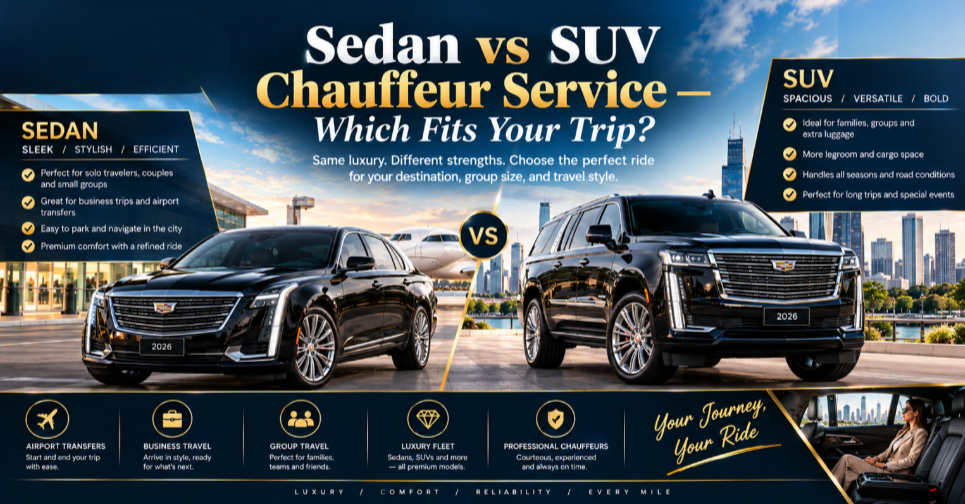
You’ve decided a chauffeured ride makes more sense than driving yourself, parking, or gambling on a rideshare. Good call. But the moment you open a booking form, you hit a second decision that trips up more travelers than it should: sedan or SUV?
They’re the two most-booked vehicle classes in Chicago’s chauffeur industry, and on paper they look interchangeable — both are black, both are luxury, both come with a professional driver. In practice, they’re built for different trips. Picking the wrong one doesn’t ruin your ride, but it can mean a cramped back seat with your knees against the console, a trunk that won’t close over your luggage, or paying more for space you didn’t need.
This guide breaks the decision down by the factors that actually matter: how many people are riding, how much you’re bringing, what the weather’s doing, and what kind of impression you’re trying to make. If you’re also weighing a Sprinter van or a stretch limousine, our full vehicle comparison guide covers the entire fleet range — this piece stays focused on the two vehicles most people are actually choosing between.
Book a sedan: if you’re traveling solo or as a pair, carrying one or two standard suitcases, and the trip is a smooth city route — think a downtown business meeting or a standard airport run in good weather.
Book an SUV: if you have three or more passengers, extra luggage or golf clubs and garment bags, you’re traveling in winter, or you simply want more road presence and a higher ride height. As a rule of thumb: when you start doing mental math about whether the trunk will close, you’ve already answered the question — go with the SUV.
Neither is objectively “better.” They’re built for different jobs, and the right call depends entirely on your specific trip.
Passenger Capacity — Where the Real Cutoff Is
An executive sedan is rated for up to three passengers, but that’s a legal capacity, not a comfortable one. In practice, a sedan works best for one or two riders. Add a third adult in the back seat and you’re looking at a genuinely tight fit for anything beyond a short hop — knees against the front seat, shoulders touching, no real elbow room.
An SUV like a Cadillac Escalade, Lincoln Navigator, or Chevrolet Suburban comfortably seats up to six passengers with proper legroom throughout, not just in the front two rows. That’s the real dividing line: if your group is three or more people, the SUV isn’t a luxury upgrade — it’s the vehicle that actually fits.
There’s a secondary consideration here too. A sedan puts everyone close together, which is fine for a couple or two colleagues who know each other well. An SUV’s extra width and captain’s-chair-style seating in some models gives each passenger more personal space, which matters more than people expect on a 40-minute airport run with people who aren’t used to sitting shoulder-to-shoulder.
Bottom line: two passengers or fewer, a sedan works well. Three or more, move to an SUV.
Luggage Space — Why an SUV Wins More Often Than You’d Think
This is the factor people most consistently underestimate when booking. A sedan’s trunk fits two standard-sized suitcases plus a carry-on or two — enough for a single business traveler on a short trip. It is not enough for a family heading to the airport with a week’s worth of luggage, or for two travelers each checking a large bag and bringing a garment bag for a wedding.
An SUV’s cargo area handles four or more full-sized suitcases, plus additional space for garment bags, golf clubs, or oversized items, without anything riding on laps or squeezing the back-seat passengers. If you’re unsure whether your luggage will fit a sedan, the honest answer is: it usually fits tighter than you’d like, and it’s a bad surprise to discover curbside at 5 a.m. before a flight.
A useful gut check before you book: lay out everything you’re bringing — every suitcase, bag, and box — and picture it in a standard car trunk, not an SUV trunk. If you’d need to fold a seat down or stack anything precariously, book the SUV. It costs a modest amount more and removes the guesswork entirely.
Winter & Weather Considerations
Chicago winters are a genuine factor in this decision, not a minor one. A sedan handles perfectly well on clear, salted roads — the vast majority of winter days. But during active snowfall, on unplowed suburban streets, or on the kind of icy morning that turns a normal 30-minute drive into an hour, an SUV’s higher ride height, all-wheel or four-wheel drive, and added weight give it a real traction and stability advantage.
This matters most for two specific situations:
- Early-morning airport departures in winter. If your flight is at 6 a.m. and there’s snow in the forecast, an SUV reduces the risk of a slow, white-knuckle drive to O’Hare or Midway.
- Suburban pickups off major roads. Side streets in Naperville, Schaumburg, or the south suburbs get plowed later than downtown arterials. An SUV handles that unplowed stretch with more confidence than a sedan.
If you’re booking a summer or early-fall trip, this factor mostly disappears — a sedan performs identically to an SUV on dry pavement. It’s specifically a November-through-March consideration in Chicago.
Business Trips — When a Sedan Signals the Right Impression
For a solo executive headed to a client meeting or an airport transfer ahead of a business trip, a sedan is often the more deliberate choice, not just the smaller one. An executive sedan — a Mercedes S-Class or similarly appointed vehicle — reads as understated and professional. It doesn’t call attention to itself the way a large black SUV can in certain settings, like arriving at a smaller downtown office or a quiet client dinner.
There’s also a practical efficiency angle: a sedan is easier to navigate through tight downtown streets, valet lines, and parking structures in areas like The Loop or River North, where every extra foot of vehicle length matters. If your itinerary involves several stops through dense downtown traffic, a sedan’s smaller footprint can genuinely shave a few minutes off each pickup and drop-off.
That said, this isn’t a hard rule. Plenty of executives specifically request an SUV for the additional presence it brings — arriving with a Cadillac Escalade or Lincoln Navigator sends a different, more commanding signal, and some corporate accounts standardize on SUVs for exactly that reason. The point isn’t that one vehicle is more “correct” for business — it’s that the choice itself communicates something, so it’s worth being deliberate about which impression you want to make.
Family or Group Trips — When an SUV Is the More Comfortable Default
For families, wedding parties, or any group of three or more traveling together, an SUV isn’t really competing with a sedan — the sedan is off the table on capacity alone. The real comparison at that point is SUV versus splitting the group across two vehicles, or moving up to a Sprinter van for larger groups.
A few scenarios worth flagging specifically:
- A family of four or five with luggage. This is the single most common case where people default to booking a sedan out of habit and then discover at pickup that it doesn’t work. One SUV comfortably solves this in a single vehicle.
- A small wedding party or bridal group. An SUV handles four to six people in formal wear more comfortably than a sedan, without garment bags getting crushed.
- Visiting relatives with kids and car seats. The additional interior width makes installing and accessing car seats significantly easier than in a sedan’s tighter back seat.
If your group exceeds six passengers, an SUV is no longer the right fit either — at that point, a Sprinter van or a full-size Sprinter limo is the correct comparison, not a second sedan.
Side-by-Side Comparison Table
| Factor | Executive Sedan | Luxury SUV |
|---|---|---|
| Comfortable passenger count | 1–2 (3 in a pinch, short trips only) | 3–6 |
| Luggage capacity | 2 standard suitcases + 1 carry-on | 4+ suitcases, plus garment bags/golf clubs |
| Winter road performance | Good on clear, salted roads | Stronger traction on snow/ice, unplowed streets |
| Downtown maneuverability | Easier in tight streets, valet lines | Slightly less nimble in dense traffic |
| Typical best use | Solo business travel, couples, short airport runs | Families, wedding parties, VIP arrivals, winter trips |
| Relative cost | Lower baseline rate | Moderately higher, more on flat-rate airport routes |
| Impression it makes | Understated, professional | Commanding, higher road presence |
This table is meant as a quick reference, not a replacement for thinking through your specific trip — a solo traveler who simply prefers an SUV’s ride height is just as valid a choice as someone following the “rules” above.
Real Trip Scenarios — What Chicago Riders Actually Book
Abstract guidelines are useful, but seeing how the decision plays out in real bookings often makes it click faster. Here’s how the choice tends to shake out across the kinds of trips All Star Limo handles most often.
The solo consultant flying out of O’Hare on a Tuesday morning:
One passenger, one rolling suitcase, one laptop bag, dry roads. This is the textbook sedan booking — nothing about the trip calls for extra space, and the sedan gets through Loop traffic to the airport with less bulk to maneuver.
A family of four flying to Orlando for spring break:
Two adults, two kids, four full-size suitcases, a stroller, and two carry-ons. A sedan trunk simply won’t close on that load. This is exactly the situation where people try to force it into a sedan to save a bit of money, then end up calling to switch vehicles the morning of the trip. Booking the SUV from the start avoids that entirely.
Two business partners headed to a downtown client dinner:
Light luggage (none, really — just briefcases), two passengers, a short trip through River North. A sedan is not just adequate here, it’s arguably the better choice — easier to valet, and it reads as appropriately understated for a client-facing evening.
A bridal party of five heading from a hotel to a ceremony:
Formal wear, garment bags, and five passengers who need room to sit without wrinkling anything. This is squarely SUV territory — a sedan would mean garment bags folded awkwardly across laps.
A January red-eye arrival at O’Hare with snow in the forecast:
Even for a single passenger with light luggage, this is a case where booking the SUV specifically for the winter-road advantage is worth the modest cost difference — particularly for a suburban drop-off after midnight, when side streets may not be plowed yet.
Common Booking Mistakes to Avoid
A few patterns come up often enough that they’re worth calling out directly:
- Underestimating luggage volume. People often mentally picture their luggage as smaller than it actually is once it’s all loaded together. If you’re rounding up the passenger count anyway, round up the vehicle class too.
- Booking a sedan for a group “because it’s cheaper,” then splitting into two cars anyway. If a group of four needs two sedans, that’s usually a similar or higher total cost than one SUV — and it means coordinating two pickups instead of one.
- Not accounting for return-trip luggage. If you’re heading to the airport light but returning with shopping bags, gifts, or additional items, it’s worth thinking about the return leg when choosing a vehicle, not just the outbound trip.
- Assuming “luxury” only means SUV. Some travelers default to an SUV assuming it’s the more premium option. An S-Class sedan is every bit as luxurious as an SUV — it’s simply built for a different passenger count.
How the Chauffeur Experience Differs Between the Two
The chauffeur’s job doesn’t change dramatically between a sedan and an SUV — professionalism, punctuality, and route knowledge stay consistent across the fleet. But a few practical differences show up in day-to-day service:
- Boarding and exiting. An SUV’s higher ride height means a small step up when boarding, which some passengers prefer and others (particularly in formal wear or with mobility considerations) find slightly less convenient than a sedan’s lower seat height.
- In-cabin conversation. A sedan’s more compact cabin naturally suits quieter, more private conversation for business calls or discussions en route. An SUV’s larger interior spreads passengers out a bit more, which works well for a family or group that isn’t trying to have a confidential conversation.
- Curbside loading time. An SUV with more luggage takes marginally longer to load and unload than a sedan with light bags — a minor factor, but worth building a few extra minutes into airport departure timing if you’re checking multiple bags into an SUV.
Cost Difference Between Sedan and SUV Chauffeur Rates
SUVs cost more than sedans, and it’s worth understanding why, so the price difference doesn’t feel arbitrary. The vehicles themselves cost more to purchase and maintain, they use more fuel, and they’re in higher demand for group and family bookings — all of which factor into the rate.
For a Chicago airport transfer, expect an SUV to run meaningfully higher than a comparable sedan transfer on the same route — the exact gap depends on distance and the specific SUV model. For hourly bookings, the per-hour rate difference tends to be more modest, since you’re paying primarily for time and the chauffeur’s service rather than vehicle-specific mileage.
The practical way to think about it: if you genuinely only need a sedan, paying for an SUV is money spent on space you won’t use. But if you’re on the edge — say, three passengers with moderate luggage — the small price step up to an SUV is usually worth it compared to the alternative of everyone being uncomfortable for the whole ride. For exact current rates by vehicle class and route, our pricing page has the full breakdown.
What’s Actually in Each Fleet Category
It helps to know what you’re choosing between in concrete terms, not just the abstract categories “sedan” and “SUV.”
Executive sedans:
In a professional Chicago chauffeur fleet typically mean a Mercedes-Benz S-Class or similarly appointed full-size luxury sedan. These are built for comfort over distance, with a quiet cabin, premium leather seating, and a trunk sized for business travel rather than family vacations. They seat up to three passengers, though two is the genuinely comfortable number.
Luxury SUVs:
Typically mean a Cadillac Escalade, Lincoln Navigator, or Chevrolet Suburban — full-size, three-row-capable vehicles with second-row captain’s chairs in many configurations. These comfortably seat up to six passengers with proper legroom, and their cargo area is sized for real luggage volume, not just an overnight bag.
Between those two categories sits a genuine gray area some travelers overlook: if you’re consistently landing between “a sedan is a bit tight” and “an SUV feels like more than I need,” it’s worth asking directly when you book whether a specific vehicle’s second-row space or trunk dimensions fit your exact situation — fleet specs vary slightly by model year and vehicle.
Which Occasions Typically Call for Each
Beyond the general passenger-and-luggage math, certain recurring occasions tend to sort cleanly into one category or the other:
Typically sedan bookings:
- Solo airport transfers for business travel
- A couple heading to a dinner reservation or theater show
- A quick point-to-point ride between downtown meetings
- Anniversary or date-night transportation for two
Typically SUV bookings:
- Family airport transfers with checked luggage
- Small wedding party or bridal group transport
- Winter airport pickups, especially early morning or late night
- A VIP client arrival where road presence matters
- Group transportation for four to six colleagues heading to the same corporate event
There are always exceptions — a solo traveler who simply prefers an SUV’s ride height, or a couple who wants the extra room for a long-distance trip to Lake Geneva or Milwaukee — and that’s fine. These categories describe what most people end up booking, not a hard rule for what you have to book.
Quick Decision Checklist Before You Book
Run through these five questions. If you answer “yes” to any one of them, book the SUV. If the answer is “no” across the board, a sedan will serve you well.
- Are there three or more passengers?
- Do you have more than two standard suitcases, or any oversized items (golf clubs, garment bags, car seats)?
- Is it winter, or is snow or ice in the forecast for your pickup window?
- Do you want the extra road presence an SUV provides, whether for a business arrival or personal preference?
- Are you unsure whether your luggage will actually fit a sedan trunk?
If none of those apply — a solo or two-person trip, light luggage, dry roads, and no strong preference either way — a sedan is the more efficient, and typically more cost-effective, choice.
FAQ
Is a sedan or SUV better for an airport transfer with two suitcases?
A sedan comfortably handles two standard suitcases for one or two passengers. If you’re adding carry-ons, a third bag, or traveling as a family, an SUV gives you room to spare instead of cutting it close.
Does an SUV cost significantly more than a sedan?
There’s a real price difference, but it’s usually smaller than people expect, especially for hourly bookings. For exact rates by route and vehicle, check the pricing page.
Which is better for a winter airport trip in Chicago?
An SUV has a meaningful traction advantage in active snow or on unplowed suburban roads. For a clear winter day with salted roads, a sedan performs just as well.
Can a sedan comfortably fit 3 adults with carry-on luggage?
Technically yes, but it’s tight — three adults in a sedan’s back seat with luggage is workable for a short ride, not ideal for anything longer than 20–30 minutes.
Is an SUV overkill for a solo business trip?
Not overkill, but usually unnecessary. A sedan is the more efficient and typically more economical choice for one traveler, unless you specifically want the added presence an SUV provides for a client-facing arrival.
Can I switch from a sedan to an SUV after I’ve already booked?
In most cases, yes, as long as you reach out with enough notice before pickup. Vehicle availability isn’t guaranteed on short notice, so if you’re unsure at the time of booking and know your trip is luggage-heavy or a larger group, it’s safer to book the SUV upfront rather than plan to switch later.
Does an SUV feel less “formal” than a sedan for a business setting?
Not inherently — a well-maintained luxury SUV is still a premium, professional vehicle. The difference is more about presence than formality: a sedan reads as understated, an SUV reads as more commanding. Neither is wrong for a business context; it depends on the impression you want to make.
What if my group is exactly three people with moderate luggage?
This is the most common borderline case. Three passengers technically fit in a sedan, but with any real luggage, it’s a tight fit. Most travelers in this exact situation find the small cost step up to an SUV worth it for the additional comfort, especially on longer rides like a suburb-to-airport transfer.
Are child car seats easier to install in an SUV?
Generally yes. An SUV’s wider back seat and higher door opening make installing and accessing a car seat noticeably easier than in a sedan’s lower, tighter rear doors — worth factoring in if you’re traveling with young children.
Booking Tips for Getting the Right Vehicle the First Time
A few small habits make it far more likely you get the right vehicle on the first try, rather than discovering a mismatch at pickup:
Count your luggage before you book, not after:
It sounds obvious, but most sedan-vs-SUV mismatches happen because the booking was made days in advance, before packing was finished. If you’re booking early, round up rather than guessing low.
Mention special items when you book:
Golf clubs, oversized garment bags, car seats, or any item that isn’t a standard suitcase should be flagged at booking time, not discovered curbside. It takes one extra line in the booking notes and avoids a scramble later.
For return trips, think about what you’re bringing home:
An outbound sedan booking can turn into an uncomfortable return trip if you’re coming back with more than you left with — extra shopping, gifts, or event materials from a conference or trade show.
When in doubt, ask:
If you’re genuinely unsure whether your group and luggage will fit a sedan, a quick call to dispatch before booking is faster and more reliable than guessing. It’s a much smaller inconvenience than arriving curbside with a car that can’t hold everything.
Book winter trips with the season in mind, not just the date:
A pickup scheduled for a clear October afternoon doesn’t need the same consideration as one scheduled for a January morning with snow already in the forecast — build the season into the vehicle decision, not just the guest count.
Ready to Book?
Whichever vehicle fits your trip, All Star Limo has both ready 24/7 with flat-rate pricing, professional chauffeurs, and real-time flight tracking for airport transfers.
Reserve Your Sedan or SUV Now →
All Star Limo
All Star Limo offers reliable Chicago limo service and black car transportation for airport transfers, corporate travel, and special events across Chicago and the surrounding suburbs. Travel in comfort with our professional chauffeurs and luxury fleet of sedans, SUVs, and Sprinter vans.
Located
Call Us