Chicago , il

If you’re booking a flight to Chicago and your trip-planning app is showing you fares into two different airports, you’ve probably already asked the question: O’Hare or Midway — which one should I actually fly into?
It’s a fair question, and it’s one that trips up even people who’ve flown into Chicago before. The two airports sit on opposite sides of the city, they’re served by different mixes of airlines, and depending on your route, one can be noticeably cheaper — or noticeably more convenient — than the other. Picking wrong doesn’t ruin a trip, but it can mean an extra 30 minutes in traffic, a higher fare, or a longer walk from the gate to baggage claim than you expected.
This guide breaks the decision down the way we see it from the ground, literally — our chauffeurs run pickups at both airports every single day, so we know which one tends to work better for which kind of traveler.
O’Hare or Midway?
If you don’t have time to read the full comparison, here’s the short version:
- Fly into Midway if you’re booking a domestic trip on a low-cost or budget carrier, you’re headed downtown or to the south/southwest suburbs, and you want a shorter, usually cheaper airport commute.
- Fly into O’Hare if you’re booking an international flight, need a specific alliance or legacy carrier, are connecting through a major hub itinerary, or your final destination is in the north or northwest suburbs.
- On price, neither airport wins across the board — it depends entirely on your specific route and which airlines fly it. We’ll walk through how to actually compare fares below.
- On distance, Midway is closer to downtown Chicago for most travelers, and the drive is usually more predictable.
Now let’s get into the details, because “usually” and “often” aren’t good enough when you’re the one booking the ticket.
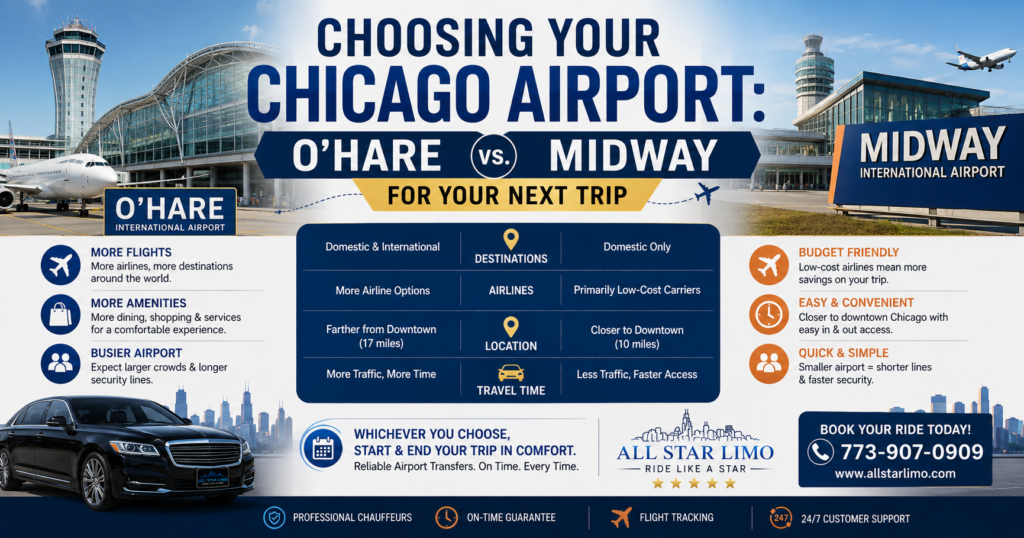
O’Hare vs. Midway at a Glance
| O’Hare (ORD) | Midway (MDW) | |
|---|---|---|
| Location | Northwest side of Chicago | Southwest side of Chicago |
| Distance to the Loop | ~17–20 miles | ~10–12 miles |
| Typical drive time downtown | 30–75 min (traffic-dependent) | 25–40 min (traffic-dependent) |
| Terminals | 4 active passenger terminals | 1 terminal |
| Dominant carriers | United, American | Southwest |
| International service | Extensive | Minimal to none |
| Best for | International trips, business travel, hub connections | Domestic point-to-point, budget fares, downtown/south-suburb trips |
| Airport size | One of the busiest airports in the world | Compact, single-terminal |
Keep this table in mind as you read through the rest of this guide — most of what follows is really an explanation of why each row looks the way it does, and how that translates into a real decision for your specific trip.
Airlines & Route Networks at Each Airport
The single biggest factor in choosing between O’Hare and Midway isn’t distance or price directly — it’s which airlines actually fly where you’re going. Everything else follows from that.
O’Hare International Airport (ORD)
O’Hare is one of the busiest airports in the world by flight operations, and it functions as a major hub for two of the largest carriers in the U.S.:
- United Airlines operates one of its largest domestic and international hubs out of O’Hare, with connections across North America, Europe, Asia, and Latin America.
- American Airlines also runs a significant hub at O’Hare, with heavy domestic coverage and a growing international network.
Because of this dual-hub setup, O’Hare has the deepest bench of international routes of any Chicago airport by a wide margin. If your trip involves a transatlantic or transpacific connection, or you’re booking through a legacy carrier’s mileage program, there’s a strong chance your itinerary routes through O’Hare regardless of your final destination.
O’Hare also hosts a long list of additional carriers — Delta, JetBlue, Alaska, and a rotating set of international flag carriers — which means more schedule options throughout the day, more backup flights if something gets cancelled, and generally more flexibility if your travel dates aren’t fixed.
The tradeoff: more airlines and more gates means more terminals to navigate. O’Hare runs four active passenger terminals spread across a large footprint, so depending on which terminal you land in and which one you need for a connection, you may be looking at a longer walk — or a shuttle ride between terminals — than you’d deal with at a smaller airport.
Midway International Airport (MDW)
Midway is Chicago‘s second airport, located on the city’s southwest side, and it runs on a very different model. Instead of being a legacy-carrier hub, Midway is dominated by low-cost and point-to-point carriers:
- Southwest Airlines is by far the largest operator at Midway and effectively anchors the airport’s schedule.
- Additional service comes from carriers like Delta and a smaller rotation of others, but Southwest’s presence is what defines Midway’s route map.
Because Southwest runs a point-to-point network rather than a traditional hub-and-spoke system, Midway is strong for direct domestic flights to a wide range of U.S. cities, but it has essentially no international long-haul presence. If you’re flying to another North American city on a straightforward, non-connecting itinerary, there’s a good chance Midway has a direct option — often at a fare that undercuts the equivalent O’Hare route.
Midway is also physically compact. It has a single terminal, which means no inter-terminal shuttles, shorter walks from check-in to gate, and generally a faster experience getting from curb to security — something that matters if you’re cutting it close on time or traveling with kids.
What this means for your booking
- Booking international? Start your search at O’Hare. It’s very likely your only real option for a direct long-haul flight, and even connecting itineraries usually route through ORD.
- Booking a domestic point-to-point trip, especially on Southwest? Check Midway first. You’ll often find a direct flight at a competitive price with less airport to navigate.
- Flying with a major airline’s rewards program (United MileagePlus, American AAdvantage)? You’re almost certainly flying O’Hare, since that’s where those airlines concentrate their Chicago schedules.
- Not sure which carrier has the better schedule for your dates? Search both airports separately rather than letting one aggregator app quietly default to one or the other — some search tools weight results toward the airport with more listed flights, which isn’t always the cheapest or most convenient one for your specific trip.
A closer look at O’Hare’s terminal layout
O’Hare‘s four active terminals are organized roughly by airline group: United operates out of Terminal 1, American out of Terminal 3, a mix of international and other domestic carriers out of Terminal 2 and Terminal 5 (the international terminal), and construction has been ongoing for years as part of the airport’s long-term expansion plan.
If you’re connecting between a domestic and international flight, or between two different airlines, double-check which terminal each leg departs from — the walk (or the shuttle ride via the Airport Transit System train) between, say, Terminal 1 and Terminal 5 is not a quick one. This is one of the more common reasons O’Hare connections feel more complicated than they look on paper, and it’s worth padding your connection time if your itinerary shows a terminal change.
Why alliance membership matters more at O’Hare
If you’re a frequent flyer chasing status or redeeming miles, the airline alliance behind your ticket matters more at O’Hare than at Midway, because it determines which terminal you’ll use and how smooth your connection will be. United anchors the Star Alliance presence at ORD, while American anchors One world. Southwest, which dominates Midway, isn’t part of a traditional global alliance in the same way, so Midway travelers generally don’t need to think about alliance logistics at all — one terminal, one set of gates, most connections are a short walk regardless of which flight you’re catching next.
Distance & Typical Drive Time to Downtown
This is where a lot of the “which airport is closer” searches come from, and the honest answer is: it depends on where in Chicago you’re actually headed, not just “downtown” in the abstract.
Midway to downtown
Midway sits roughly 10 to 12 miles southwest of the Loop. In light-to-moderate traffic, that translates to a drive time of roughly 25 to 40 minutes to downtown hotels and business districts, depending on time of day and exact destination. Midway’s shorter distance and simpler road access (via the Stevenson or Bishop Ford expressways, depending on your route) tend to make trip times more predictable than the equivalent O’Hare run — there’s less mileage for a rush-hour backup to eat into.
O’Hare to downtown
O’Hare is located about 17 to 20 miles northwest of the Loop, and while it’s closer to expressway access, the distance itself means more exposure to traffic on the Kennedy Expressway, which is one of the more congested stretches of highway in the region during weekday rush hours. A trip that takes 30 minutes at 10 PM on a Tuesday can stretch to 60–75 minutes during a Friday evening rush. O’Hare transfers generally need more buffer time built in, especially for anyone catching a flight rather than arriving on one.
Why “closer to downtown” isn’t the whole story
If your Chicago trip isn’t actually ending downtown, the “which airport is closer” question changes completely:
- Headed to the north or northwest suburbs (Schaumburg, Rosemont, Arlington Heights, Evanston)? O’Hare is almost certainly your shorter drive.
- Headed to the south or southwest suburbs (Orland Park, Tinley Park, Naperville, Oak Brook, Hinsdale)? Midway is typically the faster, more direct route, and in our experience running these transfers daily, it’s usually the airport our south-suburb clients prefer for exactly that reason.
- Staying at a downtown hotel or in The Loop, River North, or the Gold Coast? Midway edges out O’Hare on average drive time, but the gap narrows or disappears outside of peak traffic hours.
The practical takeaway: don’t just compare the two airports in isolation — compare each one against your actual final destination. A traveler headed to a conference at McCormick Place and a traveler headed to a client meeting in Naperville can have opposite “correct” answers to the same O’Hare-vs-Midway question.
Traffic patterns worth knowing before you book a pickup time
Chicago’s rush hours run roughly 6:30–9:30 AM and 3:30–6:30 PM on weekdays, and both airports feel the effect, just in different ways. The Kennedy Expressway into O’Hare is prone to slowdowns from merging traffic near the Edens Junction and from construction zones that seem to rotate year to year — it’s one of the more heavily trafficked corridors in the region. Midway’s access routes, primarily via the Stevenson Expressway or surface streets through the southwest side, see less of that bottleneck effect, though the Stevenson itself can back up during peak commute windows.
A rule of thumb our chauffeurs use: for an O’Hare departure during weekday rush hour, build in a minimum of 90 minutes of drive-time buffer from a downtown pickup; for Midway, 45–60 minutes is usually enough under the same conditions. Outside of rush hour, both airports run much closer to their baseline drive times.
Parking and curbside pickup differences
Midway’s compact, single-terminal design also extends to its parking and curbside setup — arrivals pickup is generally easier to navigate, with less circling and a shorter walk from baggage claim to the curb. O’Hare‘s larger footprint means more signage to read and, depending on your terminal, a longer walk or a shuttle connection to reach ground transportation pickup areas. This is one more reason business travelers on tight schedules often lean toward Midway when their route allows it — less time spent navigating the airport itself on either end of the trip.
Price Differences by Route
There’s no universal rule that says one Chicago airport is cheaper than the other — pricing depends heavily on the specific route, the airlines that serve it, and how far out you’re booking. That said, there are patterns worth knowing before you start comparing fares.
When Midway tends to be cheaper
Midway’s fare advantage usually shows up on domestic routes where Southwest has a strong, direct presence and where the O’Hare equivalent involves a legacy carrier without much low-cost competition on that specific city pair. Because Southwest doesn’t charge traditional change fees and often prices aggressively on routes it dominates, travelers booking flexible domestic trips frequently find better base fares — and lower total cost once baggage and change-fee policies are factored in — flying into Midway.
When O’Hare tends to be cheaper (or simply better value)
O’Hare can come out ahead on price in a few common situations:
- International routes, where O’Hare is often the only realistic option and the comparison isn’t really “cheaper vs. more expensive,” it’s “available vs. not available.”
- Routes with heavy competition among multiple carriers at O’Hare (United, American, Delta, JetBlue, and others all competing on the same city pair), which can push fares down even on a legacy-hub airport.
- Award travel and mileage redemptions, since O’Hare’s hub carriers typically offer more redemption inventory on their own metal out of their home hub.
How to actually compare fares before booking
- Search both airports separately rather than trusting one combined “Chicago” search to surface the true cheapest option — some booking engines don’t weight the two airports evenly.
- Check total cost, not just base fare. A Midway flight with a checked-bag fee can end up costing more than an O’Hare flight with bags included, depending on the airline.
- Factor in your ground transportation cost as part of the total trip price, not as an afterthought. If a cheaper Midway fare saves you $40 but the airport is significantly closer to your final destination, your total trip cost — flight plus transfer — usually favors Midway even further. Conversely, if a slightly pricier O’Hare fare gets you a nonstop instead of a connection, the time saved often outweighs the fare difference.
- Watch fare trends by season. O’Hare’s international routes fluctuate with peak travel seasons (summer, holidays) more than Midway’s domestic-heavy schedule, which tends to stay more stable.
None of this means you need to become a fare-tracking expert before every Chicago trip. It just means the “which airport is cheaper” question is really a “which airport serves my specific route better” question in disguise — and it’s worth a five-minute side-by-side search before you book.
A simple worked example
Say you’re flying from Chicago to a mid-size city like Nashville or Kansas City. On a route like that, you might see a Southwest flight out of Midway priced noticeably below a comparable United or American flight out of O’Hare — but the O’Hare flight might be nonstop while the Midway option requires a connection, or vice versa, depending on the day.
The “cheaper” ticket isn’t automatically the better value once you factor in an extra layover, a tighter connection window, or a bag fee that wasn’t in the base fare. Before you book, it’s worth pulling up both airports side by side for the same travel dates and comparing total itinerary time and total out-of-pocket cost — not just the headline fare.
Booking timing and how it affects your airport choice
Fare patterns can shift depending on how far out you book. O’Hare’s international routes and legacy-carrier domestic fares tend to move more with demand spikes around holidays and major events (conventions at McCormick Place, for example, can tighten hotel and flight availability across the board).
Midway’s Southwest-heavy schedule tends to hold steadier, predictable pricing further out, in part because Southwest’s fare structure doesn’t fluctuate with the same dynamic pricing swings as some legacy carriers. If you’re booking well in advance and flexibility matters more than a rock-bottom fare, that stability is worth factoring into your airport choice, not just the ticket price on the day you search.
Which Airport Fits Your Trip Type
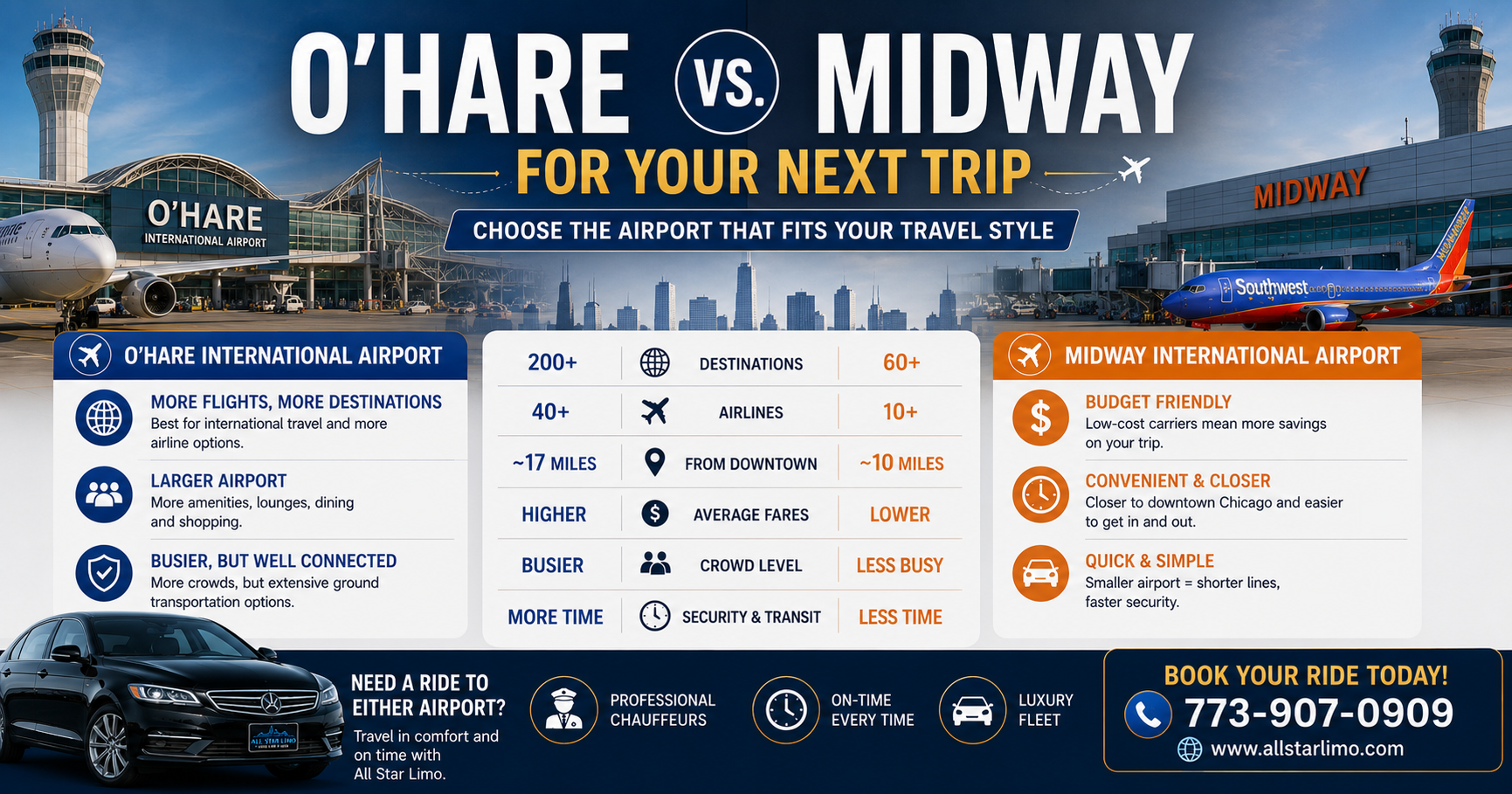
Different trips have different priorities. Here’s how the O’Hare-vs-Midway decision tends to shake out by traveler type, based on what we see booking transfers for both.
Business travelers
If you’re flying in for meetings and need predictable scheduling, the calculus usually favors O’Hare — more flight frequency throughout the day, more rebooking options if a meeting runs long or a flight gets delayed, and better access if your destination is a corporate campus in the northwest suburbs (a common location for Chicago-area headquarters). The tradeoff is traffic exposure on the Kennedy during peak commute hours, so business travelers booking O’Hare should build in extra buffer time for both the flight and the ground transfer, especially for early-morning departures or evening arrivals.
If your business trip is centered on downtown meetings and you’re not tied to a specific legacy carrier’s schedule, Midway can actually be the smarter choice — shorter transfer, single terminal, less time lost to airport logistics on a trip where every hour matters.
Leisure travelers
For most leisure trips — visiting family, a weekend getaway, a straightforward point-to-point vacation — Midway tends to be the more efficient choice, provided your route is served by Southwest or another Midway carrier. Lower fares, a simpler single-terminal layout, and a shorter drive to the neighborhoods where a lot of Chicago’s hotels and attractions are concentrated all work in its favor.
Families traveling with kids in particular tend to have an easier time at Midway simply because there’s less airport to move through — one terminal means less walking, fewer chances to get separated in a crowd, and a more manageable overall footprint.
International travelers
If any leg of your itinerary crosses an ocean, this one isn’t really a close call: O’Hare is the airport built for it. Between United’s and American’s international hub operations and the roster of foreign flag carriers that serve ORD, it’s the airport with the infrastructure — immigration, customs, international terminal facilities — to handle long-haul arrivals and departures. Midway simply doesn’t operate at that scale for international service, so for most international itineraries, the choice isn’t O’Hare-vs-Midway at all; it’s simply O’Hare.
Group and family travel
Larger groups traveling together — extended family reunions, wedding parties flying in from out of town, corporate offsites — tend to do better logistically at Midway when the route allows it, simply because it’s easier to keep a group together in a single terminal than to coordinate multiple people through O’Hare’s larger, more spread-out layout. That said, if the group is arriving from overseas or connecting through a hub itinerary, O’Hare becomes the default regardless of group size, and it’s worth arranging a single coordinated ground transfer — like a Sprinter van — rather than having everyone split into separate rides once they land.
Event and convention travel
If your trip to Chicago is tied to a specific event — a conference at McCormick Place, a trade show, a concert or sporting event downtown — your airport choice should weigh event location as heavily as flight price. McCormick Place and most downtown venues sit closer to Midway’s drive-time radius than O’Hare’s, so unless your only viable flight option lands at O’Hare, a Midway arrival can shave real time off your first day in the city. During major convention weeks, both airports see a spike in ground transportation demand, so booking your transfer in advance rather than trying to arrange one on arrival is worth doing regardless of which airport you land at.
How to Decide: A 3-Step Checklist
If you’ve read this far and still aren’t sure, here’s a quick way to land on an answer:
- Is any part of your trip international? If yes, book O’Hare and stop there — Midway isn’t a realistic option for long-haul international service.
- Where in Chicagoland are you actually headed? If it’s downtown, the south suburbs, or the southwest suburbs, lean Midway. If it’s the north or northwest suburbs, or you need a specific hub carrier’s schedule, lean O’Hare.
- Compare both airports for your exact travel dates before booking. Don’t assume — search Midway and O’Hare separately, compare total fare (including bags and fees) and total itinerary time, and factor in your ground transfer as part of the overall trip cost.
Most travelers land on the right airport just by working through those three questions in order. The cases that stay genuinely close — a domestic trip with decent options at both airports and a downtown destination — usually come down to which specific flight time and fare combination works best for your schedule, at which point either airport is a reasonable choice.
Frequently Asked Questions
Is Midway or O’Hare better overall?
Neither is universally “better” — it depends on your route, your final destination in Chicagoland, and whether your trip is domestic or international. Midway generally wins on shorter transfer times and often on price for domestic point-to-point routes; O’Hare wins on international access, airline variety, and flight frequency.
Are flights cheaper into Midway or O’Hare?
It varies by route. Midway often has an edge on domestic fares where Southwest competes directly, especially on routes without much competition at O’Hare. O’Hare can be competitive or cheaper on routes with multiple airlines fighting for the same city pair, and it’s typically the only option for international fares. Always compare both airports for your specific route before booking rather than assuming one is cheaper across the board.
Which Chicago airport is closer to downtown?
Midway is closer to downtown Chicago for most travelers, roughly 10–12 miles versus O’Hare’s 17–20 miles, which usually translates to a shorter and more predictable drive to the Loop, River North, or the Gold Coast. That said, if your final destination is in the north or northwest suburbs, O’Hare is often the closer, faster option instead.
Which airport has better airline options?
O’Hare has a broader mix of airlines overall, including United, American, Delta, JetBlue, and a range of international carriers, making it the stronger choice for schedule flexibility and international connections. Midway is dominated by Southwest, which gives it strong direct-route coverage for domestic point-to-point travel but a much narrower overall airline mix.
Is it faster to get through security at Midway or O’Hare?
Midway’s single-terminal layout generally makes for a faster, more straightforward walk from check-in to gate, since there’s no inter-terminal travel involved. O’Hare’s four terminals can mean a longer walk or a shuttle ride, particularly if you’re connecting between terminals, so travelers should build extra time into an O’Hare itinerary, especially during peak hours.
Can I fly into one Chicago airport and out of the other?
Yes, and some travelers do this deliberately to combine a cheaper fare on one leg with better flight timing on the other. Just keep in mind the two airports are roughly 20 miles apart on opposite sides of the city, so if your trip involves connecting between them yourself, plan for real drive time between ORD and MDW rather than assuming they’re close together.
Booking Your Ground Transportation
Once you’ve picked your airport, the last piece of the puzzle is getting to and from it without adding stress to your trip. Whichever airport you land at, we run flat-rate, chauffeured transfers with real-time flight tracking, so your driver is waiting whether your flight lands early, on time, or hours late.
- O’Hare Airport Limo Service — flat-rate transfers to and from all four ORD terminals, with meet-and-greet available for international arrivals.
- Midway Airport Limo Service — quick, flat-rate pickups and drop-offs for Midway’s single terminal, especially popular with our south-suburb clients.
- Chicago Airport Limo Service — a full overview of everything we cover across O’Hare, Midway, Chicago Executive, and DuPage Airport.
No surge pricing, no guessing what your ride will cost when you land — just a professional chauffeur waiting curbside. Book your airport transfer online or call (708) 998-6336 to check availability for your travel dates.