Chicago , il

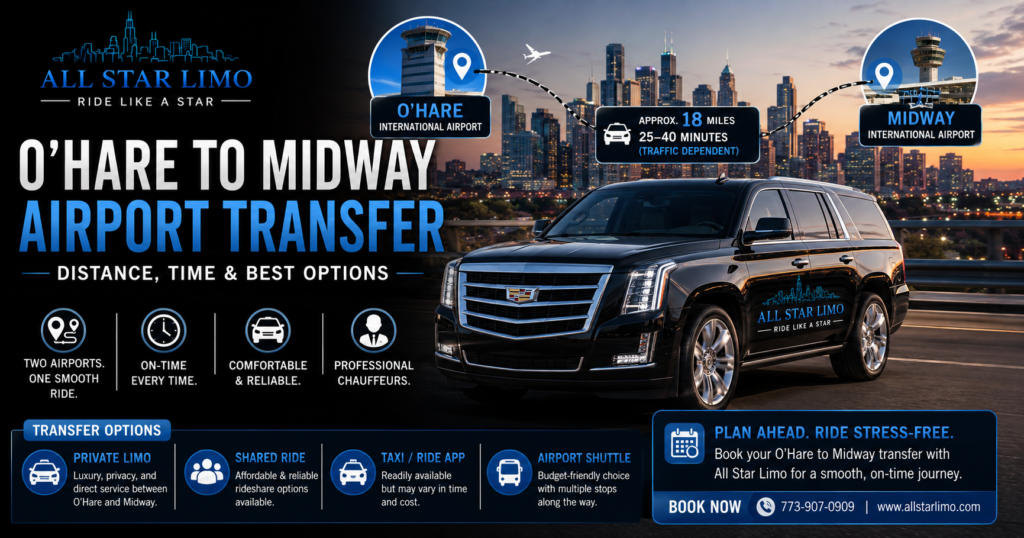
O’Hare (ORD) and Midway (MDW) are roughly 20-25 miles apart by road, on opposite sides of Chicago — O’Hare in the northwest, Midway in the southwest. A private car takes 35-60 minutes depending on traffic, while CTA public transit takes 70-90 minutes with a downtown transfer. If you’re connecting between the two airports on separate tickets, budget at least 3 hours between flights, and lean toward a private car or taxi if your layover is under 2.5 hours.
There is no direct flight, train, or shuttle that connects O’Hare and Midway in a single hop. Both airports sit on opposite ends of the city, and getting between them always means crossing a meaningful chunk of Chicago traffic or transit lines. This guide breaks down exactly how far apart they are, how long each transfer option really takes, and which method makes sense depending on how tight your connection is.
This kind of transfer comes up more often than travelers expect. Some airlines split itineraries across O’Hare and Midway when it’s cheaper than a single-airport routing, and Chicago is also a common self-connect city for travelers piecing together separate one-way tickets on different carriers — Southwest largely operates out of Midway, while most legacy and international carriers use O’Hare. Whatever the reason you’re crossing the city, the underlying logistics are the same: two airports, one metro area, and a transfer that’s entirely on you to manage. Understanding the real distance, the real drive times, and the actual risk involved is the difference between a connection that goes smoothly and one that turns into a scramble.
How Far Is O’Hare From Midway? Distance & Drive-Time Table
O’Hare International Airport (ORD) sits about 17-18 miles northwest of downtown Chicago, while Midway International Airport (MDW) is about 10-11 miles southwest of the Loop. Because they’re on opposite sides of the city, a straight line between them (the “as-the-crow-flies” distance) is only about 15 miles, but the actual driving route runs closer to 20-25 miles depending on which expressway your driver takes — usually a combination of I-90/I-94 and I-55, or surface streets like Cicero Avenue during off-peak hours.
| Route Segment | Approx. Distance | Off-Peak Drive Time | Rush Hour Drive Time |
|---|---|---|---|
| O’Hare (ORD) to Midway (MDW) | 20-25 miles | 35-45 minutes | 50-70+ minutes |
| Midway (MDW) to O’Hare (ORD) | 18-22 miles | 30-40 minutes | 45-65+ minutes |
| O’Hare to Downtown Loop | 17-18 miles | 25-35 minutes | 40-55 minutes |
| Midway to Downtown Loop | 10-11 miles | 20-25 minutes | 25-35 minutes |
A few things worth knowing about these numbers. First, the range exists because Chicago traffic is genuinely unpredictable — the Kennedy Expressway (I-90/94) near O’Hare backs up hard on weekday mornings and evenings, while the Stevenson Expressway (I-55) near Midway usually has shorter, milder rush windows. Second, driving distance is always longer than straight-line distance because the road network has to route around the city rather than cutting through it. Third, weather matters more in Chicago than in most cities — a winter storm or a summer thunderstorm can add 20-30 minutes to any of these times regardless of the hour.
If you’re mapping this out yourself, a good rule of thumb is to check real-time traffic conditions the morning of your transfer rather than relying on a fixed estimate, since a 35-minute trip at 10 AM can easily become a 65-minute trip at 4:30 PM.
Transfer Methods Compared: Private Car, CTA Train, Taxi & Shuttle
There are four realistic ways to get between O’Hare and Midway, and each one trades off speed, cost, and reliability differently. Here’s how they stack up side by side.
| Method | Travel Time | Approx. Cost | Reliability | Best For |
|---|---|---|---|---|
| Private car / limo | 35-60 min | $85-$150+ flat rate | High — door-to-door, tracked pickup | Tight connections, luggage, groups |
| CTA Blue Line + Orange Line | 70-90 min | $2.50-$5 | Moderate — depends on transfers, delays | Long layovers, budget travel, light luggage |
| Taxi / rideshare | 40-65 min | $50-$90, surge pricing possible | Moderate — subject to surge and driver availability | Solo travelers without advance booking |
| Shared shuttle van | 60-90 min | $30-$50 per person | Lower — multiple stops, fixed schedule | Budget travelers with flexible time |
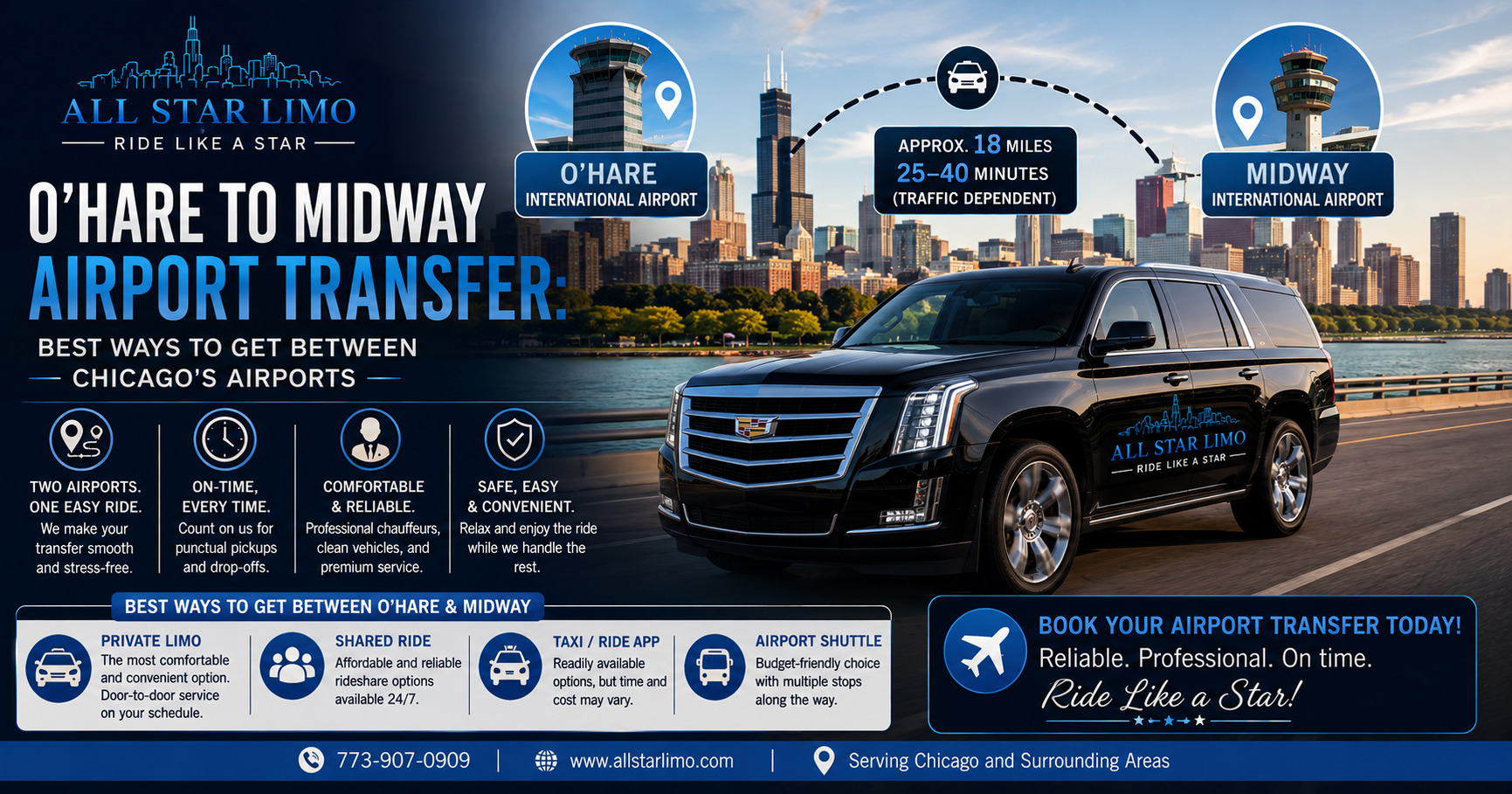
Private car or limo service: is a pre-booked, flat-rate ride with a professional chauffeur who tracks your flight and is waiting when you land. It’s the most predictable option because the price and pickup time are locked in before you travel — no surge pricing, no guessing whether a taxi will be available at the curb.
The CTA train (Blue Line from O’Hare to downtown, transferring to the Orange Line toward Midway): is the cheapest option by a wide margin, but it’s also the slowest and least convenient with luggage. The ride typically takes over an hour once you factor in the downtown transfer, plus walking time between platforms and to/from the airport terminals themselves.
Taxis and rideshare apps: sit in the middle — faster than transit, but pricing fluctuates with demand, and availability at either airport can be inconsistent during peak travel times, storms, or major Chicago events.
Shared shuttle vans: are budget-friendly but make multiple stops along the way, so the time savings over transit are modest while the discomfort of shared luggage space and unpredictable routing can be a real downside for anyone on a schedule.
How Much Time to Budget for a Connecting Flight
If you booked separate tickets on different airlines — one landing at O’Hare, one departing from Midway (or vice versa) — you’re responsible for your own transfer, and airlines won’t hold a flight for you if you’re late. This is different from a single-ticket connection at the same airport, where the airline manages the timing.
Here’s a practical way to think about your buffer:
- Under 2.5 hours between flights: Risky. Only attempt this with a private car booked in advance, and even then, build in extra time for TSA re-screening, since you’ll need to clear security again at the second airport.
- 2.5-3.5 hours: Workable with a private car or taxi, especially if your inbound flight lands on time and you’re not checking bags that need to be re-collected and re-checked.
- 3.5-5 hours: Comfortable for any transfer method, including CTA transit, as long as you’re not traveling during a major weather event or Chicago rush hour.
- 5+ hours: Enough time to explore transit or even take a break downtown before continuing to your second airport.
Keep in mind that O’Hare and Midway are not connected internally — there is no secure, airside way to move between them. You must exit the secure area at the first airport, transfer across the city, and go through security screening again at the second airport before your next flight. That security line, especially at O’Hare during peak hours, can easily eat 20-40 minutes on its own, so factor it into your buffer separately from the drive time.
Also budget time for baggage. If your bags were checked through to your final destination on a single itinerary, you won’t need to collect them — but if you booked separate tickets, you’ll need to claim your bags at the first airport and re-check them at the second, which adds meaningful time on top of the transfer itself.
Fastest Option for Tight Connections
When the clock is working against you, a pre-booked private car is the fastest and most reliable way to get between O’Hare and Midway. Here’s why it beats the alternatives when time matters most:
- No waiting for a ride to become available. Your car and chauffeur are scheduled and waiting, unlike a taxi queue or rideshare app during a surge period.
- Flight tracking. A professional car service tracks your inbound flight, so if you land early or are delayed, the pickup adjusts automatically — you’re not stuck calling to explain you missed your ride.
- Direct, non-stop routing. Unlike a shared shuttle that makes other stops, or a train that requires a downtown transfer, a private car takes the most direct expressway route available at that hour.
- One less unknown. With a flat rate booked ahead of time, you know the exact cost before you land, so there’s no scrambling to find a payment method or worrying about surge pricing eating into your budget mid-connection.
For anyone with a layover under three hours, CTA transit and shared shuttles introduce too many variables — a delayed train, a missed transfer, or an unexpected stop can turn a “should be fine” connection into a missed flight. A private car removes most of those variables.
Cheapest Option (If Time Isn’t a Constraint)
If your layover is comfortably over four or five hours and you’re traveling light, the CTA Blue Line to Orange Line combination is the most budget-friendly way to cross the city. At roughly $2.50-$5 depending on your fare card, it’s dramatically cheaper than any car-based option.
The trade-off is time and effort: you’ll walk from the terminal to the train platform at O’Hare, ride the Blue Line toward downtown, transfer stations to catch the Orange Line, ride it out to Midway, and then walk from the Midway CTA station to the terminal. With bags, that walking and transferring adds real friction, and delays on either line ripple straight into your schedule with no backup plan.
A shared shuttle van sits in between — a bit faster than transit in some cases, cheaper than a private car, but still subject to multiple stops and a fixed departure schedule that may not align with when you actually land.
Why a Private Car Is the Safer Bet for Missed-Connection Risk
The real cost of a missed connection isn’t just the inconvenience — it’s rebooking fees, a night in a hotel, and the ripple effect on the rest of your trip. When weighing transfer options between O’Hare and Midway, it helps to think in terms of risk, not just average travel time.
CTA transit and shared shuttles both have single points of failure: a delayed train, a missed transfer window, or a shuttle that’s already full when you arrive. A taxi or rideshare depends on driver availability at the exact moment you need one, which becomes unreliable during Chicago’s frequent weather disruptions, major events, or peak travel days like holidays.
A booked private car removes most of those failure points. The vehicle is reserved specifically for you, the driver tracks your flight status, and the route is chosen in real time based on current traffic — not a fixed schedule. For travelers with a tight window, checked luggage, a family in tow, or simply zero appetite for uncertainty on a connection day, the modest cost difference between a private car and a taxi or shuttle is a reasonable trade for a dramatically lower chance of missing the next flight.
If you’re transferring through Chicago and want that certainty built in, All Star Limo’s airport transfer service provides flat-rate, flight-tracked pickups between O’Hare and Midway, with a chauffeur waiting curbside so there’s no guesswork on either end of your connection.
Step-by-Step: Getting From O’Hare to Midway by Private Car
- Book ahead. Reserve your private car with your flight number attached so the dispatch and chauffeur can track your arrival in real time. Most services allow booking anywhere from a few hours to several weeks in advance.
- Land and collect any checked bags. If you’re on separate tickets, head to baggage claim; if your bags are checked through, skip straight to the pickup point.
- Meet your chauffeur. For a professional car service, your driver is typically waiting at a designated curbside spot or, with meet-and-greet service, just past baggage claim holding a sign with your name.
- Load luggage and depart. Your chauffeur takes the most efficient route based on current traffic — usually I-90/94 to I-55, or a surface-street alternative if the expressways are backed up.
- Arrive at Midway. You’re dropped directly at your departure terminal, ready to head straight to check-in and security.
The whole process, door to door, typically takes 35-60 minutes depending on time of day, with no walking, no transfers, and no schedule to catch beyond your own.
Step-by-Step: Getting From O’Hare to Midway by CTA Train
- Follow airport signage to the CTA Blue Line station, located within the O’Hare terminal complex — a walk of several minutes depending on which terminal you land in.
- Purchase a fare card or tap a contactless card at the station entrance.
- Ride the Blue Line toward downtown Chicago, roughly a 40-45 minute ride to the Loop.
- Transfer to the Orange Line, typically at a downtown station such as Clark/Lake — this involves walking between platforms and waiting for the next train.
- Ride the Orange Line toward Midway, another 20-30 minutes.
- Walk from the Midway CTA station to the terminal, roughly a 10-minute walk depending on your airline’s check-in location.
Total time typically lands between 70 and 90 minutes under normal conditions, longer if there are delays on either line or if you’re carrying substantial luggage through the transfers.
Understanding Chicago Traffic Patterns Between the Airports
Chicago’s expressway system is the single biggest variable in any O’Hare-to-Midway transfer, and understanding it can help you time your trip better regardless of which method you choose.
The Kennedy Expressway (I-90/I-94): which connects O’Hare to downtown, is notorious for weekday backups between roughly 6:30-9:30 AM and 3:30-6:30 PM. Construction zones are common year-round, and even a minor accident can add 20+ minutes with little warning. If your flight lands during these windows, build extra buffer into your plan regardless of transfer method.
The Stevenson Expressway (I-55): which serves Midway, tends to have shorter and less severe rush periods than the Kennedy, making Midway-side traffic somewhat more predictable. That said, I-55 still slows considerably around the I-90/94 interchange and near downtown during peak commuter hours.
Surface street alternatives: like Cicero Avenue or Harlem Avenue, can sometimes beat the expressways during the worst rush-hour windows, since experienced local drivers know when a side route saves more time than sitting in expressway traffic. This is one advantage of using a chauffeur who drives these roads daily versus a rideshare driver who may not be as familiar with the fastest real-time route.
Weather: is the wildcard that applies to every method. Chicago winters bring snow and ice that can slow both driving and CTA service, while summer thunderstorms cause sudden slowdowns on the expressways. If your transfer falls during a forecasted weather event, add at least 30 extra minutes to whichever estimate you’re working with — and lean toward a private car service that can adjust routing in real time rather than a fixed-schedule shuttle or train.
What Happens If Your Flight Lands Late or Early?
A connecting flight between two separate airports puts the timing entirely in your hands, so it’s worth thinking through what happens if your inbound flight doesn’t land on schedule.
If your flight is delayed: A pre-booked private car with flight tracking automatically adjusts your pickup time, so you’re not paying extra or losing your reservation because of an airline delay outside your control. CTA transit doesn’t care when you land — the trains run on their own schedule, so a delay simply eats directly into your connection window. A taxi or rideshare may also become harder to find if you land during a busy period, since demand spikes when multiple delayed flights land around the same time.
If your flight lands early: This is genuinely useful extra buffer, but only if your transfer method can take advantage of it. A private car with flight tracking can often move your pickup earlier with a quick call, while a scheduled shuttle van will still depart on its fixed timetable regardless of when you’re ready.
If you need to check a bag between flights: Add 15-25 minutes to whatever timeline you’re using. Bag claim at O’Hare, in particular, can be slow during peak arrival banks when several international or domestic flights land close together.
The overarching theme here is that flexibility matters as much as raw speed. A transfer method that can absorb a delay without falling apart is often more valuable than one that’s marginally faster on paper but has no room for error.
Downtown Chicago Layover: Worth a Stop?
If you’ve got five or more hours between an O’Hare arrival and a Midway departure (or vice versa), some travelers consider breaking up the transfer with a short stop in downtown Chicago — grabbing a meal in the Loop, walking the Riverwalk, or seeing a bit of the Magnificent Mile before continuing on.
This can work, but it adds real logistical complexity: you’ll need luggage storage or a car that can wait, plus a buffer for traffic getting back to Midway afterward. It only makes sense with a private car that can hold your bags and bring you directly to the second airport afterward, or if you’re comfortable checking luggage at a downtown storage service. For most travelers on a genuine connection — rather than a planned Chicago stopover — it’s simpler and lower-risk to head straight to the second airport and use any extra time there instead, where you have full control over security lines, food options, and gate proximity.
If Chicago is actually your destination rather than a layover city, a private transfer that routes through downtown on the way to your hotel — rather than straight airport-to-airport — is worth asking about when booking, since it can combine your arrival transfer with sightseeing time at no extra driving cost.
Booking Tips for a Smooth Airport-to-Airport Transfer
A little preparation goes a long way when you’re transferring between two airports on a schedule. A few habits that consistently make the difference between a smooth transfer and a stressful one:
- Share your flight number when booking, not just a pickup time. This is what allows a private car service to track delays and adjust automatically — a fixed pickup time alone doesn’t account for a flight landing late.
- Confirm your pickup location the day before. O’Hare has five terminals, each with different curbside pickup zones, so knowing exactly where to meet your driver avoids wasted time wandering between terminals.
- Keep carry-on essentials accessible — your ID, boarding pass for the next flight, and any documents you’ll need for a second security screening — rather than buried in checked luggage.
- Build in a buffer beyond the “average” time estimate. Average traffic times are just that — averages. A genuinely tight connection deserves the more conservative end of the time range, not the optimistic one.
- Have a backup contact number for your driver or dispatch, especially during weather events, so you can communicate directly if anything changes on either end.
- Avoid scheduling the tightest possible connection on your first trip through Chicago. If it’s your first time making this specific transfer, a little extra buffer is worth the peace of mind until you know how the route and timing actually feel in practice.
Group and Family Transfers Between O’Hare and Midway
Traveling with family, a group, or significant luggage changes the calculation for which transfer method makes sense. CTA transit becomes considerably harder with strollers, multiple suitcases, or young children navigating platform transfers and stairs. Shared shuttles charge per person, so a group of four or five can end up paying close to what a private SUV or Sprinter van would cost — without the benefit of direct, non-stop routing or space to keep everyone and their bags together.
For groups, a private SUV or executive van (seating up to 6-14 passengers depending on group size) is usually both more comfortable and more cost-effective per person than booking multiple shared shuttle seats or several rideshare vehicles that may not even arrive together. It also means the whole group travels on one schedule instead of being split across separate cars or train cars, which matters when everyone needs to make the same connecting flight.
FAQ: O’Hare to Midway Airport Transfer
How far is O’Hare from Midway?
O’Hare and Midway are about 20-25 miles apart by road, though the straight-line distance is closer to 15 miles. The driving route varies depending on which expressway is fastest at the time — typically I-90/94 combined with I-55, or surface streets during off-peak hours.
How long does the O’Hare to Midway shuttle or transfer take?
A private car or taxi typically takes 35-60 minutes depending on traffic. CTA public transit (Blue Line to Orange Line, with a downtown transfer) takes 70-90 minutes. Shared shuttle vans generally fall in the 60-90 minute range due to multiple stops.
What’s the fastest way to get between O’Hare and Midway?
A pre-booked private car with flight tracking is the fastest and most predictable option, since it avoids transit transfers, shuttle stops, and ride-hailing wait times. Off-peak, a direct drive can take as little as 35 minutes.
What’s the cheapest way to transfer between Chicago’s airports?
The CTA Blue Line to Orange Line combination is the cheapest, typically costing $2.50-$5 total. It’s best suited to travelers with light luggage and a layover of four hours or more.
Is there a direct train or shuttle between O’Hare and Midway?
No single train or shuttle runs directly between the two airports. CTA transit requires a transfer through downtown Chicago, and shuttle services typically make additional stops along the route rather than running non-stop.
How much time should I leave for a connecting flight between O’Hare and Midway?
For separate tickets, budget at least 3 hours total — this covers the transfer itself, security re-screening at the second airport, and a buffer for Chicago traffic. Under 2.5 hours is considered risky and should only be attempted with a pre-booked private car.
Does the airline help if I miss my connection between O’Hare and Midway?
Generally, no. If you booked two separate tickets — even on the same airline — the carrier has no obligation to accommodate you if traffic, weather, or transit delays cause you to miss your second flight, since these are treated as two independent itineraries. This is the main reason travel advisors recommend building in extra buffer time or choosing a booked, flight-tracked private car for this specific transfer.
Can I walk or bike between O’Hare and Midway?
No. The two airports are roughly 20+ miles apart by road, well beyond a practical walking or cycling distance, especially with luggage and a flight to catch. Some cycling routes exist along parts of the corridor, but they aren’t a realistic option for a time-sensitive airport transfer.
Is it cheaper to take a taxi or book a private car in advance?
It depends on timing and demand. A metered taxi or rideshare can sometimes be slightly cheaper during low-demand periods, but prices spike with surge pricing during rush hour, bad weather, or high-travel days — which are exactly the moments when reliability matters most. A flat-rate private car locks in the price ahead of time, so there’s no risk of paying more simply because you’re transferring during a busy window.
Planning a connection between O’Hare and Midway?
All Star Limo offers flat-rate, flight-tracked transfers with professional chauffeurs across Chicago’s airports. Our chauffeurs know the fastest routes between ORD and MDW at any hour, monitor your flight status automatically, and meet you curbside so your connection stays on schedule from the moment you land to the moment you board.
Explore our Midway Airport limo service,
our O’Hare Airport limo service,
or view our full Chicago airport limo service options