Chicago , il

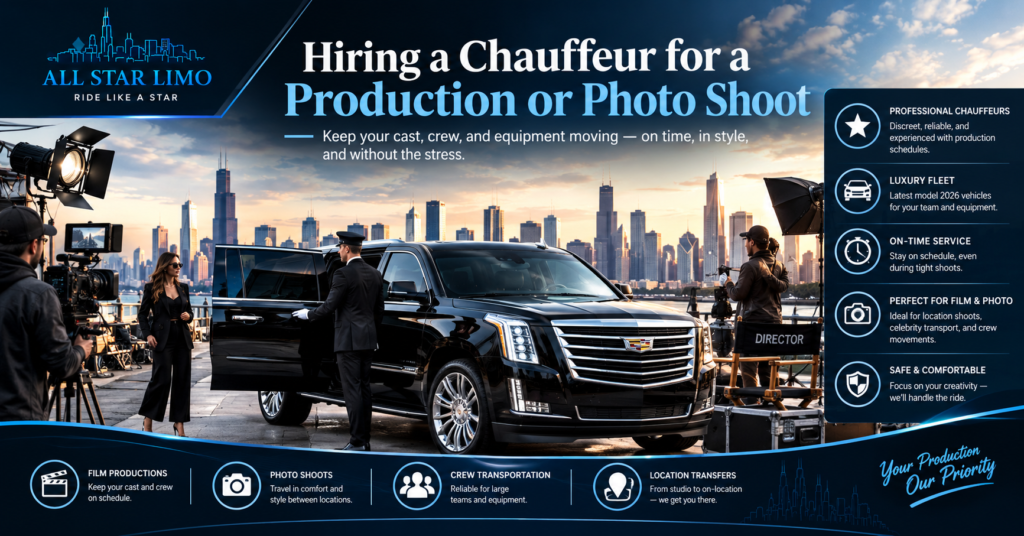
Most transportation bookings work backward from a fixed schedule — a flight time, a meeting time, an event start. Production and photo shoot transportation works differently: the schedule itself is often fluid, shaped by weather, light, how many takes a scene needs, or how a location scout’s day actually unfolds once crews are on the ground. Booking a chauffeur for this kind of work means booking flexibility as much as a vehicle.
Production transportation is almost always booked hourly rather than point-to-point, built around a call sheet’s structure rather than a single fixed pickup time, with the vehicle sometimes serving as a prop rather than pure transportation, and coordinated through a single production contact who can communicate schedule changes as they happen.
Accept That the Call Sheet Is an Estimate, Not a Guarantee
Before booking anything, get comfortable with the core reality of production scheduling — because it shapes every decision after this.
- Call times shift. A 7 AM crew call can slide by hours in either direction because of weather, an earlier scene running long, or a permit issue. Booking transportation with the same rigid assumption as an airport transfer sets up a mismatch from day one.
- Hourly booking, not point-to-point, is almost always the right structure. An hourly arrangement — vehicle and chauffeur available for a block of time — absorbs the fluidity of a real shoot day far better than a single scheduled trip. A point-to-point booking assumes a defined start and end; a production day rarely offers either with any real precision.
- Wait time is often the majority of the booking, not an exception. A chauffeur waiting through a lighting setup, multiple takes, and a wrap is normal for this kind of work — plan for it and say so upfront, don’t treat it as a contingency. On some shoot days, the vehicle might drive for only 20 total minutes across an 8-hour booking, with the rest spent staged and waiting.
- Ask your provider directly how they handle a day that runs long. Whether hourly bookings can extend, and how that’s billed, is worth confirming before the day starts, not while it’s already running behind. A provider who has clearly thought through this scenario, rather than treating every extension as a novel negotiation, is a better fit for production work.
- Build buffer into both ends of the estimate. If the call sheet says 8 hours, discuss a structure that can flex beyond that rather than a hard cutoff. This protects the shoot from an awkward moment where the vehicle needs to leave right as a critical final setup is finally ready to go.
- Recognize that even a well-run production runs behind sometimes. This isn’t a reflection of poor planning — it’s simply how creative, weather-dependent, and technically complex work unfolds in practice. A transportation plan built around the assumption of occasional delay is more realistic than one built around a best-case schedule.
Decide Whether the Vehicle Is Transportation or a Prop
This is the single most important early decision, because it changes almost everything else about the booking.
- Transportation-only bookings are the simpler case. Getting cast, crew, or equipment between locations functions like any other group or executive hourly rental, just on a production schedule.
- On-camera vehicle bookings are a different request entirely. If the vehicle needs to appear in a shot — as a background element, a scripted prop, or part of a brand’s visual identity — say so clearly and early, including any specific color, model, or aesthetic requirement. Not every vehicle in a given category looks identical, and a specific creative vision benefits from lead time to match the exact vehicle rather than whatever happens to be available.
- Clarify stationary vs. driven. A parked background vehicle has different practical needs than one that has to be driven during filming, which can involve driving choreography, a camera car following alongside, or specific route requirements for a moving shot. Confirm which scenario applies, since it affects how much on-set coordination time is actually needed.
- Address usage rights and compensation directly if the vehicle appears in the final cut. This sits outside standard transportation terms — a vehicle appearing in a commercial, a music video, or a film is a different kind of asset than one simply transporting people, and treating it as such in the conversation with your provider avoids a misunderstanding later.
- If it’s purely functional, skip all of the above. A crew shuttle doesn’t need any of this complexity — book it like a standard hourly group rental with production-level scheduling flexibility.
- When in doubt, over-communicate the intended use rather than under-communicate it. A provider who knows upfront that a vehicle needs to look pristine for a specific shot, or needs to be positioned at a precise angle, can prepare accordingly — discovering this need on set, mid-shoot, leaves much less room to actually deliver on it.
Map Out Every Location, Even If Timing Is Uncertain
Production days rarely stay in one place. Planning the movement matters as much as planning the schedule.
- Give your provider the full location list at booking, even without precise timing — this lets them understand the day’s shape and estimate realistic drive times, and lets a chauffeur mentally map out the day rather than reacting to each move as a surprise.
- Build real buffer between locations. A back-to-back schedule assumes everything goes to plan, which — as covered in Step 1 — it usually doesn’t. A 20-minute drive scheduled with zero slack becomes a problem the moment the previous setup runs 15 minutes over.
- Communicate location changes the moment they happen. Location scouting shifts and last-minute additions are normal; a chauffeur told early can adjust, one told late cannot — and a late notification often means the vehicle isn’t positioned where it needs to be when the crew is actually ready to move.
- Flag genuinely unpredictable movement (documentary-style, following subjects) before booking. Not every hourly arrangement is built for real-time, on-the-fly changes — confirm your provider can actually handle it, since this is meaningfully different from even a flexible but pre-planned scripted shoot day.
- Account for equipment space separately from passenger comfort. Camera gear, lighting, and production materials take up real room — don’t assume a vehicle sized for people alone has space for gear too. A crew of four with a full lighting and camera package needs meaningfully more cargo space than four passengers with ordinary luggage.
- Consider whether equipment needs its own vehicle entirely. For a larger production with substantial gear, splitting equipment transportation from cast and crew movement sometimes makes more sense than trying to fit everything into a single vehicle, particularly if the equipment needs to arrive and be set up before the crew itself does.
Put One Person in Charge of Coordination
Production bookings work best through a single point of contact, not the cast or crew who’ll actually ride in the vehicle.
- Designate one coordinator with visibility into the full schedule — a production coordinator, line producer, or producer’s assistant — rather than leaving communication to whoever happens to be in the car. Multiple people independently contacting a chauffeur or dispatch with different, possibly conflicting information is one of the more common sources of confusion on a shoot day.
- Establish how day-of changes get relayed, and to whom. A direct line between your coordinator and either the chauffeur or a dedicated dispatch contact means a schedule shift gets handled in minutes, not discovered too late. Confirm this channel exists and works before the shoot day begins, not as an assumption.
- Request the same chauffeur and vehicle across a multi-day shoot. Familiarity with your production’s rhythm and key personnel compounds — a driver on day three coordinates better than one starting cold each morning, having already learned the production’s general pace, the coordinator’s communication style, and the typical daily pattern.
- Confirm billing fits your production’s accounting process. Productions often need specific invoicing or documentation — check this before the shoot, not when it’s time to reconcile expenses. Some productions need itemized daily invoices, others need a single consolidated bill for the full shoot; knowing which your production requires avoids a mismatch at the accounting stage.
- Address NDAs directly if your production needs them. High-profile shoots, unreleased projects, or well-known talent often call for this — ask rather than assume standard service already covers it. A provider unfamiliar with this request may need more lead time to prepare the appropriate paperwork or brief the assigned chauffeur accordingly.
- Keep the coordinator’s contact information current and accessible to the transportation provider throughout the shoot. If the coordinator changes partway through a multi-day production, updating this information promptly avoids a gap where communication has nowhere reliable to go.
Match the Vehicle to What the Day Actually Needs
- Lean toward SUVs or larger vehicles for equipment capacity, even with a small cast or crew — gear adds up fast, and camera bodies, lenses, tripods, and lighting cases fill trunk space more quickly than most people expect until they’ve actually loaded a vehicle for a shoot.
- Separate talent transportation from general crew transportation if your production does. Talent vehicles often prioritize discretion in a way a crew shuttle doesn’t need to — a well-known actor or on-camera personality may specifically need a lower-profile vehicle and a chauffeur experienced with maintaining privacy, distinct from the practical, higher-capacity vehicle serving general crew movement.
- A Sprinter van suits larger crews moving together with gear — confirmed specifically for the added equipment space, not just passenger count. This is often a better fit than two smaller vehicles, both for cost efficiency and for keeping the crew together as a unit throughout the day.
- Flag any specific on-camera vehicle positioning needs — doors open for a shot, a particular angle — since this can require extra coordination time on set, and a chauffeur briefed on this in advance can position the vehicle correctly on the first attempt rather than needing repeated adjustment while the crew waits.
- Consider vehicle color and condition even for transportation-only bookings that might appear in behind-the-scenes footage. Some productions document their own process for promotional purposes, and a vehicle that might end up in b-roll footage is worth a brief mention even if it’s not the primary on-camera asset.

Book on a Timeline That Matches Production Reality
- Book the moment a shoot date is genuinely locked. Production schedules shift, but once confirmed, book fast — especially if the date falls during a high-demand season (wedding season, a major local event) competing for the same fleet. A confirmed shoot date competing with a Saturday in June for vehicle availability is a genuinely harder booking than the same request made on a quiet weekday in February.
- Shorter-notice bookings are sometimes more workable here than for other occasions, since flexible hourly arrangements can have more fleet flexibility than a highly specific fixed-time request — but don’t assume this as a guarantee, particularly if your production needs a specific vehicle for an on-camera role rather than any generally available vehicle.
- For multi-day productions, book the whole schedule at once. This secures better consistency in chauffeur and vehicle assignment than booking day by day, and it also gives your provider a clearer picture of the total commitment, which can sometimes translate into better overall terms than a series of separate, disconnected single-day bookings.
- Tell your provider if the schedule has a window rather than a fixed date. A provider aware of that flexibility can sometimes offer better terms than one assuming a hard commitment, since they can plan around the eventual firm date with more lead time once it’s confirmed.
- Reconfirm details as the shoot date approaches, particularly for a booking made well in advance. A location or schedule detail confirmed months ahead sometimes shifts as the actual shoot date nears — a quick check-in a week or so before the shoot ensures everyone is still working from the same, current information.
Know How This Plays Out for Common Scenarios
- A commercial shoot needing a hero vehicle for brand footage. The clearest vehicle-as-prop case — specify every visual detail precisely, book well ahead, and confirm exclusive use for the shoot’s duration so the specific vehicle isn’t pulled for another booking mid-day.
- A documentary or reality-style shoot with an unpredictable schedule. Needs the most flexible hourly arrangement possible, with real-time communication built in rather than a fixed location list, since the entire premise of this kind of shoot is following events as they unfold rather than a predetermined script.
- A fashion or editorial shoot moving between several urban locations in one day. Benefits from an SUV with room for equipment, wardrobe, and styling materials, plus a flexible booking accounting for setup time at each stop, not just drive time — a fashion shoot’s per-location time is often dominated by styling and lighting setup rather than the shooting itself.
- A corporate video shoot on a more predictable, scripted schedule. Can often be booked more like a standard executive hourly rental, though buffer for inevitable delays is still worthwhile, since even a well-scripted corporate shoot day can run long once actual filming begins.
- A multi-day television or film production. Book the full schedule at once and request consistency, treating it as a standing engagement rather than disconnected daily bookings, with the added benefit of a chauffeur who becomes genuinely useful to the production’s daily rhythm by mid-shoot.
- A single-day influencer or social media content shoot. Often simpler in scope than a full commercial production but still benefits from hourly flexibility, particularly if the shoot involves several quick location changes across a compressed timeframe.
Know Chicago’s Own Production Quirks
- Downtown and neighborhood locations behave differently. A Loop shoot has different parking, permit, and traffic realities than one in Wicker Park or Pilsen — a chauffeur familiar with the specific area beats one only generally familiar with the city, particularly for navigating narrower residential streets or finding realistic staging spots near a specific address.
- Chicago weather is a genuine production variable. Harsh winters, humid summers, and unpredictable spring weather make outdoor shoots especially prone to schedule shifts — another reason flexible booking matters more here than in a milder climate, and another reason to build real buffer into any outdoor-shoot transportation plan.
- Permits can restrict vehicle access to specific hours or staging areas. Brief your transportation provider on any location-specific restrictions so there’s no mismatch between where a chauffeur expects to wait and what the permit allows — a vehicle staged in a spot that later turns out to violate a location permit is an entirely avoidable problem with a bit of advance communication.
- Peak production season clusters in warmer months, overlapping with wedding and festival season’s demand on the same local fleet — book early for a warm-weather shoot for exactly this reason, since your production is effectively competing with every wedding, prom, and summer festival booking for the same pool of vehicles.
- Ask local production contacts for provider recommendations if you’re new to shooting in Chicago. On-the-ground knowledge from a unit production manager or local crew supplements your own research well, particularly around which providers have direct experience with the specific neighborhoods or venue types your production is using.
A Few Things Worth Asking Before You Book
- “How do you handle a shoot day that runs significantly longer than the booked hours?”
- “Can the same chauffeur and vehicle be assigned across multiple days of our shoot?”
- “Do you have experience with vehicles used as props or set pieces, not just transportation?”
- “What billing and documentation can you provide that fits our production’s accounting process?”
- “Can your chauffeurs accommodate an NDA or confidentiality agreement if our production requires one?”
A provider who answers all five clearly and specifically is signaling real experience with this kind of work — vague or hesitant answers are worth treating as a signal to keep looking.
Frequently Asked Questions
How is booking transportation for a photo shoot different from a standard hourly rental?
The core difference is flexibility — production schedules are frequently estimates rather than fixed times, wait time is often a significant part of the booking rather than an exception, and communication typically runs through a production coordinator managing the full day’s schedule rather than the passengers themselves.
Can a vehicle be used as a prop in a photo shoot or commercial, not just for transportation?
Yes, this is a common request, but it should be specified clearly and early, including any specific vehicle color or model requirements, whether the vehicle needs to be driven or simply parked as a background element, and any usage rights or compensation considerations beyond standard transportation terms.
What happens if our shoot runs longer than the booked hourly window?
This varies by provider — ask directly at booking how schedule extensions are handled and billed, since production work frequently runs longer than initially planned.
Do we need to specify all our shoot locations in advance, even if timing is uncertain?
Providing the full list of planned locations, even without precise timing, helps your provider understand the day’s general scope and plan realistically.
Can the same chauffeur and vehicle be booked for a multi-day production?
This is often possible and generally worth requesting specifically, since a chauffeur who becomes familiar with your production’s schedule and key personnel over multiple days tends to coordinate more smoothly than starting fresh each day.
Is it possible to book transportation for both crew and equipment in the same vehicle?
Often yes, though it’s worth confirming vehicle size accounts for both passenger count and equipment volume specifically — an SUV or Sprinter van is frequently a better fit than a standard sedan once camera and production equipment are factored in alongside passengers.
Do productions need special billing or invoicing compared to a standard personal booking?
Many productions have specific accounting and documentation requirements — confirming your provider can accommodate whatever billing structure your production’s finance process needs is worth doing at the time of booking rather than after the shoot.
What if our production needs a vehicle that’s stationary the entire day as a background prop, with no actual driving involved?
This is worth communicating specifically, since it changes both the booking structure and potentially the pricing compared to a vehicle that’s actively driving passengers throughout the day.
Can we request a specific chauffeur again for a future production if the first experience worked well?
Many providers can accommodate this kind of request, particularly for a production company with recurring transportation needs across multiple projects.
How does location scouting transportation differ from shoot-day transportation?
Location scouting often involves a smaller group and more open-ended, exploratory movement between potential locations, compared to a shoot day’s more structured (if still flexible) schedule. The same hourly, flexible-booking principles apply, though scouting days sometimes benefit from even more real-time adaptability.
Should we book separate vehicles for equipment and for cast/crew?
For a larger production with substantial gear, this often makes more sense than trying to fit everyone and everything into one vehicle, particularly if equipment needs to arrive and be set up before the crew itself does. For a smaller shoot with modest equipment, one appropriately sized vehicle (an SUV or Sprinter) can usually handle both.
Is Chicago a good city for outdoor production shoots year-round?
Outdoor shoots are more weather-dependent in Chicago than in a milder climate, given the city’s seasonal extremes — this doesn’t make outdoor shoots impossible outside of summer, but it does mean building extra schedule flexibility into any outdoor shoot planned for winter or the shoulder seasons.
Book Flexible Transportation Built for Production Schedules
A shoot day rarely goes exactly according to the call sheet — your transportation shouldn’t be the thing that breaks when it doesn’t.
Explore more: