Chicago , il

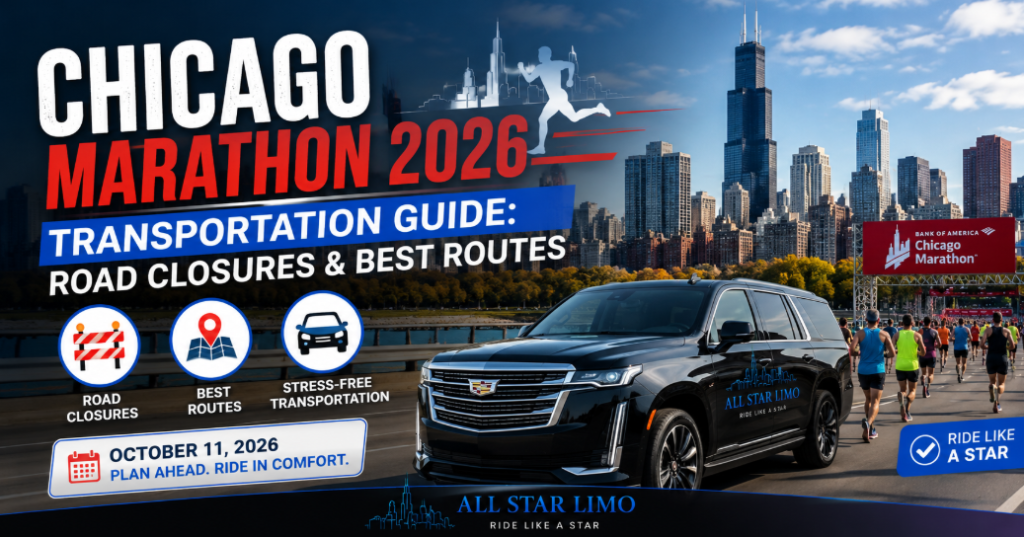
The 2026 Bank of America Chicago Marathon runs on Sunday, October 11, 2026. Road closures span downtown Chicago — Grant Park, the Loop, State Street, and Michigan Avenue — from roughly 4:00 AM until mid-afternoon, and rideshare apps get unreliable the moment those closures go into effect. The safest strategy is to book a private car or SUV in advance, know your drop-off/pickup zone before the corrals close, and build in extra time on both ends of the day. If you only read one section, read Runner Drop-Off Logistics and Post-Race Pickup below.
Whether you’re running your first marathon, flying in to cheer on a loved one, or just trying to get from your hotel to a meeting without getting boxed in by barricades, this guide breaks down exactly what to expect and how to move around Chicago on marathon weekend.
What Streets Close on Chicago Marathon Weekend
The Bank of America Chicago Marathon starts and finishes in Grant Park, and the 26.2-mile course loops through 29 neighborhoods before runners return downtown. That means the heaviest closures are concentrated in the Loop, River North, and the Near South Side, with rolling closures along the full route as the race progresses.
General closure zones to know:
- Grant Park perimeter (Columbus Drive, Balbo Drive, Ida B. Wells Drive) — closed overnight into the afternoon for start/finish staging.
- State Street and Michigan Avenue corridors — closed to vehicle traffic during the early morning hours as runners funnel into corrals, and again as the course passes through downtown multiple times.
- The Loop — expect closures on major east-west and north-south streets from roughly 5:00 AM to 3:00 PM. If you’re staying or working in The Loop, plan your day around the race, not around normal Sunday traffic patterns.
- Lake Shore Drive — sections typically close for the race and reopen in stages as the course clears.
- Bridges over the Chicago River — many are closed to vehicles during the race to protect the runner path, which affects north-south crossings well beyond the immediate route.
The City of Chicago and the marathon’s official race organizers publish a detailed street closure map closer to race day, and it’s worth checking that map the week of the event since exact closure times shift slightly year to year. But for planning purposes, assume downtown Chicago is essentially closed to normal vehicle traffic from early morning until mid-afternoon on October 11, 2026.
If your trip touches the Gold Coast, River North, or the Loop that weekend, chauffeurs who drive these streets daily — like our team serving River North and Gold Coast — already build alternate routing into race-weekend bookings, which matters far more than it sounds like it should.
Why Rideshare Apps Struggle on Marathon Weekend
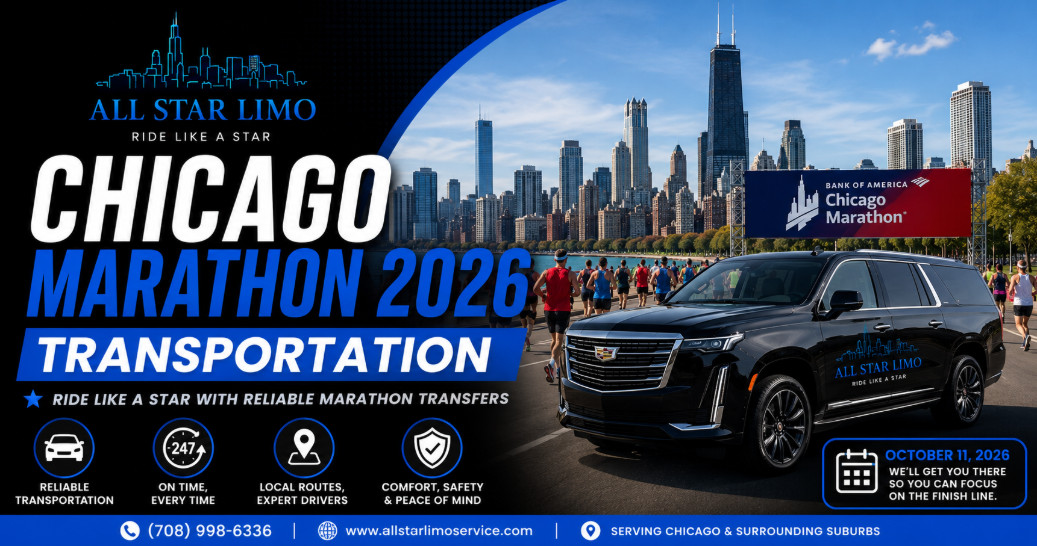
If you’ve ever tried to order a rideshare in downtown Chicago during a major event, you already know the pattern: the app shows a car five minutes away, then ten, then it cancels altogether. Marathon weekend makes this worse for a few specific reasons.
Surge pricing compounds fast:
Tens of thousands of runners, plus spectators, plus hotel guests trying to check out on a normal schedule, all hit the same rideshare pool within a few hours. Prices can multiply several times over during peak windows — pre-dawn drop-off and mid-morning-to-afternoon pickup.
Drivers can’t reach closed streets:
A rideshare driver assigned to your pickup may be routed to a street that’s barricaded, and neither the app nor the driver always knows that until they’re stuck at a closure. That means longer wait times, more cancellations, and drivers rerouting you to a pickup point blocks from where you actually are.
GPS routing doesn’t account for race-day closures in real time:
Standard mapping tools update closures inconsistently on event days, so a rideshare driver’s app might route them straight into a barricade.
Driver availability drops in the exact zones you need them:
Drivers who do understand the closures often avoid downtown entirely on marathon morning, which shrinks the available pool right when demand peaks.
The practical result: if you’re relying on a rideshare app to get you to a 5:30 AM corral time or to your hotel right after the race, you’re gambling with the most time-sensitive parts of your day. A pre-booked chauffeur who knows the closure map in advance — and who commits to a flat rate regardless of surge conditions — removes that variable entirely. Our flat-rate pricing means your marathon-weekend transfer costs the same whether it’s 4:30 AM or 4:30 PM.
Getting to Your Hotel From O’Hare or Midway That Weekend
Marathon weekend brings a noticeable spike in air travel into Chicago, as runners fly in from across the country and internationally for one of the six World Marathon Majors. Both O’Hare and Midway see heavier-than-usual weekend traffic, and downtown hotels fill up fast.
A few things to plan for:
- Book your airport transfer ahead of time: Rideshare wait times at both O’Hare and Midway stretch out during high-volume weekends, and marathon weekend is one of the busiest of the fall. A scheduled pickup with flight tracking means your chauffeur adjusts automatically if your flight is delayed — no re-booking, no standing at the curb refreshing an app.
- Arrive Friday or Saturday if possible, not Sunday morning: With downtown streets closing early Sunday, anyone flying in race morning risks landing right as closures tighten around hotels near Grant Park, the Loop, and the Magnificent Mile.
- Confirm your hotel’s exact drop-off access: Many downtown hotels sit inside or adjacent to the closure zone. Chauffeurs who work Chicago daily know which hotel entrances remain accessible on race morning and which require a short walk from the nearest open street — information that saves real time when you’re traveling with luggage.
- Expect longer transfer times on race day itself: A trip from O’Hare to a Loop hotel that normally takes 35–45 minutes can take considerably longer with rolling closures in effect, especially between 6:00 AM and 2:00 PM.
If your trip involves flying in Thursday or Friday for an expo visit and pasta dinner before racing Sunday, standard airport limo service works exactly like any other weekend. It’s the Saturday-night-into-Sunday-morning window where planning matters most.
Spectator Strategy — Best Viewing Areas and How to Reach Them
Spectating the Chicago Marathon is one of the best free events in the city — the course runs through 29 neighborhoods, and different miles have very different atmospheres. But getting to and between viewing spots takes some strategy, since the same closures that affect runners also affect anyone trying to cross the course by car.
Pick one side of the course and stay there, or plan your crossing points in advance. Because the marathon route loops through downtown more than once, spectators can sometimes catch runners at two different points if they move efficiently on foot or via public transit — but crossing from one side of the route to the other by car is often impossible until the race clears that section.
Popular spectator zones include:
- Grant Park (start/finish) — highest energy, but also the most crowded. Arrive well before the start if you want a good viewing spot near the finish line for later in the day.
- Lincoln Park, around the 8K mark — a lively early-race atmosphere.
- Pilsen, around Mile 19 — known for a strong neighborhood cheer scene.
- Chinatown, near Mile 21 — a distinctive, high-energy stretch as runners hit the tougher back half.
- Northalsted (Boystown), around Miles 7 and 9 — one of the most festive blocks on the entire course.
How to actually get there: Public transit (the CTA) is usually more reliable than driving on marathon morning, since trains aren’t affected by street closures the same way vehicles are. If you’re coordinating a group — say, family flying in to watch one runner finish, then heading to a celebratory lunch — a pre-arranged car that drops you at a transit-accessible point near your viewing zone, then picks your group up afterward at a predetermined location outside the closure zone, tends to work far better than trying to hail something mid-event. Our group transportation options handle exactly this kind of multi-stop, multi-passenger coordination.
Runner Drop-Off Logistics Before 6 AM Corral Time
If you’re running, your morning starts well before most of Chicago wakes up. Corrals typically close around 30–45 minutes before the wave start times, and the start area sees very heavy foot traffic in the hour beforehand. Missing your corral window isn’t a minor inconvenience — it can mean missing your wave entirely.
Plan backward from your corral closing time, not your alarm clock: Give yourself a buffer for security screening, gear check, and the walk from drop-off to your corral, which can be a longer walk than it looks on a map given the crowds.
Know your drop-off zone in advance: Streets immediately around Grant Park close to general traffic very early — often well before 5:00 AM. A scheduled chauffeur who already knows the designated runner drop-off points avoids the confusion of circling for an open street that a rideshare driver unfamiliar with the closures might not anticipate.
Dress for the wait, and pack your gear-check bag the night before: This isn’t a transportation tip exactly, but it matters for the same reason: the fewer decisions you’re making at 4:30 AM, the smoother your drop-off goes.
Coordinate with your whole travel party if multiple people are running: If you’re traveling with a group where several people are running different waves, or a mix of runners and spectators, one scheduled vehicle that handles the early drop-off — rather than several separate rideshare calls competing for the same scarce driver pool — tends to be both cheaper and far less stressful. This is one of the most common early-morning bookings we handle every October, and it’s exactly what our chauffeur service is built around: a driver who shows up when they say they will, regardless of what’s happening with surge pricing everywhere else.
Post-Race Pickup — Coordinating a Meet Point After the Finish
Getting to the start is only half the logistics problem. The finish is arguably harder, because you’re coordinating a pickup for someone who just ran 26.2 miles, in an area still affected by closures, often with family members trying to find each other in a massive crowd at the same time.
Set a meet point well outside the immediate finish area:
Grant Park and the surrounding blocks are extremely crowded for hours after the race, and cell service can be spotty in dense crowds. Agree in advance on a landmark a few blocks away from the finish chute — somewhere findable and outside the busiest congestion.
Build in a wide pickup window, not an exact time:
Finish times vary, post-race recovery takes longer than people expect, and the walk from the finish line to baggage claim and then to a meet point can take 30–60 minutes on its own. A scheduled car with some flexibility in the pickup window beats trying to time a rideshare request to the minute.
Expect the closure zone to still be active for hours after the last finishers come through:
Street reopening happens in stages, not all at once, so a pickup that seems simple on a normal day may require your driver to route around still-closed blocks well into the afternoon.
If you’re managing a group — runner plus family plus luggage from a hotel checkout:
This is exactly the kind of day where a single pre-arranged vehicle for the whole group, rather than several people separately trying to hail rides in a saturated market, saves real money and real stress. Whether that’s a black car for two or a Sprinter van for a bigger group headed straight to the airport after a celebratory lunch, booking ahead is the single biggest lever you have on marathon weekend.
Booking Transportation Around Other Fall Events
Marathon weekend rarely happens in isolation. Chicago’s fall calendar is packed, and several other things can compound the transportation challenge if your trip overlaps with them:
- Chicago River bridge lifts — scheduled periodically in spring and fall, these can add unrelated closures on top of marathon closures if your route crosses the river outside the immediate race zone.
- Other fall road races and half-marathons — Chicago hosts several smaller running events in September and October that can affect specific neighborhoods even when they’re unrelated to the main marathon.
- Convention and event traffic at McCormick Place — fall is a heavy trade show season, and overlapping convention traffic downtown adds another layer of congestion beyond the marathon closures themselves.
- Concerts, sports games, and private events — if your trip includes an evening event the same weekend, that’s a separate transportation need worth booking alongside your marathon-day plans rather than figuring out on the fly.
If your October trip involves more than just race day — a corporate event, a wedding, a Bears game, or a concert — it’s worth booking all of your transportation for the weekend at once rather than piecing it together event by event. Our events limo service team handles exactly this kind of multi-day, multi-event coordination, so you’re not re-explaining your schedule to a different driver or app every time.
Chicago Marathon 2026 Transportation FAQ
1. When is the 2026 Chicago Marathon?
The Bank of America Chicago Marathon takes place on Sunday, October 11, 2026, starting and finishing in Grant Park.
2. What time do roads close for the Chicago Marathon?
Closures around Grant Park and the start area typically begin in the early morning hours, well before 5:00 AM, with rolling closures along the course continuing through the morning and into the early-to-mid afternoon as the race clears each section.
3. Can I take a rideshare to my hotel during the marathon?
You can try, but expect long wait times, surge pricing, and drivers who get stuck at closures they didn’t anticipate. A pre-booked car with a driver who knows the closure map is significantly more reliable that weekend.
4. How early should I book transportation for marathon weekend?
Given the seasonal spike in demand, booking several weeks ahead is safest, especially for early-morning runner drop-off and immediate post-race pickup, which are the two highest-demand windows of the day.
5. What’s the best way to get to the start line before my corral closes?
Plan your drop-off well before your corral closing time, know your designated drop-off zone in advance, and account for the walk from drop-off to your corral through race-morning crowds.
6. Where should I tell my family to meet me after I finish?
Pick a landmark a few blocks outside the immediate finish area in Grant Park, since the finish zone itself stays extremely crowded for hours and cell service can be unreliable there.
7. Is it faster to fly into O’Hare or Midway for the marathon?
Both airports work well for marathon travel; Midway tends to be a quicker transfer from the south suburbs and parts of downtown, while O’Hare has more flight options for travelers coming from farther away. Either way, book your airport transfer in advance given the weekend’s overall travel spike.
8. Do road closures affect getting to McCormick Place or other downtown venues that weekend?
Yes — if you have unrelated business downtown on marathon Sunday, expect significant detours and longer travel times through early afternoon, even outside the immediate race footprint.
Explore More Chicago Travel Guides
- The Loop Limo Service
- Gold Coast & Magnificent Mile Limo Service
- River North Limo Service
- O’Hare Airport Limo Service
- Midway Airport Limo Service
- Events Limo Service
- Group Transportation
About the Author
Marcus Bennett is a Chicago-based travel and transportation writer who has covered the city’s major events — from marathon weekend to convention season at McCormick Place — for over eight years. He works closely with the dispatch and chauffeur teams at All Star Limo Service to translate real, on-the-ground routing knowledge into practical guides for travelers, runners, and spectators navigating Chicago’s busiest weekends. When he’s not writing, he’s usually found cheering from the Pilsen stretch of the marathon course with a cup of coffee in hand.
Ready to lock in your marathon-weekend ride? Book online or call (708) 998-6336 — flat-rate pricing, no surge, 24/7 dispatch.