Chicago , il
- Home
- About
- Services
- Fleet
- Areas
- Pricing
- Blogs
- Contact
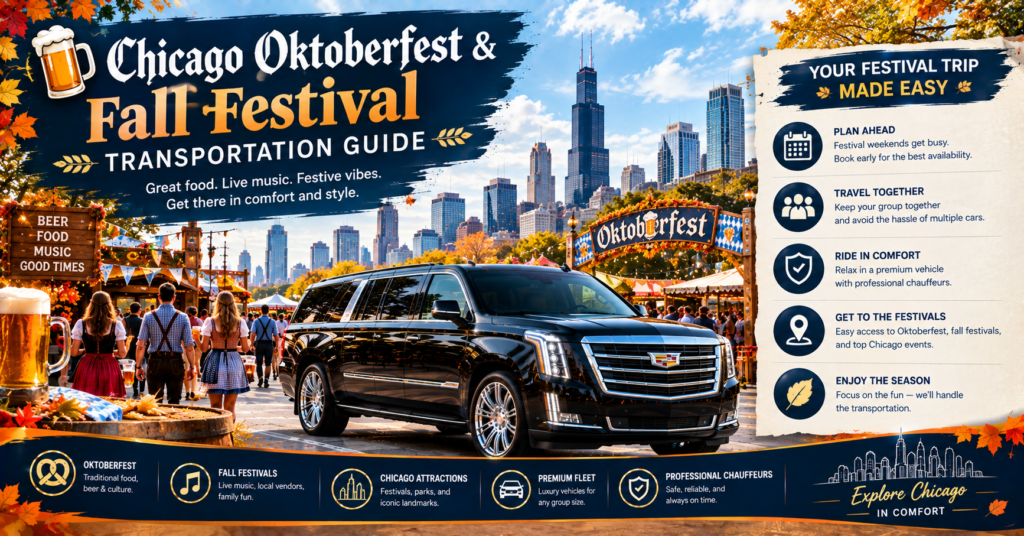
Chicago’s fall festival season runs roughly from mid-September through late October, concentrated in Lincoln Square, Lakeview, and North Center. Street closures around Western Avenue, Lincoln Avenue, and the Southport Corridor push parking blocks away from the festival gates, and rideshare pickup zones get backed up once the beer tents fill. The most stress-free way to handle it is a pre-booked chauffeured ride with a fixed pickup window — you skip the parking hunt entirely and you’re not the one deciding whether you’re okay to drive home after a few steins. All Star Limo runs hourly limo rentals and group transportation built around exactly this kind of festival-hopping.
If you’ve ever tried to find a parking spot within six blocks of Lincoln Square during Oktoberfest weekend, you already know the problem. Add a few thousand people in dirndls and lederhosen, a police-monitored street closure, and a rideshare app that suddenly wants to charge you three times the normal fare, and “quick trip to the beer tent” turns into an hour of logistics before you’ve had a single pretzel. Chicago’s fall festival calendar is unusually dense compared to most cities — instead of one big citywide event, it’s a string of neighborhood-scale festivals packed into six or seven weekends, each with its own street closures, its own parking headaches, and its own crowd surge the moment the tents shut down for the night.
What makes this different from booking a car for a normal night out is the compressed timing and the concentrated geography. Every Oktoberfest and fall street fest funnels thousands of people into a few closed-off blocks, then releases nearly all of them back onto the sidewalk within the same fifteen-minute window when the tents close. That’s a very different transportation problem than an evening out where people trickle home gradually — and it’s exactly the kind of predictable crunch that a pre-arranged chauffeur solves better than an on-demand app ever can.
This guide breaks down where Chicago’s Oktoberfest and fall festival season actually happens, what the street closures look like on the ground, why a planned car service fits the day better than driving yourself or gambling on surge pricing, and how to time pickup so you’re not standing on a cold corner at 10:05 PM watching your rideshare estimate climb.
Where Chicago’s Main Oktoberfest & Fall Festivals Happen
Chicago doesn’t have one Oktoberfest — it has a whole run of them, spread across neighborhoods from mid-September into late October. Most cluster on the North Side, which is good news for transportation planning: several festivals sit close enough together that one group can realistically hit two in an afternoon if the ride timing is handled right.
| Festival | Neighborhood | General Location | Typical Timing |
|---|---|---|---|
| German-American Oktoberfest & Von Steuben Parade | Lincoln Square | Western Ave. & Lincoln Ave. | Mid-September, Fri evening through Sun evening |
| Old Town Oktoberfest | Old Town | North near St. Michael’s | Late September weekend |
| St. Alphonsus Oktoberfest Chicago | Lakeview | Lincoln/Southport/Wellington intersection | Late September, Fri–Sun |
| Lincoln Square Ravenswood Apple Fest | Lincoln Square / Ravenswood | Along Lincoln Ave. and Ravenswood corridor | Early October weekend |
| Oktoberfestiversary | North Center | Along Lincoln Ave. business strip | Mid-October weekend |
The headline event is the German-American Oktoberfest in Lincoln Square, organized around Western and Lincoln Avenue — the neighborhood’s German heritage runs deep here, and the festival has grown into one of the more crowded weekends on the North Side calendar, complete with a parade down Lincoln Avenue. A few weeks later, St. Alphonsus Oktoberfest takes over the intersection of Lincoln, Southport, and Wellington in Lakeview, drawing a younger, bar-crawl-adjacent crowd since it sits inside walking distance of the whole Southport Corridor.
Both are free to attend, both run three days, and both close public streets to make room for beer tents, vendor booths, and stages. Both also draw heavily from outside their own neighborhood — plenty of attendees are coming from elsewhere in the city or the suburbs specifically for the event, which is a big part of why parking pressure builds so fast once the gates open.
Because these events run on consecutive weekends rather than all at once, plenty of groups treat late September and early October as a full “Oktoberfest circuit” — hitting Lincoln Square one weekend and Lakeview the next, sometimes with the same crew. That pattern is exactly where a group transportation booking earns its cost: one vehicle, one pickup point, no one re-downloading a rideshare app at 9 PM with spotty service because six hundred other people are doing the same thing on the same block.
What each event actually looks like on the ground
The German-American Oktoberfest:
Is the anchor event of the season and the one most out-of-towners think of first. It’s organized by the German Day Association around the intersection of Western and Lincoln, runs three days, and typically includes a Von Steuben Day Parade down Lincoln Avenue on the Saturday — which means an additional layer of street closures on top of the festival footprint itself. Expect two large tents, live oompah bands most of the day, a Kinderfest segment aimed at families earlier on Sunday, and a crowd that skews heavily toward neighborhood locals and German heritage groups early in the weekend, then broadens out as word spreads.
St. Alphonsus Oktoberfest:
In Lakeview runs a few weeks later and pulls a noticeably different energy — it sits inside the Southport Corridor, a strip already dense with bars and restaurants, so the festival crowd blends with the neighborhood’s normal Friday-and-Saturday-night foot traffic. That makes it one of the more walkable festivals on this list if you’re staying nearby, but also one of the more congested for anyone trying to drive through Lakeview that weekend, since Lincoln, Southport, and Wellington all converge at the same point.
Old Town Oktoberfest:
Runs a similar three-day format slightly earlier in the season near St. Michael’s, drawing a mostly local, walk-up crowd from the surrounding Old Town and Gold Coast blocks. Lincoln Square Ravenswood Apple Fest shifts the tone toward a daytime, family-oriented street fest in early October — less beer tent, more local vendors and apple-themed food, but it still closes the same stretch of Lincoln Avenue and creates the same parking squeeze. Oktoberfestiversary in North Center, a bit further north along the Lincoln Avenue business strip, tends to be smaller and more neighborhood-focused, which makes it a good option for groups who want the Oktoberfest atmosphere without quite as much crowd density.
A handful of suburban Oktoberfests — Naperville, Brookfield, Highland Park, Mokena — round out the season for anyone based outside the city, and the same logic about street closures, limited parking, and end-of-night surge pricing applies at a smaller scale in most of those downtown suburban districts too.
Neighborhood Street Closures & Parking Reality
This is the part first-timers underestimate. Lincoln Square isn’t a stadium with a dedicated lot — it’s a residential and commercial neighborhood with narrow streets, permit parking, and a business district that doesn’t want its curb space eaten by festival traffic. When German-American Oktoberfest sets up, Western Avenue and a stretch of Lincoln Avenue get closed to vehicle traffic for the tents, stages, and pedestrian flow. Side streets around Leland, Sunnyside, and Wilson fill with residential permit parking, and unmarked spots disappear within the first hour of the festival opening.
Lakeview’s St. Alphonsus Oktoberfest runs into a similar squeeze at the Lincoln/Southport/Wellington intersection — one of the more awkward six-way junctions on the North Side even on a normal day. Add a street closure and festival barricades, and through-traffic gets rerouted onto side streets that weren’t built for the volume. Southport itself is a retail and bar corridor, so weekend parking there is already tight before a festival adds several thousand extra pedestrians.
A few things that catch people off guard every year:
- Rideshare pickup zones get relocated. Apps often can’t route a driver directly to the festival gate once streets are closed, so you’re walking a block or two to a designated pickup point regardless — the same distance you’d walk to a pre-arranged chauffeur meeting spot, minus the surge pricing.
- Surge pricing spikes hardest at closing time. When a three-day tent event lets out at 10 PM on a Saturday, demand for rides jumps all at once. That’s usually the worst possible moment to be summoning a car cold.
- Residential permit zones get ticketed aggressively. Chicago doesn’t relax permit enforcement for festival weekends — a car left in the wrong zone can get a ticket even if half the block is festival-goers.
- Public transit gets crowded but still beats driving. The Brown Line stops near Lincoln Square and the Southport station near Lakeview are the fallback most locals use — but if your group has more than two or three people, or you’re coming from the suburbs, a car service usually ends up faster door-to-door.
If you’re driving in from outside the city — Naperville, Schaumburg, Orland Park, or anywhere in the collar suburbs — the math tips even further toward booking a ride. You’re not just solving festival-day parking; you’re solving an hour-plus drive home after an afternoon of beer tents, which brings us to the bigger reason a car service makes sense here.
Driving vs. transit vs. a booked car — how they actually compare
Every option gets you to the festival gate eventually, but the experience — and the risk — around each one is different once you factor in a few hours of drinking and a hard end-of-night crowd surge.
| Option | Getting there | Getting home | Biggest downside |
|---|---|---|---|
| Driving yourself | Circling for street parking or paying for a nearby lot | Walking back to the car, then deciding if you’re actually okay to drive | The decision you don’t want to have to make at 10 PM |
| Rideshare app | Usually fine before the festival opens | Surge pricing and long wait times as everyone requests at once | Unpredictable price and unpredictable wait when it matters most |
| CTA Brown Line / bus | Reliable, no parking to worry about | Crowded trains, walking to/from the station in the cold | Slower for groups, and less practical from the suburbs |
| Pre-booked chauffeured ride | Direct drop-off at the closest open access point | Fixed pickup window, no surge, driver already knows the closure layout | Needs to be booked ahead of time |
For a solo trip from an apartment two blocks from Lincoln Square, transit or a short walk is genuinely the easiest answer. But for a group, a family with kids at the Kinderfest portion of the day, anyone coming from the suburbs, or anyone who wants the night to end without a debate about who’s driving — a booked car removes nearly every variable in that table at once.
Why a Designated Driver Service Makes Sense Here
Oktoberfest is, by design, a beer festival. Steins, brats, and hours of standing in a tent tend to add up faster than people plan for, especially across a full afternoon or evening. Self-reporting whether you’re okay to drive after that kind of day is exactly the judgment call nobody should have to make under pressure, in a crowd, at 9:45 PM with a car parked six blocks away in a permit zone.
A pre-booked chauffeured ride removes that decision entirely. You already know how you’re getting home before the first stein is poured, which means nobody in the group has to volunteer to stay sober, nobody has to negotiate who’s “fine to drive,” and nobody has to stand on a cold street corner refreshing a rideshare app that keeps cancelling on them because every driver in a three-mile radius is already booked.
It’s a practical safety upgrade, but it’s also just a better day out. A chauffeur means:
- No circling for parking before the festival even starts.
- No walking six blocks in the cold to find your car afterward.
- No flat per-mile surge charge that triples between 9 and 10 PM.
- A known pickup window instead of an app estimate that keeps changing.
- One less thing for whoever organized the outing to manage.
All Star Limo‘s chauffeurs are licensed, background-checked, and run on flat-rate pricing — so the price you’re quoted for a festival pickup is the price you pay, regardless of how backed up Lincoln Avenue gets at closing time. You can build a custom window with hourly limo rentals, which works well for a group that wants the vehicle to wait nearby and shuttle between stops rather than a single one-way drop-off.
There’s also a practical weather angle that’s easy to overlook when you’re booking in advance. Mid-September in Chicago can still run warm in the afternoon and drop sharply once the sun goes down, and by the time Oktoberfestiversary and the Ravenswood Apple Fest roll around in October, evenings can be genuinely cold.
Waiting outside for a rideshare that keeps re-estimating its arrival time is a different experience at 38 degrees than it is in August. A chauffeur who’s already parked nearby and watching for your text means less standing around in the cold at the exact point in the night when everyone’s tired, a little buzzed, and ready to be home.
Group Booking for Festival Crawls
Oktoberfest weekends are rarely a solo outing. Most bookings we see for this season are friend groups of six to fourteen, work teams doing an informal happy-hour outing, or families splitting into a parent group and a college-age group that both want to end up at the same beer tent by early evening. That’s where group transportation earns its keep over everyone driving separately or splitting into three different rideshares that arrive at three different times.
A few ways groups typically structure it:
The single-festival group ride
One pickup point — a home, a hotel lobby, an office — one drop-off at the festival gate, and a return pickup at an agreed time. Works well for groups of six to ten in an SUV or Sprinter van, and it’s the simplest option if you’re only hitting one event.
The Oktoberfest crawl
Some groups treat the season as a circuit — Lincoln Square one weekend, Lakeview the next — and book the same driver for both. Others want a single afternoon that covers two neighborhoods: a few hours at one tent, then a ride over to a second event or an after-party in Wicker Park or Lincoln Park. This is where an hourly booking with a Sprinter van or party bus makes the most sense, since the vehicle stays with your group instead of you re-booking rides between stops.
The corporate or organization outing
Companies and organizations that book a group outing to Oktoberfest as a team event usually want predictable per-person cost and a single point of coordination — one booking, one invoice, guaranteed pickup times at the end of the night regardless of surge conditions. That’s a natural fit for event limo service, which is built around exactly this kind of group outing to concerts, sports, and festivals.
The family group
Ravenswood Apple Fest and the Sunday Kinderfest portion of German-American Oktoberfest both draw a noticeably family-heavy crowd — strollers, kids, grandparents along for the day. For that group, the priority usually isn’t beer at all, it’s not having to wrangle car seats, strollers, and tired kids through six blocks of festival crowd to get back to a parked car. A single SUV pickup right at the closure perimeter solves that far better than trying to load everyone into a rideshare that might send a sedan too small for the group.
The out-of-town or suburb group
Groups coming in from Naperville, Schaumburg, Oak Brook, Orland Park, or further out tend to book round-trip: pickup at home or a suburban meeting point, drop-off at the festival, and a return pickup later that night. This avoids the worst version of the day — a long suburban drive home after several hours at a beer tent — and it’s usually more cost-effective per person than everyone driving in separately and paying for parking near a closed-off neighborhood.
Vehicle sizing matters here more than people expect. A stretch SUV comfortably seats up to six, a Sprinter van handles larger groups of ten to fourteen with room for coats and bags once the weather turns, and for a bigger crawl — bachelor or bachelorette-style groups, larger office outings — a party bus or the 22-passenger stretch Hummer keeps everyone together for the ride between neighborhoods instead of splitting across multiple cars. You can browse the full lineup on the group transportation page, or get a sense of general vehicle sizing on the Chicago party bus rental guide if a bigger group crawl is the plan. For groups that also need reliable pickup logistics across multiple stops — say, a hotel block downtown feeding into a festival outing — the approach outlined in the Chicago shuttle service guide covers the coordination side in more depth.
Timing Pickup Around Festival Hours
Festival hours matter more than most people plan for, because pickup timing is where things either go smoothly or turn into forty-five minutes of standing on a cold corner. Most North Side Oktoberfest events follow a similar structure across their three-day run:
| Day | Typical Hours | Best Pickup Strategy |
|---|---|---|
| Friday | Evening opening, roughly 5–10 PM | Early evening drop-off, late pickup — Friday nights tend to run a steadier crowd flow than Saturday |
| Saturday | Midday through 10 PM | Busiest day; book pickup 15–20 minutes before official close to beat the exit rush, not exactly at closing time |
| Sunday | Midday through early evening | Lighter, family-oriented crowd — easiest day to book a flexible pickup window |
The biggest mistake groups make is booking pickup for the exact moment a festival’s official closing time hits. That’s when every rideshare in the area gets requested simultaneously, when the crowd is thickest trying to exit through the same one or two open streets, and when a chauffeur — even one who’s already close by — can lose ten or fifteen minutes just navigating the last two blocks. Building in a 15–20 minute buffer, and giving your chauffeur a specific cross-street or landmark rather than “the festival” as the meeting point, avoids almost all of that.
For groups planning a multi-stop day, it helps to build the schedule backward from the last pickup rather than forward from arrival — decide what time you actually want to be home, work back through how long each stop realistically takes, and book the vehicle’s hourly window around that. All Star Limo‘s dispatch team can help structure that timing when you book online or call ahead, especially for multi-neighborhood crawls where the return trip matters as much as the drop-off.
A few timing habits that make the day smoother
- Pick a landmark, not “the festival.” Give your chauffeur a specific cross-street or a nearby business as the meeting point rather than the festival name itself — with streets closed, “meet at the entrance” can mean three different things depending on which barricade you’re standing near.
- Text ahead when you’re wrapping up. A quick heads-up 20–30 minutes before you’re ready gives a chauffeur time to navigate closure detours instead of trying to arrive the exact minute you text “ready.”
- Don’t schedule the pickup for the festival’s stated closing time. Build in the 15–20 minute buffer mentioned above — arriving stress-free five minutes late beats standing in a crowd that’s all trying to leave through the same gate at once.
- Plan the return trip when you book, not after. Locking in both legs of the trip at the same time avoids the scenario where everyone’s ready to go home and suddenly discovers same-day availability is tight on a Saturday night in late September.
Chicago’s fall festival season is short, dense, and genuinely one of the better reasons to be in the city between mid-September and late October — live German bands, local beer, a parade, apple cider, and a few thousand neighbors all out at once. The transportation side doesn’t have to be the part that stresses you out. Handle the street closures and the end-of-night crowd with a plan instead of a gamble, and the whole day runs the way it’s supposed to.
What to keep in mind before you head out
A little pre-planning on the logistics side goes further than most people expect for these festivals:
- Confirm the closure map for that specific weekend. Each festival publishes its own street closure footprint a week or two ahead — Lincoln Square’s layout isn’t identical to Lakeview’s, and the exact blocks can shift slightly year to year, so it’s worth a quick check before you fix a meeting point.
- Dress for the temperature swing, not just the forecast high. A 70-degree afternoon at German-American Oktoberfest can drop into the 50s by the time the tents close, and standing outside waiting on a ride is a very different experience once the sun’s down.
- Keep your phone charged. Festival crowds strain cell coverage, and coordinating a pickup point over a spotty connection is exactly the kind of friction a pre-arranged ride avoids — your chauffeur already has the plan, so a dead battery matters less.
- Have a backup meeting point in mind. If the primary spot turns out to be inside a closure you didn’t expect, knowing the next-closest open corner saves everyone a confused ten minutes of walking in circles.
- Loop in your driver on group size changes. If two more people join at the last minute, a quick call before pickup means dispatch can confirm the vehicle still fits everyone comfortably, rather than sorting it out curbside.
None of this is complicated, but it’s the difference between a festival day that ends smoothly and one that ends with everyone standing on a cold corner trying to figure out where the car actually is.
Ready to Book Your Fall Festival Ride?
Flat-rate pricing, licensed chauffeurs, and a vehicle sized for your group — no surge charges when the tents close for the night.
Chicago Oktoberfest & Fall Festival Transportation FAQs
Can a car service get close to the festival with street closures?
Yes. Chauffeurs know the open pickup points around each closure and meet you there — usually the same one to two blocks a rideshare would need anyway, with a set meeting point instead of a guess.
How much does group transportation to Oktoberfest cost in Chicago?
It’s flat-rate or transparent hourly, based on vehicle size — no surge, even at closing time. Rates by vehicle are on the Chicago limo pricing page.
How far in advance should I book for an Oktoberfest weekend?
2–3 weeks ahead, especially for Sprinter vans and party buses on the busiest Saturdays. Call (708) 998-6336 to check same-day availability.
Can one booking cover multiple festivals or neighborhoods in one day?
Yes. Hourly bookings keep the vehicle with your group for the whole window — a few hours at one tent, then a ride to the next stop, on your schedule.
All Star Limo
All Star Limo offers reliable Chicago limo service and black car transportation for airport transfers, corporate travel, and special events across Chicago and the surrounding suburbs. Travel in comfort with our professional chauffeurs and luxury fleet of sedans, SUVs, and Sprinter vans.
Located
Call Us