Chicago , il

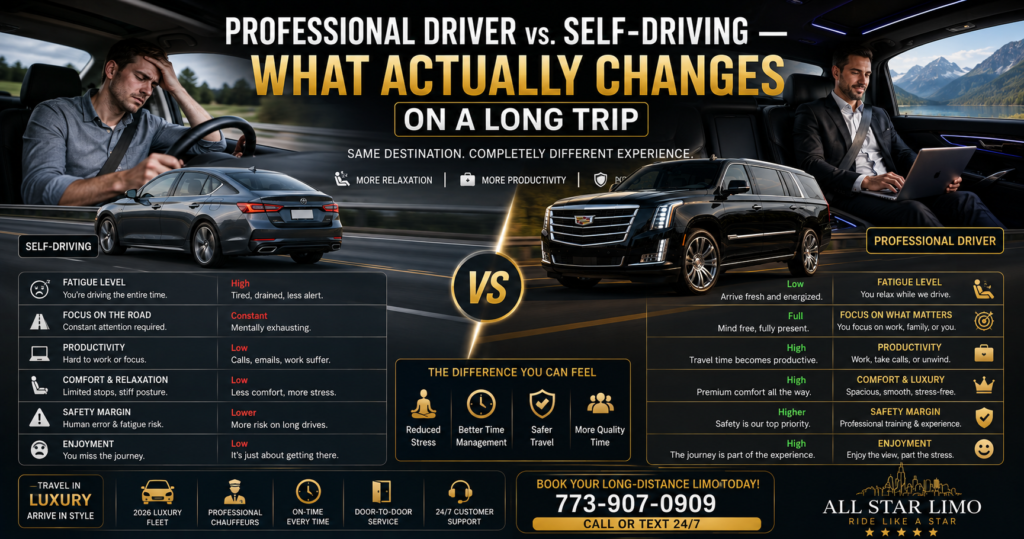
Fatigue and unfamiliar-road risk both rise sharply after roughly 2-3 hours of continuous driving, and both compound further at night or on unfamiliar highways. A professional driver removes both variables entirely — you’re not the one whose attention has to hold for hours, and you’re not the one navigating roads you’ve never driven. This guide focuses on the safety and decision side of that trade-off. If you’re also weighing the cost and booking logistics of hiring a driver versus other travel options, our full cost and booking breakdown covers that in detail.
Most people default to driving themselves on a long trip without really weighing the alternative — it’s the familiar option, the one that requires no extra decision. But “familiar” and “actually the better choice for this specific trip” aren’t the same thing, and the gap between them grows the longer and later the drive gets. This guide walks through what actually happens to attention and risk on a long self-driven trip, what a professional driver’s training is built to address, and how to recognize when a trip is genuinely a better fit for hiring a driver than doing it yourself.
The Fatigue Problem — What Happens to Attention and Reaction Time on Long Drives
Driver fatigue isn’t a vague discomfort — it’s a measurable decline in the specific mental functions that keep a driver safe, and it starts showing up well before most people would describe themselves as “tired.”
What happens physiologically during extended driving:
- Reaction time slows progressively the longer a driver has been at the wheel, particularly on monotonous stretches like highways where there’s little to keep attention actively engaged
- Microsleeps — brief, involuntary lapses in attention lasting a few seconds — become measurably more likely after several hours of continuous driving, especially during the body’s natural low-alertness windows (mid-afternoon and late night)
- Peripheral awareness narrows, meaning a fatigued driver is more likely to miss a hazard at the edge of their field of vision — another vehicle merging, a pedestrian, a road sign — than a well-rested one
- Decision-making degrades in ways that are hard to self-assess in the moment — fatigued drivers consistently underestimate how impaired their own judgment has become, which is part of why fatigue is so dangerous: the person experiencing it often doesn’t recognize it clearly enough to stop
Why this matters more on long trips specifically:
A 20-minute local drive rarely pushes anyone into meaningful fatigue territory. A 4, 6, or 8-hour highway trip is a different situation entirely — it’s long enough for fatigue to build steadily, and highway driving’s monotony (long straight stretches, consistent speed, minimal need for active decision-making) is exactly the kind of driving that accelerates the onset of drowsiness compared to more engaging, varied driving conditions. Ironically, the very quality that makes highway driving feel “easy” — less active steering and decision-making than city driving — is part of what makes it more fatigue-prone over long stretches, since there’s less to keep the brain actively engaged.
The self-assessment problem:
most drivers believe they’ll recognize when they’re too tired to continue safely and pull over accordingly. In practice, fatigue impairs the very judgment needed to make that call — a driver who feels “fine, just a little tired” is often further along the fatigue curve than they realize, which is a meaningfully different risk profile than, say, recognizing you’re low on gas.
Night Driving and Unfamiliar Highways — Where Self-Driving Risk Concentrates
Two conditions compound the fatigue problem specifically, and long trips frequently involve both.
Night driving: reduces visibility, increases glare from oncoming headlights, and coincides with the body’s natural circadian dip in alertness — the hours roughly between midnight and dawn are when the body is biologically primed for sleep, regardless of how rested someone felt earlier in the day. A long trip that starts in the evening and stretches past midnight, or one departing very early in the morning before sunrise, pushes a driver into exactly the window where alertness naturally drops, on top of whatever fatigue has already accumulated from the drive itself.
Unfamiliar highways: add a different kind of load — not physical tiredness, but constant low-level cognitive effort spent on navigation, lane positioning, and anticipating unfamiliar interchanges or exits, effort a driver on a familiar commute doesn’t have to spend. This split attention — partly on driving safely, partly on figuring out where to go — leaves less mental capacity available for hazard detection than driving a known route, even before fatigue becomes a factor. Combine an unfamiliar highway with night driving and several hours of accumulated fatigue, and the risk factors aren’t just adding up individually — they interact, each one making the others harder to manage.
A professional driver structurally removes both of these variables: Route familiarity and time-of-day driving experience are baseline requirements of the job, not incidental — an experienced long-distance chauffeur has typically driven a given regional route enough times that navigation isn’t competing for attention the way it would for a first-time driver on that road, and professional scheduling accounts for fatigue-prone hours rather than pushing through them by necessity.
What a Professional Driver’s Training Actually Covers
“Professional driver” implies a level of preparation beyond simply holding a license, and it’s worth understanding what that training typically includes, since it directly addresses the risk factors above.
Defensive driving certification:
Most professional chauffeur training includes defensive driving instruction — techniques for anticipating other drivers’ mistakes, managing following distance, and reacting to sudden hazards, rather than only reacting to problems as they arise. This is a different skill set than simply having driven for many years personally; it’s structured training specifically aimed at hazard anticipation.
Route and regional hazard awareness:
Professional drivers who regularly cover certain long-distance corridors build a working knowledge of that route’s specific quirks — where construction tends to appear seasonally, which stretches see heavier truck traffic, where weather patterns typically cause the earliest issues during a storm. This kind of accumulated, route-specific knowledge is difficult to replicate on a one-time personal drive, no matter how experienced the driver is generally.
Fatigue and hours-of-service awareness:
Professional drivers, particularly those covering longer routes, are generally trained to recognize their own fatigue signs early and to plan breaks proactively, rather than pushing through discomfort the way a self-driving traveler under time pressure might be tempted to. This is as much a professional discipline as a skill — recognizing that stopping is the correct call, even when it feels like it’s costing time.
Vehicle-specific handling experience:
A professional driver operating a specific vehicle regularly has handling familiarity — how it responds in wet conditions, its blind spots, its braking behavior — that a traveler renting or driving an unfamiliar vehicle for a single long trip doesn’t have, which matters more than it might seem for handling in an unexpected situation.
This isn’t a claim that professional drivers are infallible or that self-driving is inherently reckless — millions of long trips are self-driven safely every day. It’s a more specific point: the training and structural advantages above are exactly the tools that counter the fatigue and unfamiliarity risks described above, in a way that simply “being a careful person” doesn’t fully replicate on a long, unfamiliar, possibly late-hour drive.
The Decision Point — Signs a Trip Is a Better Fit for a Driver Than Self-Driving
Not every long trip needs a professional driver — plenty of long drives are genuinely fine to handle yourself. The question is recognizing which specific trips shift the calculation. A few signals worth weighing honestly before deciding:
- Trip length beyond 3-4 hours in a single stretch. This is roughly where sustained fatigue risk starts climbing meaningfully for most drivers, especially without a planned multi-stop break schedule.
- Departure or arrival during traditionally low-alertness hours — late night, very early morning, or immediately after a full workday when you’re already starting from a depleted baseline rather than a rested one.
- An unfamiliar route, especially one involving highway interchanges, mountain driving, or roads you’ve never driven, where navigation adds cognitive load on top of the drive itself.
- A destination where you need to arrive functional — for a client meeting, a wedding, a performance, or any event where showing up mentally sharp actually matters, rather than a trip where arriving tired has no real consequence.
- You’re already starting the trip tired — after a full workday, a poor night’s sleep, or general exhaustion, which compounds rather than resets during the drive itself.
- Weather conditions add uncertainty — a long trip through unfamiliar territory during rain, snow, or fog raises the stakes of both fatigue and unfamiliarity simultaneously.
- You’d otherwise be driving completely alone with no ability to trade off with another driver if fatigue sets in partway through.
If several of these apply to a specific trip, that’s a reasonable signal the trip is a better fit for hiring a driver than it might otherwise seem on a purely “how far is it” basis. A short, familiar daytime drive rarely needs this consideration — a long, unfamiliar, late-hour drive to an event where you need to be sharp on arrival is a different calculation entirely.
What You Actually Do During the Ride Instead of Driving
The flip side of removing yourself from the driving task is what that time actually becomes available for — and this is where the decision shifts from “avoiding a risk” to “gaining something.”
Work: For a business trip, the hours spent as a passenger are hours that can go toward preparing for the meeting at the destination, catching up on email, or taking calls — productive time that self-driving simply eliminates, since driving safely requires full attention.
Rest: For a trip where you need to arrive genuinely rested — a wedding, a family event, a physically demanding occasion — the option to sleep or simply relax during the ride, rather than needing to summon alertness for the drive itself, is often the difference between arriving present and engaged versus arriving depleted before the event has even started.
Mental preparation: For anything with emotional weight — a difficult family visit, an important negotiation, a performance — having the travel time to mentally prepare rather than needing to focus on the road can meaningfully change how someone shows up at the other end.
Simply not having to think about the drive at all: There’s a less measurable but real benefit in not needing to hold route, timing, and hazard awareness in your head for several hours — a kind of low-grade cognitive load that most people don’t notice consciously during a drive but do notice the absence of afterward, in the form of feeling less depleted on arrival.
This is the core reframe worth sitting with: self-driving isn’t just “the free option” — it has a real cost in the form of the hours and mental energy the drive consumes, even when nothing goes wrong. A professional driver doesn’t just reduce risk; it converts those hours into time you actually control.
Addressing the Objection — “Isn’t It Just Easier to Drive Myself?”
This is the honest, common pushback, and it deserves a direct answer rather than a dismissal.
“I’d rather have control of the car.”
This is a legitimate preference, and for many trips it’s entirely reasonable to keep. The reframe worth considering: control over the vehicle and control over your schedule and destination are different things. A professional driver doesn’t reduce your control over where you go or when — you set the itinerary. What it changes is who’s managing the physical task of driving, which is a narrower trade than it might initially feel like.
“It seems like more effort to arrange than just getting in my car.”
For a single, simple trip, this can be true — booking does require a step that self-driving doesn’t. But weighed against the actual coordination self-driving quietly requires — planning rest stops, accounting for fatigue windows, navigating unfamiliar roads — the “extra effort” of booking a driver is often smaller than it initially appears, and it’s front-loaded before the trip rather than something you’re managing in real time while also driving.
“I’ve done long drives before without a problem.”
This is true for most people, most of the time — fatigue-related incidents are a risk, not a certainty, on any given trip. The relevant question isn’t whether you’ve gotten away with it before; it’s whether a specific upcoming trip has enough of the risk factors above stacked together that the odds are meaningfully different this time — a late-night unfamiliar drive to an important event carries a different risk profile than a familiar daytime commute, even if both are “driving.”
“It feels like giving something up.”
For some people, driving is genuinely enjoyable, and that’s a real consideration worth respecting — this isn’t a universal recommendation to never drive yourself again. It’s a case for recognizing that some specific trips — long, late, unfamiliar, high-stakes on arrival — are a different category than a drive taken for its own enjoyment, and treating them differently isn’t giving something up so much as matching the choice to the actual trip.
What to Look for When Hiring a Long-Distance Driver
If the considerations above make hiring a driver the right call for a specific trip, a few things are worth confirming before booking:
- Licensing and interstate authority, if the trip crosses state lines — a reputable provider should confirm this without hesitation
- Defensive driving training and background screening for the specific driver assigned to your trip, not just a general company policy statement
- Experience with your specific route or region, particularly for longer or less common trips, since route familiarity is one of the clearest advantages over self-driving
- Vehicle maintenance standards, especially for a vehicle that will be on the highway for several continuous hours
- How the company handles driver fatigue and rest breaks on longer trips — a provider who has a clear, structured answer to this is generally more trustworthy than one who hasn’t thought about it
- Reviews or references specific to long-distance trips, not just local, short-ride feedback — the demands and expectations of a multi-hour trip are different enough that general local reviews don’t always translate directly
For the practical side of this — pricing structures, what counts as long distance, vehicle options, and booking timelines — our companion guide on hiring a limo for a long-distance trip covers that ground in detail.
How a Professional Trip Is Structured Differently From a Self-Driven One
Beyond training and route familiarity, the way a long trip is planned changes when a professional driver is involved, in ways that address fatigue risk structurally rather than relying on willpower in the moment.
Breaks are planned, not negotiated mid-drive.
A self-driving traveler under time pressure often talks themselves out of a planned stop — “I’ll push through, I’m almost there” — precisely at the point fatigue is most likely to be distorting that judgment. A professional trip typically builds rest stops into the schedule from the start, treating them as a fixed part of the plan rather than a flexible item to skip if time gets tight.
Departure timing accounts for fatigue windows, not just traffic.
Self-driving trip planning often optimizes purely for traffic avoidance — leaving early to beat rush hour, for instance — without weighing whether that departure time also lands in a circadian low-alertness window. Professional scheduling for longer trips typically weighs both factors together.
There’s no pressure to “just get there” that overrides safety judgment.
One of the quieter dynamics in self-driven fatigue is the pull to finish the trip rather than stop for the night partway through — sunk-cost thinking that a driver actively want to get home or to a destination can fall into. A professional driver’s job is specifically to make the safety call independent of that pressure, which removes a subtle but real risk factor from the equation.
The vehicle itself is prepped for the specific trip.
Tire pressure, fluid levels, and general roadworthiness checks ahead of a long highway trip are standard practice for a professional vehicle in a way that’s easy to skip on a personal vehicle before an unplanned or last-minute long drive.
None of this requires distrust of your own judgment generally — it’s simply describing structural differences that exist regardless of how careful or experienced any individual self-driving traveler is, because they’re built into the process rather than dependent on remembering to apply them under pressure.
Family Trips, Groups, and Shared Driving — Does Splitting the Wheel Solve the Problem?
A common self-driving strategy for long trips is splitting driving duties among multiple people in the car, and it’s worth addressing directly whether this resolves the fatigue concern.
What shared driving does help with: it does extend the total distance a group can reasonably cover in a day, since a rested second driver can take over when the first starts to fatigue. For trips where the group has multiple willing, licensed, comfortable drivers, this is a genuine mitigation the professional-driver framing above doesn’t need to override.
Where it falls short of fully solving the problem:
- Handoffs happen at inconvenient times. In practice, driving swaps often happen when it’s convenient to stop — a gas station, a meal — rather than precisely when the current driver’s fatigue is peaking, which means there’s still a window where a tiring driver continues past the ideal handoff point.
- Passengers in a moving vehicle rest less effectively than truly ceasing to travel. A “resting” driver in the passenger seat of a moving car, especially with other passengers, road noise, and stops, typically doesn’t recover alertness as effectively as someone not traveling at all — meaning the “rested” driver taking over later may be less rested than assumed.
- Not everyone in a group is an equally experienced or comfortable driver, particularly on an unfamiliar highway or at night — swapping to a less confident driver under those conditions can introduce a different kind of risk rather than eliminating the original one.
- Young children or a fussy travel period can prevent genuine rest for the “off-duty” driver, especially on family road trips, meaning the theoretical benefit of shared driving doesn’t always play out as cleanly in practice.
For a family or group trip specifically, a professional driver removes this entire calculation — no one in the group needs to drive at all, which also means everyone, including whoever would otherwise be the primary driver, gets the full benefit of arriving rested rather than just the passengers.
Frequently Asked Questions
Is it actually statistically safer to hire a driver than to drive myself long distance?
Driver fatigue and unfamiliar-road driving are well-documented contributors to crash risk generally, and a professional driver structurally addresses both — trained for fatigue recognition and typically familiar with the route. That said, safety also depends heavily on the specific driver and company, so vetting a provider’s training and licensing matters as much as the general premise.
What if I get tired halfway through a trip I’m driving myself — what should I actually do?
Pull over at the earliest safe opportunity rather than pushing through — a short rest, caffeine, or simply stopping for the night if it’s a multi-day trip are all better options than continuing to drive while fatigued. This is exactly the judgment call fatigue makes harder to trust in the moment, which is part of why planning ahead (including considering a professional driver before the trip starts) matters more than trying to self-assess mid-drive.
Does hiring a professional driver make sense for a short 2-hour trip?
It can, particularly if the trip happens at night, on an unfamiliar route, or ends at an event where arriving rested matters — but for a short, familiar daytime drive, self-driving is often perfectly reasonable. The decision checklist earlier in this guide is more about which specific factors apply to your trip than a strict distance cutoff.
Can I request the same driver for a round trip, or a return leg a few days later?
This is generally something to ask about directly when booking — many providers will accommodate a request for driver consistency, though it can depend on scheduling and how far apart the two legs of the trip are.
Is a professional driver only worth it for business travel, or does it make sense for personal trips too?
The safety reasoning applies regardless of trip purpose — a late-night family drive or a long trip to a personal event carries the same fatigue and unfamiliarity risk as a business trip covering the same distance. The “arrive functional” consideration applies just as much to a family occasion or personal event as it does to a client meeting.
How is this different from just hiring any rideshare or taxi for a long trip?
Standard rideshare and taxi services aren’t generally structured or licensed for extended long-distance interstate trips the way a professional chauffeur or limo service is, and driver training, vehicle standards, and route experience vary far more in that category. For a genuinely long trip, a service built specifically around long-distance travel is a different proposition than an on-demand local ride extended further than it’s typically designed for.
Does splitting driving duties with someone else in the car solve the fatigue problem?
It helps but doesn’t fully solve it — handoffs often happen at convenient stopping points rather than exactly when fatigue peaks, and a passenger resting in a moving vehicle typically doesn’t recover alertness as completely as someone not traveling at all. For groups or families, a professional driver removes the calculation entirely rather than partially mitigating it.
Is caffeine or other stimulants a reasonable substitute for stopping when fatigued?
Caffeine can temporarily mask some symptoms of fatigue but doesn’t reverse the underlying decline in reaction time and judgment — it’s a poor substitute for an actual rest stop, particularly on a long, unfamiliar, or late-hour drive where the accumulated risk factors are already stacked.
Let an Experienced Driver Handle the Miles You Don’t Want to Drive
The safest and most comfortable version of a long trip is often the one where you’re not the one managing fatigue, unfamiliar roads, and hours of sustained attention — while still arriving exactly where and when you need to.
All Star Limo provides professional, trained chauffeurs for long-distance and interstate travel, with drivers experienced on regional routes and trained specifically for the demands of extended trips.
Related reading: