Chicago , il

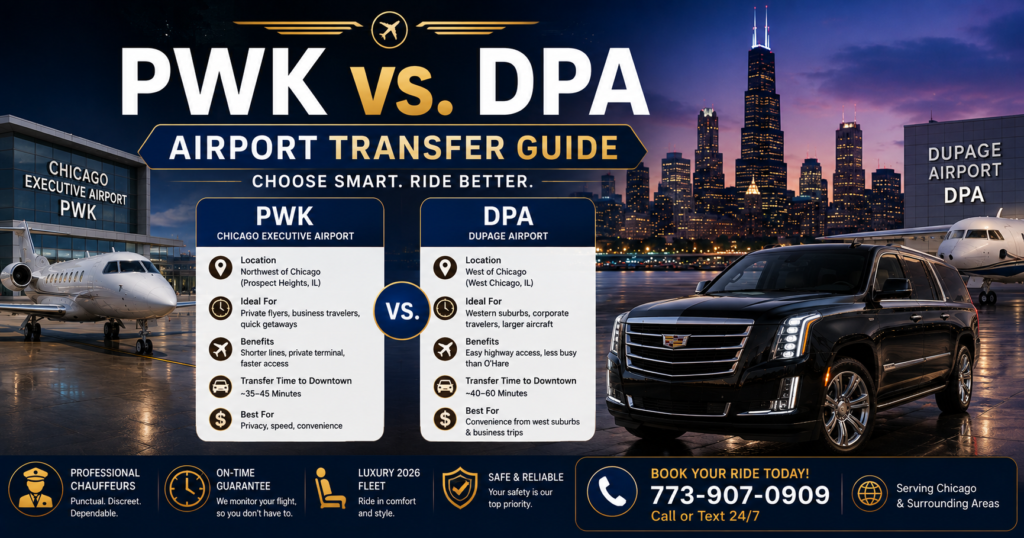
Chicago Executive Airport (PWK) sits in Wheeling, roughly 25 minutes from downtown Chicago and the fastest option for most North Shore and city-center trips. DuPage Airport (DPA) sits in West Chicago, roughly 40–50 minutes from downtown, and is the better call for Naperville, Oak Brook, and the I-88 corridor. Neither airport has commercial rideshare readily available planeside — both require a pre-booked chauffeur who can coordinate directly with your FBO.
If your itinerary shows “Chicago” but your tail number is headed to PWK or DPA instead of O’Hare, you’ve already made the smarter call — shorter lines, no TSA wait, and a ramp that’s minutes from your car. The part that trips up first-time charter passengers and the executive assistants booking for them isn’t the flight. It’s the ground transfer afterward, because these two general aviation airports sit on opposite sides of the metro area and neither one works quite like a commercial terminal curb.
This guide breaks down exactly where PWK and DPA sit relative to downtown Chicago, which FBOs operate at each, how runway-side pickup actually works, and which airport your charter operator is more likely to route you into — so you can book ground transportation that matches your flight, not a guess.
It’s worth saying upfront: neither airport is “better” in an absolute sense. Chicago Executive and DuPage each serve a distinct piece of the metro area, and the right choice usually comes down to where you’re actually headed once you’re on the ground, what kind of aircraft you’re flying, and how much runway your operator wants under the wheels. Executive assistants booking on behalf of a traveling principal, in particular, tend to get tripped up by treating “flying into Chicago” as a single destination — when in practice, PWK and DPA are 30 miles apart and can add or subtract nearly half an hour of ground time depending on which one shows up on the itinerary.
The good news is that once you know which airport you’re landing at, coordinating a smooth transfer is a solved problem — provided your ground transportation company actually has experience working general aviation ramps, not just airline curbs.
PWK vs. DPA — Location & Distance to Downtown Chicago
The single biggest factor in choosing between these two airports — assuming your charter operator gives you the option — is geography. They sit roughly 30 miles apart on opposite sides of the city, and that difference shows up directly in your ground transfer time.
Chicago Executive Airport (PWK):
is located in Wheeling, Illinois, about 20 miles northwest of the Loop, tucked between the Edens Spur and I-294. Because it sits close to the Kennedy corridor, a chauffeured transfer to downtown Chicago typically runs 25–35 minutes outside of rush hour, and it’s an even shorter run to the North Shore suburbs — Northbrook, Deerfield, Glenview, and Highland Park are all within a 15–20 minute drive.
DuPage Airport (DPA):
is located in West Chicago, Illinois, roughly 30 miles west of downtown and closer to the I-88 corridor. It’s the more practical airport for anyone headed to Naperville, Wheaton, Oak Brook, or the western corporate suburbs, where the drive from DPA can be under 20 minutes. A transfer into the Loop from DPA, by contrast, typically runs 40–55 minutes depending on traffic on I-88 and the Eisenhower.
| Factor | Chicago Executive (PWK) | DuPage Airport (DPA) |
|---|---|---|
| Location | Wheeling, IL | West Chicago, IL |
| Distance to the Loop | ~20 miles | ~29 miles |
| Typical transfer time downtown | 25–35 minutes | 40–55 minutes |
| Best for | Downtown, North Shore, O’Hare-adjacent suburbs | Naperville, Oak Brook, Wheaton, I-88 corridor |
| Runway length (primary) | 5,001 ft (Runway 16/34) | 7,571 ft (Runway 2R/20L) — second longest in the region after O’Hare |
Neither distance is prohibitive — this is Chicagoland, and a 30-minute chauffeured ride in a private car is a non-event compared to what a commercial-terminal passenger deals with. But if you’re the one setting the arrival airport with your charter broker, and both are equally available, picking the one closer to your actual destination shaves real time off the trip.
PWK’s Reach — North Shore and Northwest Suburbs
Because Chicago Executive sits just off the Edens Spur and I-294, it’s the more efficient choice for anything north or northwest of the city. Northbrook, Deerfield, Highland Park, Lake Forest, and Glenview are all realistically a 15–25 minute chauffeured ride away, which is part of why PWK sees heavy traffic from corporate clients and residents with homes along the North Shore. Downtown Chicago runs a bit longer — 25–35 minutes in normal traffic, closer to 45 during a weekday evening rush — but it’s still the fastest private-aviation option into the Loop outside of O’Hare itself.
DPA’s Reach — Western Suburbs and the I-88 Corridor
DuPage Airport sits almost squarely in the middle of Chicago’s western business corridor. Naperville, Wheaton, Warrenville, and Oak Brook are typically a 15–20 minute drive, and the airport is a common landing point for executives with offices along I-88’s “Illinois Technology and Research Corridor,” home to a dense cluster of corporate campuses. The tradeoff is the trip back toward the city center — the drive into downtown Chicago from DPA runs meaningfully longer than the equivalent PWK trip, simply because of the extra distance and the number of arterial roads and expressway merges involved.
A Simple Rule of Thumb
If your final destination is north of the Eisenhower Expressway or inside the Loop, PWK usually gets you there faster. If your destination is west of Route 53 — Naperville, Oak Brook, Wheaton, or anywhere along I-88 — DPA is almost always the shorter ride. For destinations that sit right in the middle, like the western edge of downtown or Elmhurst, the two airports end up close enough that other factors (FBO availability, runway length, weather routing) tend to decide it instead.
FBOs at Each Airport (Signature, Atlantic Aviation, and More)
Your ground transfer doesn’t start at “the airport” — it starts at a specific FBO gate, and the two airports differ quite a bit in how many operators you’ll find on the ramp.
FBOs at PWK
Chicago Executive is one of the busiest business-aviation fields in the Midwest, and it supports multiple full-service FBOs on the field, including Signature Flight Support, Atlantic Aviation, and Priester Aviation. Because there are several competing operators, it’s worth double-checking which ramp your aircraft is parked at before your chauffeur arrives — a driver staged at the wrong FBO gate can add unnecessary minutes even at a small airport.
FBOs at DPA
DuPage Airport takes a different approach: rather than hosting several competing FBOs, the airport itself operates a single, unified DuPage Flight Center, run directly by the DuPage Airport Authority. That consolidation actually simplifies ground coordination — there’s only one ramp and one set of gate contacts to coordinate with, which reduces the odds of a miscommunication about where exactly to stage your vehicle.
Either way, the FBO matters more at these airports than the airport code itself. When you book with All Star Limo, give your chauffeur the FBO name (not just “PWK” or “DPA”) along with your tail number — that’s what determines exactly where the car waits.
What FBOs Typically Offer
Both PWK’s and DPA’s FBOs are built around the same core promise as any full-service business-aviation facility: fast fuel and ground handling for the aircraft, and a comfortable, private lounge for passengers and crew while paperwork and turnaround happen. Most offer amenities like conference rooms, quiet workspaces, coffee and refreshments, crew cars, and — critically for ground transportation — a dedicated ramp entrance separate from any public terminal area. This is exactly why an FBO-to-limo handoff can happen so quickly compared to a commercial arrival: there’s no security queue and no long walk between the aircraft and the vehicle.
Why FBO Choice Sometimes Isn’t Yours to Make
If you’re chartering through a broker rather than owning or managing the aircraft directly, the FBO assignment is often made by the operator based on fuel contracts, hangar space, or existing relationships — not passenger preference. That’s fine; it doesn’t change your experience much either way, as long as your ground transportation provider is told which FBO to stage at. What it does mean is that “book my ride to PWK” is genuinely less useful information than “book my ride to Signature at PWK” — the second version gets your chauffeur to the right gate on the first try.
Runway-Side Pickup — How Chauffeur Coordination Works
This is the part that surprises passengers coming from commercial travel: at a general aviation airport, “pickup” usually means the car is staged on the FBO ramp itself, not at a curb past security.
Here’s how a coordinated FBO transfer typically works:
- Share your tail number and FBO in advance. Your chauffeur uses this to track your aircraft’s actual position, not just your scheduled arrival time — which matters when charter departures shift by 20–30 minutes, as they often do.
- The chauffeur stages early. Rather than timing the drive to your scheduled block time, a properly coordinated transfer has the vehicle parked and ready before wheels-down, adjusting automatically if the flight is early or delayed.
- Planeside or FBO-lounge greeting. Depending on the FBO’s ramp policy, your chauffeur either meets you directly at the aircraft steps or just inside the FBO lobby — either way, there’s no terminal walk, no baggage carousel, and no rideshare pickup zone to navigate.
- Luggage handling and direct departure. Bags go straight from the ramp cart into the vehicle, and you’re moving toward your destination within minutes of stepping off the aircraft.
The one thing that makes or breaks this process is communication between the chauffeur and the FBO’s ramp staff — which is exactly why booking with a rideshare app or a generic car service (neither of which typically has ramp access or an FBO relationship) tends to fall apart for private aviation arrivals. A driver without prior FBO coordination may be stuck waiting in short-term parking rather than on the ramp itself.
Why Flight-Tracking Beats a Scheduled Pickup Time
Commercial flight ground transportation is built around a scheduled arrival time because commercial flights are relatively predictable once they’re airborne. Charter flights aren’t — a Part 135 operator can adjust a departure by 20 minutes for a late passenger, a maintenance check, or a weather hold at the origin airport, and none of that shows up as a “delay” on any public tracking site the way an airline flight would. A ground transportation provider that only works off your originally quoted pickup time is essentially guessing. One that tracks your actual tail number sees the real position of the aircraft and adjusts staging accordingly, so the car is genuinely ready when you land — not sitting idle for an hour, and not scrambling in twenty minutes late.
What to Have Ready Before You Land
A smooth handoff comes down to a handful of details communicated ahead of time: your tail number, the FBO name, your expected time on the ground (in case you’re continuing on the same aircraft), the number of passengers and bags, and any special requirements — car seats, wheelchair access, or a request for a specific vehicle class. None of this needs to be finalized weeks in advance; even a same-day charter booking gives a coordinated ground transportation team enough to stage correctly, as long as the tail number and FBO are confirmed once the flight plan is filed.
Share your tail number, we’ll handle the rest. All Star Limo coordinates directly with FBOs at PWK, DPA, O’Hare, and Midway for true planeside pickup — no terminal walk, no waiting.
Which Airport Do Charter Operators Use Most, and Why
If you’re booking through a charter broker or fractional program rather than picking the airport yourself, it helps to understand why an operator routes you to one field over the other.
PWK tends to get the nod: when the trip involves a downtown meeting, a North Shore residence, or a same-day turn where minimizing ground time matters. Its runway (5,001 feet) comfortably handles the light and midsize jets that make up the bulk of charter traffic — Citations, Phenoms, Learjets, and similar aircraft — and its proximity to the city makes it the default choice for many Part 135 operators serving Chicago business travelers.
DPA gets the call: when the aircraft itself demands more runway, when the passenger’s destination is in the western suburbs, or when PWK’s ramp is congested — which happens during peak business-travel periods and major Chicago events. DPA’s 7,571-foot primary runway is the second-longest in the region after O’Hare, meaning it can comfortably accommodate larger cabin aircraft (super-midsize and select heavy jets) that some operators would rather not bring into a busier, more space-constrained field like PWK.
In practice, many charter operators default to whichever field is closer to the passenger’s actual endpoint, then adjust for aircraft size, ramp availability, or weather routing on the day of the flight. If your broker gives you a choice and your destination is genuinely split down the middle, downtown-bound trips lean PWK, and western-suburb trips lean DPA.
Aircraft Category and Runway Fit
Most charter traffic into the Chicago area falls into the light jet and midsize categories — think Citation CJ-series, Phenom 300, Learjet 60, and Hawker 800 — and both PWK and DPA handle these comfortably. Where the two airports diverge is at the upper end of the size range. DPA’s longer primary runway gives operators more margin for super-midsize and select heavy-cabin aircraft, particularly on hot summer days when high density altitude eats into available runway performance. PWK can and does handle larger aircraft as well, but operators flying a heavier jet on a warm day sometimes prefer the extra runway length DPA offers as a safety margin.
Ramp Congestion and Seasonal Demand
Both airports see traffic spikes tied to Chicago’s event calendar — auto shows, major conventions at McCormick Place, the Chicago Marathon weekend, and the holiday travel period around Thanksgiving and New Year’s all push more charter traffic into the region generally. When PWK’s ramp gets tight during one of these peaks, some operators shift flights to DPA simply because it has more room, even for passengers whose actual destination would normally favor PWK. This is one more reason it’s worth confirming your airport and FBO close to your travel date rather than assuming it’ll match a previous trip.
Ground Transportation Options Compared (Private Car vs. Rental)
Neither PWK nor DPA has a taxi stand, rideshare pickup zone, or rental counter sitting next to the FBO the way a commercial terminal does. Your realistic options are a pre-arranged chauffeured car, a rental car delivered to the FBO, or — in a pinch — a rideshare pickup arranged through the FBO’s front desk. Here’s how they actually compare for a charter passenger.
| Option | Pros | Cons |
|---|---|---|
| Pre-booked chauffeured car | Planeside pickup, flight-tracked timing, no wait even on early/delayed arrivals, luggage handled | Requires booking ahead (same-day is usually still possible) |
| Rental car delivered to FBO | Full control of the vehicle for a multi-day trip | No chauffeur, you’re driving unfamiliar roads, limited to standard rental fleet |
| Rideshare via FBO front desk | Can work for a short, solo, low-stakes trip | No flight tracking, driver waits in a public lot (not the ramp), no coordination if your flight shifts, inconsistent vehicle quality |
For a single business traveler making a quick in-and-out trip with no time pressure, a rideshare arranged through the FBO can be workable. For anything involving a group, a tight meeting schedule, discretion, or a flight time that’s likely to move — which describes most charter travel — a chauffeured transfer coordinated directly with your FBO is the option that actually protects your schedule.
Matching the Vehicle to the Trip
Charter passengers arriving at PWK or DPA aren’t a single profile, and the right vehicle varies with the trip. A solo executive headed to a downtown meeting is usually best served by an executive sedan or an S-Class for a quiet, low-key ride. A family or small group with luggage typically needs a full-size SUV like a Cadillac Escalade or Lincoln Navigator. Larger charter groups — a full flight-share cabin, a sports team, or an entertainment party — are better matched to a Sprinter van or stretch vehicle that can move everyone together rather than splitting the group across multiple cars. Booking with a provider that maintains a full fleet, rather than a single vehicle type, means the car matches the trip instead of the other way around.
Discretion for High-Profile Passengers
One advantage general aviation airports already offer over commercial terminals is privacy — no public gate area, no crowds, no photography risk in a terminal hallway. That advantage only holds up if the ground transportation matches it. A rideshare pickup arranged through an FBO front desk still puts a passenger’s name and pickup location into a third-party app’s system. A pre-arranged chauffeur working directly with the FBO and briefed on confidentiality requirements keeps that same privacy intact all the way to the vehicle door.
Booking Tips for Time-Sensitive Charter Arrivals
Charter schedules move. A wheels-up delay at the origin airport, a weather hold, or a last-minute passenger change can shift your arrival by 20 minutes or more with little notice. A few habits make sure your ground transfer keeps pace:
- Give your chauffeur the tail number, not just a flight time. Tail-number tracking shows the aircraft’s actual position, which is far more reliable than a scheduled block time that charter flights routinely miss by a few minutes in either direction.
- Confirm the exact FBO, especially at PWK. With three or more FBOs on the field, “meet me at Chicago Executive” isn’t specific enough — name the FBO by name (Signature, Atlantic, or Priester).
- Book earlier for peak charter periods. Weekday mornings, Friday afternoons, and major event weekends (auto shows, conventions at McCormick Place, holidays) put pressure on both FBO ramps and the chauffeurs staged there — a day or two of notice keeps your preferred vehicle available.
- Flag any customs or NDA requirements up front. International arrivals or high-profile passengers sometimes need extra lead time for FBO clearance or a signed confidentiality agreement — mention this when booking, not planeside.
- Same-day bookings are usually still possible. Charter travel is inherently last-minute at times — a same-day call is almost always workable if the fleet has availability, even if it isn’t ideal.
- Account for Chicago weather in winter. Snow and ice add ground-transfer time on both the I-88 corridor near DPA and the Edens/Kennedy interchanges near PWK — build in extra buffer for a December or January arrival, especially for an evening pickup after dark.
- Coordinate a return trip at the same time as your arrival. If your itinerary includes a same-day or next-day departure, booking both legs together with one provider means your outbound pickup is scheduled with full knowledge of your original arrival details, and there’s one point of contact if anything shifts.
Booking for Executive Assistants and Travel Coordinators
If you’re booking on behalf of a principal rather than traveling yourself, the details that matter most are the ones you can gather from the charter broker or flight department well before wheels-up: aircraft tail number, FBO, expected block time, number of passengers, and any preferences around vehicle type or NDA requirements. Passing all of that to your ground transportation provider in one message — rather than piecemeal as details trickle in — gives the chauffeur team the most lead time to stage correctly and reduces the number of confirmation calls needed on the day of travel.
PWK or DPA — Making the Final Call
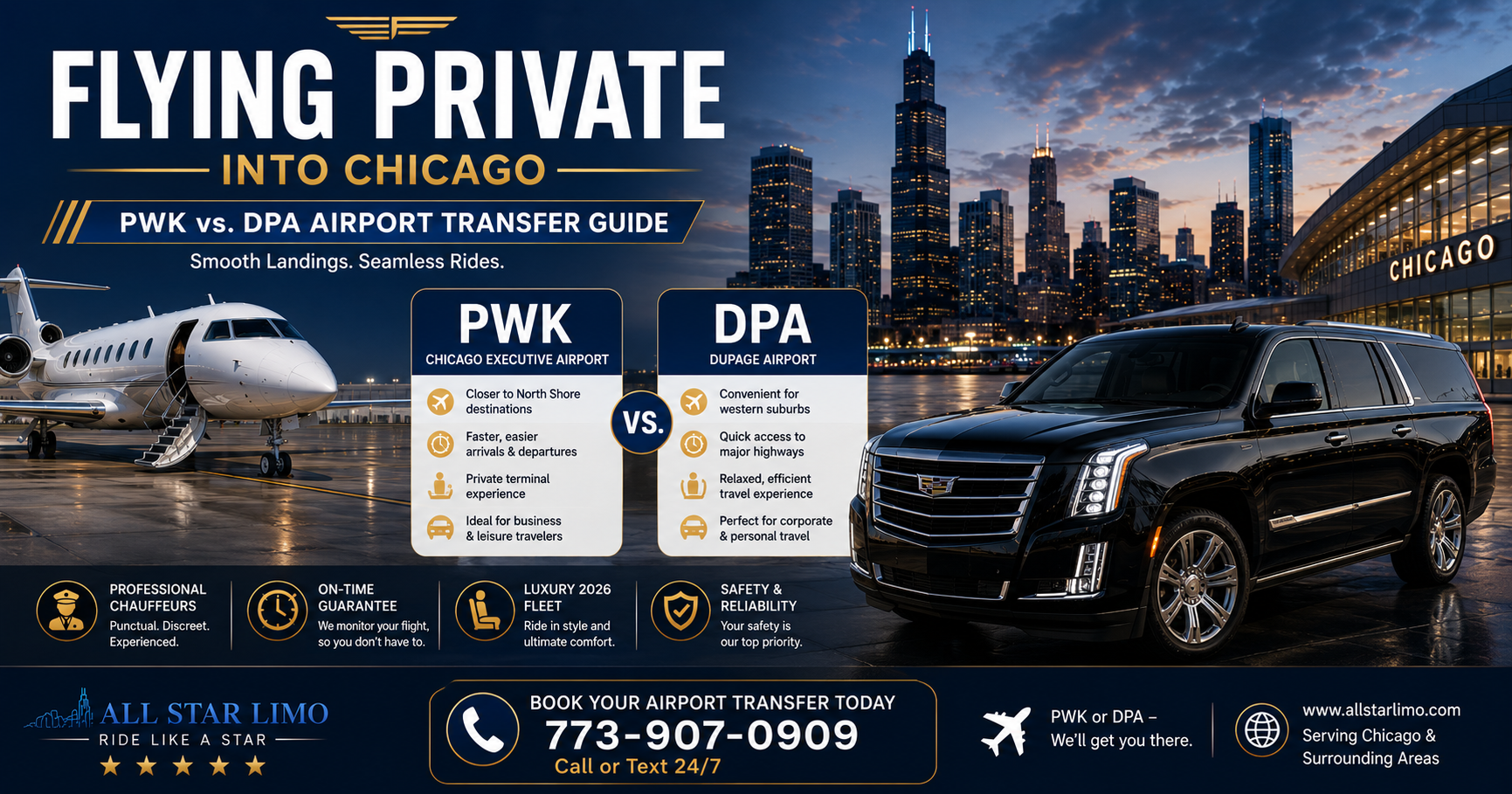
When you have a genuine choice between the two, the decision usually comes down to three questions: Where are you actually going once you’re on the ground? What size aircraft is making the trip? And is either ramp likely to be congested on your travel date? For most downtown and North Shore trips, PWK‘s shorter drive makes it the more convenient option. For anything west of the city — Naperville, Oak Brook, Wheaton — DPA’s proximity outweighs the extra runway distance from downtown. And on the rare trip where a larger aircraft or a congested PWK ramp forces the decision, DPA’s longer runway and single, well-organized FBO make it a dependable fallback.
Whichever airport shows up on your flight plan, the ground transfer itself shouldn’t be the variable you have to think about. A chauffeur who already knows both ramps, already has a relationship with the FBOs, and is tracking your tail number rather than a printed schedule turns the “PWK vs. DPA” question into a formality — the car will be waiting either way.
Frequently Asked Questions
Is PWK or DPA closer to downtown Chicago?
PWK, in Wheeling, is closer — about 20 miles and a 25–35 minute drive to the Loop. DPA, in West Chicago, is roughly 29 miles out and typically runs 40–55 minutes to downtown.
Which airport is better for a Naperville or Oak Brook meeting?
DPA. It sits much closer to the I-88 corridor, and a transfer to Naperville, Wheaton, or Oak Brook from DPA can be under 20 minutes, versus a longer cross-metro drive from PWK.
Can a chauffeur meet me directly at the aircraft?
In most cases, yes — subject to the individual FBO’s ramp access policy on that day. All Star Limo coordinates with the FBO ahead of time so your chauffeur is positioned for a planeside or FBO-lobby greeting, whichever the ramp allows.
Do I need to book ground transportation in advance for a charter flight?
It’s strongly recommended, since neither PWK nor DPA has a rideshare or taxi stand at the FBO. That said, same-day and last-minute bookings are usually still workable — charter travel is inherently unpredictable, and a good ground transportation provider builds for that.
What if my charter flight is delayed?
A chauffeur tracking your tail number will see the delay in real time and adjust their staging accordingly, so you’re not paying for — or waiting on — a car that showed up on the original schedule.
Do PWK and DPA handle large private jets, or just light aircraft?
Both handle a wide range. PWK’s primary runway (5,001 ft) comfortably serves light and midsize jets. DPA’s primary runway (7,571 ft) is the second-longest in the Chicago region after O’Hare and can accommodate larger cabin and super-midsize aircraft.
Is there a taxi stand or rideshare pickup zone at PWK or DPA?
No. Neither airport has a public curb, taxi stand, or dedicated rideshare zone next to the FBO the way a commercial terminal does. Ground transportation at both fields is arranged through the FBO or pre-booked directly with a car service that has an existing ramp relationship.
Can All Star Limo handle a group arriving on the same charter flight?
Yes. The private jet limo service fleet includes SUVs, Sprinter vans, and stretch vehicles, so a full charter cabin can be moved together rather than split across multiple pickups — useful for corporate teams, wedding parties, or entertainment groups landing at either PWK or DPA.
Landing at PWK or DPA? Your chauffeur is already staged.
Flat-rate pricing, real-time tail-number tracking, and direct FBO coordination — for individuals, families, and executive teams flying private into Chicago.
Related Chicago Airport & Private Aviation Guides