Chicago , il

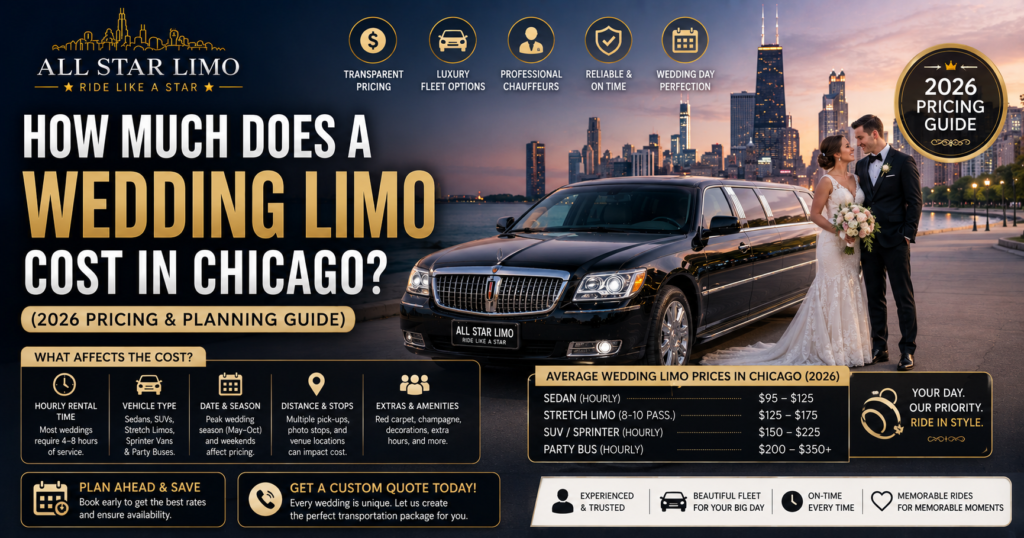
Most Chicago couples pay $95–$250/hour for wedding transportation, with a 2–4 hour minimum depending on the vehicle. A standard stretch limo for a 3-hour wedding day (ceremony to reception) typically lands between $400–$700 total before gratuity, while a Sprinter limo or party bus for a larger wedding party runs $600–$1,200+. Peak season (May, June, September) and Saturday bookings sit at the top of that range.
This guide breaks down real 2026 Chicago wedding limo pricing by vehicle type, how many cars your wedding actually needs, what’s included versus what shows up as a surprise fee, and how far in advance to book — based on 10+ years of running wedding transportation across Chicago and the suburbs.
Wedding transportation is one of those line items couples tend to underestimate until they’re deep in vendor quotes. Unlike a DJ or a florist, a limo company is booking your most time-sensitive day — one where a 20-minute delay doesn’t just inconvenience the couple, it pushes back photos, cocktail hour, and sometimes the entire reception schedule. That’s why pricing for wedding transportation isn’t just about the hourly rate on a website; it’s about matching the right vehicle, the right number of hours, and the right chauffeur experience to a day that has zero room for a missed pickup.
Below, we walk through exactly what drives the cost of a Chicago wedding limo in 2026, how to figure out how many vehicles you actually need (this is where most couples either overspend or get caught short), what a realistic ceremony-to-reception timeline looks like for both downtown and suburban weddings, and the fees that don’t always show up on the first quote you get.
Chicago Wedding Limo Pricing Breakdown by Vehicle
Wedding limo pricing in Chicago isn’t one flat number — it depends heavily on vehicle type, passenger count, and how many hours you book. Here’s what couples are actually paying in 2026:
| Vehicle Type | Passengers | Hourly Rate | Typical Minimum | Best For |
|---|---|---|---|---|
| Executive Sedan (S-Class, Maybach) | 2–3 | $95–$150/hr | 2 hrs | Bride & groom getaway car, VIP arrival |
| Stretch Limo (Lincoln MKT) | 8–10 | $150–$200/hr | 3 hrs | Wedding party, bridesmaids/groomsmen |
| Sprinter Limo / Executive Van | 10–14 | $175–$225/hr | 3 hrs | Larger bridal party, extended family |
| Sprinter Party Bus | 14 | $200–$250/hr | 3–4 hrs | Groomsmen send-off, guest shuttle |
| Stretch Hummer Limo | 18–22 | $250–$350/hr | 3–4 hrs | Full wedding party in one vehicle |
| Rolls-Royce / Rolls-Royce Cullinan | 2–3 | $200–$350/hr | 2–3 hrs | Bride’s arrival, statement getaway car |
Rates vary by season, day of week, and distance between venues — the numbers above reflect typical Chicago and south suburb pricing. For current flat rates on a specific vehicle, check the Chicago limo pricing page or explore the full wedding limo fleet.
A Closer Look at Each Vehicle Type
Executive sedans (Mercedes-Benz S-Class, Maybach): These are the go-to choice for a bride and groom’s private getaway car, or for a VIP arrival where the focus is elegance rather than group size. Because they seat only 2–3 comfortably in formalwear, they’re rarely the only vehicle booked for a wedding — most couples pair one with a larger vehicle for the bridal party. The S-Class limo service is a popular pick for this exact role.
Stretch limos (Lincoln MKT and similar): This is the traditional wedding-day vehicle — the one people picture when they think “wedding limo.” It comfortably seats a bridal party of 8–10 in formalwear, with enough interior length for gowns and photos inside the vehicle itself. It’s the most requested option for ceremony-to-reception transport for small-to-mid-size wedding parties.
Sprinter limos and executive vans: For wedding parties that have outgrown a traditional stretch limo — bigger bridal parties, mixed groups, or couples who want more headroom for hair and makeup touch-ups en route — a Sprinter limo offers 10–14 passenger capacity with a more open, modern cabin. It’s also generally easier to load and unload in formalwear than a low-profile stretch limo.
Sprinter party buses: These lean more social than formal — bench or lounge-style seating, standing room, and a layout built for a group that’s celebrating rather than posing for photos. They’re a strong fit for groomsmen transportation, a bachelor-party-adjacent send-off, or shuttling a larger group of guests between venues.
Stretch Hummer limos: The largest single-vehicle option, seating up to 22. This is the choice when a couple wants the entire wedding party — bridesmaids and groomsmen together — riding as one group instead of splitting into two vehicles. It’s also the vehicle most likely to need extra turning radius, so it’s a better fit for wider streets and suburban venues than tight downtown blocks.
Rolls-Royce and Rolls-Royce Cullinan: These are statement vehicles, typically booked for the bride‘s arrival or the couple’s getaway car rather than for moving the full wedding party. Because there are a limited number of these vehicles in any Chicago-area fleet, they book out the furthest in advance of anything on this list.
How Many Vehicles Does Your Wedding Actually Need?
This is the question most couples get wrong — and it’s the one that blows up a wedding transportation budget the fastest. Use this rough formula based on wedding party size:
- Bride + bridesmaids only (4–6 people): One stretch limo or Sprinter limo covers hair/makeup location to ceremony.
- Bride’s party + groom’s party separately (8–14 people total): Two vehicles — typically a stretch limo for the bridal party and a second sedan or SUV for the groom.
- Full wedding party (14–22 people): One Sprinter party bus or stretch Hummer, or two mid-size vehicles running parallel routes.
- Guest shuttle needed (50+ guests, hotel block or parking-limited venue): Add a 14-passenger Sprinter or a dedicated shuttle service booked separately from the bridal party vehicle.
A common mistake: booking one large vehicle to save money, then realizing it can’t make two stops (salon → ceremony → photo location) without leaving half the party waiting. If your day has more than two location changes, price out hourly rental options with a dedicated chauffeur who stays with the vehicle all day instead of a single point-to-point transfer.
Questions to Ask Yourself Before Booking Vehicle Count
- Are the bride and groom getting ready at the same location, or separately? Separate prep locations almost always mean two vehicles, even for a small wedding party, since both sides need to arrive at the ceremony independently.
- How many total stops does the day include? Count every leg: prep location(s) → ceremony → photo location(s) → reception → optional late-night departure. Each additional stop adds either more hours to a single vehicle’s booking or justifies a second vehicle running in parallel.
- Does your venue have parking or drop-off restrictions? Some downtown venues and popular Chicago neighborhood spots have limited loading zones, which can make a single larger vehicle harder to maneuver than two smaller ones.
- Do you need a guest shuttle in addition to wedding party transportation? These are usually priced and booked separately, since guest shuttles run on a different schedule than the bridal party’s timeline. Our group transportation options cover this need for larger guest counts.
Getting this right at the planning stage — not two weeks before the wedding — is what keeps transportation costs predictable instead of turning into a last-minute add-on scramble.
Timeline: Ceremony-to-Reception Logistics in Chicago
Chicago weddings almost always involve at least one meaningful drive — and that drive is where hourly minimums and traffic timing actually matter.
Typical Loop-to-suburb example:
A ceremony at a downtown Chicago church (say, near the Gold Coast or River North) with a reception at a suburban venue in Naperville, Oak Brook, or Orland Park adds 35–55 minutes of drive time each way depending on traffic and time of day. Saturday afternoon departures (2–4 PM) hit the worst of weekend event traffic near the expressways.
Building the timeline:
- Hair/makeup location pickup → ceremony venue (buffer 15 min for photos before departure)
- Ceremony → photo location (parks, the Lincoln Park area, or venue grounds — budget 45–90 min for photos)
- Photo location → reception venue
- Optional: getaway car at the end of the night
Each leg needs its own buffer. A 3-hour hourly minimum sounds like plenty until you factor in a photographer running behind schedule or valet lines at a popular reception venue. Most experienced planners book a 30–45 minute cushion into the total hours reserved.
Downtown church-to-suburban-venue example:
A Saturday morning ceremony at a Loop or Gold Coast church with an early-afternoon reception in a suburb like Naperville or Oak Brook is one of the most common Chicago wedding routes — and one of the least forgiving on timing. Expressway traffic on I-90/94 or I-88 during a weekend midday window can add 15–20 minutes beyond typical drive-time estimates, especially if there’s a Cubs, Bears, or festival event downtown that same day. Couples booking this route should build in extra buffer specifically around 11 AM–2 PM departures.
All-downtown wedding example:
When the ceremony, photos, and reception are all within Chicago’s downtown core — say, a church near River North with a reception at a Loop hotel — drive times shrink, but loading-zone and valet timing becomes the bigger variable. A chauffeur who knows which hotels have dedicated event entrances versus shared valet queues can save 10–15 minutes per stop compared to one who doesn’t.
South suburb-to-south suburb example:
Weddings that stay entirely within the south suburbs — Orland Park, Tinley Park, Frankfort, Mokena, New Lenox — tend to have the most predictable timelines, since these routes avoid the worst of downtown congestion. This is also All Star Limo‘s core service area, so chauffeurs running these routes typically know back-road alternatives if a main road backs up unexpectedly.
Building your own timeline:
A simple way to stress-test your schedule: write out every stop with an estimated arrival time, then add 15 minutes to each leg as a buffer. If the total exceeds the vehicle’s reserved hours, either add time to the booking or trim a stop from the day. This single exercise catches most wedding-day transportation problems before they happen.
Peak Wedding Season Pricing (May–June Surcharge Reality)
Chicago wedding season runs roughly April through October, but May, June, and September are peak. Here’s what that means for pricing:
- Saturday bookings in peak months often carry a premium of 10–20% over off-peak weekday or winter rates.
- Minimum hour requirements increase — a 2-hour minimum in January can become a 3–4 hour minimum on a June Saturday.
- Popular vehicles (Rolls-Royce, stretch Hummer) book out 2–3 months ahead for peak Saturdays.
- Sunday and Friday weddings typically see better availability and sometimes lower minimums, since most Chicago weddings cluster on Saturday.
If your date falls in peak season, lock in transportation as early as possible — vehicle availability disappears well before pricing does.
Why peak pricing exists:
Limo companies operate a fixed fleet — there’s only so many stretch limos, Sprinters, and specialty vehicles in any Chicago-area company‘s inventory. During May, June, and September, wedding demand competes directly with prom season (spring), corporate event season, and — in early fall — homecoming bookings. When demand for a limited fleet spikes, both pricing and minimum-hour requirements adjust to reflect it.
Weekday and Sunday advantage:
Couples with flexibility on their wedding date can often save meaningfully by choosing a Friday or Sunday wedding, or a date outside the May–June–September window. Vehicle availability is wider, minimum-hour requirements are often lower, and — since most Chicago venues also discount weekday rentals — the transportation savings tend to compound with other vendor savings.
Holiday weekend considerations:
Memorial Day, Fourth of July, and Labor Day weekends bring their own pricing and availability pressure, independent of wedding season generally, since these dates also see high demand for corporate events, family travel, and general hourly rentals. If your wedding falls on one of these weekends, book earlier than you would for a typical peak Saturday.
What’s Included vs. Hidden Fees
Wedding limo quotes can look identical on paper and still end up very different at checkout. Here’s what to confirm before you book:
Usually included:
- Chauffeur for the full reserved hours
- Standard decor (ribbons, “Just Married” signage on request)
- Bottled water
Commonly separate — ask directly:
- Gratuity — typically 18–20%, sometimes built into the quote, sometimes added at booking
- Overtime — billed per 15- or 30-minute increment if you run past your reserved hours; rates are usually higher than your base hourly rate
- Red-carpet service — an add-on at some companies, included at others
- Champagne/bar service — often an add-on due to licensing; ask if BYOB is allowed instead
- Fuel surcharge or cleaning fee — rare, but worth confirming for long-distance suburb-to-city routes
Ask for a written, itemized quote before you book — not just an hourly rate. A transparent company will show flat-rate or clearly itemized pricing with no surge charges, which you can compare against the breakdown on the Chicago limo pricing page.
Five Questions to Ask Every Limo Company Before You Sign
- Is gratuity included in this quote, or added at booking/day-of? Get the exact percentage in writing.
- What’s your overtime rate, and how is it billed — per 15 minutes, per 30 minutes, or per hour? This matters more than the base rate if your day has any risk of running long.
- Is the chauffeur the same person for the entire booking, or could vehicles/drivers swap between stops? For a wedding day, consistency matters — a chauffeur who’s been with the party since the morning knows the schedule and the people involved.
- What happens if a vehicle breaks down or is delayed? Ask specifically about backup vehicle policy — a company with a larger fleet can usually swap in a replacement faster than a smaller outfit.
- Can I get a written cancellation and rescheduling policy? Wedding dates sometimes shift. Know the deposit and refund terms before you commit.
A company that answers all five of these clearly and in writing — before you’ve paid a deposit — is generally a safer bet than one that only quotes an hourly rate over the phone.
How Far in Advance to Book
| Wedding Date | Recommended Booking Window |
|---|---|
| Peak Saturday (May, June, Sept) | 3–6 months ahead |
| Off-peak Saturday | 1–3 months ahead |
| Weekday or Sunday wedding | 2–4 weeks ahead |
| Rolls-Royce / specialty vehicle | 3+ months ahead, any season |
Booking early doesn’t just protect availability — it also locks in pricing before any seasonal rate adjustments. Most Chicago limo companies, including ours, recommend reserving wedding transportation as soon as the venue and guest count are finalized, since that’s when vehicle count and hours become clear. You can check availability and book online once your timeline is set.
What to have ready when you book:
Vehicle availability and accurate quotes both depend on a few key details: your date, ceremony and reception addresses, estimated wedding party size, and a rough hour-by-hour timeline if you have one. Even a loose draft timeline helps a limo company recommend the right number of vehicles and hours instead of over- or under-booking.
Locking in vs. finalizing details later:
You don’t need every detail nailed down to reserve a date — most companies allow adjustments to vehicle type, exact pickup times, and stop order closer to the wedding date, as long as the overall booking window and vehicle count stay roughly the same. What you can’t easily change last-minute is vehicle availability itself, which is why the reservation should happen early even if the day-of details are still in flux.
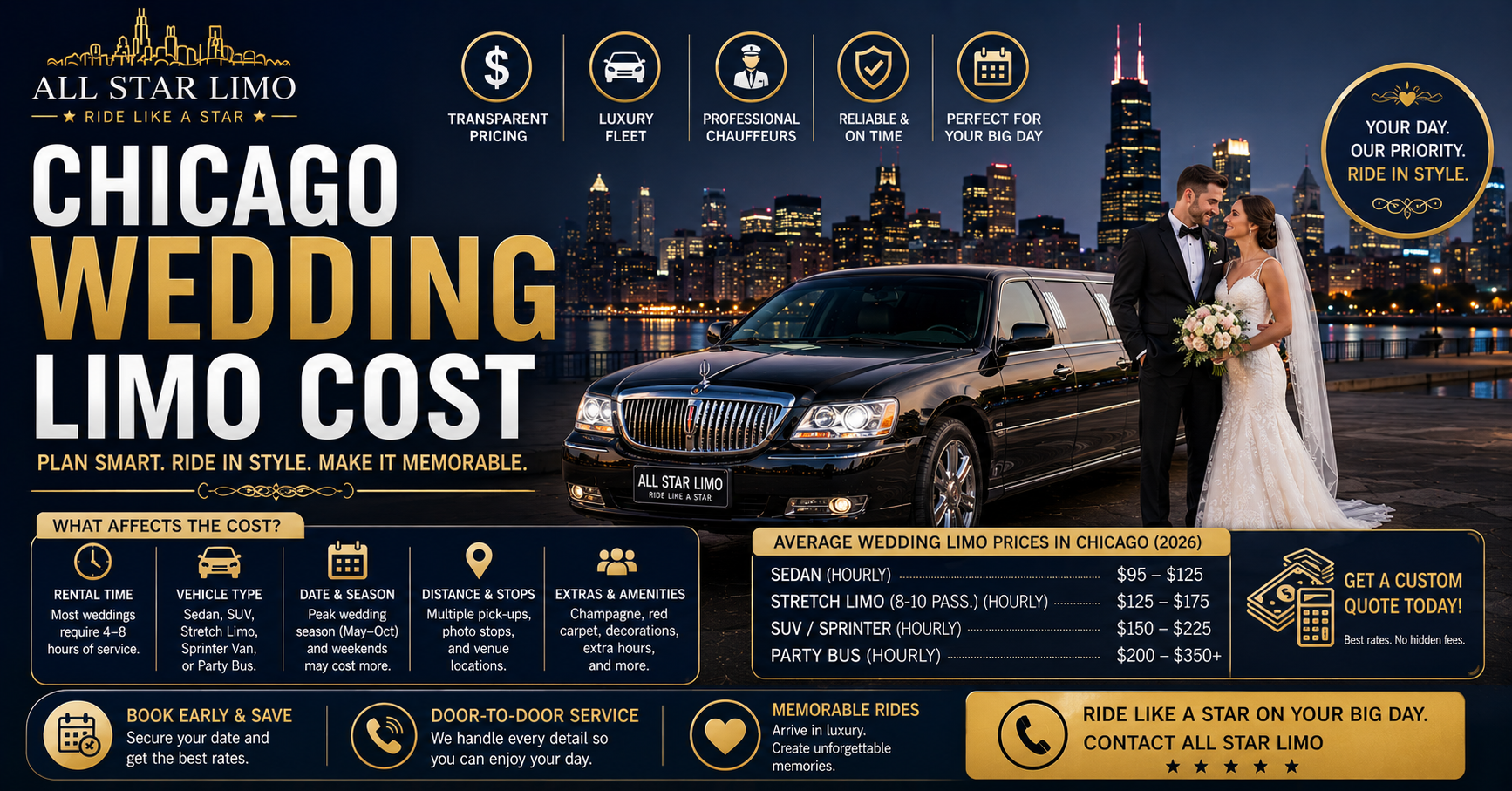
Wedding Limo vs. Party Bus vs. Sprinter — Which Fits Your Wedding Party
- Stretch limo: Best for smaller, formal bridal parties (up to 10) who want the classic wedding-day look for photos and arrival.
- Sprinter limo/executive van: Best for mid-size parties (10–14) who want more headroom, easier entry/exit for formalwear, and a more modern interior.
- Sprinter party bus: Best for groomsmen send-offs, bachelor/bachelorette-adjacent transport, or moving a larger group with a more social, standing-room layout.
- Stretch Hummer: Best when the full wedding party (up to 22) wants to travel together in one vehicle instead of splitting into two cars.
For a deeper side-by-side comparison of these options — including cost differences and which one actually fits your guest count — see our Sprinter van vs. stretch limo vs. party bus comparison guide.
Matching vehicle to wedding style, not just headcount:
A formal, traditional wedding with a black-tie dress code tends to pair better with a stretch limo or Rolls-Royce — vehicles built for photo-ready arrivals. A more relaxed or modern wedding, especially one with a younger wedding party or a rehearsal-dinner-into-wedding-weekend structure, often fits better with a Sprinter limo or party bus, since the interior layout supports a more social atmosphere without sacrificing comfort.
Mixing vehicle types across the day:
Some couples book one vehicle type for daytime formal transport (ceremony to photos) and a different one for the evening send-off — for example, a stretch limo for the ceremony and a Sprinter party bus for guests heading between the reception and an after-party or hotel block. This works well when the day has a clear formal/casual split, though it does mean coordinating two separate bookings and confirming both timelines line up.
Real Chicago Venue Routing Realities
Chicago’s most popular wedding venues each come with their own logistics quirks:
- Downtown hotel venues (Drake Hotel, Palmer House, Hyatt Regency): Valet and loading-zone timing matters most here. Chauffeurs familiar with downtown hotel drop-off procedures avoid the circling-the-block delay that eats into your reserved hours.
- Neighborhood venues (River North, Wicker Park, Lincoln Park): Tight streets and limited parking mean a stretch limo may struggle with turning radius on smaller side streets — a Sprinter or sedan is sometimes the better fit.
- Suburban venues (Oak Brook, Naperville, Orland Park, Tinley Park): Longer highway drive times, but generally easier loading/unloading. These routes are where hourly minimums and traffic-timing buffers matter most, since a delay on I-55 or I-88 can eat 20+ minutes.
A chauffeur who already knows these routes — not just the address — is often the difference between an on-time wedding day and a stressed one. Our chauffeurs run these exact corridors daily as part of wedding limo service across the city and south suburbs.
Case Study Notes: Popular Chicago Wedding Venue Types
Historic hotel ballrooms (Drake Hotel and similar Magnificent Mile properties):
These venues typically have a formal event entrance separate from the main guest valet, but not every chauffeur knows which door to use or how early to arrive to avoid a queue. Weddings here often run tight on the ceremony-to-cocktail-hour window, so a chauffeur with prior experience at the property is genuinely useful — not just a nice-to-have.
Boutique event spaces (loft- and gallery-style venues like the Ivy Room and similar Chicago venues):
These spaces are frequently located on side streets with limited loading zones and no dedicated valet, which makes a large stretch Hummer or party bus harder to maneuver than a stretch limo or Sprinter. Couples booking a boutique venue should confirm vehicle size against the venue’s actual street access before finalizing their vehicle choice.
Suburban banquet halls and country clubs:
These venues generally offer the most generous loading and parking access of any category, but come with the longest highway drive time from a downtown ceremony. The tradeoff is usually worth it for the easier drop-off — but it does mean the drive-time buffer matters more than the on-site logistics.
Outdoor and garden venues (forest preserves, botanical gardens, private estates):
Seasonal weddings at outdoor venues add a variable most couples don’t think about: unpaved or gravel drop-off areas that some stretch vehicles can’t navigate comfortably. Confirming ground surface and drop-off distance with the venue ahead of time avoids a last-minute vehicle swap.
Every one of these venue types can work well with the right vehicle and the right chauffeur experience — the mismatches happen when a vehicle is booked based on passenger count alone, without factoring in how (and where) it actually needs to load and unload on the day.
Sample Wedding Transportation Budgets
Every wedding is different, but seeing full scenarios laid out — rather than just an hourly rate — makes it easier to plan your own budget. These are illustrative examples based on typical 2026 Chicago pricing; your actual quote will depend on date, vehicle availability, and exact route.
Scenario 1: Small, intimate wedding (bridal party of 4, downtown ceremony and reception) One stretch limo, 3-hour minimum, at roughly $175/hour = $525, plus gratuity (18–20%) = approximately $620–$650 total. This covers pickup at the prep location, arrival at the ceremony, a short photo stop, and drop-off at the reception.
Scenario 2: Mid-size wedding (bridal party of 8, groomsmen of 6, downtown-to-suburb route) Two vehicles: a stretch limo for the bridal party (4-hour minimum at $185/hour = $740) and a sedan or small SUV for the groomsmen (3-hour minimum at $120/hour = $360). Combined base cost before gratuity: $1,100, plus gratuity brings the total to roughly $1,300–$1,350.
Scenario 3: Large wedding party (18–20 people, all traveling together, suburban venue) One stretch Hummer limo, 4-hour minimum during peak season at $300/hour = $1,200, plus gratuity = approximately $1,400–$1,450 total. This scenario assumes the full wedding party rides together for the entire ceremony-to-reception window.
Scenario 4: Full-day coverage with guest shuttle (large wedding, hotel block, downtown venue) Bridal party stretch limo (4 hours at $185/hour = $740) plus a separate 14-passenger Sprinter guest shuttle running a loop between the hotel and venue for several hours (5 hours at $200/hour = $1,000). Combined base cost: $1,740, plus gratuity brings the total to roughly $2,050–$2,100.
These numbers move up or down based on season, day of week, and exact vehicle selection — but they illustrate the real range couples should expect to budget, rather than relying on a single “average” number that doesn’t reflect their actual wedding day structure.
What Actually Moves Your Final Price
If you’re comparing quotes from multiple Chicago limo companies and the numbers don’t match, it’s almost always one of these factors:
- Vehicle age and condition. Newer fleet vehicles, especially specialty vehicles like a 2026 Mercedes-Benz S-Class or a Rolls-Royce Cullinan, command a premium over older models.
- Chauffeur experience level. Companies that assign chauffeurs with specific wedding-day experience — not just general driving experience — sometimes build that into their rate structure.
- Fleet size and backup availability. A company with a larger, more diverse fleet can typically offer more flexible backup options if a specific vehicle becomes unavailable, which can factor into pricing.
- Distance from the company’s base of operations. A limo company based in the south suburbs may price a downtown Chicago pickup differently than a company based downtown — and vice versa for a far-suburb reception.
- Day-of-week and time-of-day demand. As covered above, Saturday afternoon in peak season is the highest-demand slot on the calendar; a Tuesday morning is the lowest.
Understanding which of these factors apply to your specific wedding helps you evaluate whether a lower quote is genuinely a better deal, or whether it’s missing something a higher quote includes — like backup vehicle guarantees or a more experienced chauffeur.
Common Wedding Limo Mistakes to Avoid
Booking the minimum hours and hoping the day stays on schedule:
Wedding days almost never run exactly on time. Booking the bare minimum hours to save money is the single most common cause of unexpected overtime charges — and overtime rates are almost always higher than the base hourly rate.
Not confirming vehicle size against venue access:
As covered above, a beautiful stretch Hummer doesn’t help if it can’t turn onto the venue’s street. Always confirm vehicle dimensions against venue access before booking, especially for boutique or historic venues.
Assuming one vehicle can make every stop without a time penalty:
A vehicle making multiple stops (prep location → ceremony → photos → reception) needs realistic drive-time and buffer built into the hours reserved — it’s not free just because it’s the same vehicle for the whole day.
Forgetting the groom’s side needs transportation too:
Many couples plan the bride’s transportation in detail and treat the groomsmen’s ride as an afterthought, then scramble for a second vehicle a few weeks out — right when availability is tightest.
Not getting the quote in writing:
A verbal hourly rate over the phone isn’t the same as a written, itemized quote showing gratuity, overtime rates, and any add-ons. Always get it in writing before paying a deposit.
Frequently Asked Questions
1. How much does a wedding limo cost in Chicago in 2026?
Most couples pay $95–$250/hour depending on vehicle type, with a 2–4 hour minimum. A typical 3-hour wedding day booking runs $400–$700 for a stretch limo, more for Sprinter vans, party buses, or specialty vehicles like a Rolls-Royce.
2. What’s the average hourly minimum for a wedding limo?
Most Chicago limo companies require a 2-hour minimum for weekday or off-peak bookings and a 3–4 hour minimum for Saturday weddings during peak season (May, June, September).
3. How many limos do I need for my wedding party?
It depends on party size and number of stops. A bridal party of 4–6 usually needs one vehicle; a full wedding party of 14–22 often needs a Sprinter party bus or stretch Hummer, or two vehicles running in parallel.
4. Is gratuity included in wedding limo pricing?
Not always. Gratuity (typically 18–20%) is sometimes built into the quoted rate and sometimes added separately at booking — always ask for a fully itemized quote before reserving.
5. How far in advance should I book a wedding limo in Chicago?
For peak Saturdays (May–June, September), book 3–6 months ahead. For off-peak or weekday weddings, 1–3 months is usually enough. Specialty vehicles like a Rolls-Royce should be booked 3+ months out regardless of season.
6. What happens if the wedding runs longer than the reserved hours?
Overtime is typically billed in 15- or 30-minute increments at a rate at or above your base hourly rate. Building in a 30–45 minute buffer when booking helps avoid this.
7. Can one limo cover ceremony, photos, and reception?
Yes, if you book enough hours and the vehicle stays with your party for the full day rather than a one-way transfer. This is where hourly rentals work better than a single point-to-point booking.
8. What’s the difference between a wedding limo and a black car for a wedding?
A stretch limo or specialty vehicle (Rolls-Royce, Hummer) is built for the classic wedding-day look and larger parties. A black car or executive sedan works well for a smaller getaway car or VIP arrival where formality matters more than group size — see our S-Class limo service for that option.
9. Do Chicago wedding limo prices go up during peak season?
Yes — Saturday bookings in May, June, and September typically run 10–20% higher than off-peak pricing, and minimum hour requirements often increase as well.
10. Should the bridal party and groomsmen ride in the same vehicle?
It depends on your day’s logistics. If both sides are getting ready at the same location and departing together, one larger vehicle can work. If they’re prepping separately — which is more common — most couples book two vehicles so each side can arrive at the ceremony independently and on their own schedule.
11. What’s the best way to compare quotes from different Chicago limo companies?
Compare full itemized totals, not just hourly rates. A company quoting $150/hour with gratuity and overtime clearly spelled out may end up cheaper than one quoting $130/hour with those costs added later. Ask each company for the same information — hourly rate, minimum hours, gratuity policy, and overtime rate — so you’re comparing apples to apples.
Choosing the Right Chicago Wedding Limo Company
Price is only part of the decision. For a day with zero room for error, a few other factors matter just as much:
- Licensing and insurance. Confirm the company is licensed and commercially insured — not just for legal protection, but because insured companies typically maintain their fleets to a higher standard.
- Reviews specific to weddings. General reviews are useful, but reviews that mention wedding-day experience specifically tell you more about how the company handles time-sensitive, high-stakes bookings.
- Fleet transparency. A company that shows its actual fleet — vehicle photos, passenger capacity, luggage space — makes it easier to pick the right vehicle instead of guessing from a generic stock photo.
- Local experience. A company that primarily serves Chicago and the surrounding suburbs will generally know venue-specific logistics — loading zones, traffic patterns, and backup routes — better than a national booking platform dispatching an out-of-area driver.
- Responsiveness before you book. How quickly and clearly a company answers your questions during the quote process is often a preview of how they’ll handle day-of communication.
Quick Planning Checklist
Before you request a quote, have these ready — it speeds up getting an accurate price and helps avoid surprises later:
- Wedding date and day of week confirmed
- Ceremony and reception addresses
- Number of stops (prep location, ceremony, photos, reception, after-party)
- Bridal party and groomsmen headcount
- Rough hour-by-hour timeline, even if it’s a first draft
- Preferred vehicle type, or willingness to get a recommendation based on party size
- Budget range for transportation specifically
- Backup plan discussed with the company (weather, delays, vehicle issues)
Working through this list before your first quote call turns a vague “how much is a wedding limo” question into a specific, accurate number — which is exactly what you need to lock into your overall wedding budget with confidence.
Ready to Book Your Wedding Transportation?
Wedding-day logistics don’t leave room for guesswork. All Star Limo has run Chicago and suburban wedding transportation for 10+ years, with flat-rate pricing and no surge charges.
- Explore Wedding Limo Service
- View the full Fleet
- Compare Hourly Rental pricing
- See Prom Limo Service if you’re also planning transportation for a teen milestone event
- Book online or call (708) 998-6336