Chicago , il


You request a quote from three different Chicago car services. One comes back with a single number. Another asks how many hours you need. A third won’t give you a number at all until minutes before your ride, and it keeps changing. Same city, same distance, three completely different pricing logics — and if you don’t know which one you’re looking at, it’s easy to book the wrong service for your trip or get blindsided by a final charge that doesn’t match what you expected.
This guide breaks down the three pricing models you’ll run into when comparing Chicago car service quotes: flat-rate, hourly (also called “as-directed”), and rideshare-style surge pricing. By the end, you’ll know exactly what each number on a quote actually represents, which model fits which kind of trip, and which fine-print fees to check for before you hit “confirm.”
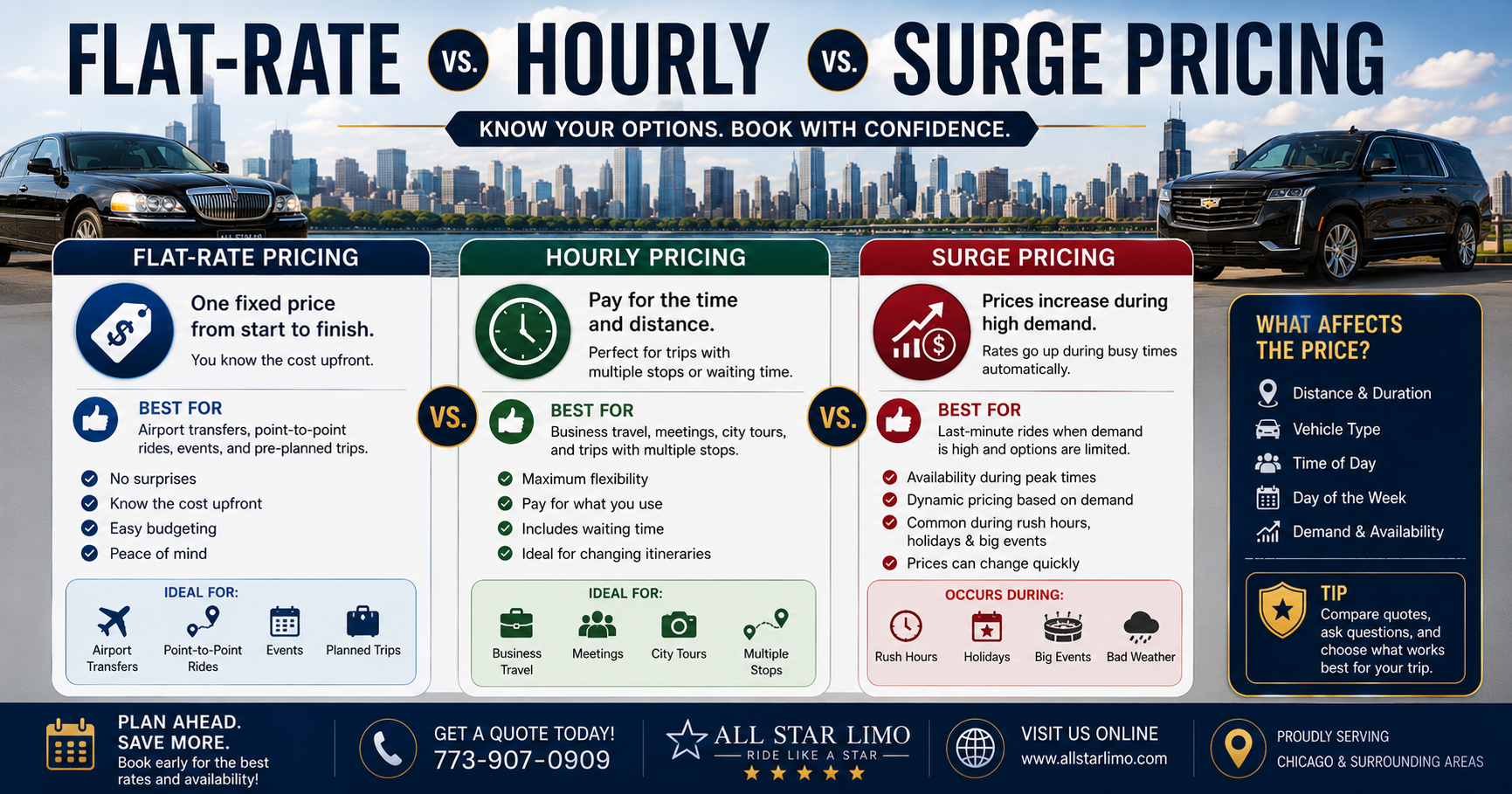
Flat-rate pricing is a fixed, pre-agreed price for a specific point-to-point trip — you know the total before you ride, regardless of traffic or time of day. Hourly (as-directed) pricing bills by the clock for trips with multiple stops or open-ended plans, usually with a minimum booking window. Surge pricing is dynamic, algorithm-driven pricing used by rideshare apps like Uber and Lyft, where the price can double or triple based on real-time demand — and it’s the one model where the price you see isn’t guaranteed until the moment you book.
How Flat-Rate Pricing Works
Flat-rate pricing is the simplest model to understand, and it’s the one most first-time bookers actually want, even if they don’t know the term for it yet. Here’s the mechanic: the car service quotes you one number for a defined trip — say, downtown Chicago to O’Hare — based on your pickup address, your destination, the vehicle type, and the standard route between the two. That number is what you pay. It doesn’t move if your flight lands late, if the Kennedy Expressway is a parking lot, or if your driver has to take the Ohio Street feeder instead of the express lanes to avoid construction.
What Determines a Flat Rate
A flat rate isn’t pulled out of thin air — it’s calculated from a handful of fixed inputs before the trip ever starts:
- Distance and route between the confirmed pickup and drop-off points
- Vehicle class (executive sedan, SUV, Sprinter van, stretch limo)
- Base zone or suburb the trip originates from, since routes from further-out suburbs naturally cost more than routes from downtown
- Standard traffic assumptions for that route and time of day, already baked into the price by the operator
Because all of these are locked in before you leave the driveway, flat-rate pricing removes the single biggest source of anxiety in ground transportation: watching a meter run while you sit in gridlock. All Star Limo prices its Chicago airport transfers this exact way — for example, a sedan from downtown Chicago starts at $90 to O’Hare and $85 to Midway, with suburb-specific starting rates published on the Chicago limo pricing page for areas like Naperville, Schaumburg, Oak Brook, and Evanston. A Naperville-to-O’Hare sedan transfer, for instance, starts at $115 — a different number than the downtown rate, but still fixed once it’s confirmed.
When Flat-Rate Pricing Makes Sense
Flat-rate is built for trips with a clear start and a clear end:
- Airport transfers — pickup at home or a hotel, drop-off at the terminal (or the reverse)
- One-way point-to-point rides — office to a dinner reservation, hotel to a specific venue
- Predictable, repeatable routes — the same commute or transfer booked regularly
The tradeoff is flexibility. A flat rate covers one defined route. If you decide midway through the trip that you also need a stop at the pharmacy and then a second stop at a friend’s house, that’s technically outside the scope of what was quoted, and most operators will either need to requote the trip or shift you into a different pricing structure. That’s exactly the gap hourly pricing is designed to fill.
How Hourly / As-Directed Pricing Works
Hourly pricing — sometimes labeled “as-directed” or “on-call” service — works differently. Instead of pricing a single route, the car service reserves a vehicle and chauffeur for a block of time, and you direct the itinerary as you go. The meter (figuratively speaking, since most professional operators don’t run a literal taxi meter) is the clock, not the map.
The Core Mechanics of Hourly Billing
A few things are consistent across nearly every hourly car service booking:
- Minimum hours. Most operators set a minimum booking window — often two to four hours — because dispatching a vehicle and chauffeur for less time than that isn’t operationally efficient for them. All Star Limo‘s hourly limo rentals publish rates starting at $80/hour for an executive sedan, with SUVs and Sprinter vans priced higher per hour, and larger vehicles like the Sprinter carrying a 3-hour minimum listed on the pricing page.
- The clock starts at pickup, not at booking. You’re billed for the hours the vehicle is actively in service for you, not for time spent waiting for your reservation window to begin.
- Overages are billed in increments. If you booked three hours and the wedding photos run long, most operators will extend in 30- or 60-minute increments at the same hourly rate — not a new flat fee.
- The vehicle waits between stops. Unlike a flat-rate one-way trip, hourly service means the chauffeur parks and waits (within reason) while you’re at dinner, at a meeting, or at each stop on a multi-venue evening.
When Hourly Pricing Makes Sense
Hourly is the right model whenever your plans aren’t a straight line from A to B:
- Weddings — church, photo locations, reception, and possibly a late-night exit, all in one booking
- Corporate roadshows — multiple client meetings across the city in a single day
- Nights out — dinner, then a show, then a second stop, with the same driver waiting throughout
- Proms and formal events — pickup, group photos, the venue, and a return trip, all under one reservation
The tradeoff here is the opposite of flat-rate: cost predictability depends on you (or your event) staying roughly on schedule. If a wedding reception runs two hours past what was booked, that overage shows up on the final invoice. A good operator will tell you this upfront and confirm the overage rate in writing — which is worth asking about explicitly if it isn’t already on your quote.
How Rideshare Surge Pricing Differs
Surge pricing is a different animal entirely, and it’s worth understanding clearly because it’s the model most first-time bookers have already experienced — usually the hard way, watching a $22 ride estimate turn into $61 by the time they actually tap “confirm.”
How Surge Actually Gets Calculated
Rideshare platforms like Uber and Lyft use real-time algorithms that adjust price based on the ratio of riders requesting cars to drivers currently available in a given zone. When a concert lets out, when it starts raining, when a flight delay dumps three hundred travelers into a taxi line at once, or simply during Friday rush hour — the algorithm raises the price to (in theory) pull more drivers into that area and ration demand. The multiplier is usually shown as something like “1.8x” or “2.5x” the base fare, and it can change in the minutes between when you open the app and when you actually book.
Why This Model Creates Uncertainty
A few structural features of surge pricing make it fundamentally less predictable than flat-rate or hourly models:
- The price isn’t locked until the moment of booking. A quote you see is an estimate at that instant, not a guarantee.
- It scales with events outside your control. Weather, sports games, concerts, and flight delays at O’Hare and Midway are all classic surge triggers — which means the exact moments you most need reliable transportation (a big storm, a packed arrivals hall) are often the moments pricing spikes hardest.
- Driver assignment is also dynamic. You’re matched with whichever driver is nearest and available, not a specific chauffeur or vehicle class you’ve vetted in advance.
Surge isn’t inherently a bad model — it exists because it does a reasonable job of balancing supply and demand across a huge, decentralized network of independent drivers. But it’s a poor fit for anything where you need price certainty locked in ahead of time: an early-morning flight you can’t afford to be late for, a corporate car for a client, a wedding party on a schedule. That’s the gap flat-rate and hourly car services are built to close — flat-rate pricing means your 5 AM O’Hare pickup costs exactly what you were quoted last week, not whatever the app decides thirty minutes before your alarm goes off.
Reading the Fine Print — Fees to Watch For
Whichever pricing model you’re comparing, the quoted number is rarely the whole story unless the operator is explicit about what’s included. Here’s what to check for on any Chicago car service quote before you book.
Gratuity
Some quotes include gratuity in the flat rate or hourly figure; others add it as a separate line item, typically 15–20%. Ask directly: “Is gratuity included in this number, or added at the end?” This single question resolves more billing surprises than any other.
Tolls and Parking
Airport transfers and downtown trips through Chicago’s toll roads and paid parking zones can add real cost. A transparent operator will state whether tolls are built into the flat rate or billed as a pass-through cost. All Star Limo‘s pricing page notes that rates can vary based on tolls, parking, and wait time — which is the kind of disclosure worth looking for on any quote, not a red flag specific to one company.
Wait Time and Cancellation Policies
Ask what happens if your flight is delayed, or if you need to cancel. Reputable airport transfer services build in flight tracking and a grace period for arrivals automatically — but it’s worth confirming rather than assuming, especially with unfamiliar operators.
After-Hours and Holiday Surcharges
Some hourly and flat-rate services add a surcharge for very early or very late pickups (think 3 AM), or for major holidays. This is different from surge pricing because it’s a fixed, disclosed add-on rather than a live algorithmic multiplier — but it still changes your total, so it belongs on your checklist.
Multi-Stop Fees on “Flat-Rate” Quotes
If a trip you assumed was a simple point-to-point actually needs a second stop, ask before you book whether that changes a flat-rate quote into an hourly one, or whether a small stop fee applies. This is the most common source of “why did my final bill not match the quote” confusion.
Vehicle Substitution Clauses
Rarely discussed, but worth asking: what happens if your reserved vehicle class isn’t available at pickup time? Does the operator upgrade you at no charge, or downgrade with a partial refund? A company confident in its fleet — like one offering a full range from executive sedans to the Sprinter limo and stretch options — should have a clear answer.
Comparing the Three Models Side by Side
| Flat-Rate | Hourly / As-Directed | Surge (Rideshare) | |
|---|---|---|---|
| Price locked before ride? | Yes | Yes (base rate; overages billed at same rate) | No — can change until booking moment |
| Best for | Point-to-point trips, airport transfers | Multi-stop days, weddings, events | Short, spontaneous single rides |
| Traffic risk to you | None — operator absorbs it | Indirect — clock keeps running | Baked into dynamic price |
| Driver/vehicle known in advance? | Yes | Yes | No — assigned at dispatch |
| Typical minimum | None (single trip) | 2–4 hours | None |
| Fine print to check | Tolls, stop changes, gratuity | Overage rate, minimum hours | Multiplier at time of booking |
A Practical Way to Decide Which Model You Need
If you can answer these two questions, you’ll usually know which pricing model fits your trip:
Question 1: Do I know exactly where I’m starting and where I’m ending, with no stops in between? If yes, you want flat-rate. This covers the overwhelming majority of airport transfers, whether that’s a straightforward O’Hare limo service run or a Midway Airport transfer from a downtown hotel.
Question 2: Will my plans involve multiple stops, waiting, or an itinerary that could shift once I’m out the door? If yes, you want hourly / as-directed. This is the right model for a wedding day, a night combining dinner and a show, or a corporate car service day with several client stops across the Loop and River North.
If neither applies — you just need a quick, short ride and price isn’t the deciding factor — a rideshare app’s surge model may be fine. But for anything time-sensitive, higher-stakes, or planned in advance, flat-rate or hourly with a licensed operator removes the guesswork entirely.
Why This Matters More in Chicago Specifically
Chicago’s geography and event calendar make pricing-model literacy especially useful here. O’Hare and Midway both see regular weather delays and gate congestion that spike rideshare demand right when travelers are most stressed and least able to absorb a surprise 2.5x multiplier. Add in McCormick Place convention traffic, Cubs and Bears game days, Lollapalooza and other festival weekends, and Chicago’s notorious winter storms, and you have a city where “the price might triple in the next twenty minutes” is a real, recurring possibility — not a hypothetical.
That’s part of why flat-rate operators built around Chicago’s airport and downtown corridor market themselves specifically on eliminating that variable. It’s also why it’s worth reading a quote carefully rather than assuming every “$85 to Midway” number means the same thing across every provider — some are guaranteeing that price, others are estimating it.
Common Mistakes First-Time Bookers Make
Comparing a rideshare estimate to a limo flat-rate quote as if they’re the same thing. They’re not measuring the same commitment. A rideshare estimate is a snapshot; a flat-rate quote from a licensed car service is a locked number.
Not asking about the overage rate before booking hourly service. If a wedding runs long, you want to already know the per-hour (or per-30-minute) rate rather than negotiating it in the moment.
Assuming gratuity is included when it isn’t (or vice versa). This single line item is the most common source of “the final bill was higher than I expected” complaints across the industry.
Booking a flat rate for a trip that actually needs multiple stops. If your plans could realistically expand, say so upfront — it’s a five-second conversation with dispatch that saves a billing dispute later.
Not confirming flight-tracking policy for airport pickups. A flat rate is only as good as the pickup timing behind it. Confirm the operator tracks your actual flight, not just your originally scheduled time.
A Real-World Price Walkthrough
Numbers are easier to reason about with an actual scenario, so here’s how the three models would play out for the same traveler on the same night.
The trip:
A business traveler lands at O’Hare at 9 PM on a Thursday. Their meeting the next morning is downtown, and they also want a ride back to O’Hare Friday evening for a 7 PM flight — right in the middle of Friday rush hour, one of the heaviest surge windows in the city.
Flat-rate scenario:
The traveler books a sedan transfer from O’Hare to their downtown hotel Thursday night, and a second sedan transfer from the hotel back to O’Hare Friday evening. Both are priced individually before the trip, based on the published downtown-to-O’Hare rate. The Friday rush-hour drive might take longer in traffic, but the price agreed on Wednesday when they booked is the price charged Friday — the operator absorbed the traffic risk, not the traveler. Total cost: two predictable, pre-known numbers, unaffected by the fact that one of them happens to fall in rush hour.
Hourly scenario:
Suppose the same traveler also needs the car to wait outside a second downtown meeting Friday afternoon, then continue on to a client dinner, and finally head to O’Hare that evening — four stops, one continuous booking. Here, hourly pricing is clearly the better fit: instead of stitching together three or four separate flat-rate legs (each carrying its own base cost), the traveler books one vehicle for, say, a 5-hour window at the hourly sedan rate. The driver waits at each stop, and the traveler pays for the block of time rather than per leg.
Surge scenario:
Now imagine the same Friday-evening O’Hare run, but booked last-minute through a rideshare app instead of reserved in advance. Because it’s rush hour on a Friday — a predictable high-demand window — the app is likely showing a 1.5x to 2x multiplier by the time the traveler requests a ride from their hotel lobby. The exact fare isn’t knowable days in advance the way the flat-rate quote was; it depends on demand in that specific few minutes.
The takeaway isn’t that one model is universally “better” — it’s that each is built for a different shape of trip, and matching the model to the trip is what keeps the final invoice matching the original expectation.
Building a Quote Request That Avoids Surprises
Whether you’re calling a Chicago car service or filling out an online booking form, a few details make the difference between a quote that holds and one that turns into a follow-up phone call about extra charges.
Give the exact pickup and drop-off addresses, not neighborhood names. “Somewhere in the Loop” and a specific street address can price differently depending on traffic patterns and parking access at that block.
State the vehicle class you want up front. Sedan, SUV, and Sprinter pricing differs meaningfully — for example, an executive sedan to O’Hare from downtown starts at $90, while a Sprinter to the same terminal starts at $275, according to All Star Limo‘s published rate sheet. Asking for “a car” without specifying class is the fastest way to get a quote that doesn’t match what shows up.
Mention every stop you’re reasonably confident about. If there’s a chance you’ll need a second stop, flag it as a possibility during the quote request rather than after the driver has already left for a single-destination trip.
Ask directly: “Is this flat-rate, or is this an estimate?” This is the single most useful sentence you can add to any quote request, across every type of car service. A confident operator will answer immediately and specifically.
Confirm the payment and cancellation terms in writing. Email or text confirmation matters more than a verbal quote, particularly for weddings, proms, and corporate travel booked weeks in advance.
For hourly bookings, ask what the overage increment is. Some operators bill overages in 15-minute increments, others in full hours — knowing which one applies before the day of the event avoids a surprise on the final invoice.
Who Tends to Prefer Each Pricing Model
Different travelers gravitate toward different pricing structures based on what they’re optimizing for, and it’s worth recognizing which category you fall into.
Business travelers and executives:
tend to prioritize flat-rate airport transfers because their schedules are fixed and unforgiving — a locked price and a locked pickup time matter more than shopping for the lowest possible fare on a given day. This is also why many companies standardize on a single corporate limo service provider rather than leaving employees to book rideshare on expense reports.
Wedding parties and event planners:
default to hourly service almost universally, because a wedding day is inherently a multi-stop, time-uncertain itinerary — ceremony, photos, reception, and often a late-night exit that doesn’t run on a fixed schedule. Hourly wedding limo bookings are built around flexibility within a defined block, not a single point-to-point trip.
Groups traveling to concerts, sports games, or nights out:
often split between hourly service (if they want one vehicle for the whole night) and multiple flat-rate one-way trips (if they just need transportation there and back at set times). Event limo service bookings in Chicago frequently use hourly pricing specifically because arena and stadium exits are unpredictable — nobody knows exactly what time the game or concert actually lets out.
Casual, spontaneous riders:
a quick trip to a restaurant, a solo ride across town with no luggage — are the group for whom rideshare surge pricing is a reasonable tradeoff, since the stakes of a price fluctuation are lower and the convenience of an on-demand app often outweighs the planning involved in booking a reserved car service.
Frequently Asked Questions
1. Is flat-rate pricing always cheaper than hourly?
Not necessarily — it depends on the trip. For a simple one-way transfer, flat-rate is usually cheaper because you’re not paying for wait time or return travel. For a multi-stop day, hourly often works out cheaper than booking several separate flat-rate trips back to back, since you avoid paying multiple “trip minimums” in a row.
2. Can a flat-rate quote change after I book?
With a reputable operator, no — the number you’re given for a defined route is the number you pay, barring a genuine change in the trip itself (an added stop, a different destination). Always ask directly if you’re unsure whether a quote is guaranteed or an estimate.
3. Why does rideshare surge pricing spike specifically at airports?
Airport arrivals create sudden, concentrated demand spikes — hundreds of passengers requesting rides within the same 20-minute window, especially after a delayed bank of flights lands at once. The algorithm reacts to that ratio of riders to available drivers in real time, which is exactly the scenario flat-rate airport transfers are designed to avoid.
4. What’s a normal minimum for hourly limo service in Chicago?
Two to four hours is standard across most Chicago operators, with larger vehicles like Sprinter vans sometimes carrying a three-hour minimum given the size of vehicle and driver commitment involved.
5. Does gratuity get added on top of a flat-rate or hourly quote?
It depends entirely on the operator, and this is exactly the kind of detail that should be confirmed before booking rather than assumed. Ask whether the number you’re quoted already includes gratuity.
6. Is it worth booking a flat-rate limo instead of a rideshare for an airport run?
For anything time-sensitive — an early flight, a client pickup, a group with luggage — yes, generally. You’re trading a potentially lower rideshare price on a good day for guaranteed pricing, a known vehicle class, flight tracking, and a chauffeur who’s confirmed in advance rather than assigned at the last minute.
Booking With Price Certainty in Chicago
Reading a quote correctly comes down to one question: is this number locked, or is it an estimate that could still move? Flat-rate and hourly car service both answer “locked” — the difference is just whether you’re pricing a single route or a block of time. Surge pricing answers “it depends,” which is fine for a casual, low-stakes ride but a real risk for anything you’re counting on.
All Star Limo prices every Chicago trip as flat-rate or transparent hourly, with published starting rates on the Chicago limo costs page and no algorithmic surge, regardless of flight delays, weather, or event traffic. If your trip is a straight run to the airport, an O’Hare or Midway flat rate covers you start to finish. If your day involves multiple stops — a wedding, a corporate itinerary, or a night combining several venues — hourly limo rentals give you a chauffeur and vehicle for the whole window, billed by the clock instead of the ride.
Ready to see an exact number for your trip? Book online for an instant flat-rate or hourly quote, or call (708) 998-6336 to talk through which pricing model fits your Chicago itinerary.