Chicago , il


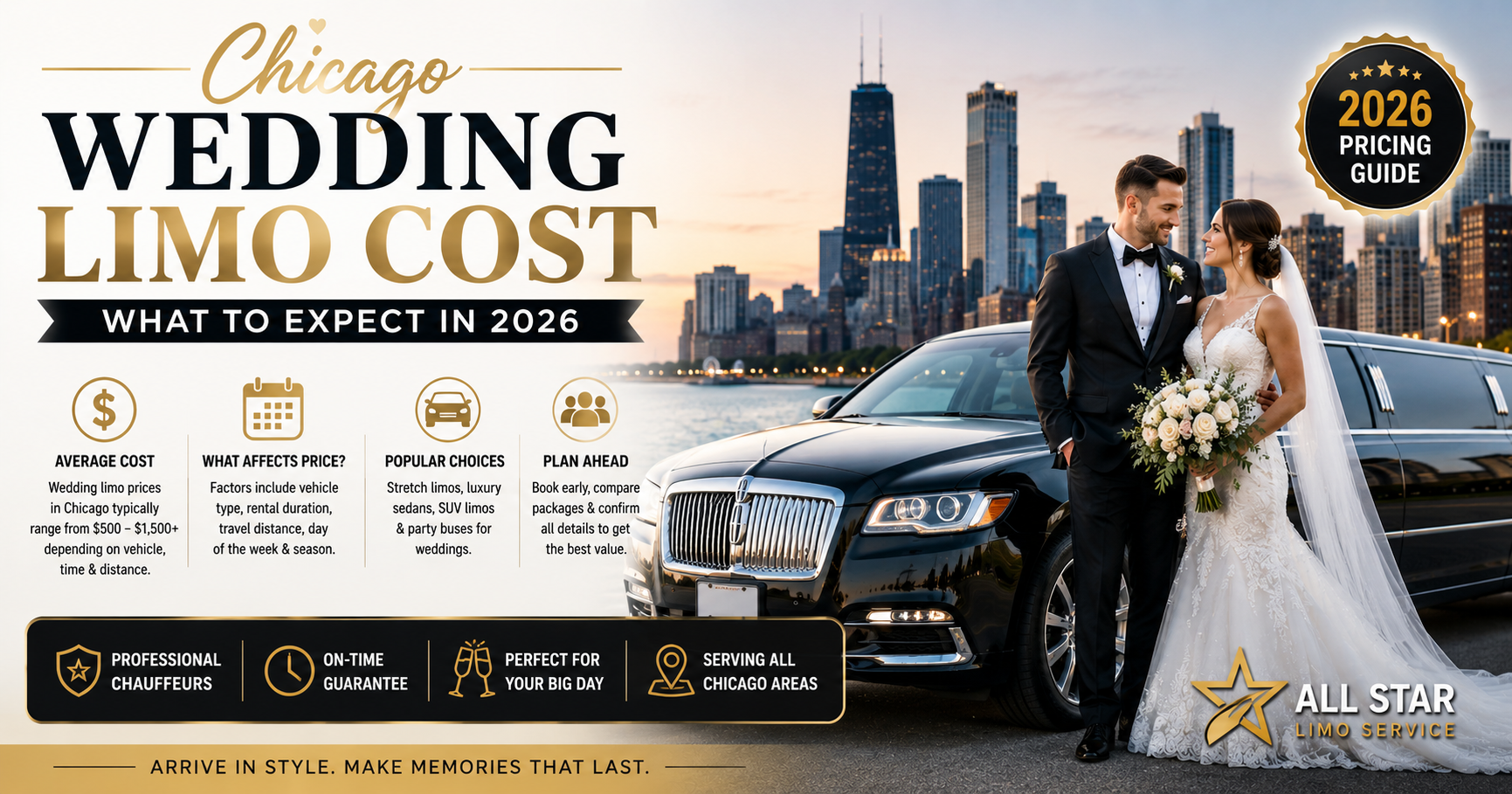
Most Chicago couples pay $300–$1,600+ for wedding-day transportation, depending on vehicle type, hours, and how many cars the wedding party needs. Hourly rates typically run $80–$100/hr for a sedan, $120–$160/hr for a stretch limo or Sprinter, and $180–$300+/hr for a Rolls-Royce or stretch Hummer — almost always with a 2–4 hour minimum. Peak wedding season (May–June) pushes every number toward the top of that range, and popular Saturdays book out weeks in advance.
That’s the short version. The rest of this guide breaks down exactly what drives the price up or down, how many vehicles your specific wedding actually needs, what’s typically included versus billed as an extra, and how far ahead you should be booking based on real Chicago wedding logistics — from Loop churches to suburban reception halls.
If you’d rather skip the research and just get a number for your date, our Chicago wedding limo service team can quote you directly. Everything below is the “why” behind that quote.
Chicago Wedding Limo Pricing Breakdown by Vehicle
Wedding transportation in Chicago isn’t one price — it’s a range that shifts with vehicle class, passenger count, and how “showpiece” the car needs to be for photos. Here’s how the market typically breaks down.
| Vehicle | Typical Passengers | Hourly Rate | Common Minimum | Best For |
|---|---|---|---|---|
| Executive Sedan (Mercedes S-Class, similar) | 2–3 | $80–$110/hr | 3 hours | Bride & groom “sweetheart” ride |
| Stretch Limo (Lincoln MKT-style) | 8–10 | $120–$150/hr | 3–4 hours | Bridal party, getaway car |
| Mercedes Sprinter | 10–14 | $130–$160/hr | 3–4 hours | Full wedding party, comfortable and photogenic |
| Rolls-Royce (sedan or Cullinan) | 2–3 | $180–$260/hr | 3 hours | Couple’s showpiece arrival/exit |
| Stretch Hummer / Party Bus | Up to 22 | $220–$300+/hr | 4 hours | Groomsmen, bachelorette-style send-off, large parties |
Get a Free Corporate Limo Quote →
A few things worth understanding about this table:
Sedans are the budget anchor, not the whole budget
A single sedan for the couple looks affordable in isolation, but most weddings need at least one more vehicle for the wedding party or guests — which is where total cost climbs.
Stretch limos and Sprinters sit in the same price band for a reason
Both typically seat a full bridal party. The choice usually comes down to aesthetic (classic stretch look vs. a taller, more comfortable van-style cabin) rather than price.
Showpiece vehicles like a Rolls-Royce are priced for the photo, not the mileage
Couples booking one almost always pair it with a second, more practical vehicle for the rest of the wedding party.
“Total cost” and “hourly rate” are different questions
A 4-hour Sprinter booking at $150/hr isn’t $150 — it’s $600 before gratuity. Always ask for the all-in total, not just the per-hour figure, when comparing quotes. Our Chicago limo pricing page breaks down typical all-in ranges across vehicle types if you want a broader comparison beyond weddings specifically.
Why the range is so wide even within one vehicle type
Two couples booking the “same” stretch limo on the “same” Saturday can still end up with noticeably different quotes. The variables usually come down to: whether the date falls in peak season, whether the booking is a weekday or weekend, how many total hours are requested, how far the vehicle has to travel to reach the first pickup, and whether any decor, champagne service, or red-carpet add-ons are bundled in. None of this means pricing is arbitrary — it means a generic “average” number is only ever a starting point, and the real figure comes from a quote built around your actual date, headcount, and route.
A note on comparing quotes apples-to-apples
When you call around for quotes, ask each company for the same three things: the vehicle year/model, the total hours, and whether gratuity is included. Comparing a 3-hour quote against a 4-hour quote, or a gratuity-included quote against a gratuity-excluded one, will make an identical vehicle look like it has wildly different pricing when the actual rates are close.

How Many Vehicles Does Your Wedding Actually Need?
This is the question that actually determines your final bill — more than any single hourly rate. Couples consistently underestimate vehicle count, then get surprised when the quote is higher than the “per hour” number they had in mind.
Use this rough formula as a starting point:
1 vehicle for the couple (if you want a dedicated “just married” car separate from the party — optional, but common for photos and the grand exit).
1 vehicle per 8–14 people in the wedding party, depending on whether you choose a stretch limo (seats 8–10) or a Sprinter (seats 10–14).
1 additional shuttle or party bus per 20–40 guests, only if you’re providing guest transportation between a hotel block, ceremony, and reception — common for downtown weddings where parking is scarce or for suburban venues far from guest lodging.
A few real-world examples of how this plays out:
A 6-person wedding party with no guest shuttle typically needs just one stretch limo or Sprinter — the simplest and most affordable setup.
A 10-person wedding party plus the couple wanting a separate exit car often books a Sprinter for the party and a sedan or Rolls-Royce for the couple — two vehicles running in parallel or sequentially.
A large wedding (200+ guests) with a hotel block downtown frequently adds one or two 14-passenger shuttles running a continuous loop between hotel and venue, on top of the wedding party’s main vehicle.
The mistake we see most often: couples book based on the wedding party size alone and forget that parents, grandparents, or the officiant sometimes need a ride too — which either means a bigger vehicle or an extra one. Walk through your actual guest list and lodging situation before locking in a vehicle count, not just your bridal party headcount. Our group transportation options are built specifically for this kind of multi-vehicle, multi-stop coordination.
A quick worksheet to run through before you call for quotes:
- How many people are in the bridal party (bride, groom, bridesmaids, groomsmen)? This sets your minimum vehicle size.
- Do the bride and groom want a separate car from the party, either for privacy before the ceremony or for a dedicated grand-exit vehicle?
- Are parents or grandparents riding with the party, or do they need their own transportation?
- Is there a hotel block, and if so, how far is it from the ceremony and reception?
- Is parking limited at either venue, making a guest shuttle more of a necessity than a nice-to-have?
- Does the officiant need transportation, particularly for destination or non-venue ceremonies?
Answering these six questions before requesting quotes almost always produces a more accurate number than asking “how much for a wedding limo” in isolation, since the vehicle count — not just the vehicle type — is doing most of the work in the final price.
Multi-vehicle coordination is its own logistics problem
When a wedding books two or three vehicles, the harder question often isn’t cost — it’s timing. A Sprinter carrying the bridal party and a sedan carrying the couple need to arrive at the ceremony in a coordinated sequence, and if a guest shuttle is also running a loop between the hotel and venue, that adds a third schedule to manage. This is where working with a single company that dispatches all vehicles from one point of contact tends to be far less stressful than piecing together bookings from multiple separate vendors.
Get a Free Hourly Rental Quote →
Timeline: Ceremony to Reception Logistics in Chicago
tend to fall into one of two logistical patterns, and the pattern you’re in changes both your vehicle needs and your total booked hours.
Pattern 1: Downtown ceremony, downtown or near-downtown reception
Think a Loop or Gold Coast church followed by a reception at a hotel or venue a few miles away. Drive times are short (10–20 minutes), but Chicago traffic and street parking restrictions mean chauffeurs need buffer time, especially on a Saturday afternoon with event traffic, street closures, or a Cubs or Bears game adding congestion. Couples in this pattern often book 3–4 hours total: pickup, photo stops at a lakefront or architectural backdrop, ceremony arrival, and the short hop to the reception.
Pattern 2: City ceremony, suburban reception (or vice versa)
This is extremely common — a church in the city or a near-north suburb, followed by a reception venue further out in places like Oak Brook, Naperville, or the south suburbs. Drive times here run 30–60 minutes depending on the exact route, which means your vehicle (and chauffeur) is committed for longer, and your hourly total climbs accordingly. Couples in this pattern typically book 4–6 hours to comfortably cover the full loop plus photo time, rather than trying to squeeze it into a bare minimum.
A realistic sample timeline for a Loop-to-suburb wedding:
- 12:30 PM — Chauffeur arrives at hotel for bride and bridal party pickup
- 1:00 PM — Photo stop (Millennium Park, Promontory Point, or similar)
- 2:00 PM — Arrival at downtown ceremony
- 3:30 PM — Ceremony ends, wedding party loads for reception
- 4:15 PM — Arrival at suburban reception venue
- 4:15–4:30 PM — Vehicle released, or held for a later grand exit
The planning lesson here: don’t book your vehicle hours based on the ceremony-to-reception drive time alone. Build in real buffer for photos, traffic, and the fact that wedding parties rarely load into a car exactly on schedule. Chauffeurs plan for this, but the hours still need to be booked, not assumed.
Where timelines usually break down
The single most common cause of a wedding-day transportation delay isn’t traffic — it’s photos running long. A “quick” photo stop at a lakefront or architectural backdrop routinely takes twice as long as planned once the photographer starts working through group combinations. A good chauffeur builds in slack for this automatically, but the booked hours still need to reflect it. If your photographer has given you a shot list with multiple locations, share that with your transportation company when you book — it changes how many hours you actually need, not just where the stops are.
Coordinating with the wedding planner or day-of coordinator
If you have one, the transportation company should be talking directly to them about timing, not relaying every change through you on the day itself. A planner who knows the ceremony is running 15 minutes behind can adjust the vehicle’s departure time from the reception venue in real time — something that’s much harder to manage if the couple is the only line of communication between planner and chauffeur.
The grand exit is a separate logistics question from the ceremony transfer
Many couples book their main vehicle only through the reception’s start, then release it — which is fine if you don’t want a grand exit. But if a classic car-departure moment (sparklers, confetti, a vintage car for the send-off) is part of your vision, that requires either holding the same vehicle for the full reception or booking a separate vehicle just for the exit. Decide this early, since it directly affects total booked hours.
Get a Free Prom Limo Quote →
Peak Wedding Season Pricing (May–June Surcharge Reality)
Chicago’s wedding season runs roughly April through October, but May and June are the tightest months for limo availability — and pricing reflects that.
Here’s what actually changes during peak season:
Saturday rates run higher than weekday rates: often by 10–20%, simply because Saturday demand across every vendor category (venues, photographers, transportation) is highest.
Minimum hour requirements can increase: A 3-hour minimum in February might become a 4-hour minimum on a June Saturday, because companies are turning away other bookings to hold that vehicle and chauffeur for your date.
Popular vehicles book out weeks or months ahead: A single showpiece vehicle like a Rolls-Royce or stretch Hummer exists in limited numbers in any Chicago-area fleet. If your date falls in peak season, that specific vehicle may simply not be available if you wait too long — regardless of budget.
Multi-vehicle weddings compete for the same pool: If your wedding needs a Sprinter and a sedan on the same June Saturday a hundred other weddings are also happening, availability — not just price — becomes the real constraint.
The practical takeaway: if your date is in May or June, price isn’t the biggest risk — availability is. Lock in vehicles as early as realistically possible (more on timing in the booking section below), and build a little flexibility into your budget for peak-season minimums.
Why May and June specifically, and not just “summer.”: Chicago’s wedding calendar clusters heavily around late spring because it threads the needle between reliable warm weather for outdoor photos and avoiding the peak heat and humidity of July and August. That clustering means the limo, photography, and venue markets all see their tightest availability in the same eight-to-ten week window — which compounds the effect on pricing and availability compared to a random summer weekend.
Other dates that quietly spike demand: Wedding season pricing isn’t only about May and June. Holiday weekends (Memorial Day, Fourth of July, Labor Day) and any Saturday that overlaps with a major downtown event — a marathon, a large convention at McCormick Place, a Cubs or Bears home game — can tighten vehicle and chauffeur availability even outside peak wedding months. If your date lands near one of these, treat it with the same urgency as a peak-season Saturday.
Off-peak dates as a genuine cost-saving lever: Couples with flexibility on their date can meaningfully lower transportation costs (and often venue and vendor costs generally) by choosing a Friday, a Sunday, or a date outside May–June. This isn’t a guarantee of dramatically lower pricing, but the combination of lower demand and more vehicle availability typically means more room to negotiate hours, vehicle upgrades, or package inclusions than you’d have on a contested June Saturday.
Get a Free S-Class Limo Quote →
What’s Included vs. Hidden Fees
Wedding limo quotes can look very different from company to company even for the “same” vehicle and hours, because what’s bundled into the rate varies. Before comparing prices, know what to ask about:
Usually included in a standard quote:
- The vehicle and chauffeur for the booked hours
- Standard mileage within the Chicago metro area
- Basic decor (ribbons, “Just Married” signage on request)
Commonly billed separately — ask up front:
- Gratuity. Typically 15–20% and often not included in the quoted hourly rate. A $600 quote can become $700+ once gratuity is added — ask whether it’s included or additional.
- Overtime. If the wedding runs long (it usually does), overtime is billed per the contracted rate, sometimes at a premium rate after the scheduled hours end. Ask what the overtime rate is before you sign, not after the reception is running late.
- Red-carpet service. A nice touch for arrivals, but not universally included — confirm if it’s part of your package or an add-on.
- Champagne or beverage service. Often available but frequently priced as an upgrade, especially for non-alcoholic options for a dry wedding party.
- Extra stops. A photo stop that wasn’t in the original plan, or a detour to pick up a forgotten item, can trigger a per-stop fee with some companies.
- Long-distance or out-of-state travel. Destination weddings or venues well outside the standard service area sometimes carry a travel surcharge.
The single best question to ask any Chicago limo company: “What’s the all-in total, including gratuity, for my exact hours and vehicle?” A quote that only states the hourly rate is an incomplete quote. Our wedding limo packages are built to be transparent about what’s bundled — champagne toast service and planner coordination are already part of our Celebration and Grand Affair tiers, for example, rather than surprise add-ons.
A short checklist to bring to every quote conversation:
- Is gratuity included, and if not, what percentage should I budget for?
- What is the overtime rate if the day runs past the booked hours?
- Is there a cancellation or rescheduling policy, and what’s the deadline to change the date without penalty?
- Does the quote include decor and signage, or is that billed separately?
- Is there a deposit required, and is it refundable under any circumstances?
- What happens if the vehicle breaks down or is unavailable the day of — is there a backup vehicle guarantee?
That last question matters more than couples usually expect. A reputable company should have a clear answer about backup vehicles, not a vague reassurance — your wedding day is not the moment to discover there’s no contingency plan.
Reading a contract before you sign:
Wedding limo bookings are typically secured with a signed contract and a deposit, not just a verbal quote. Read the contract for exactly the items above — gratuity, overtime rate, cancellation policy, and what vehicle is guaranteed (a specific vehicle, or “a vehicle in this class”). If the contract only guarantees a vehicle class rather than the specific car you were shown in photos, ask directly whether the exact vehicle can be confirmed, especially for a showpiece car like a Rolls-Royce that couples often book for the visual as much as the ride.
Get a Free Shuttle Service Quote →
How Far in Advance to Book
Booking timelines matter more for weddings than almost any other limo use case, because your date is fixed and vehicle inventory is finite. Here’s a realistic booking calendar:
9–12 months out: If you have a specific showpiece vehicle in mind (a particular Rolls-Royce, a stretch Hummer for a large wedding party) and your date falls in May or June, this is when serious couples start reaching out — especially for popular Saturdays.
4–6 months out: The comfortable zone for most weddings. You likely have a headcount, a venue, and a rough timeline locked in, which means you can request an accurate quote rather than a rough estimate.
6–8 weeks out: Still workable for most vehicle types outside of peak Saturdays, but your first-choice vehicle may no longer be available if it’s popular.
2–4 weeks out: This is the minimum realistic window for off-peak dates (fall, winter, weekday weddings) or when a couple is flexible on vehicle type. Peak-season Saturdays booked this late are a real gamble — you may be choosing from whatever’s left, not what you originally wanted.
Under 2 weeks: Possible for off-season or weekday weddings with standard vehicles, but don’t count on it for peak season or specialty vehicles.
A note on planner coordination: if you’re working with a wedding planner, loop them into transportation booking early. Planners often know which vendors have flexibility on timing and which are already fully booked for your date — and a good limo company will coordinate directly with your planner on timeline logistics rather than leaving you to relay every timing change yourself.
What actually happens if you wait too long
It’s rarely a flat “no availability” answer — it’s usually a narrowing of options. Call a Chicago limo company eight weeks before a June wedding and you might still get a vehicle, just not your first choice of color, model, or exact package. Call two weeks before and you may be choosing between whatever vehicles happen to be free that specific day, with far less room to negotiate hours or add-ons. The cost of waiting isn’t always a higher price — it’s often a smaller menu of choices.
Booking in stages is completely normal
You don’t need every detail finalized to reserve a date. Many couples put down a deposit to lock in a vehicle and date months out, then finalize exact hours, stops, and add-ons closer to the wedding once the full-day timeline is set with the planner and photographer. Ask any company you’re considering whether they support this two-stage approach — reserve now, finalize later — since it removes the pressure to have every logistical detail locked in before you’re ready to commit to a date.
A realistic worst case, and how to avoid it
The scenario every couple wants to avoid is discovering three weeks before the wedding that their preferred vehicle is booked and available options don’t match the wedding party size. This is almost always preventable simply by reaching out as soon as the venue and date are confirmed — even before the guest list or final headcount is finished — to get a vehicle held, with details finalized later.
Get a Free Sprinter Limo Quote →
Wedding Limo vs. Party Bus vs. Sprinter — Which Fits Your Wedding Party
These three options get compared constantly, and the right pick depends less on price and more on your wedding party‘s size and vibe.
Stretch limo: is the classic choice — the visual most people picture when they think “wedding car.” Best for wedding parties of 8–10 who want the traditional look for photos and a more formal, quiet ride between stops. Interior space is more limited than a Sprinter, so it’s a tighter fit for larger groups.
Sprinter van/limo: trades some of the classic stretch-limo look for significantly more interior room, easier entry and exit (higher roofline, wider door), and comfortable seating for 10–14. This tends to be the better pick for larger wedding parties, for anyone in formalwear or a large dress who wants easier movement, or for weddings with a longer ceremony-to-reception drive where comfort over an hour-plus ride matters more than the classic silhouette.
Party bus / stretch Hummer: is built for a bigger group and a livelier atmosphere — sound systems, standing room, and a party-forward feel rather than a formal one. This is the right call for large wedding parties (14–22 people), groomsmen or bridesmaid transportation that’s meant to feel like a celebration in transit, or weddings where the reception send-off is meant to have some energy to it rather than a quiet exit.
A simple way to decide: if your priority is classic wedding photography and a formal ride, choose the stretch limo. If your priority is comfort and practical space for a bigger group, choose the Sprinter. If your priority is atmosphere and your group leans toward celebration over formality, choose the party bus or Hummer. Many Chicago weddings actually combine two of these — a Rolls-Royce or sedan for the couple, and a Sprinter or party bus for the wedding party — rather than picking just one. See the full lineup on our fleet page to compare options side by side.
A side-by-side gut check:
| Priority | Best Fit |
|---|---|
| Classic wedding photos, formal look | Stretch limo |
| Comfortable ride for a larger party, easier entry/exit | Sprinter |
| Lively atmosphere, big group, celebratory feel | Party bus / stretch Hummer |
| Intimate, showpiece arrival for just the couple | Rolls-Royce or S-Class sedan |
| Budget-conscious, small party | Executive sedan or single Sprinter |
A practical note on formalwear and dress logistics:
Wedding dresses with long trains or full skirts genuinely change which vehicle makes sense. A stretch limo’s lower roofline and tighter door openings can make entry and exit awkward for a large gown, while a Sprinter’s higher ceiling and wider door tend to be noticeably easier. If the dress is elaborate, it’s worth mentioning to the limo company when booking — most can advise on which vehicle in their fleet will be easiest to manage in formalwear, and some couples bring the dress (or a similar-sized stand-in) to a vehicle viewing beforehand specifically to test this.
Don’t overlook the practical middle ground:
Not every wedding needs a showpiece vehicle or a party bus. For many Chicago weddings, a single well-appointed Sprinter — used for the couple’s arrival, doubling as the bridal party’s transport, and available for the exit — covers the entire day’s needs at a lower total cost than running two or three separate vehicles. It’s worth asking your limo company to price out both a single-vehicle and multi-vehicle plan before assuming you need more than one car.
Get a Free Party Bus Quote →
Real Chicago Venue Case Studies: Routing and Time Realities
Numbers on a page are one thing — actual Chicago routing is another. Here’s how the logistics play out for a few common venue patterns (used as illustrative examples of the kind of routing and timing couples should plan around, not as pricing quotes tied to any specific venue).
Downtown hotel ballroom weddings (Loop / River North / Gold Coast) — a Drake Hotel-style example
A historic Gold Coast property like The Drake is a classic example of the “ceremony and reception at the same address” pattern. This setup minimizes drive time, but adds a different challenge: downtown loading zones, valet coordination, and event traffic on Michigan Avenue or Lake Shore Drive during peak hours. The vehicle’s real job here often isn’t a long drive at all — it’s precise timing, arriving exactly when the wedding party is ready to walk out for a photo stop along the lakefront, then getting back before the schedule slips. Multi-vehicle weddings at a hotel-ballroom venue benefit from a chauffeur who already knows which loading entrances work for a stretch vehicle and which get blocked during valet-heavy hours.
Neighborhood and boutique venues — an Ivy Room-style example
A smaller, neighborhood-style venue (the kind of intimate boutique space The Ivy Room represents in Chicago’s wedding scene) often means tighter streets, limited or no dedicated loading area, and a chauffeur who needs to know the specific block, not just the neighborhood. These venues frequently pair with a ceremony at a separate location, meaning the vehicle is doing real work between two stops rather than just idling curbside — which is exactly the kind of routing that should shape your booked hours, discussed above. Couples booking boutique or neighborhood venues should confirm with their transportation company that the chauffeur has handled that specific street or block before, since Chicago’s neighborhood venues vary enormously in how much space there is to actually pull up and load a wedding party.
Near-north venues with a suburban reception
A common pattern pairs a ceremony near Lincoln Park or the Gold Coast with a reception venue in a suburb like Oak Brook or Naperville. This routing typically runs 30–45 minutes depending on the exact suburb and time of day, and Friday or Saturday afternoon traffic on the expressways can add real variability. Couples in this pattern should book enough hours to absorb traffic uncertainty rather than planning to the minute.
South suburban venues (Orland Park, Tinley Park, Frankfort, Mokena area)
For weddings entirely within the south suburbs — a common pattern for couples who live in or near this corridor — drive times between ceremony and reception are often shorter and more predictable than a city-to-suburb route, since both stops are typically within the same general area. This is also where multi-vehicle coordination (wedding party vehicle plus a guest shuttle from a nearby hotel) tends to be simplest to execute reliably, since the whole route stays local.
The consistent lesson across all three patterns: routing determines your hour count more than the ceremony length does. A 30-minute ceremony with a 45-minute drive on each side needs more booked hours than a 30-minute ceremony where everything happens within a few blocks — plan your vehicle hours around the map, not just the schedule.
Frequently Asked Questions
How much does a wedding limo cost in Chicago?
Most Chicago wedding transportation totals fall between $300 and $1,600+, depending on vehicle type, hours booked, and how many vehicles the wedding needs. A single sedan for a few hours sits at the low end; multi-vehicle weddings with a Sprinter, a showpiece car, and guest shuttles sit at the higher end.
What’s the average hourly rate for a wedding limo in Chicago?
Expect roughly $80–$110/hr for a sedan, $120–$160/hr for a stretch limo or Sprinter, and $180–$300+/hr for a Rolls-Royce or stretch Hummer, generally with a 3–4 hour minimum.
How many hours do I need to book for my wedding?
Most Chicago weddings book 3–4 hours for same-area ceremony-and-reception logistics, and 4–6 hours when the ceremony and reception are in different parts of the city or suburbs. Always add buffer time for photos and traffic rather than booking the bare minimum drive time.
Is gratuity included in the quoted price?
Not always. Gratuity (typically 15–20%) is frequently billed separately from the hourly rate. Always ask whether your quote is all-in or before gratuity so you’re comparing accurate totals across companies.
How far in advance should I book my wedding limo?
For peak season (May–June) Saturdays or a specific showpiece vehicle, 4–6 months ahead is a safe window, with some couples booking 9–12 months out. Off-peak or weekday weddings have more flexibility, sometimes booking successfully just a few weeks out.
What happens if my reception runs longer than the booked hours?
Most companies bill overtime at a set rate beyond the contracted hours, sometimes at a premium after the scheduled end time. Confirm the overtime rate before booking, since Chicago weddings running long is common, not an edge case.
Should I book one large vehicle or multiple smaller ones?
It depends on your wedding party size and whether you want guest shuttles. A single Sprinter or stretch limo works well for a party of 8–14; larger weddings, or weddings needing separate transportation for the couple and the party, typically need two or more vehicles.
Do Chicago limo companies charge more for suburban venues?
Not necessarily as a surcharge, but longer drive times to suburbs (Oak Brook, Naperville, and similar) mean more booked hours are needed, which increases the total even at the same hourly rate. Destination weddings well outside the standard Chicagoland service area may carry an additional travel fee.
What’s included in a typical wedding limo package versus billed as an extra?
Vehicle, chauffeur, and standard mileage are almost always included. Gratuity, overtime, red-carpet service, champagne service, and extra unplanned stops are commonly billed separately unless your package explicitly bundles them — ask for a full breakdown before booking.
Planning Your Chicago Wedding Transportation
The short version of everything above: your total cost is driven far more by vehicle count and booked hours than by any single hourly rate, peak-season Saturdays require booking months earlier than you’d expect, and the “all-in” number — including gratuity and any add-ons — is the only number worth comparing between quotes.
If you’re ready to put real numbers to your specific date, guest count, and route, our Chicago wedding limo service team builds custom quotes around exactly this kind of planning — from a single sedan for the couple to full multi-vehicle coordination for the whole wedding party and guests. Browse the fleet page to see vehicle options, check our Chicago limo pricing page for rates across all occasions, or explore hourly rental options if your day needs a more flexible, non-package structure. Planning prom transportation too? Our Chicago prom transportation cost guide covers that separately.