Chicago , il

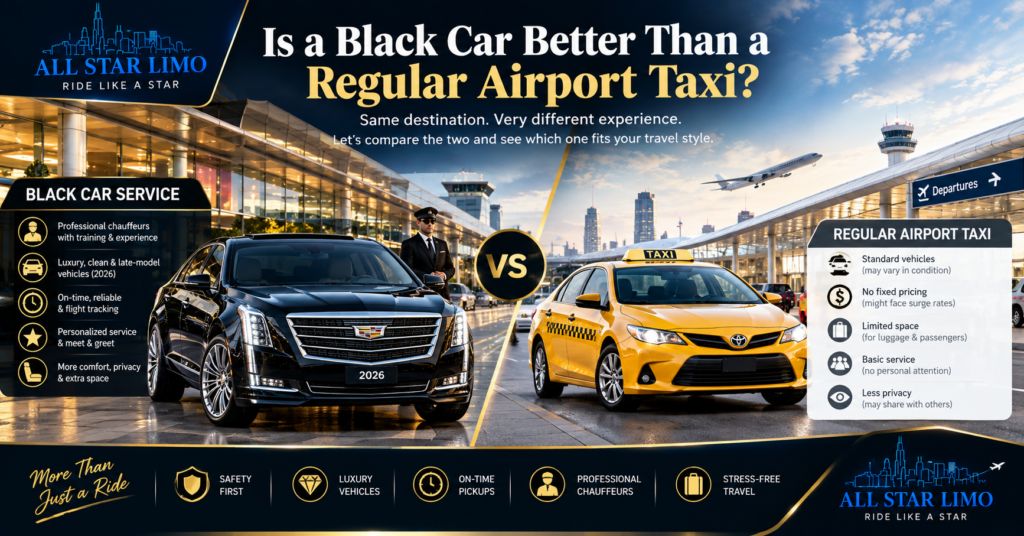
For most travelers, yes — a black car is the better choice. You get a flat rate quoted before you ever get in the vehicle, a scheduled pickup tied to your actual flight (not a random spot in a taxi line), and a professionally maintained vehicle with a vetted, commercially insured chauffeur. A metered taxi can still make sense for a short, spontaneous trip with no luggage and no fixed schedule — say, a quick hop from a downtown hotel to a nearby meeting where you don’t want to book anything in advance. But for airport transfers specifically, where timing, pricing certainty, and vehicle reliability matter most, a flat-rate black car wins on nearly every metric that matters to a traveler standing at baggage claim with a flight to catch or a long day already behind them.
The rest of this guide breaks down exactly why, point by point — the fare structure, the wait times at O’Hare and Midway, the vehicle and driver standards, what’s actually included in each price, and the specific situations where a taxi still holds up.
Black Car vs. Taxi in Chicago: A Side-by-Side Snapshot
Before going section by section, here’s the comparison in one place — the version most people are really searching for when they type “black car vs taxi Chicago” or “metered taxi vs flat rate car service” into Google at the gate.
| Factor | Metered Airport Taxi | Flat-Rate Black Car |
|---|---|---|
| Pricing model | Meter runs on distance + time stopped in traffic | Fixed rate quoted before the ride starts |
| Price known in advance | No — final total only known at drop-off | Yes — confirmed at booking |
| Pickup at the airport | Walk/shuttle to taxi stand, then join a live queue | Chauffeur tracks your flight, meets you at the curb or baggage claim |
| Wait time predictability | Unknown until you’re in line | Scheduled to your actual flight arrival |
| Vehicle condition | Varies by individual owner/operator | Single fleet standard, late-model vehicles |
| Driver vetting | City chauffeur license (baseline) | City license plus company background checks, training, higher insurance |
| Tolls & fees | Usually added on top of the meter | Typically bundled into the flat rate |
| Extra passenger / late-night surcharges | Common, itemized separately | Not typical — rate is the rate |
| Best for | Short, spontaneous, no-luggage trips with zero lead time | Airport transfers, business travel, families with luggage, any trip where timing matters |
| Advance booking required | No | Recommended, but same-day is often available |
This table is the short version of everything below — where each row comes from, why it works this way in Chicago specifically, and what it actually feels like in practice at O’Hare or Midway rather than in the abstract.
How a Taxi Fare Actually Works vs. a Flat-Rate Black Car Quote
The single biggest functional difference between a metered taxi and a black car isn’t the vehicle — it’s how the price is determined, and when you find out what it is.
A taxi fare is a moving target:
Chicago medallion taxis run on a metered system: a flag-drop charge when you get in, then a per-mile rate that keeps ticking as the cab moves, plus a per-minute charge that kicks in whenever the vehicle is stopped or crawling in traffic. That last part matters more than most riders realize. Expressway traffic into the Loop from O’Hare during evening rush hour doesn’t just make your trip longer — it makes it more expensive, because the meter charges for time spent sitting still just as much as time spent moving. You get into the cab not knowing your final number, and you find out only when you’re pulling up to the curb at your destination, watching the meter one last time before it locks in.
A black car quote is fixed before the ride starts:
When you book a Chicago black car, you’re quoted a flat rate based on your pickup point and destination — for example, a downtown-to-O’Hare transfer runs from around $90 in an executive sedan, and downtown-to-Midway from around $85, with SUV and Sprinter options priced separately. That number doesn’t change if your flight lands during rush hour, if there’s an accident on the Kennedy, or if your pickup runs a few minutes long because your bag was the last one off the carousel. The full route pricing is published on our pricing page, so you can compare your specific trip before you ever pick up the phone.
There’s a psychological dimension here too. A metered fare puts a small, persistent stressor into every ride — a runner counting up in the corner of your eye, tied directly to how long you sit in traffic. A flat rate removes that entirely. Traffic becomes someone else’s problem to route around, not a line item you’re personally paying for in real time.
Tolls are another quiet difference:
In a metered taxi, tolls are typically added on top of the metered fare — another number that appears only at the end. In a black car booking, tolls, standard wait time, and airport recovery fees are usually already built into the flat rate you were quoted, so what you agreed to is what you pay. If you want the itemized breakdown for hourly and as-directed service too, that’s covered in detail on the black car service page, alongside route-specific tables for the most common suburb-to-airport transfers.
Taxi-Stand Wait Times at O’Hare & Midway vs. Scheduled Pickup
Pricing is only half the equation. The other half is what happens between the moment you land and the moment you’re actually in a vehicle moving toward your destination — and this is where the two models diverge just as sharply.
Taxi stands operate on a first-come, first-served queue:
At O’Hare, the taxi stand is typically reached via a walk or a shuttle from baggage claim, depending on which terminal you land in, and then you join a line that can range from a short wait to twenty-plus minutes during peak arrival windows — conventions at McCormick Place, holiday travel weeks, and Friday evening rushes are the usual culprits. Midway’s taxi stand is generally more compact and can move faster on an average day, but it’s still a live queue with no way to know your position until you’re standing in it. Neither stand can tell you in advance how long your particular wait will be, because it depends entirely on how many cabs and how many arriving passengers happen to converge at that exact moment.
A black car pickup is scheduled to your flight, not to a queue:
When you book airport limo service with a chauffeur company, the driver is tracking your actual flight number in real time — not your originally scheduled arrival time, but where the plane actually is. If your flight is delayed forty minutes, the pickup shifts with it automatically. If you land early, the same applies. Either way, there’s no queue to join: your chauffeur is either already at the curb or already texted with a meeting point, and for many services — including meet-and-greet service — the driver meets you at baggage claim itself, helps with your bags, and walks you out.
This distinction matters most in exactly the situations where it’s hardest to absorb a long, unpredictable wait: a 6 a.m. flight when you’re already running on no sleep, a red-eye arrival at midnight, a connecting flight with a tight window to a meeting, or traveling with kids and a stroller and three bags where standing in an outdoor taxi line for twenty minutes in Chicago winter isn’t a minor inconvenience — it’s genuinely miserable. Our O’Hare limo service and Midway limo service pages both go into the terminal-specific pickup logistics for each airport if you want the exact meeting-point details before you book.
There’s also a return-trip version of this problem worth mentioning. Getting a taxi to the airport from a hotel or home address can mean calling a dispatch line and waiting for whatever cab happens to be nearby — no guaranteed arrival window, and no way to lock in a driver two days ahead of an early flight. A pre-booked black car, by contrast, is confirmed in advance with a set pickup time, which matters enormously when you have a flight to catch and zero margin for a driver who doesn’t show up on time.
Vehicle Condition & Driver Vetting — What’s Actually Different
Here’s where the two models genuinely diverge on quality, not just convenience.
Taxi fleets vary widely, and you don’t get to choose:
Chicago’s medallion taxi system includes vehicles owned and maintained by many different individual owners and small fleet operators, which means condition varies cab to cab. Some are newer and well-kept; others have higher mileage, worn interiors, or maintenance that’s been deferred. When you hail whichever cab is next at the stand, you have no way to know in advance which one you’re getting — you find out when the door opens.
A black car fleet is a single standard, set by one company:
Chauffeur companies operating flat-rate black car service typically run a fleet of late-model executive sedans and SUVs — think current-generation Cadillac Escalades, Lincoln Navigators, Chevrolet Suburbans, and Mercedes-Benz sedans — maintained to one consistent standard because one operator is responsible for every vehicle in it. You can see the full fleet before you book, which isn’t something a taxi stand offers. That consistency extends to details that matter more than they sound: charged phone chargers, water bottles, clean interiors every single ride, not “usually clean.”
Driver vetting is the bigger difference, and it’s structural, not cosmetic:
Chicago taxi drivers are licensed through the city’s chauffeur licensing process, which sets a baseline. But black car chauffeurs at established companies typically go through an additional layer of company-level screening on top of that municipal license — background checks, driving record review, and training specific to airport logistics, defensive driving, and discreet, professional service.
It’s the difference between a licensing floor everyone has to clear, and a company actively selecting and training its own drivers to a higher, self-imposed bar. Commercial insurance coverage on the vehicle itself is typically higher and more comprehensive with a dedicated black car operator as well, since executive transportation companies build their business around liability standards that go beyond the legal minimum.
None of this means every taxi ride is a bad experience or every black car ride is flawless — but the predictability is the real difference. With a taxi, vehicle condition and driver professionalism are a roll of the dice each time. With a booked chauffeur service, you’re choosing a known standard in advance, which is exactly what a business traveler heading to a client meeting or a family heading to a wedding actually wants — no surprises, no variability, the same experience every single time you book.
Meter Surcharges vs. What’s Included in a Black Car Quote
This is the section most travelers skip past until they’re staring at a fare that’s higher than they expected — so it’s worth being specific.
Taxi meters carry a list of surcharges that stack on top of the base fare, and most riders don’t know the full list until they’ve been charged for it:
- Tolls — added on top of the metered fare, not included in it
- Extra passenger fees — many taxi fare structures add a charge per additional rider beyond the first
- Late-night and early-morning surcharges — overnight hours often carry a higher rate
- Airport pickup/departure fees — a flat add-on charged specifically for airport trips, separate from the metered distance
- Credit card processing fees — some cabs still charge extra for card payment over cash
- Wait-time charges — if your driver has to circle or wait curbside, that time is often billed
Individually, none of these is enormous. Stacked together on an airport run with two passengers, tolls, and a rush-hour wait, they can meaningfully change what you thought your fare would be — and because they’re itemized on top of a meter that was already unpredictable, the final total is genuinely hard to estimate in advance.
A black car quote is built to include those variables up front:
Not tack them on afterward. When you book through the black car service page, the flat rate you’re quoted is designed to bundle in tolls, standard wait time, and the base fare into one number — the same number whether you’re traveling solo or with a second passenger, whether you land at 6 a.m. or 11 p.m., and whether traffic is light or heavy. Extra luggage, additional stops, or a larger vehicle (SUV or Sprinter instead of a sedan) are priced clearly as options rather than surprise line items, and you know about them before you book, not after you’ve arrived.
This is really a question of who absorbs the risk of a variable trip. In a metered taxi, you absorb it — traffic, timing, and surcharges are all your problem in the moment. In a flat-rate black car, the operator absorbs it — they quoted a number knowing traffic could be bad, and that’s baked into the price rather than passed to you as an unpleasant surprise at the curb.
When a Taxi Still Makes Sense
To be fair to the traditional taxi model — it isn’t obsolete, and there are real situations where it’s genuinely the better tool for the job.
A short, spontaneous trip with no luggage:
If you’re downtown without a reservation and need to get four blocks to a lunch meeting in the next ten minutes, hailing a cab off the street is faster than booking anything in advance, and the fare on a short trip is low enough that the metered-vs-flat-rate difference barely matters.
No advance planning at all:
Black car service, by design, works best when it’s booked ahead — even if that’s just twenty minutes ahead through an app or a quick call. If you genuinely need a ride right now with zero lead time and you’re not near a black car company’s coverage area, a street-hailed taxi is still one of the few options that doesn’t require any booking step at all.
Cash-only situations:
Some travelers specifically want to pay cash with no digital trail or advance card authorization, and taxis are generally more flexible about that than a pre-booked flat-rate service, which typically requires a card on file at booking.
Very short airport-adjacent trips:
Moving between two points that are both immediately at or near the airport — say, an airport hotel a half-mile from the terminal — is often a low-stakes taxi trip where the flat-rate/scheduling advantages of a black car matter less because the trip is short and low-risk either way.
What a taxi generally isn’t well suited for: multi-passenger family travel with several bags, early-morning or red-eye flights where a guaranteed pickup window matters, corporate travel where a predictable invoice and professional presentation matter, or any trip where sitting in an unpredictable line at O’Hare or Midway isn’t something you want to gamble on. For those situations — which describe the majority of actual airport transfers — the case for booking ahead is strong. If you’re weighing group travel specifically, our group transportation page covers the larger-vehicle options a taxi simply can’t offer.
It’s also worth being honest about the in-between cases, because most real trips aren’t purely one or the other. A single business traveler landing at Midway on a Tuesday afternoon with just a carry-on, heading four miles to a meeting downtown, might genuinely be fine in either a taxi or a black car — the stakes are low, the trip is short, and the cost difference is small either way. The calculus shifts fast, though, the moment any of these show up: checked luggage, more than one passenger, an odd-hours flight, a client or colleague riding along where presentation matters, or a trip where being even fifteen minutes late has real consequences. Those are the situations where the predictability of a flat-rate, flight-tracked pickup stops being a nice-to-have and starts being the actual point of booking one.

Why This Comparison Looks Different in Chicago Specifically
Chicago’s taxi and black car markets both operate under the same basic city framework — chauffeur licensing through the city, public passenger vehicle rules, and shared roads — but the day-to-day experience of each diverges once you’re actually moving through O’Hare, Midway, and the expressways connecting them to downtown and the suburbs.
O’Hare is one of the busiest airports in the country, which means its taxi stand absorbs enormous swings in demand depending on the hour, the season, and whatever convention happens to be wrapping up at McCormick Place that week. That volume is exactly what makes queue-based pickup unpredictable — the stand isn’t understaffed or mismanaged, it’s just responding to a highly variable number of arriving passengers with a first-come, first-served line that can’t be sped up by planning ahead, because a taxi stand by definition doesn’t take reservations.
Midway, being smaller and more geographically contained on the south side, tends to have shorter average taxi lines, but it also serves a different travel pattern — a lot of south suburb and southwest suburb traffic heading to and from neighborhoods like Orland Park, Tinley Park, and Frankfort, where the drive itself can run 25 to 40 minutes depending on traffic. For trips that long, the gap between a metered fare and a flat rate becomes more pronounced, because more minutes on the meter means more opportunity for the fare to climb in ways a flat quote simply doesn’t.
Then there’s Chicago’s weather and seasonality, which taxi-stand waiting doesn’t account for but genuinely affects the experience of it. A twenty-minute wait at an outdoor taxi stand in July is an inconvenience. The same wait in January, with wind coming off the lake, is a different kind of experience entirely — and it’s exactly the scenario where a scheduled, curbside black car pickup earns its keep.
Booking in Advance vs. Hailing on Arrival
The last piece of this comparison is really about what kind of traveler you are, and how much certainty you want going into a trip.
Hailing on arrival means accepting the unknowns until the moment they resolve. You don’t know your fare until the meter stops. You don’t know your wait time until you’re in the taxi line. You don’t know your vehicle or driver until the door opens. For some trips, that’s completely fine — the unknowns are small and low-stakes. For an airport transfer after a long flight, they add friction at exactly the moment you have the least patience for it.
Booking in advance means resolving those same unknowns before you ever leave home. You know your rate before your trip starts — it’s on the pricing page in black and white. You know your pickup window, because it’s tied to your actual flight number rather than a queue. You know your vehicle class, because you selected it — sedan, SUV, or Sprinter — when you booked. For business travelers, this also means a clean, itemized invoice instead of a taxi receipt that needs explaining on an expense report, which is part of why corporate limo service accounts with monthly billing are common among frequent flyers.
Booking ahead does require one thing a taxi doesn’t: a little bit of planning, even if it’s just the day before your flight. In exchange, you trade a handful of unknowns for a fixed, predictable experience from the moment you land to the moment you’re dropped off — which, for most travelers weighing a black car against a regular airport taxi, is exactly the trade worth making.
Frequently Asked Questions
Is a black car more expensive than a metered taxi?
Not necessarily, and often it’s comparable or cheaper once every fee is counted. A metered taxi’s final cost depends on traffic, time of day, and add-on surcharges (tolls, extra passengers, late-night rates) that aren’t visible until the trip ends. A black car’s flat rate already includes tolls and standard wait time in one quoted number, so while a very short, light-traffic taxi ride might occasionally come in lower, an airport transfer during rush hour in a metered cab can easily exceed a black car’s flat rate once every surcharge is added. Check specific routes on the pricing page to compare.
How long is the taxi line typically at O’Hare or Midway?
It varies significantly by time of day and travel season. On a quiet midday arrival, the wait can be minimal. During peak periods — Friday evenings, holiday travel weeks, and major convention dates tied to McCormick Place — the taxi stand at O’Hare in particular can back up considerably, and there’s no way to know your exact wait until you’re standing in it. Midway’s stand tends to move a bit faster on average but follows the same unpredictable, first-come-first-served structure.
Are black car drivers held to different licensing standards than taxi drivers?
Both taxi and black car drivers must hold the appropriate Chicago chauffeur license as a baseline. The difference is what’s layered on top of that minimum. Established black car operators typically add their own background checks, driving-record reviews, and company-specific training in defensive driving and professional service, plus commercial insurance coverage built around executive transportation liability standards — a self-imposed bar above the municipal licensing floor that every taxi driver clears.
Can a taxi fare change unexpectedly during the ride?
Yes. Because a taxi runs on a live meter, the fare keeps increasing for both distance traveled and time spent stopped in traffic, so a ride that hits unexpected congestion will cost more than the same ride with no traffic — even though the distance is identical. Tolls, extra-passenger charges, and late-night surcharges can also be added on top of the metered fare. A flat-rate black car quote doesn’t change once it’s confirmed, regardless of traffic conditions during the trip.
Do I need to book a black car in advance, or can I get one on arrival too?
Advance booking is recommended and gets you the most reliable pickup, especially for early-morning or red-eye flights, but same-day and even short-notice bookings are often available depending on the operator’s current availability — it’s worth calling to check rather than assuming you need days of lead time. For weddings, proms, and other high-demand event dates, booking further ahead is strongly advised. You can check current availability and book online or by phone at any time.
What’s the difference between a black car and a full limo?
Black car service generally refers to executive sedans and SUVs used for airport transfers, corporate travel, and everyday private rides. Limo service typically refers to stretch limousines and specialty vehicles for weddings, proms, and formal events. If you’re headed to O’Hare or a business meeting, a black car is the right fit; if you’re headed to a wedding or prom, a stretch limo or event limo service is the better match.
Book a Flat-Rate Black Car for Your Next Airport Trip
If the taxi-stand line at O’Hare or Midway isn’t something you want to gamble on, a flat-rate black car takes the guesswork out of the whole trip — fixed price, flight-tracked pickup, and a professionally maintained vehicle every time.
→ See Full Airport Limo Service Details
→ Compare Rates on the Pricing Page
Or call our dispatch team directly at (708) 998-6336 to check same-day availability.
Explore More Services
- Black Car Service — flat-rate executive sedans and SUVs for airport and corporate travel
- Airport Limo Service — full coverage of O’Hare, Midway, Chicago Executive, and DuPage airports
- O’Hare Airport Limo Service — flat-rate transfers with terminal meet-and-greet
- Midway Airport Limo Service — fast, flat-rate service from the south side
- Chauffeur Service — discreet, professional drivers for business and private travel
- Corporate Limo Service — accounts and monthly billing for frequent business travel
- Group Transportation — SUVs, Sprinters, and vans for larger parties
- Hourly Limo Rentals — as-directed chauffeur service by the hour
- Sprinter Limo Service — larger-group airport and event transportation
- Event Limo Services — weddings, proms, concerts, and private events
- Our Fleet — see every vehicle available to book
- Pricing Page — full flat-rate breakdown by route and vehicle