Chicago , il

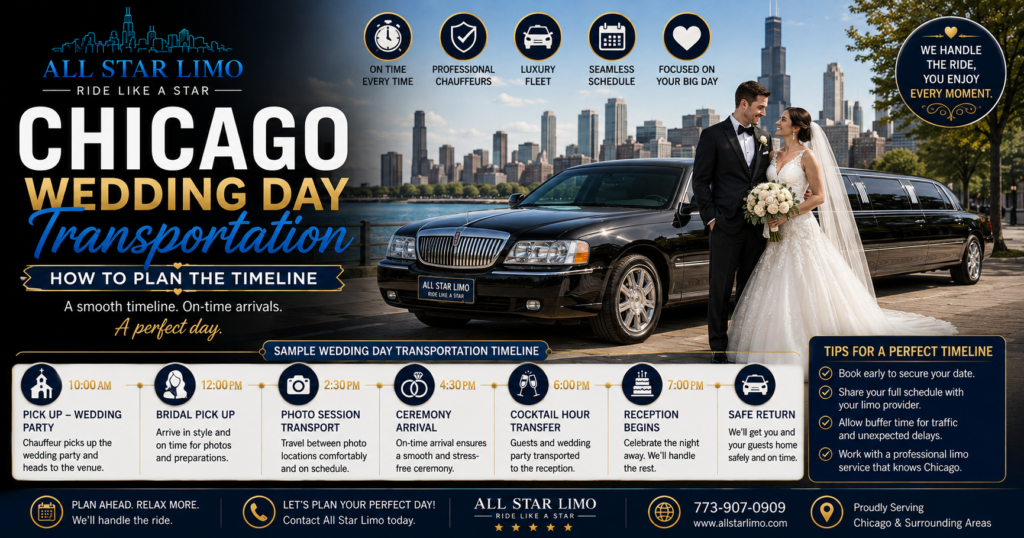
Lock your wedding transportation timeline 4–6 weeks before the wedding, once your ceremony and reception venues, photographer, and officiant have confirmed their own schedules. Build a 15–20 minute buffer into every leg of the day — getting ready, ceremony arrival, photo blocks, and the reception grand entrance — since Chicago traffic, weather, and photo overruns are the most common causes of a wedding running behind. A typical Chicago wedding needs one vehicle for the couple, one or two for the bridal party, and a shuttle if guest count exceeds 40–50 people traveling between venues.
Planning transportation is usually the last logistics piece couples tackle, and it’s often the one that gets rushed. But the timeline you build for your limo or shuttle service is really the timeline for your entire wedding day — every other vendor works around it. Get it wrong and your photographer loses golden-hour light, your officiant starts the ceremony late, or your reception entrance happens to a half-empty room because half your guests are still stuck in Loop traffic. Get it right, and transportation becomes invisible — which is exactly the goal.
This guide walks through how far ahead to lock your timeline, a realistic hour-by-hour template for a Chicago wedding, how many vehicles you actually need, routing considerations specific to city and suburban Chicago, and how to build in enough buffer that a 20-minute delay doesn’t turn into a missed ceremony.
How Far Ahead to Finalize Your Transportation Timeline
Most Chicago couples start thinking about transportation the moment they book their venue, but the timeline itself — the actual minute-by-minute schedule — can’t be finalized until a few other pieces are locked in first.
Here’s the realistic sequence:
- 9–12 months out: Book your ceremony and reception venues, and reserve your transportation provider. At this stage you’re only confirming vehicle type and headcount, not exact times.
- 2–3 months out: Confirm your photographer’s and officiant’s schedules. Photographers in particular drive the timeline — they’ll tell you how long they need for getting-ready shots, first look, wedding party portraits, and family formals.
- 4–6 weeks out: This is when the actual transportation timeline should be finalized. By now you know your ceremony start time, your venue’s photo restrictions (some Chicago churches limit photography during Mass), and roughly how the day is structured. Your limo company should receive a written timeline at this point — pickup addresses, pickup times, number of passengers per stop, and a point of contact.
- 1–2 weeks out: Final headcount confirmation and a short call or email to reconfirm every pickup time and address with your transportation provider. This is also when you should confirm who’s riding in which vehicle — bridal party logistics tend to shift right up until the final week.
- Day before: A brief text or call confirming chauffeur arrival times, driver contact info, and any last-minute changes (a guest dropped out, a photo location moved).
If you’re working with a full-service planner, they’ll often manage this handoff. If you’re doing it yourself, the biggest mistake is finalizing transportation before the photographer’s shot list is set — because the shot list is what actually determines how long you need vehicles parked at each location. A transportation provider working from a vague “ceremony at 4, reception at 6” outline can’t build an accurate schedule; they need every stop, every address, and roughly how long the vehicle needs to wait at each one.
It also helps to understand why the 4–6 week window matters specifically. Book too early, and you’re locking in pickup times before your caterer, officiant, and photographer have finalized theirs — which usually means rewriting the transportation schedule at least once anyway. Wait too late, and popular vehicles for your date may already be booked by another wedding, especially on Saturdays in peak months. The 4–6 week mark is the sweet spot where enough of the day is locked in to build an accurate timeline, but there’s still enough runway to make changes if something doesn’t work.
A note on peak season:
May through June is Chicago’s busiest wedding season, and popular routes (downtown to the North Shore, or south suburbs into the city) get booked out early. If your wedding falls in peak season, move your booking conversation up to 3–4 months out even though the detailed timeline still won’t be locked until 4–6 weeks prior.
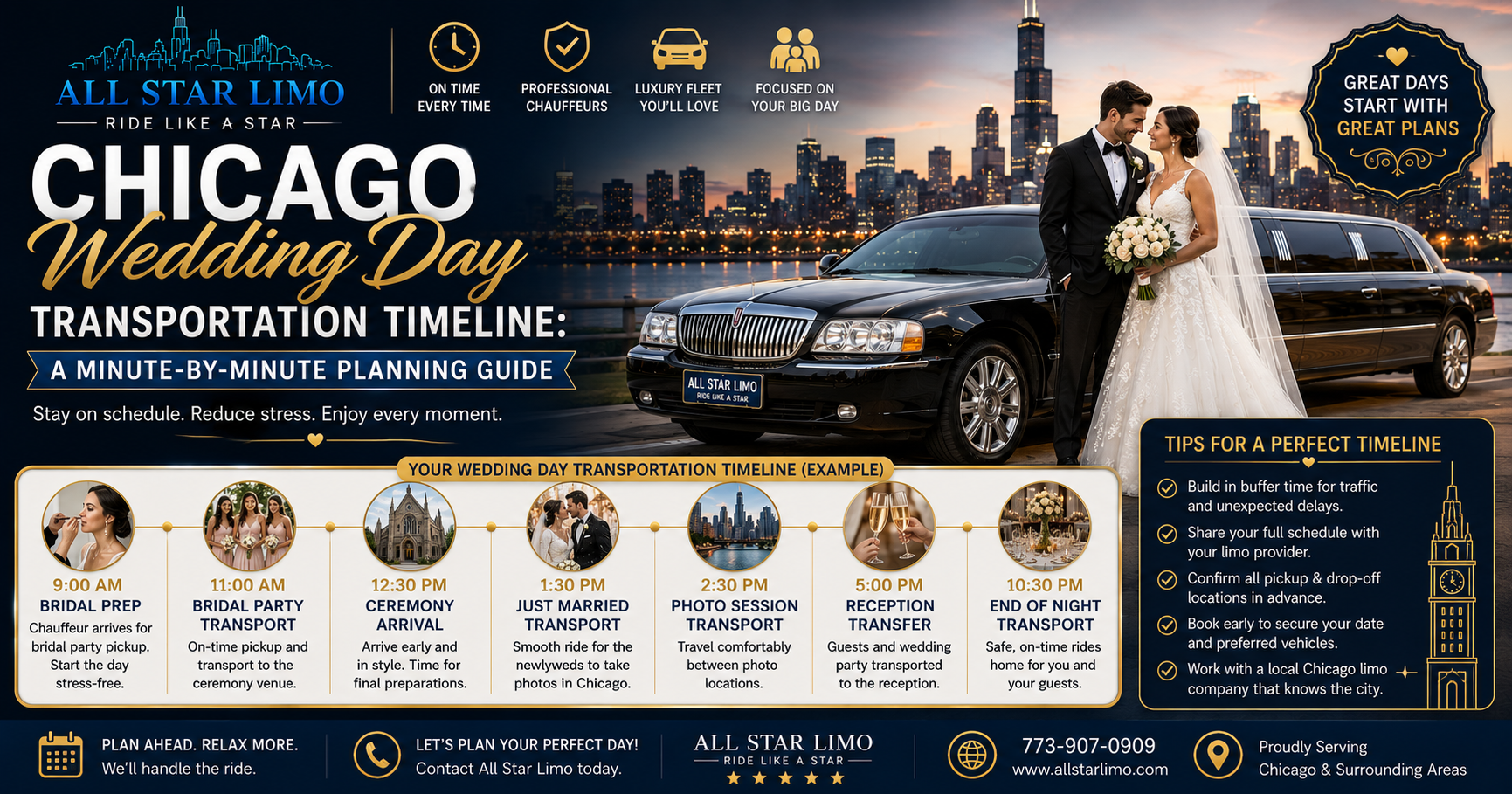
Sample Hour-by-Hour Timeline (Getting Ready → Ceremony → Photos → Reception)
Every wedding is different, but this template reflects a common structure for a Chicago wedding with a 4:00 PM ceremony and a downtown or near-suburban reception. Adjust the anchor points — ceremony time, venue distances — and the rest of the timeline shifts around them.
11:00 AM — Hair and makeup wraps for the wedding party Vehicles aren’t needed yet, but this is the point where your transportation coordinator (or a designated bridesmaid/groomsman) should do a headcount check against the final passenger list.
12:30 PM — First vehicle arrives at the getting-ready location If you’re doing a first look or bridal party photos before the ceremony, your limo or SUV needs to be on-site with time to spare — chauffeurs typically arrive 15 minutes before the scheduled pickup to load garment bags, gifts, and personal items.
12:45 PM — Bridal party departs for the first-look or photo location Allow real drive time, not GPS best-case time. A 12-minute Google Maps estimate from Lincoln Park to a Loop photo location can easily become 25 minutes with midday traffic and parking/unloading at the destination.
1:00 PM – 2:30 PM — Wedding party and family portraits This block is almost always where timelines slip, because photographers are working around light, group coordination, and (often) traffic getting between two or three photo locations. If your photographer wants multiple backdrops — say, a lakefront shot and a downtown architectural shot — your vehicle needs to sit with the group at each stop, not circle the block.
2:45 PM — Depart for the ceremony venue Build in extra time here specifically. This is the one leg of the day with a hard deadline (the ceremony can’t start without the bride, groom, or officiant), so it deserves the largest buffer of the day.
3:15 PM — Arrival at ceremony venue Arriving 30–45 minutes before a 4:00 PM ceremony gives room for final touch-ups, family seating, and vendor coordination without anyone feeling rushed.
4:00 PM — Ceremony begins
4:30 PM — Ceremony ends; family and wedding party photos at the ceremony site Many couples underestimate this block. Between congratulations, family regrouping, and any additional formal photos at the ceremony venue, 30–45 minutes is typical before vehicles can actually load and depart.
5:15 PM — Depart for reception venue (or a second photo location) If you’re doing a “golden hour” photo session between ceremony and reception, this is where it gets inserted — and it’s also where couples most often ask their transportation provider to hold a vehicle on standby for 30–60 minutes rather than doing a separate pickup.
6:00 PM — Arrival at reception venue; cocktail hour begins for guests
6:45 PM — Grand entrance / reception formally begins
Late evening — Guest shuttle runs (if applicable):
If you’ve hired a shuttle for guests, this is typically scheduled as a return loop — one continuous pickup at the reception venue running every 30–45 minutes starting around 9:30 or 10:00 PM, rather than one single mass departure.
This template assumes a single ceremony and reception venue relationship that’s reasonably close together. If your ceremony is at a church on one side of the city and your reception is 30+ miles away in the suburbs, add 45–60 minutes to the “depart for reception” block and communicate that directly with your caterer, since a later grand entrance shifts dinner service.
Adjusting the template for a morning or midday wedding:
Not every Chicago wedding follows an afternoon-into-evening structure. For an 11:00 AM ceremony with a brunch or early-afternoon reception, shift every block roughly five hours earlier and keep the same relative spacing between them. The one thing that doesn’t shift proportionally is the getting-ready block — hair and makeup for a full wedding party still takes roughly the same amount of time regardless of what hour the ceremony starts, which often means an earlier alarm clock for morning weddings rather than a shorter prep window.
Adjusting for a first-look timeline:
Couples doing a first look before the ceremony (rather than seeing each other for the first time at the altar) typically compress the post-ceremony photo block, since most formal portraits happen beforehand. That usually means less buffer is needed between “ceremony ends” and “depart for reception,” but more buffer is needed earlier in the day, since the first look and its surrounding photos become the timeline’s most schedule-sensitive block instead of the post-ceremony session.
Adjusting for a single-venue wedding:
If your ceremony and reception happen at the same location, the “depart for reception” leg disappears entirely, which simplifies vehicle logistics considerably — often reducing the total vehicle count needed, since the couple’s car and wedding party vehicle only need to make one trip each (to the venue in the morning or early afternoon) rather than shuttling between two locations.
How Many Vehicles You Actually Need
This is one of the most common questions couples ask, and the honest answer is: it depends on your wedding party size, your guest count, and whether ceremony and reception are at the same location. Here’s how to think through it.
Vehicle for the couple:
Almost every wedding has one dedicated vehicle for the bride and groom — often a stretch limo, an S-Class sedan, or a classic car for photos and the ride between ceremony and reception. Even couples who otherwise keep transportation minimal usually splurge here, since it’s the vehicle in the most photographs.
Vehicles for the bridal party:
A wedding party of 6–10 people (bridesmaids and groomsmen combined) typically fits in one Sprinter limo or stretch SUV. Larger wedding parties, or parties that want to travel separately by gender for getting-ready logistics, often need two vehicles — one for each side. All Star Limo’s Sprinter limo service is a common fit here since it comfortably seats 10–14 with luggage and garment space, which a stretch sedan often can’t accommodate once dresses, shoes, and gift bags are loaded in.
Vehicles for immediate family:
Parents and grandparents are frequently forgotten in the vehicle count until the week of the wedding. If your ceremony and reception venues are different, at minimum plan a car for each set of parents, especially if they’re walking someone down the aisle and need to arrive with the wedding party rather than as regular guests.
Guest shuttle:
This is the piece that scales with your total guest count, not your wedding party size. As a rule of thumb:
- Under 40 guests traveling between venues: A shuttle is optional; most guests will drive themselves.
- 40–100 guests, especially with parking constraints: One 14-passenger Sprinter van running continuous loops between the ceremony and reception (or between a hotel block and the venue) is usually sufficient.
- 100+ guests, or a downtown venue with limited parking: Two shuttles, or a single larger coach/party bus, running on a tighter loop schedule.
For most Chicago weddings, this breaks down to 1 vehicle for the couple + 1–2 for the wedding party + 1 shuttle (if needed) = 3–4 vehicles total. Larger, multi-location weddings can run 5 or more. All Star Limo’s group transportation options — Sprinter vans, party buses, and a 22-passenger stretch Hummer — cover the upper end of that range, and it’s worth reviewing the full fleet page early in planning so you can match vehicle capacity to your actual guest list rather than guessing.
A practical tip:
build your vehicle count around your photo timeline, not just your guest list. If your photographer wants the couple and wedding party at three separate locations before the ceremony, you need vehicles that can wait at each stop — which sometimes means booking one more vehicle than your headcount alone would suggest, simply so nobody is standing around waiting for a car to loop back.
Don’t forget the vendor and personal-item logistics:
Garment bags, an overnight bag for the send-off, gifts exchanged between the couple, and any decor items being transported between venues all take up real space in a vehicle. A stretch limo that comfortably seats eight people can feel cramped once six garment bags and a box of centerpieces are loaded in. When you’re confirming your vehicle count with your provider, mention what you’re transporting in addition to people — it can be the difference between a comfortable ride and one where someone’s dress ends up wrinkled in the trunk.
Matching vehicle style to the wedding’s overall look:
Beyond capacity, vehicle choice is also a visual decision — a classic stretch limousine reads differently in photos than a modern black SUV or a vintage-style vehicle. Couples planning a formal, black-tie wedding often lean toward a stretch limo or a Mercedes-Benz S-Class for the couple’s car, while more relaxed or modern weddings frequently choose SUVs for a cleaner look in arrival and departure photos. It’s worth deciding on this early, since specialty vehicles are the first to book out during peak wedding months.
Church-to-Venue and Suburban Routing Considerations
Chicago’s geography creates a few routing patterns that come up again and again in wedding planning, and each one affects how much buffer you need to build in.
Downtown ceremony, downtown reception:
This is the most forgiving setup — short drive times, but dense traffic and limited unloading zones. The Loop, River North, and the Gold Coast all have narrow streets, valet-only zones, and heavy pedestrian and vehicle congestion, especially on weekend afternoons and evenings. A drive that looks like 8 minutes on a map can take 20 with circling for a legal stop. Build extra time specifically for the loading and unloading portion of each stop, not just the drive.
City ceremony, suburban reception (or vice versa):
Common for couples with a church ceremony in the city and a reception venue in Naperville, Schaumburg, Oak Brook, or the south suburbs. These routes involve highway travel (I-90, I-290, I-55, or I-294), which is fast outside rush hour but can add 30–45 minutes during a Friday evening or Saturday afternoon slowdown. If your ceremony ends around 4:30–5:00 PM on a weekend, check current traffic patterns for your specific route in the weeks before the wedding — that window frequently overlaps with weekend outbound congestion.
Suburb-to-suburb weddings:
Many south suburban weddings — Orland Park, Tinley Park, Frankfort, New Lenox, Mokena, Lemont — involve shorter, more predictable drive times than downtown routes, but fewer alternate roads if there’s an accident or construction closure. A provider that regularly works these routes will know backup roads; it’s worth asking directly whether your transportation company operates in your specific suburb daily or occasionally, since local route knowledge is what actually prevents delays here, not just vehicle quality.
Multi-location photo sessions:
If your photographer wants shots at a park, a landmark, and then the ceremony venue, treat each leg as its own timeline item with its own buffer — don’t just add up straight-line drive times. Parking and load-in/load-out time at each stop typically adds 10–15 minutes beyond the drive itself.
Weather-dependent routing:
Chicago weather is genuinely unpredictable across all four seasons — summer storms, fall wind, winter snow, and spring rain all show up on wedding weekends. If your route includes an outdoor photo stop, have a backup indoor location in mind and let your transportation provider know both addresses in advance so a last-minute change doesn’t require a scramble.
Airport-adjacent venues:
Some Chicago wedding venues sit close to O’Hare or Midway flight paths or near airport-adjacent hotels used for out-of-town guest blocks. If part of your guest list is flying in the morning of, or flying out the morning after, coordinate with a provider that already handles both wedding transportation and airport transfers, so the same company — and the same live-dispatch scheduling — can cover both without a separate booking.
Rush hour windows to plan around:
Chicago’s weekday rush hours (roughly 7–9 AM and 4–6:30 PM) are well known, but wedding-specific traffic patterns matter more on weekends: Saturday afternoon congestion around downtown event venues, sporting events, or festivals can add unpredictable delays that don’t show up in a typical weekday traffic forecast. If your wedding date coincides with a major Chicago event — a Cubs or Sox game, a downtown festival, a marathon — check road closures specifically, since those can force detours that add real time to even a short route.
If your wedding involves any of these longer or multi-leg routes, it’s worth reviewing your provider’s wedding limo service page and confirming they’re familiar with your specific ceremony-to-reception path — not just Chicago in general.
Building in a Buffer — What Happens if Something Runs Late
Every wedding day timeline should assume something will run behind schedule, because on most wedding days, something does. The goal isn’t a perfect timeline — it’s a timeline with enough slack that a delay in one place doesn’t cascade into every event after it.
Where delays actually happen:
In practice, the most common sources of lateness aren’t transportation itself — they’re getting-ready running long, photo sessions overrunning because a group shot takes longer to organize than planned, or a ceremony starting late because guests are still arriving. Transportation absorbs these delays whether or not it caused them, which is exactly why the schedule needs padding.
Where to put the buffer:
Not every leg of the day needs equal padding:
- Getting ready → first photos: 15-minute buffer. Low risk, but hair/makeup often runs slightly long.
- Photos → ceremony: 20–30-minute buffer. This is the highest-priority buffer of the day, since the ceremony has a hard start time and often an officiant or venue with a strict schedule (especially church ceremonies with back-to-back bookings).
- Ceremony → reception: 15–20-minute buffer. Post-ceremony photos and congratulations reliably run longer than couples expect.
- Reception grand entrance: Built-in flexibility here is usually fine, since a DJ or coordinator can adjust announcements by a few minutes without guests noticing.
Communicate the buffer to your provider, not just yourself:
A transportation company that knows you’ve built in a 20-minute cushion before the ceremony can make smarter real-time decisions — for example, taking a slightly longer but more reliable route instead of the fastest one, if traffic looks unpredictable.
Have a single point of contact:
On the wedding day itself, chaos multiplies when multiple people are texting the chauffeur with conflicting instructions. Assign one person — a maid of honor, best man, or day-of coordinator — as the single contact for any timeline changes, and make sure that person has the driver’s or dispatcher’s direct number.
Plan for the worst-case, not just the likely case:
If your ceremony absolutely cannot start without you, ask your provider what happens if a vehicle breaks down or a driver is stuck in an unexpected closure — a company running live dispatch and a backup fleet can reroute a replacement vehicle in a way that a single independent driver can’t.
A well-built buffer doesn’t just prevent lateness — it changes the entire feel of the day. Couples and wedding parties who know they have room to breathe move slower, smile more in photos, and generally enjoy the process instead of watching the clock.
Backup planning for the transportation itself:
Buffers protect against a late day, but it’s worth separately thinking through what happens if a vehicle has a mechanical issue or a driver is unexpectedly unavailable. Ask your provider directly: do they operate a live dispatch system that can send a replacement vehicle from elsewhere in the fleet, or is your booking tied to a single independent driver with no backup? This is a small question that matters most on the one day you can’t afford it to go wrong.
Wedding Transportation Planning Checklist
Use this as a working checklist alongside your broader wedding planning timeline. It’s organized by when each task should realistically happen, matching the booking sequence covered earlier in this guide.
9–12 months out:
- Confirm ceremony and reception venues and addresses
- Get a rough vehicle quote and reserve your preferred transportation provider, especially for peak-season Saturdays
- Note any venue-specific restrictions (valet-only drop-off, limited parking, load-in time windows)
2–3 months out:
- Confirm your photographer’s shot list and estimated time needed for each photo block
- Confirm officiant and ceremony start time
- Finalize your wedding party roster so vehicle capacity can be planned accurately
4–6 weeks out:
- Send your transportation provider a written timeline: every address, every pickup time, passenger count per stop, and how long the vehicle needs to wait at each location
- Confirm final vehicle count and vehicle types
- Decide whether you need a guest shuttle, and if so, get the schedule and loop frequency confirmed
1–2 weeks out:
- Reconfirm every pickup time and address with your provider
- Finalize who is riding in which vehicle
- Share the final timeline with your wedding party, parents, and day-of coordinator
- Confirm a single point of contact for day-of timeline changes
1–2 days before:
- Confirm chauffeur arrival times and get a direct contact number for your driver or dispatcher
- Double-check any last-minute changes: dropped guests, moved photo locations, weather-related backup plans
- Confirm what personal items (garment bags, gifts, overnight bags) need to travel in which vehicle
Day of:
- Have your single point of contact keep the driver updated on any timing shifts
- Build in the buffers outlined above rather than trying to make up time by rushing
- Trust the schedule you built — it already accounts for the delays that typically happen
FAQ: Chicago Wedding Transportation Timeline
How long before the ceremony should the transportation timeline be finalized?
Aim for 4–6 weeks before the wedding, once your photographer’s shot list and ceremony start time are confirmed. Reconfirm every pickup time and address again 1–2 weeks out, since headcounts and small logistics details commonly shift in the final stretch.
How many limos do I need for an average Chicago wedding?
Most weddings need 3–4 vehicles: one for the couple, one or two for the wedding party, and a guest shuttle if more than 40–50 guests are traveling between venues. Larger wedding parties or multi-location photo sessions may require an additional vehicle.
Should the same vehicle stay with us all day, or do we need separate pickups for each leg?
Both approaches work. Keeping one vehicle with the couple for the full day (getting ready through the reception exit) is simpler to coordinate and avoids gaps between pickups, but it does mean paying for the vehicle to wait during the ceremony and photo blocks. Separate scheduled pickups can be more cost-efficient but require tighter timeline coordination.
What’s a realistic buffer to build in for Chicago traffic?
15–20 minutes for most legs of the day, and 20–30 minutes specifically for the drive to the ceremony, since that’s the one stop with a fixed start time. Weekend afternoon and early evening traffic on highway routes to the suburbs can add more, so check your specific route in the weeks before the wedding.
Do we need a separate shuttle for guests, or can they just drive themselves?
If parking is limited at either venue, if you expect guests to be drinking at cocktail hour or the reception, or if your guest count is over roughly 40–50 people traveling between locations, a shuttle running continuous loops is worth the cost. For smaller weddings with ample parking at both venues, most guests are comfortable driving themselves.
What happens if our photo session runs long and pushes the timeline back?
This is exactly what the buffer is for. A transportation provider with live dispatch can adjust pickup and departure times in real time without you needing to renegotiate the schedule — which is one reason it’s worth confirming with your provider ahead of time how they handle in-the-moment timeline shifts.